
The UK digital marketing industry is worth over £26 billion and growing every year, yet most small businesses in Britain still have no real marketing strategy in place. That gap is exactly where a new agency can sit and earn well. This guide gives you a clear, practical path to starting your own digital marketing agency in the UK, covering everything from picking your services and setting prices in pounds to getting your first paying client. No padding. No theory that does not apply to real life.
Who Gets the Most Out of This Guide
This is written for someone who already has digital marketing skills — maybe from a job at an agency, years of freelancing, or managing social media and ads for someone else — and is now seriously thinking about going out on their own.
You are probably not a complete beginner. You know what SEO or paid ads mean. What you are unsure about is the business side: how to register, what to charge, how to find clients, and whether this can actually pay your bills in the UK.
If that sounds like you, keep reading. If you are still learning the fundamentals of digital marketing itself, this guide will be harder to apply. Start with the skills first, then come back.
What the UK Market Actually Looks Like for New Agencies
The UK is a strong market for starting a digital marketing agency. Millions of small businesses across England, Scotland, Wales, and Northern Ireland need help with Google rankings, paid ads, email marketing, and social media. Most of them cannot afford a large agency. That is where a lean, focused new agency fits in perfectly, and it is no surprise that digital marketing is consistently ranked one of the top businesses to start in the UK.
What makes the UK market a bit different from, say, the US market, is that British businesses tend to respond better to local, relationship-driven outreach. Cold email campaigns alone rarely land well here. Being visible in your local area or a specific industry often works better at the start.
You also need to know your legal setup before you take money from a client. In the UK, you can operate as a sole trader or register a limited company through Companies House. Most agency owners go limited fairly quickly because it separates your personal finances from the business and looks more professional to clients. You can register your business with Companies House online in about 24 hours for just £50. You will also need to understand your Self Assessment tax return obligations as soon as you start earning.
One more thing: if your agency turns over more than £90,000 in any rolling 12-month period, you must register for VAT. Most new agencies are well below that at the start, but it is worth knowing early.
How to Actually Build Your Agency: Step by Step
Step 1: Pick One Niche and Stick With It
The fastest way to get clients as a new agency is to specialise. Generalist agencies struggle to stand out, especially when they are new and have no track record. A niche makes everything easier — your marketing, your proposals, your results.
Good niche examples for the UK market include: local service businesses (plumbers, dentists, solicitors), e-commerce brands, estate agents, hospitality, or B2B SaaS companies. Pick based on two things: where you already have experience or contacts, and where businesses are actively spending money on marketing.
A new agency owner in Manchester, for example, who spent three years doing SEO for a law firm, would have a massive head start pitching to other law firms. They understand the language, the regulations around advertising, and what results look like. That experience is worth more than any certification.
Step 2: Choose Two or Three Services, Not Ten
New agency owners often make the mistake of listing every possible service they can offer. This confuses clients and makes delivery a nightmare when you are a team of one.
Start with a small, clear service menu. Strong options for 2026 include:
- SEO (on-page, local SEO, content strategy)
- Paid social (Meta Ads, TikTok Ads for e-commerce)
- Google Ads (PPC)
- Social media management
- Email marketing
- Content writing and blog strategy
Pick two or three that you genuinely do well. Once you have consistent revenue and maybe your first hire, you can add more.
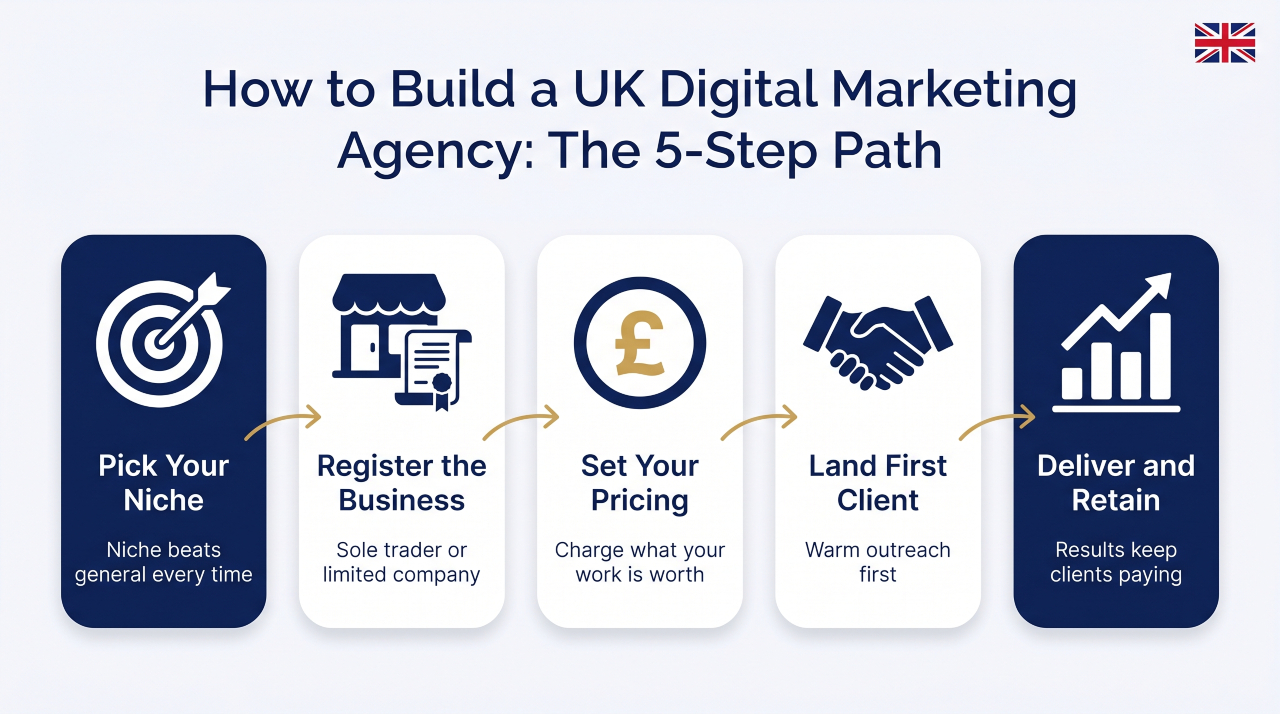
Step 3: Set Your Prices in a Way That Makes Sense
Pricing is where most new UK agency owners either undersell themselves badly or quote figures so high they never hear back.
Here is a realistic pricing guide for UK agencies starting out in 2026:
- Social media management: £500 to £1,500 per month per client
- SEO retainer: £750 to £2,500 per month depending on scope
- Google Ads management: 10% to 15% of ad spend, with a minimum of £500 per month
- Full content marketing package: £1,000 to £3,000 per month
- One-off audits or strategy days: £250 to £750
If you have five clients paying you an average of £1,000 per month each, that is £5,000 per month in revenue. After a few months of strong delivery, moving those retainers up to £1,500 is reasonable. Ten clients at £1,500 each is £15,000 per month before costs. These are achievable numbers within your first year if you deliver results.
Do not race to the bottom on price. UK clients generally trust agencies that charge a fair rate more than those offering to manage everything for £200 a month. Cheap pricing signals low confidence.
Step 4: Set Up the Tools You Actually Need
You do not need expensive software to get started. Keep costs low until revenue justifies them.
Free or low-cost tools that actually work:
- Google Search Console — essential for tracking SEO results for your clients at no cost
- Canva Pro — design work for social content, around £100 per year
- Notion or Trello — client project management, free tiers are enough at the start
- Mailchimp or ActiveCampaign — email marketing management for clients
- Semrush or Ahrefs — SEO research, both around £80 to £120 per month, well worth it once you have two or more SEO clients
- Meta Business Suite — free for managing Facebook and Instagram ads
- Xero or FreeAgent — UK-friendly accounting software, around £12 to £30 per month
Total monthly tool cost when starting out: roughly £150 to £250. Keep a sharp eye on this number as you grow.
Step 5: Land Your First Client (Here Is How It Actually Works)
Most new UK agencies get their first clients through warm outreach, not cold email blasts.
Start with the people you already know. Former colleagues, local business owners, people in your LinkedIn network who run small businesses. Let them know you have launched, tell them what you specialise in, and ask if they know anyone who might need help. This sounds simple because it is, and it works.
After warm contacts, the next most effective routes are:
- LinkedIn outreach — personalised, short messages to business owners in your niche. Comment on their content first before messaging.
- Local networking events — chambers of commerce, business breakfast clubs, and industry meetups exist all over the UK and are often underused by digital marketers.
- Google Business Profile — set one up for your own agency immediately. Local businesses searching for marketing help near them will find you.
- Referrals — once you have one happy client, ask them directly if they know anyone else. A simple ask at month three can double your client list.
Cold outreach on email or social does work eventually, but it takes volume and patience. Save that for when you have case studies and results to show. When you are ready to go deeper on outreach, use these marketing strategies to attract your first clients and build a pipeline that does not rely on luck.
What Most Guides Get Wrong About Starting a UK Agency
Most articles on this topic tell you to “find your niche” and “build a website” and leave it there. The part they skip is the awkward middle period: the first 90 days before you have any results to show.
Here is what actually works in that gap. Offer one or two local businesses a short pilot project at a reduced rate — say £250 for a month — with a clear agreement that if results are good, they move onto a proper retainer. This is not working for free. You are buying a case study and a testimonial, which are worth thousands in future contracts.
A new agency in Bristol did exactly this with a local restaurant group, running their Instagram and Google Ads for one month at a low rate. The results were strong, the client went onto a £900 per month retainer, and that case study helped the agency land three more hospitality clients in the next two months. The pilot cost a little time. The return was significant.
Do not skip the evidence-building phase. No one wants to be your first client at full price.
Your Exact First Steps Starting This Week
Here is what to do, in order, if you are serious about starting your agency:
This week: Decide between sole trader and limited company. If you plan to grow and take on clients quickly, register your agency as a limited company from day one. It takes one day online and immediately separates your personal finances from the business.
Next: Build a simple website. Three pages is enough — Home, Services, and Contact. Do not spend three months perfecting it. Done beats perfect when you have no clients yet.
Then: Write down a list of 20 people you know who either own a business or know someone who does. Contact 10 of them this week with a short, direct message explaining what you now do.
After that: Set up your Google Business Profile, optimise your LinkedIn page for your niche, and book one local networking event in your area.
Do not try to do everything at once. One client who pays and stays beats five calls that go nowhere.
Frequently Asked Questions
1. Do I need qualifications to start a digital marketing agency in the UK?
No formal qualifications are required by law. Clients care about results, not certificates. That said, Google and Meta both offer free certifications that add credibility when you are starting out and have no case studies yet.
2. How much can I realistically earn in the first year?
Most new UK agency owners earn between £20,000 and £50,000 in their first year, depending on how quickly they land clients and how well they deliver. Reaching £60,000 to £80,000 in year two is realistic with five to eight retained clients.
3. Should I work alone or hire someone straight away?
Start alone. Hiring before you have steady income creates pressure and risk. Once you are consistently billing £6,000 to £8,000 per month, look at bringing in a freelancer before committing to a full hire.
4. Do I need a physical office?
No. Most UK agencies, especially smaller ones, operate fully remotely. Clients rarely expect you to have an office. A professional website, clean video calls, and good communication matter far more.
5. How long does it take to get the first client?
With warm outreach starting on day one, most people land their first paid client within four to eight weeks. Cold outreach alone can take three to six months. The difference is starting with people who already know you.
The Single Most Important Thing to Take From This
Starting a digital marketing agency in the UK is genuinely achievable if you already have the skills. The business side is simpler than most people expect. Register properly, pick a niche, keep your service list tight, and go after clients through relationships before anything else.
The agencies that fail in year one usually do so because they spent too long building the perfect brand and not enough time talking to potential clients. Flip that priority and you are already ahead of most.
Pick your niche today. Register your business this week. Send your first outreach message before the end of the month. That is how it starts.