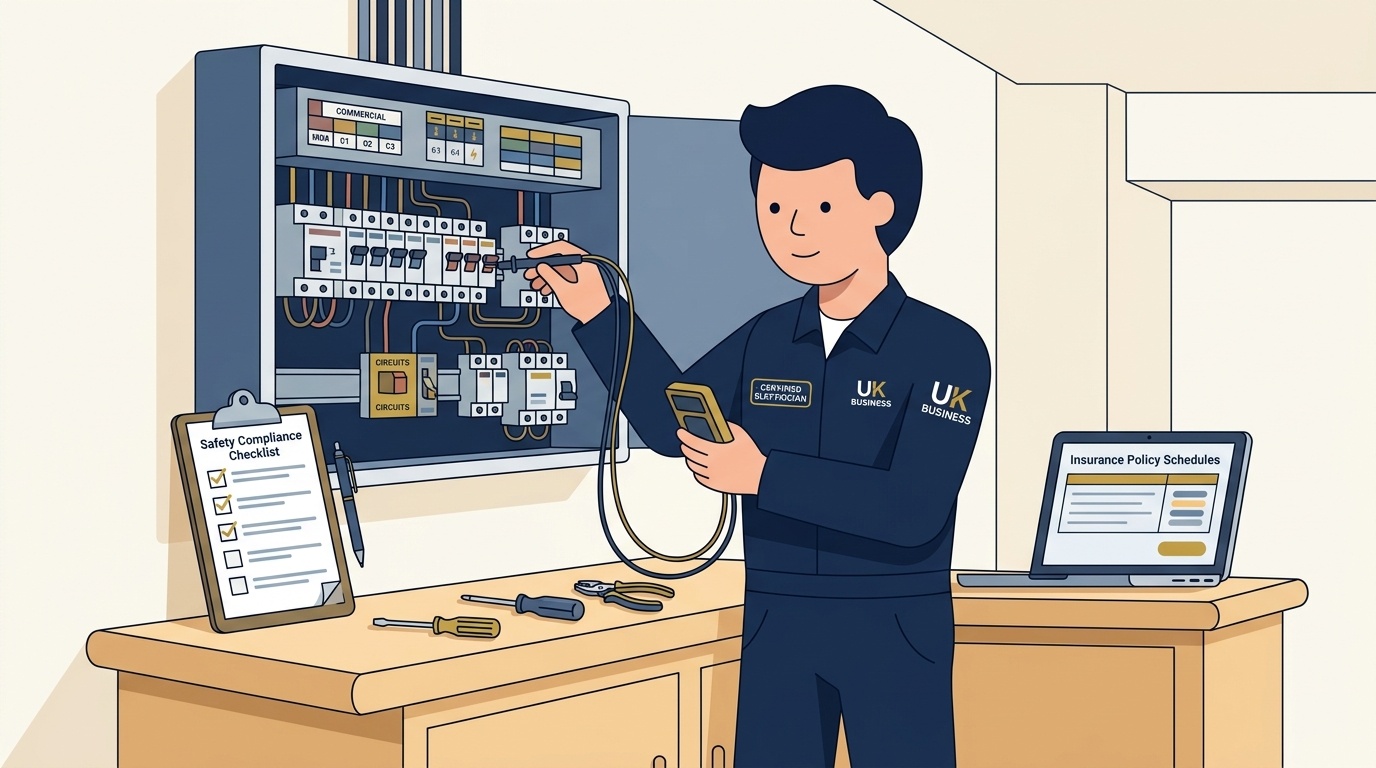
Quick Answer: What Is Electrician Public Liability Insurance?
Electrician public liability insurance protects electrical contractors against financial compensation claims and legal fees resulting from accidental third-party injury or property damage caused by their electrical operations. While not mandated by general UK statute for sole traders without staff, holding a minimum of £2 million in public liability cover is compulsory for registration with competent person schemes including NICEIC and NAPIT. Commercial building contractors, property managers, and public sector tenders routinely require £5 million or £10 million in indemnity limits. In 2026, standard annual premiums for self-employed electricians range between £150 and £350 for £2 million to £5 million in baseline cover, depending on turnover, scope of commercial installation, and specific trade endorsements.
Key Takeaways for UK Electrical Contractors
- Scheme Compulsion: Both NICEIC and NAPIT require registered electrical contractors to maintain at least £2 million in public liability indemnity to sign off work under Part P building regulations.
- Commercial Tenders: Upgrading cover from £2 million to £5 million typically adds £50 to £100 to your annual premium, yet opens access to commercial fit-outs and main contractor frameworks.
- Critical Efficacy Cover: Standard policies exclude claims when installed safety equipment fails to operate. Electricians working on fire alarms, security circuits, or emergency lighting require an explicit efficacy endorsement.
- Employers Liability Mandate: Employing apprentices, administrative staff, or labour-only sub-contractors creates a strict legal duty under the Employers Liability (Compulsory Insurance) Act 1969 to hold £5 million in cover, backed by fines of £2,500 per uninsured day.
- Rip-Out Extension: Standard public liability covers resultant fire or water destruction, but excludes the cost of exposing and reinstating undamaged walls or ceilings to replace a defective run of cable without a financial loss extension.
Electrician Public Liability Insurance UK
Data compiled by Electrical Safety First research reports reveals that electrical distribution systems, wiring failures, and faulty consumer units cause more than 14,000 fires across Great Britain each year. For a self-employed sparky or established electrical contractor, a single loose neutral connection, drill strike into a concealed pipe, or overlooked isolation protocol can trigger devastating structural destruction or fatal physical shock. Electrician public liability insurance serves as your frontline financial shield, ensuring a catastrophic worksite incident does not liquidate your business assets or personal savings.
Operating in modern UK contracting requires clear separation between optional risk safeguards and contractual requirements. While domestic homeowners rarely ask to see your schedule of insurance, trade bodies, commercial landlords, and principal building contractors demand documented verification before allowing access to any job site. If you plan to expand from domestic rewires into commercial fit-outs, knowing exact indemnity tiers, policy endorsements, and cost factors prevents you from paying for hollow cover that fails when a claim lands.
Whether you operate as a sole trader or run an established limited company, securing the right policy structure directly impacts your commercial eligibility. Similar to selecting sole trader insurance, electrical contracting demands policy wording that matches specific site activities. This detailed guide breaks down statutory regulations, trade body mandates, typical 2026 premiums, and the critical endorsement clauses that keep electrical contractors protected.
What Does Electrician Public Liability Insurance Actually Cover?
Public liability insurance protects your enterprise against claims of legal compensation brought by third parties, including domestic homeowners, commercial clients, visitors, or members of the general public. If your business operations, equipment, or finished installations cause bodily harm, death, or property destruction, your insurer funds both the legal defence representation and any awarded financial settlement up to your chosen policy limit.
In electrical work, claims rarely involve minor scuffs. The inherent risks of mains voltage, combustible surroundings, and structural modifications mean liabilities quickly reach hundreds of thousands of pounds. Key operational risks covered by a specialized electrical policy include:
- Accidental Property Damage: For instance, while running twin-and-earth cable through ceiling joists, your drill strikes an unmapped central heating pipe, flooding three storeys of engineered oak flooring and commercial server equipment below.
- Third-Party Personal Injury: A customer or site visitor trips over an uncoiled extension reel or step ladder in an unlit corridor, suffering a fractured hip that leads to compensation claims for loss of earnings, private medical rehabilitation, and general damages.
- Post-Completion Fire and Arc Flash Damage: Six months after you install a sub-distribution board in a commercial restaurant kitchen, an arcing fault ignites grease deposits behind the cladding. If forensic fire investigators trace the ignition to installation fault, your completed operations cover responds.
- Legal Defence and Expert Representation: Specialist electrical litigation requires expert forensic engineers and counsel. Your insurer covers these professional fees, which often exceed £40,000 before a case even reaches court.
Without adequate public liability insurance in place, your business must fund these damages directly. If you trade as a sole trader, you retain unlimited personal liability, meaning courts can seize personal savings and residential property to satisfy an unpaid compensation order.
Choosing Your Indemnity Limit: £2m, £5m, or £10m?
Selecting an indemnity limit is one of the most common decision points for electrical contractors. In the UK commercial insurance market, public liability is structured in distinct tiers: £1 million, £2 million, £5 million, and £10 million. While £1 million policies exist, they are largely obsolete for registered professionals because neither competent person schemes nor commercial clients accept them.
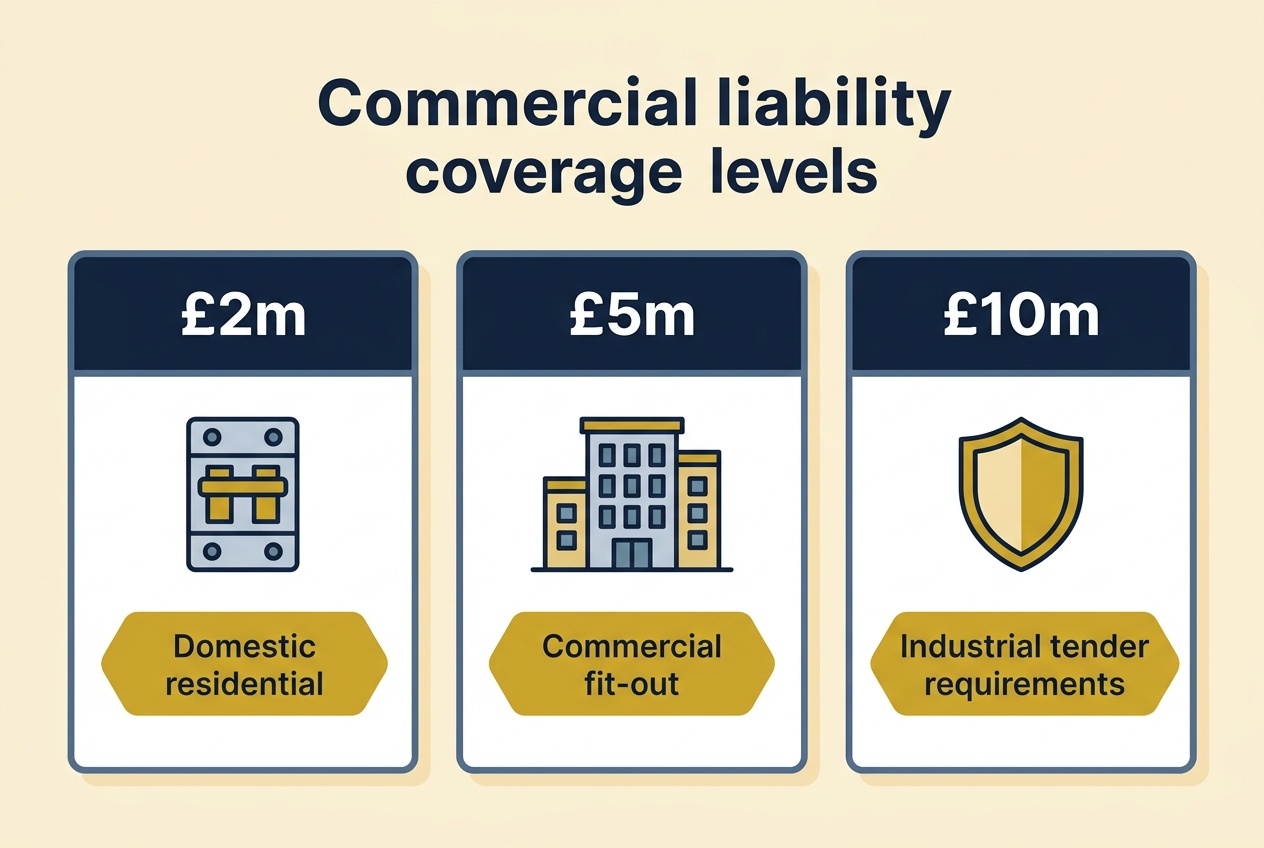
Indemnity tiers determine commercial contract eligibility and project scope for UK electrical contractors.
evaluating where each indemnity tier applies ensures you do not overpay for unnecessary cover while avoiding contract disqualification on valuable projects:
| Cover Level | Primary Target Sector | Acceptance & Compliance | Typical Annual Cost |
|---|---|---|---|
| £2 Million | Domestic residential repairs, consumer unit changes, socket additions, private landlord rental inspections. | Meets minimum registration rules for NICEIC Domestic Installer and NAPIT Part P schemes. | £150 – £220 |
| £5 Million | Commercial offices, retail units, schools, NHS clinics, local council housing maintenance frameworks. | Standard threshold for commercial lease agreements, principal building contractors, and public sector tenders. | £220 – £350 |
| £10 Million | Major construction projects, rail networks, airports, petrochemical plants, multi-storey commercial towers. | Mandated by Tier 1 main contractors (Balfour Beatty, Morgan Sindall, Kier) and Crown Commercial Service frameworks. | £350 – £600+ |
Notice the minimal price differential between £2 million and £5 million of cover. In most underwriting cases, stepping up to £5 million adds roughly £60 to £100 per year. For an active contractor, that modest cost is recovered on the very first commercial contract or agency subcontractor placement.
NICEIC, NAPIT, and ECA Insurance Requirements
In the UK, self-certification of domestic electrical installations under Approved Document P of the Building Regulations requires membership in an authorized Competent Person Scheme (CPS). If you register as an Approved Contractor or Domestic Installer with the NICEIC, NAPIT, or the Electrical Contractors Association (ECA), holding verifiable public liability insurance is an absolute prerequisite.
These professional bodies enforce strict compliance checks during your annual assessment:
- Minimum Cover Threshold: Both NICEIC and NAPIT rules mandate that registered businesses maintain at least £2 million in public liability cover at all times. If your insurance lapses or drops below this figure, your scheme membership is suspended, revoking your ability to notify building control electronically.
- Professional Indemnity (PI) Insurance: While public liability covers accidental property damage and injury, it does not cover financial loss resulting from faulty professional design, advice, or inspection reports. NAPIT requires registered members to carry a minimum of £250,000 in professional indemnity insurance. NICEIC similarly mandates PI cover for contractors producing Electrical Installation Condition Reports (EICRs) or completing formal design specifications.
- Scope of Registered Activities: Your insurance schedule must reflect every activity you declare on your scheme registration. If you register for commercial three-phase installations or photovoltaic solar systems but your insurance certificate states domestic only, your scheme assessor will issue a non-compliance notice.
Contractors operating through a formal corporate entity should also verify how their policy aligns with limited company vs sole trader status. Insuring in your personal name when trading through an incorporated entity creates an ownership disconnect that insurers can use to decline a claim.
Critical Endorsements: Where Standard Trade Policies Fail
The biggest trap for electrical contractors is assuming all public liability policies provide identical protection. Budget aggregator policies designed for generic handymen or painters often carry restrictive exclusions that render them useless during an electrical crisis. When arranging electrician public liability insurance, ensure the following five clauses are explicitly endorsed on your schedule:
1. Efficacy Cover (Failure of Safety Systems)
Standard public liability insurance covers accidental damage caused directly by your physical tools or actions. However, standard policy wording excludes claims where a safety-critical system you installed simply fails to perform its intended emergency function. For electricians installing smoke detectors, addressable fire alarm panels, intruder alarms, emergency egress lighting, or surge protection devices, you must hold efficacy cover. If a commercial premises burns down because an alarm circuit you wired failed to trigger the smoke dampers, efficacy cover funds the resulting multi-million-pound property claim.
2. Rip-Out and Reinstatement Extension
Consider this scenario: You wire a new office suite, running hundreds of meters of multi-core cable through stud walls, beneath screeded floors, and behind finished plasterwork. A manufacturing defect or installation error in the cabling causes internal faulting. Public liability covers resultant fire destruction, but it excludes the cost of demolishing undamaged plasterboard, lifting floor tiles, and repairing structural finishes just to reach and replace the bad cable. Adding a financial loss and rip-out extension ensures these investigative and restoration expenses are paid by the insurer.
3. Damage to Property Worked Upon (Custody and Control)
Standard commercial liability policies exclude damage to the exact item or physical component you are working on. If you are replacing a component inside a £35,000 industrial computerized control panel and drop a screwdriver across the busbars, causing a catastrophic internal burnout, standard public liability may decline the cost of the control panel itself while only agreeing to cover peripheral smoke damage. A specialized electrical trades policy amends this exclusion to include property held in your care, custody, and control.
4. Hot Work Permit Conditions
Applying heat to conduit, using blowlamps for lead cable jointing, or operating angle grinders to cut steel trunking introduces spark and open-flame hazards. Most commercial policies include strict hot work conditions: maintaining a functioning fire extinguisher within two meters, clearing combustible materials within six meters, and conducting a mandatory continuous fire watch for at least 60 minutes after flame extinction. Violating any condition invalidates your cover if a smouldering fire ignites hours after you leave the site.
5. Height and Depth Limitations
Electrical contracting frequently involves working on warehouse high-bay lighting, agricultural roof spaces, or outdoor floodlighting rigs. Many standard trade policies place automatic restrictions capping work at 10 meters or 15 meters above ground level. If your work involves scissor lifts, boom cherry pickers, or mobile access towers above standard domestic eaves height, you must declare these activities to have the height ceiling removed or adjusted.
Complementary Policies: Building a Complete Protection Package
Public liability is the foundation of your risk management, but it only addresses third-party claims. A resilient electrical contracting firm requires several integrated policies to protect its staff, physical machinery, and operational cash flow.

Presenting verified insurance certificates and regulatory compliance documents builds client trust during tender submissions.
When evaluating what business insurance do you actually need in the UK, electricians should evaluate three essential policy companions:
Employers Liability Insurance (£5m Statutory Minimum)
Under official GOV.UK Employers’ Liability guidelines, holding employers liability insurance is a strict legal requirement the moment you take on any staff member. This rule applies to full-time PAYE employees, but also to electrical apprentices, college day-release trainees, and labour-only subcontractors working under your direct supervision and tool supply. Under the Employers Liability (Compulsory Insurance) Act 1969, failing to maintain this insurance carries daily fines of up to £2,500, plus an additional £1,000 fine for failing to produce your certificate during a site inspection by the Health and Safety Executive electricity at work guidance inspectors. Most UK commercial insurers issue £10 million as standard cover.
Professional Indemnity (PI) Insurance
Public liability responds to physical damage. In contrast, professional indemnity covers financial losses suffered by a client due to negligent professional advice, architectural electrical design calculations, cable sizing errors, or faulty test certifications. If you produce an Electrical Installation Condition Report (EICR) that misclassifies a serious code C2 defect as acceptable, and the client subsequent suffers commercial downtime or tenant litigation, PI insurance steps in to fund the defence and commercial compensation.
Tools, Equipment, and Van Storage Cover
Tool theft remains an endemic threat across the UK trades. The average electrical contractor carries between £4,000 and £12,000 in specialized equipment, including calibrated multi-function testers (such as Megger or Fluke units), SDS drills, hydraulic crimpers, and battery platforms. Replacing these out-of-pocket can halt business operations instantly. When adding tool cover, inspect the policy for overnight van parking clauses. Reputable trade policies cover tools stored in a locked van overnight, provided the vehicle meets approved Thatcham deadlocks or alarm requirements, avoiding the unrealistic requirement to empty your van every single evening.
How Much Does Electrician Public Liability Insurance Cost in 2026?
Annual premiums for electrical contractors are shaped by trade risk classifications, annual turnover, workforce size, and past claims history. Because electrical installation carries fire and electrocution hazards, premiums are slightly higher than those for general painters or joiners, but remain affordable when structured correctly.
| Business Profile | Core Cover Limits Included | Primary Work Scope | Estimated 2026 Annual Cost |
|---|---|---|---|
| Sole Trader (Domestic) | £2m Public Liability + £250k Professional Indemnity | Domestic rewires, consumer units, smart home, private landlord EICRs. | £160 – £260 / year |
| Sole Trader + Apprentice | £5m Public Liability + £10m Employers Liability + £5k Tools | Mixed domestic and light commercial shop fit-outs, EV chargers. | £340 – £520 / year |
| Small Contracting Firm (3-5 Staff) | £5m Public Liability + £10m Employers Liability + £500k PI + Efficacy | Commercial sub-contracting, warehouse three-phase, fire alarm installations. | £750 – £1,400 / year |
| Industrial Contracting Ltd | £10m Public Liability + £10m Employers Liability + £1m PI + Plant Cover | Tier 1 infrastructure, manufacturing plants, high-voltage distribution. | £1,800 – £3,500+ / year |
To keep your insurance overhead lean without sacrificing essential cover, apply these practical underwriting strategies:
- Bundle Your Covers Into a Single Policy: Purchasing public liability, professional indemnity, and tools protection from separate insurers results in duplicate administration fees. A unified electrical contractor policy typically yields a 15% to 25% package discount.
- Utilize Trade Scheme Discounts: Both NICEIC Insurance Services and NAPIT Insurance offer members negotiated broker rates, often delivering an upfront 10% discount that offsets part of your annual scheme registration fee.
- Accurately Disclose Bona-Fide Subcontractors: If you hire bona-fide subcontractors who carry their own verified public liability insurance, ensure your broker does not classify them as labour-only staff, which needlessly inflates your employers liability wage roll calculations.
- Maintain Valid Risk Assessments: Documenting regular calibration certificates for test equipment and maintaining signed method statements demonstrates professional competence, lowering insurer risk scoring during commercial renewals.
Frequently Asked Questions About Electrician Public Liability Insurance
Is public liability insurance legally compulsory for electricians in the UK?
Public liability insurance is not mandated by general UK criminal statute for a sole trader working without employees. However, it is compulsory in practice. You cannot register with competent person schemes like NICEIC or NAPIT without at least £2 million in cover. In addition, main building contractors, commercial clients, and public sector tenders require proof of cover before permitting you onto a worksite.
What is the difference between £2 million and £5 million public liability cover?
The difference lies in the maximum payout ceiling per claim and your eligibility for commercial work. A £2 million policy satisfies residential domestic requirements and basic competent person scheme rules. A £5 million policy is required by commercial managing agents, principal building contractors, local councils, and commercial fit-out frameworks. The annual premium difference between £2 million and £5 million is typically only £50 to £100.
Does public liability insurance cover my electrical tools and testers?
No. Standard public liability insurance only covers third-party property damage and physical injury claims. It provides zero financial protection for your own tools, multi-function testers, or materials. To safeguard your test meters and power tools against theft or accidental destruction, you must add a dedicated tools in transit and business equipment extension.
Why do electricians need efficacy insurance?
Standard public liability policies cover active damage caused during work, but exclude claims where a safety installation fails to perform its intended emergency function. If you install emergency lighting, smoke ventilation, fire alarms, or security systems that fail to operate during an emergency, efficacy cover ensures your insurer funds the resulting property loss or personal injury claims.
Am I covered if I install solar panels or electric vehicle (EV) charging points?
Standard electrical policies may exclude specialist renewable energy or high-capacity DC installations unless declared during quote setup. EV charger installations (regulated under IET Code of Practice) and rooftop solar photovoltaic systems involve distinct electrical and work-at-height hazards. Always ensure your policy schedule explicitly states renewable energy and EV charging endorsement.
Do I need employers liability insurance if I only employ an apprentice?
Yes. Under the Employers Liability (Compulsory Insurance) Act 1969, you must maintain at least £5 million in employers liability insurance the moment you employ anyone, including college apprentices, helpers, and labour-only subcontractors. Failing to hold this insurance carries statutory fines of up to £2,500 for every uninsured day.
The Bottom Line: Securing the Right Protection for Your Electrical Business
In the electrical contracting industry, operating without verified insurance is an unacceptable business gamble. Mains voltage and concealed circuits carry inherent structural risks that can transform a standard job into a multi-million-pound legal dispute. While holding £2 million in baseline cover ensures regulatory compliance with NICEIC and NAPIT, upgrading to £5 million opens the door to high-margin commercial and public sector frameworks for a negligible difference in annual cost.
Review your policy schedule today to verify that your cover matches your real-world daily activities. Ensure essential endorsements like efficacy cover, rip-out reinstatement, and adequate tool protection are active. When operating across commercial premises, pair your liability protection with a thorough evaluating of commercial property insurance obligations to protect both your business reputation and long-term balance sheet.
Next Actions for Electrical Business Owners
Audit your existing policy documents to verify your indemnity limits, checking for height restrictions and efficacy exclusions. If you plan to expand into commercial installations or hire apprentices this year, model your cash flow and overheads using our suite of interactive business calculators to build a protected, profitable contracting business.