You’ve probably used an ATM hundreds of times. But have you ever thought about who owns those machines? It’s not always the bank. Many ATMs are owned by regular people who run them as a business.
The cash machine business is simple. You buy an ATM, place it in a busy location, and earn money every time someone uses it. The machine charges a fee for each withdrawal, and you keep most of that money.
Right now is actually a good time to get into this business. Even though more people use cards and phones to pay, cash isn’t going away. Plenty of people still need cash for tips, small businesses, and everyday purchases. In fact, there are still billions of ATM transactions every year in the United States alone.
So how much can you make? A single ATM in a good location can bring in $300 to $800 per month. Some machines earn even more. After you subtract your costs, you might pocket $200 to $500 per month per machine. That’s not bad for something that runs 24/7 without much work from you.
Understanding the Cash Machine Business Model
How ATMs Generate Revenue
Your ATM makes money in three main ways.
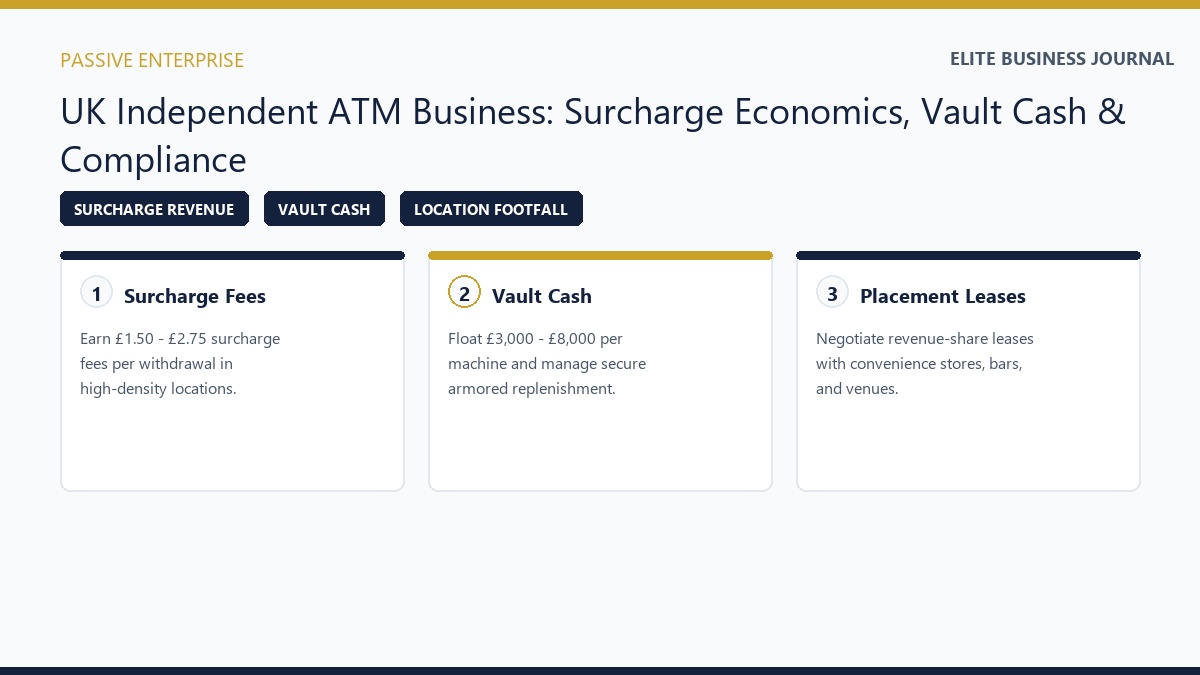
First, there’s the surcharge fee. This is the fee you see on the screen when you use an ATM that’s not from your bank. If the screen says “$3.00 fee,” that money goes mostly to the ATM owner. You get to set this fee yourself.
Second, you earn transaction fees. Every time someone uses your ATM, the payment networks pay you a small amount, usually around $0.50 to $1.00. This happens even if the customer doesn’t complete the withdrawal.
Third, there are interchange fees. These are tiny fees that come from the cardholder’s bank. They’re small, often just a few cents per transaction, but they add up.
Most of your money comes from surcharge fees. If you charge $3.00 per transaction and get 200 transactions per month, that’s $600 right there.
Types of ATM Business Models
You have three main ways to run this business.
As an independent operator, you buy your own machines and place them yourself. You keep all the profits but handle everything yourself. This gives you the most control and the best profit margins.
With a franchise, you pay a company to help you get started. They provide training, support, and sometimes even help find locations. You’ll pay franchise fees, but you get a proven system. This works well if you want more guidance.
You can also partner with existing businesses. Some companies buy ATMs and let you manage them for a share of the profits. You do less work but also make less money.
Most people who want to build a real business choose the independent operator path. You make more money and build real equity.
Initial Investment Requirements
Starting a cash machine business costs less than most businesses. Here’s what you need:
You’ll spend $2,000 to $8,000 per machine. Basic models cost less, while advanced machines with color screens and better security cost more. Most beginners start with one or two machines around $3,000 each.
You need cash to fill the machine. Most ATMs hold $2,000 to $10,000. You can start with less, maybe $1,000 to $2,000, and refill it more often.
Then there are small setup costs like processing fees, installation, and maybe a security camera. Budget another $500 to $1,000 for this.
Total startup cost for one machine: $3,500 to $11,000. That’s reasonable compared to other businesses.
Ongoing Operational Costs
Running your ATM costs money each month. You need to know these costs to calculate real profits.
Processing fees run about $20 to $50 per month per machine. This connects your ATM to the banking networks.
You might pay rent to the location owner. Some locations want $50 to $200 per month. Others prefer a percentage of each transaction, like 50 cents per use.
Internet or phone line fees cost $30 to $100 per month depending on how you connect the machine.
Maintenance and paper costs about $20 to $50 per month. You need receipt paper and occasional repairs.
Insurance might cost $300 to $500 per year per machine.
Don’t forget gas and time for cash runs. If you drive 30 minutes each way twice a month, that’s real cost.
Add it all up, and each machine might cost $150 to $400 per month to operate. Your goal is to earn $500 to $1,200 per month, leaving you with $200 to $800 in profit.
Getting Started: Legal and Regulatory Requirements
Business Registration and Licensing
You need to set up a proper business before you start. Most people form an LLC. This protects your personal assets if something goes wrong.
Register your business with your state. The process is simple and usually costs $100 to $500. You can do it yourself online in most states.
Get an EIN from the IRS. This is free and takes about 10 minutes online. You need this for taxes and to open a business bank account.
Check if your city or county requires a business license. Some do, some don’t. Call your local city hall and ask.
You might need a money transmitter license in some states. This is the most complex requirement. Some states require it for ATM operators, others don’t. Check with your state’s banking department or talk to an ATM industry association.
Banking Relationships and Sponsorship
Here’s something most people don’t know: you can’t just plug in an ATM and start. You need a sponsor bank or an ISO (Independent Sales Organization).
A sponsor bank connects your ATM to the banking networks. They vouch for you and make sure you follow the rules. You can’t join networks like Visa or Mastercard directly as a small operator.
Most new operators work with an ATM processor who already has banking relationships. Companies like Prineta, Cardtronics, or PAI handle this for you. They process transactions and provide the network connections.
You’ll also need a business bank account to receive your deposits. Some banks are friendlier to ATM businesses than others. Credit unions and smaller regional banks often work well.
Compliance Requirements
The ATM business has rules you must follow. They’re not hard, but you can’t ignore them.
ADA accessibility standards require your ATM to be usable by people with disabilities. If you have a voice guidance system and place the machine at the right height, you’re usually fine. Free standing machines need to be positioned so wheelchair users can reach them.
EMV chip card compliance means your machine can read chip cards, not just magnetic stripes. All new machines have this. If you buy an old machine, make sure it’s been upgraded.
PCI DSS security standards protect customer data. Your processor will help you stay compliant. Basically, you need to keep software updated, use encryption, and follow basic security practices. Your ATM processor usually handles most of this.
Insurance Considerations
You need insurance for your ATM business. Your homeowner’s policy won’t cover business equipment.
Get general liability insurance in case someone gets hurt near your machine. This costs about $300 to $500 per year.
Property insurance covers the machine itself if it gets damaged or stolen. This runs $200 to $400 per year per machine.
Some operators also get cash in transit insurance. This covers your cash if you get robbed while refilling machines. If you carry large amounts of cash, this makes sense.
Shop around. Some insurance companies specialize in ATM businesses and offer better rates.
Tax Obligations and Reporting
You pay regular business taxes on your ATM profits. Keep good records of all income and expenses.
You’ll pay income tax on your net profit. If you run this as a sole proprietor or LLC, it goes on your personal tax return.
You might owe quarterly estimated taxes if you make enough profit. Talk to an accountant about this.
Keep receipts for everything: machine purchases, gas for service runs, processing fees, and repairs. All these reduce your taxable income.
You don’t collect sales tax from customers. The surcharge fee isn’t subject to sales tax in most states.
Hire a CPA who knows small businesses. They’ll save you more money than they cost.
Choosing and Purchasing ATM Equipment
New vs. Refurbished Machines
Should you buy new or used? Both options work, but they have different tradeoffs.
New machines cost more, usually $3,500 to $8,000. But they come with warranties, the latest security features, and full EMV compliance. You won’t have surprise repair bills in the first few years. If you can afford it, new is safer for beginners.
Refurbished machines cost $2,000 to $4,000. Good refurbishers replace worn parts and update software. You can save thousands of dollars. But you might face repairs sooner, and warranties are shorter or nonexistent.
Used machines from random sellers on Craigslist are risky. You don’t know the history. They might not be compliant with current standards. Skip these unless you really know what you’re doing.
The sweet spot for most beginners: certified refurbished machines from reputable ATM companies. You save money but still get some protection.
Types of ATMs Available
ATMs come in different styles for different situations.
Through the wall ATMs mount in a wall with the screen facing outside. You see these at banks. They’re very secure because most of the machine is inside the building. You probably won’t use this type as a beginner.
Freestanding ATMs are what you’ll buy. They stand on the floor and can go almost anywhere. They come as one piece or two pieces (topper and safe). Most retail locations use freestanding machines.
Mobile ATMs are portable units for events and temporary locations. Unless you plan to service festivals and fairs, you won’t need these.
Stick with a basic freestanding ATM for your first machine.
Essential Features to Consider
Not all ATMs are equal. Look for these features.
Cash capacity matters. Machines hold different amounts, from 800 to 3,000 bills. A machine holding 2,000 bills can dispense $40,000 if you load it with twenties. For most locations, a 1,500 to 2,000 bill capacity works fine.
Security features protect your investment. Look for strong bolts to anchor the machine, quality locks, and anti skimming technology. Skimmers are devices criminals attach to steal card data. Good machines have anti skimming features built in.
Connectivity options determine how your ATM talks to the networks. You can use dial up phone lines, internet, or wireless. Wireless is easiest because you don’t need a phone line. Internet is fast and reliable if the location has WiFi. Some machines offer multiple options.
A color screen looks more modern and attracts more users. It’s not required, but it helps.
Built in cameras inside the machine add security. If someone tampers with the ATM, you have video.
Advertising capability lets you display ads on the screen. Some machines let you earn extra money showing ads between transactions.
Leading ATM Manufacturers and Suppliers
Several companies dominate the ATM manufacturing business.
Genmega makes reliable machines that are popular with independent operators. Their models are reasonably priced and well supported.
Hyosung is another major manufacturer. They make everything from basic to high end machines.
Nautilus Hyosung (same company, different name in some markets) is known for quality and durability.
Triton makes good entry level machines. Many beginners start with Triton.
Hantle machines are solid and common in the independent operator market.
Don’t get too hung up on brand. All major brands work fine. What matters more is getting support and service in your area.
Buy from ATM suppliers, not manufacturers directly. Suppliers like ATM Depot, Prineta, or National ATM Systems sell machines and provide support. They help with setup and processing.
Cost Breakdown and Financing Options
Let’s break down the real costs.
The machine itself: $2,500 to $5,000 for most beginners
Shipping: $100 to $300
Installation: $0 to $500 (you can do it yourself)
Initial cash load: $1,000 to $3,000
Processing setup: $0 to $500
Supplies (receipt paper, keys, etc.): $50 to $100
Total first machine cost: $3,650 to $9,400
Most people pay cash for their first machine. It’s the simplest approach. But you have financing options.
Some ATM suppliers offer financing. You might pay 10% to 20% down and monthly payments for 12 to 36 months. Interest rates vary widely.
Equipment financing companies will lend money for ATMs. Shop around for rates.
Some people use business credit cards to buy their first machine. If you have good credit and a card with a decent limit, this works. Just pay it off quickly.
A home equity line of credit offers lower rates if you own a home. But you’re putting your house up as collateral, so be careful.
If you can pay cash, do it. You’ll own the machine free and clear from day one.
Location Strategy: Finding Profitable Placements
Identifying High Traffic Locations
Location makes or breaks your ATM business. A great machine in a bad location earns nothing. An average machine in a great location makes money.
Look for places where people need cash and there’s no ATM nearby. Here are the best location types.
Convenience stores are perfect. People stop in for snacks, drinks, and cigarettes. Many want cash. A busy convenience store with no nearby ATM is gold. You can easily get 200 to 500 transactions per month in a good convenience store.
Gas stations work well, especially in areas without many banks. People traveling often need cash. Truck stops are even better because truckers use cash frequently.
Bars and nightclubs are excellent. People buy drinks with cash. They tip bartenders and DJs. Customers often take out $20 or $40 for the night. Weekend traffic can be huge. A popular bar might generate 300 to 800 transactions monthly.
Shopping centers and strip malls attract steady foot traffic. Look for centers without a bank branch nearby. Your ATM serves all the small businesses and shoppers.
Hotels and motels work if they don’t have an ATM already. Travelers need cash for tips, parking, and local businesses. Focus on budget and mid tier hotels. Luxury hotels usually have their own ATMs.
Other good spots include laundromats, bowling alleys, casinos (if allowed), pizza places, ethnic grocery stores, and anywhere people gather regularly.
Conducting Location Analysis
Don’t guess. Analyze potential locations before you commit.
Count foot traffic. Visit at different times: morning, lunch, evening, and weekend. Watch how many people come and go in an hour. Multiply that by operating hours to estimate daily traffic. You want at least 200 to 300 people per day for a good location.
Check the competition. Is there another ATM within walking distance? How far is the nearest bank? If people can walk 100 feet to a bank ATM with no fees, your machine won’t do well. You need to be the convenient option.
Research demographics. Who lives and works nearby? Younger people and lower income areas tend to use cash more. Wealthy suburbs where everyone has bank accounts and low fee cards will be tougher.
Ask the business owner about customer payment habits. Do most people pay cash or card? A place where 70% of customers pay cash is better than one where everyone uses cards.
Look at parking and accessibility. If people can’t easily park and walk to the business, they won’t use your ATM.
Visit on a Friday or Saturday night if it’s a bar or entertainment venue. See how busy it really gets.
Negotiating Placement Agreements
Once you find a good location, you need to convince the owner to let you place your ATM there.
What’s in it for them? Explain the benefits:
- Their customers can get cash without leaving
- Cash spending customers often spend more
- They might reduce credit card processing fees if more people pay cash
- It makes their business more convenient
Some owners want to be paid. Others are just happy to offer the service to customers.
If they want payment, you have options. You can pay a flat monthly fee like $50 to $150. Or you can offer a per transaction fee, like 25 to 50 cents per withdrawal.
Many operators start by offering 25 cents per transaction. If the machine does 200 transactions monthly, that’s $50 to the owner. This aligns incentives. The busier the location, the more they make.
Never pay too much. If a location wants $200 per month and you only expect 150 transactions at $3 each ($450 revenue), your margin is too thin. Walk away and find a better deal.
Some locations don’t want money. They just want the convenience for customers. These are the best deals. You keep all the profits.
Get everything in writing. Create a simple location agreement that covers:
- How much you pay the owner (if anything)
- Who pays for electricity (usually free, it costs them pennies)
- How often you’ll service the machine
- How long the agreement lasts
- What happens if either party wants out
Keep it simple. One or two pages is fine. Both parties sign it.
Revenue Sharing Models with Location Owners
Let’s look at common payment structures.
Zero cost locations: You pay nothing, owner gets the convenience. This is ideal. You keep all surcharge revenue minus your operating costs. Always try for this first.
Flat monthly rent: You pay $50 to $200 per month regardless of transactions. This is predictable but risky if transaction volume drops.
Per transaction fee: You pay 25 to 75 cents per transaction. This is fair because you both benefit from high volume. Most common is 50 cents per transaction.
Percentage split: You give the owner 10% to 30% of surcharge revenue. Less common but some owners prefer this.
Which is best? It depends on transaction volume. Let’s say your machine does 300 transactions monthly at $3 per transaction ($900 revenue).
If you pay zero: You keep $900
If you pay $100 flat: You keep $800
If you pay 50 cents per transaction: You keep $750 ($900 minus $150)
If you split 20%: You keep $720
Run the numbers for each location. Sometimes flat rent is better. Sometimes per transaction is better.
Whatever you agree on, make sure you can still profit at least $200 to $300 per month after all costs. Otherwise, it’s not worth your time.
Setting Up Your ATM Operations
Installation Process
Installing an ATM isn’t complicated, but you need to do it right.
First, choose the exact spot in the location. You want high visibility so customers see it easily. Near the entrance is good, but not blocking the doorway. Make sure there’s enough light. Dark corners make people nervous about using ATMs.
The floor must be level and stable. Concrete is perfect. If you’re putting it on tile or wood, make sure it can support 400 to 600 pounds (the machine plus cash).
You need power within six feet. A standard 110V outlet works fine. The location owner usually lets you use their electricity. An ATM uses about as much power as a refrigerator light bulb, so the cost is minimal.
Bolt the machine down. This is critical. Use concrete anchors if you’re on a concrete floor. Lag bolts work for wood. The machine comes with bolt holes in the base. Don’t skip this step. Thieves have stolen unbolted machines by just wheeling them out.
Connect to your communication line (internet, wireless, or phone line). Most modern machines use wireless or internet. Plug in the wireless modem or ethernet cable, and the machine connects to the network.
You can install it yourself or hire a technician. If you’re handy, do it yourself and save $200 to $500. If not, have the supplier send a tech or find a local ATM technician.
Installation usually takes one to three hours.
Connecting to Processing Networks
Your ATM needs to connect to Visa, Mastercard, and other card networks. You can’t do this directly. You need an ATM processor.
An ATM processor is a company that connects your machine to all the banking networks. They handle the technical stuff and make sure money moves correctly.
Good processors include:
- Prineta
- PAI (Payment Alliance International)
- NationalLink
- ATM Depot
- Cardtronics
You sign up with one processor. They charge monthly fees ($20 to $50) and sometimes small per transaction fees.
They give you a terminal ID and program your machine. Once programmed, your ATM can accept any major debit card.
The processor also handles settlements. When someone withdraws $60 from your ATM, the processor makes sure $60 comes out of their bank account and goes into yours (minus fees).
Setting up with a processor takes a few days to two weeks. You fill out an application, they verify your business, and they remotely program your machine.
Choose a processor with good customer support. You’ll call them when you have technical issues.
Loading Cash and Vault Management
Your ATM needs cash. You have to supply it.
Most operators use $20 bills. Some machines can dispense different denominations, but twenties are standard. They’re easy to get from your bank and customers expect them.
How much cash do you load? It depends on transaction volume. If your ATM does 200 transactions monthly and customers average $60 per withdrawal, that’s $12,000 in monthly withdrawals.
You don’t want to run out of cash. Running out means lost revenue and unhappy customers. But you don’t want $20,000 sitting in the machine either. That’s your money tied up earning nothing.
Most operators load enough cash for one to two weeks. If your machine dispenses $3,000 weekly, load $3,000 to $6,000.
Where do you get the cash? From your business bank account. Go to your bank and withdraw the cash you need. Some banks require advance notice for large withdrawals. Call ahead if you need $5,000 or more.
Loading cash is simple. You unlock the safe, pull out the cassette (the box that holds bills), fill it with your cash, slide it back in, and lock up. The machine counts the bills and updates its balance.
Always carry cash securely. Use a locking bank bag. Don’t flash cash around. Be aware of your surroundings.
Some operators use armored car services like Brinks or Loomis. These companies load cash for you. They charge $100 to $200 per visit, which eats into profits. Most small operators service their own machines.
Setting Surcharge Fees Competitively
The surcharge is the fee customers pay to use your ATM. You get to set this fee.
Most ATMs charge $2.50 to $3.50. Some charge more in high demand locations like bars, casinos, or concert venues.
How do you decide? Look at nearby ATMs. If the convenience store down the street charges $3.00, you can charge $3.00 too. Maybe $3.50 if your location is more convenient.
Don’t price too high. At $5.00, many people will walk away. You’ll get fewer transactions. It’s better to charge $3.00 and get 300 transactions than charge $5.00 and get 100 transactions.
Don’t price too low either. At $1.50, you’re leaving money on the table. People who need cash will pay $3.00. They won’t use your ATM more often just because it’s cheap.
The sweet spot for most locations: $2.95 to $3.50.
You can change the surcharge anytime. If you’re getting tons of transactions, try raising it by 25 cents and see what happens. If volume drops significantly, lower it back.
Some locations demand lower fees. A business owner might say “my customers won’t pay $3.00.” You can negotiate. Maybe you charge $2.50 but pay the owner less commission.
Your processor will take a small cut of the surcharge, usually 10 to 50 cents. Factor this in. If you charge $3.00 and your processor takes 40 cents, you net $2.60 per transaction.
Branding and Customization Options
Your ATM screen displays messages and branding. Use this to your advantage.
You can upload a custom logo to the welcome screen. Put your business name and phone number. This looks professional and helps if customers have questions.
Some machines let you customize the screen colors and messages. Make it welcoming. “Welcome! Your trusted ATM source” is better than generic text.
The outside of the machine can have vinyl wraps or decals. Some operators put their company logo on the machine. Others sell advertising space on the sides. A local business might pay $50 to $100 per month to advertise on your ATM.
Keep it simple and professional. A clean looking machine gets more use than one covered in messy stickers.
Inside the transaction flow, you can add a custom receipt. Put your contact info on receipts in case of problems.
Some newer machines have video screens for advertising between transactions. You can show ads and earn extra money. Or use it to promote your own services.
Creating Operational Procedures
Run your business like a business. Create simple procedures for routine tasks.
Make a service schedule. Decide how often you’ll visit each machine. Once a week? Every two weeks? Write it down and stick to it.
Create a checklist for each service visit:
- Check cash level and reload if needed
- Restock receipt paper
- Clean the screen and card reader
- Check for skimming devices
- Review transaction logs for problems
- Test a transaction to make sure everything works
- Take photos of the machine and location (proof it’s in good condition)
Keep a log for each machine. Note the date, starting cash balance, ending cash balance, and transactions. This helps you track performance and catch problems.
Have a backup plan if a machine goes down. Know who to call for repairs. Keep spare receipt paper in your car.
Create a communication plan with location owners. Give them your phone number for emergencies. Check in with them occasionally to make sure they’re happy.
Document everything. When you service a machine, make notes. If something breaks, write down what happened and how you fixed it.
Good procedures save you time and headaches later.
Cash Management and Security
Cash Forecasting and Replenishment Strategies
Running out of cash is bad. You lose money and frustrate customers. Loading too much cash ties up your capital.
Track your transaction patterns. Most machines are busiest on Fridays and Saturdays. Slow days are usually Mondays and Tuesdays.
Look at your weekly cash depletion rate. If you load $4,000 on Monday and the machine has $1,500 left on Friday, you’re going through $2,500 per week. Plan accordingly.
Build a buffer. If your machine uses $2,500 weekly, load $3,000 to $3,500. This gives you cushion in case of a busy week.
Check your machine’s cash level remotely. Most modern systems let you log in online and see how much cash remains. Check it every few days.
Set up alerts. Most processing systems can email or text you when cash gets low. Set the alert at 30% remaining. This gives you time to schedule a cash run before it runs out.
If you run multiple machines, prioritize. Service the busiest machines first. A machine doing 500 transactions monthly needs attention more than one doing 100.
Plan efficient routes. If you have five machines, service them all in one trip. Driving separately to each wastes gas and time.
Keep cash reserves in your bank account. You need enough to fill all your machines plus some extra. If you have three machines requiring $3,000 each, keep at least $10,000 liquid.
Armored Car Services vs. Self Servicing
Should you load cash yourself or hire an armored car company?
Most small operators start by servicing their own machines. It’s cheaper and gives you control.
Self servicing costs you only time and gas. You drive to the location, load cash, check the machine, and leave. For one or two machines, this takes an hour or two per week.
Armored car services cost $100 to $250 per visit per machine. If you service weekly, that’s $400 to $1,000 monthly per machine. This destroys your profit margins on small operators.
When does armored service make sense?
- You have many machines and can’t service them all yourself
- Machines are far apart and driving takes too much time
- You’re handling very large amounts of cash and want the security
- Your insurance requires it for coverage
Most operators don’t use armored service until they have 10 or more machines.
If you self service, follow safety rules. Don’t carry cash openly. Vary your service times. Be aware of your surroundings. Don’t tell people you’re carrying cash.
Some operators hire trusted employees to service machines. Pay them well and run background checks.
Physical Security Measures
Protect your investment. ATMs are targets for theft and vandalism.
Bolt the machine down properly. Use the right anchors for your floor type. Check the bolts every few months to make sure they’re tight.
Choose secure locations. A machine visible from the street and inside view of a staffed business is safer than one hidden in a dark corner.
Position security cameras to see the ATM. Many locations already have cameras. If not, install a cheap camera yourself. A $100 camera often prevents thousands in losses. Even fake cameras deter some criminals.
Install anti skimming devices. Skimmers are devices criminals attach to steal card numbers. Modern ATMs have built in protection, but you can add extra devices to the card reader. These cost $100 to $300 and are worth it.
Use quality locks. The machine comes with locks, but you can upgrade to higher security locks. Talk to your supplier about options.
Anchor the topper (the screen part) to the base. Some thieves try to pry off the topper to access the safe. Good bolts inside prevent this.
Inspect your machine at every service visit. Look for scratches, pry marks, or devices attached to the card reader. If something looks wrong, investigate.
Consider GPS tracking. Some operators hide GPS trackers inside machines. If someone steals it, you can track it down. These cost $50 to $100 plus a small monthly fee.
Partner with location owners on security. Ask them to keep an eye on the machine and call you if they see anything suspicious.
Cybersecurity Considerations
ATMs are computers connected to networks. This creates cyber risks.
Use encryption. All modern ATMs encrypt card data. Make sure your machine has end to end encryption. Your processor helps with this.
Keep software updated. ATM software needs regular security updates. Your processor or machine supplier pushes these updates remotely. Make sure you approve and install them.
Use strong passwords. Your ATM has a management password. Don’t use “1234.” Create a strong, unique password and write it down somewhere secure.
Lock the manager mode. Don’t leave the ATM in a mode where anyone can access settings. Always lock it back to customer mode.
Secure remote access. If you manage your ATM remotely, use secure connections. Don’t access your ATM management system on public WiFi.
Your processor handles most cybersecurity. They’re responsible for PCI compliance and protecting transaction data. Ask them what they do to keep systems secure.
Watch for unusual activity. If your machine suddenly processes a bunch of tiny transactions or transactions from foreign cards, investigate. It might be a testing attack.
Most cyber threats target big ATM networks, not single machines. But don’t ignore security. One data breach can cost you everything.
Insurance and Loss Prevention
Get proper insurance. Your equipment and cash are at risk.
Property insurance covers the machine if it’s damaged or stolen. This usually costs $200 to $400 per year per machine. Worth every penny.
General liability covers you if someone gets hurt at your ATM. Someone trips over your machine or claims injury. This costs $300 to $500 yearly and protects you from lawsuits.
Cash in transit insurance covers cash while you’re transporting it. If you get robbed servicing your machine, this pays you back. Cost varies but might add $200 to $500 per year if you carry significant cash.
Some policies bundle all of this together. Shop around for ATM specific insurance.
Beyond insurance, prevent losses:
- Don’t carry more cash than necessary
- Vary your service schedule so you’re not predictable
- Service during daylight hours when possible
- Bring someone with you if carrying large amounts
- Keep your vehicle locked when loading cash
- Don’t discuss your business in public places
Most ATM operators never face theft or major problems. But insurance is cheap protection against catastrophic loss.
Marketing Your ATM Business
Attracting Location Partners
You need good locations to grow your business. How do you find them?
Direct outreach works best. Drive around and identify businesses without ATMs. Walk in and talk to the owner or manager.
Your pitch is simple: “Hi, I’m [name]. I place ATMs in local businesses. I noticed you don’t have one. Would you be interested? It’s free for you, helps your customers, and might increase your cash sales. Can we talk for a minute?”
Many will say yes to a conversation. Some will say no immediately. That’s fine. Move on.
When you talk to them, focus on benefits:
- Customer convenience
- More cash customers (who often spend more)
- No cost to them
- You handle everything
Have a simple flyer or business card to leave behind. Keep it professional. Include your phone number and email.
Target businesses similar to your successful locations. If you do well in bars, pitch more bars. If convenience stores work, find more of those.
Ask for referrals. Tell your current location partners you’re looking to add machines. They might know other business owners.
Network at local business groups. Chamber of Commerce meetings, small business meetups, and industry events put you in front of business owners.
Online marketing can work too. Create a simple website explaining your service. Run local Google ads. Post in local business Facebook groups.
But nothing beats face to face conversations. Most deals happen when you walk in and talk to someone.
On Machine Advertising Opportunities
Your ATM screen is valuable real estate. People stare at it for 30 to 60 seconds during transactions.
Sell advertising space. Local businesses will pay to get their message in front of customers.
Who buys ATM advertising?
- Restaurants near the ATM location
- Car dealers and repair shops
- Injury lawyers
- Bail bondsmen (especially near bars)
- Insurance agents
- Any local business wanting exposure
Charge $50 to $200 per month per advertiser depending on your transaction volume. A machine with 500 monthly transactions can charge more than one with 100.
You can show multiple advertisers. Rotate ads every 10 seconds on the welcome screen or between transactions.
Some ATM ad networks handle this for you. They find advertisers and give you a cut. But you make more doing it yourself.
To sell ads, approach local businesses. Show them a mockup of what their ad would look like. Explain how many people will see it each month.
Create simple ad graphics using Canva or similar tools. Or have the advertiser provide their own image.
Make it a recurring monthly charge. Advertising gives you extra income beyond surcharges.
Not all machines support this feature. Check if yours does. If not, consider it when you buy your next machine.
Building Relationships with Business Owners
Your location partners can make or break you. Treat them well.
Check in regularly. Stop by every few weeks even if the machine doesn’t need service. Say hi, ask how things are going, and make sure they’re happy.
Respond quickly to problems. If they call about an issue, get there fast or walk them through a fix on the phone.
Be professional and reliable. Show up when you say you will. Service the machine on schedule. Don’t disappear for weeks.
Bring small perks occasionally. A $10 box of donuts for the staff goes a long way. Remember the owner’s name and their kids’ names if they mention them.
Keep the area clean. If your machine is messy or surrounded by trash, clean it up. It reflects on you and the location.
Share performance data. Let the owner know how many transactions the ATM did last month. They like to see it’s valuable.
Be flexible. If they need you to move the machine three feet, just do it. Don’t argue over small stuff.
Good relationships lead to referrals. Happy location owners tell their friends, and you get more placements.
Creating Professional Promotional Materials
Look professional even if you’re a one person operation.
Create business cards. Keep them simple:
- Your business name
- “ATM Placement and Services”
- Your phone number and email
- Maybe a website
Print 500 cards for $20 online. Hand them out everywhere.
Make a one page flyer for location pitches. Include:
- What you offer (free ATM placement)
- Benefits for the business
- Your contact information
- Maybe a photo of a nice ATM in a business
Design a simple logo. You can hire someone on Fiverr for $25 or use a free tool like Canva. Put it on everything.
Build a basic website. One page is fine. Explain your service, show photos of your machines, and provide contact info. A domain and hosting cost $50 to $100 per year.
Get a professional email address. Use your domain, not gmail. jason@cityatms.com looks better than jsmith87@gmail.com.
If you drive a lot for service calls, put a magnetic sign on your car. “[Your Business Name] ATM Services – [Phone Number].” This costs $50 and gets you noticed.
Print simple agreements on professional letterhead. Makes contracts feel more official.
You don’t need to spend thousands on marketing. Just look clean and professional.
Leveraging Online Presence and Networking
Most ATM business happens offline, but online presence helps.
Claim your Google Business listing. When people search “ATM placement [your city],” you want to show up. Add your business info, hours, and service area.
Join ATM owner forums and Facebook groups. You’ll learn from experienced operators and make connections. Groups like “ATM Business Owners” have thousands of members sharing tips.
Follow industry news. Websites like ATM Marketplace cover industry trends. Know what’s changing.
Connect with other operators. They’re not really competition. A good operator three towns over might refer locations to you if they’re outside their service area. You might do the same.
Build a simple email list of people who inquire about your service. Send occasional updates or tips. Keep it short.
LinkedIn can work for B2B connections. Connect with business owners and property managers.
Don’t overthink social media. You don’t need to post on Instagram daily. A simple Facebook page showing you’re a real business is enough.
The real marketing happens when you knock on doors and build relationships. Online presence just supports that.
Managing and Growing Your ATM Portfolio
Monitoring Machine Performance
Track how each machine performs. Some will be great. Others will disappoint.
Log into your processing portal weekly. Check transaction counts for each machine. Most processors provide reports showing:
- Number of transactions
- Total cash dispensed
- Surcharge revenue
- Errors or downtime
Create a simple spreadsheet. For each machine, track:
- Location name
- Monthly transactions
- Revenue
- Expenses (rent, processing fees, etc.)
- Net profit
- Transactions per day average
This shows you which machines make money and which don’t.
Compare performance month to month. Is a location trending up or down? If a machine dropped from 300 to 150 transactions, investigate why. Did a competitor move in? Did the business get slower?
Track uptime. How often is each machine working? Downtime kills revenue. If a machine is offline frequently, fix the underlying problem.
Know your cost per transaction. Add up all monthly costs for a machine and divide by transactions. If each transaction costs you $1 in total expenses and you earn $3 in surcharge, you’re profiting $2 per transaction.
Monitor cash usage patterns. When does each machine run low? Adjust your cash loading schedule accordingly.
Good monitoring helps you make smart decisions about where to add machines and which to remove.
Analytics and Reporting Tools
Your ATM processor provides basic reports. But you can dig deeper.
Most processors offer:
- Transaction history (every withdrawal with time and amount)
- Balance inquiry counts (people checking balances, no revenue)
- Error logs (what went wrong and when)
- Settlement reports (money in and out)
Download this data monthly. Save it in organized files.
Some processors offer analytics dashboards showing trends, graphs, and comparisons. Use these to spot patterns.
Third party ATM management software exists. Programs like ATM Pro or RemoteLink offer advanced features:
- Multi machine monitoring
- Profit and loss by machine
- Service route planning
- Inventory tracking
These cost $20 to $100 per month. Worth it if you have multiple machines.
Build your own spreadsheet if you’re handy with Excel. Track all your key metrics in one place.
The key metrics to watch:
- Transactions per month per machine
- Revenue per machine
- Profit per machine
- Uptime percentage
- Cash turn rate (how fast you go through cash)
Numbers tell you the truth about your business. Watch them closely.
Customer Service and Maintenance
Customers won’t call you often, but when they do, respond fast.
Put your phone number on the ATM screen and on a sticker on the machine. Make it easy to reach you.
Common customer issues:
- Machine took their money but didn’t dispense cash
- Card got stuck
- Wrong amount dispensed
- Receipt didn’t print
For most issues, you’ll file a claim with your processor. They reverse the transaction and refund the customer. Keep a log of all customer complaints.
Call customers back within a few hours. Even if you can’t solve the problem immediately, acknowledging it builds trust.
Location owners might call about:
- Machine out of order
- Receipt paper out
- Cash empty
- Machine beeping or showing error
Respond same day or next day. Walk them through simple fixes over the phone when possible. If you can’t fix it remotely, visit ASAP.
Keep spare parts on hand:
- Receipt paper (cheap, buy in bulk)
- Extra keys
- Cleaning supplies
- Basic tools
Regular maintenance prevents problems:
- Clean the card reader monthly
- Clean the screen and keypad
- Check all locks and bolts
- Update software when available
- Inspect for physical damage
A well maintained machine has less downtime and makes more money.
Identifying Underperforming Machines
Not every location will be a winner. Recognize failures and cut your losses.
A machine is underperforming if:
- It does fewer than 80 to 100 transactions monthly
- Net profit is under $100 per month
- Performance keeps declining despite your efforts
Why do machines underperform?
- Location has low foot traffic
- Customers don’t use cash
- Competition moved in nearby
- The business changed ownership or got less busy
Give new machines time. It takes two to three months for customers to notice and start using a new ATM. Don’t judge performance in the first month.
If a machine has been there six months and still does poorly, it’s probably not going to improve.
Try fixes first:
- Adjust the surcharge fee (lower might increase volume)
- Move the machine to a better spot in the same location
- Add better signage
- Ask the business to promote it
If nothing works after trying for three months, pull the machine.
Have a conversation with the location owner. Be honest: “The machine isn’t getting enough use here. I’m going to move it to a location where customers need it more.”
Most owners understand. Don’t burn bridges. You might place a machine there again later if circumstances change.
Move the machine to a new location. That same machine might do 400 transactions monthly somewhere else.
Track your success rate. If only 60% of your placements succeed, improve your location selection process.
Scaling Strategies
Once you have one or two successful machines, it’s time to grow.
Adding more machines is the obvious path. Each good machine adds $200 to $500 monthly profit. Ten machines could earn $2,000 to $5,000 per month.
But scale smart:
- Only add machines you can service properly
- Don’t overextend your cash reserves
- Focus on profitable locations, not just any location
Buy machines gradually. Add one or two every few months. Make sure you can manage the workload before adding more.
As you grow past five or six machines, you’ll need systems:
- Formal service routes and schedules
- Better inventory management
- Maybe an employee to help with cash loading
- Accounting software to track everything
Geographic expansion works well. If you dominate your town, expand to nearby towns. Stay within reasonable driving distance though. Servicing machines two hours away eats profit.
You can specialize. Some operators focus entirely on bars. Others do only convenience stores. Specialization helps you understand that business type better.
Partner with property managers. They oversee multiple locations. One good relationship might get you 10 placements.
Buy existing routes. Some operators sell their machines and locations when they retire or move. You can buy a whole portfolio at once. Make sure you see real transaction data before buying.
Don’t grow faster than you can handle. Ten well run machines beat 20 poorly managed ones.
Diversifying Location Types
Don’t put all your machines in one type of location.
If you only have machines in bars and the state passes new alcohol laws that hurt bar business, you’re in trouble. Diversity protects you.
Mix location types:
- A few convenience stores
- A couple bars or clubs
- Maybe a hotel
- A laundromat
- Some retail stores
Different locations peak at different times. Bars are busy weekends. Convenience stores are steady all week. Hotels depend on tourism seasons.
This smooths out your cash flow and reduces risk.
Some location types you might not have considered:
- Car washes
- Ethnic grocery stores
- Vape shops
- Barbershops in cash heavy neighborhoods
- Flea markets
- Bingo halls
- Truck stops
Stay open minded. Any place with foot traffic and cash users is worth exploring.
Test different location types with one machine first. If it works, add more of that type.
Maintenance and Troubleshooting
Routine Maintenance Schedule
Prevent problems with regular maintenance. Create a schedule and stick to it.
Weekly (during cash runs):
- Check cash level and reload
- Restock receipt paper
- Quick visual inspection
- Test a transaction
Monthly:
- Clean the screen thoroughly
- Clean the card reader with cleaning cards
- Wipe down the keypad and exterior
- Check all cable connections
- Inspect for physical damage or tampering
- Review error logs
Quarterly:
- Deep clean the machine inside
- Check and tighten all bolts
- Lubricate moving parts if needed
- Update any available software
- Replace worn parts proactively
Yearly:
- Full inspection by a technician (if you’re not technical)
- Replace worn components before they fail
- Review insurance and update coverage
- Evaluate location performance
Keep a maintenance log. Note what you did and when. This helps you spot recurring problems.
Regular maintenance costs a little time but saves big repair bills later.
Common Technical Issues
You’ll face technical problems. Here are the most common and how to fix them.
Machine won’t power on:
- Check if it’s plugged in (yes, really)
- Check circuit breaker at the location
- Test the outlet with another device
- Call a technician if power is there but machine won’t start
Card reader not working:
- Clean it with a cleaning card (buy these online)
- Check cable connections
- Reboot the machine
- Might need a new reader (call supplier)
Cash dispenser jammed:
- Open the cassette and look for stuck bills
- Remove bent or torn bills
- Make sure bills are loaded properly (right direction)
- Don’t overfill the cassette
Receipt printer out of paper:
- Simple fix, just load new paper roll
- Make sure paper feeds correctly
- Clean printer head monthly
Screen frozen or showing errors:
- Try rebooting (turn off, wait 30 seconds, turn on)
- If error code shows, google it or call processor
- Update software if outdated
Network connection lost:
- Check internet or phone line connection
- Reboot wireless modem if using wireless
- Check with location owner if they changed internet
- Call processor if you can’t reconnect
Most problems are simple. Don’t panic. Work through them logically.
Vendor Relationships for Repairs
You need good repair contacts. You can’t fix everything yourself.
Find a local ATM technician. Ask your machine supplier or processor for recommendations. Interview them:
- What’s your hourly rate? ($75 to $150 is typical)
- How fast can you respond to emergencies?
- Do you stock common parts?
- What machines do you service?
Get their contact info and keep it handy. When you have a major problem, you’ll be glad you have someone to call.
Build a relationship with your machine supplier. They can often troubleshoot over the phone. They sell parts and can ship them quickly.
Your processor has tech support. Use it. They can diagnose many problems remotely.
Join ATM owner forums. Other operators have faced your exact problem. Post questions and get answers fast.
Keep a small inventory of common parts:
- Receipt paper rolls
- Cleaning cards
- Extra keys
- Basic fasteners
For major repairs like replacing a cash dispenser or card reader, you’ll need professional help. These cost $200 to $800 depending on the part.
Good relationships mean faster repairs and less downtime.
Software Updates and Upgrades
ATM software needs updates for security and functionality.
Your processor or machine supplier pushes updates. They’ll notify you when updates are available.
Some updates install remotely while the machine is idle. Others require you to approve or manually install.
Always install security updates promptly. These protect against hacking and fraud.
Functional updates add features or fix bugs. Read what the update does before installing.
Schedule updates during low traffic times. Early morning on a weekday is good. Avoid Friday nights or busy periods.
Updates usually take 15 to 30 minutes. The machine will be out of service during this time.
Test the machine after any update. Run a transaction to make sure everything works.
Keep track of what version software your machine runs. This helps when troubleshooting.
Some older machines can’t run the newest software. Eventually, you might need to upgrade the whole machine to stay current.
Staying updated protects your business and keeps customers happy.
Minimizing Downtime
Every hour your machine is down, you lose money. Minimize downtime aggressively.
Monitor machines remotely. Check daily to make sure all machines are online and working.
Respond fast to problems. If a machine goes down, investigate immediately. Even if you can’t fix it right away, you need to know what’s wrong.
Stock spare parts. Having receipt paper on hand means you can fix that problem in 10 minutes instead of waiting for shipping.
Have backup plans. Know your technician’s phone number. Have your processor’s support line saved in your phone.
Preventive maintenance reduces downtime. A machine serviced regularly breaks down less.
When you do service, be thorough. If you notice a part wearing out, replace it before it fails.
Train location staff on simple fixes. Show them how to load receipt paper or clear a simple jam. Give them your number for anything complicated.
Track downtime. If a machine is offline 10% of the time, you’re losing 10% of revenue. Fix chronic problems.
Some downtime is unavoidable. But good operators keep it under 2% to 3%.
Financial Management and Profitability
Tracking Income and Expenses
Run this like a real business. Track every dollar in and out.
Income sources:
- Surcharge fees (your main revenue)
- Transaction fees from processor
- Interchange fees
- Advertising revenue (if applicable)
Log all deposits. Most processors deposit your earnings weekly or monthly. Match these to your transaction reports.
Expense categories:
- Machine purchases (capital expense)
- Cash loading (not really an expense, it’s your money cycling)
- Processing fees
- Location rent or commissions
- Internet or phone line fees
- Receipt paper and supplies
- Insurance
- Maintenance and repairs
- Gas and vehicle costs
- Accounting and legal fees
- Software subscriptions
Track expenses monthly. Use accounting software like QuickBooks or a simple spreadsheet.
Keep receipts for everything. You’ll need them for taxes.
Separate business and personal money. Use a dedicated business bank account. Don’t mix funds.
Review your finances monthly. Know exactly where you stand.
Understanding Profit Margins
What are your real margins? Let’s break it down.
Average revenue per transaction:
- Surcharge you collect: $3.00
- Minus processor fee: $0.40
- Net surcharge: $2.60
- Plus transaction fee: $0.60
- Plus interchange: $0.10
- Total revenue per transaction: $3.30
Now subtract costs per transaction:
- Location commission (if $0.50): $0.50
- Portion of monthly fixed costs: $0.40 (varies by volume)
- Net profit per transaction: $2.40
So if your machine does 250 transactions monthly:
- Revenue: 250 × $3.30 = $825
- Variable costs: 250 × $0.50 = $125
- Fixed costs: $100 (processing, internet, etc.)
- Net profit: $600
That’s a 73% profit margin. Very healthy.
But this varies wildly by location and volume. A machine doing only 100 transactions might barely profit $150 after all costs.
Know your margins. Track them per machine. Drop machines with margins below 40% to 50%.
Break Even Analysis
When do you make your money back?
Let’s say you invest $5,000 in your first machine (machine plus initial cash load and setup).
If it profits $400 per month, you break even in 12.5 months.
If it profits $600 per month, you break even in 8.3 months.
Most operators break even on each machine in 8 to 18 months depending on location quality and startup costs.
After breakeven, it’s pure profit (minus ongoing costs, of course).
A machine might last 5 to 10 years with good maintenance. After you break even, you could profit for another 4 to 9 years.
The math gets better with more machines. Your second machine has lower startup costs because you already have systems in place.
Run the numbers before placing a machine. If projections show it will take 30 months to break even, it’s probably not worth it.
ROI Timelines and Expectations
What kind of return should you expect?
First year: You’re building. You’ll invest money, place machines, learn the business. You might break even or make a small profit.
Year two: You’ve paid off your first machines and they’re generating profit. You add more machines. You might earn $1,000 to $3,000 monthly with 5 to 10 machines.
Year three and beyond: Your portfolio is established. With 10 to 20 machines, you could earn $3,000 to $8,000 monthly. This is semi passive income requiring maybe 15 to 25 hours of work per week.
Annual ROI on invested capital often ranges from 30% to 80% for good operators. This is excellent compared to most businesses or investments.
But results vary. A poorly run ATM business might lose money. A well run operation with great locations can exceed these numbers.
Be realistic. You won’t get rich quick. But you can build steady income over time.
Accounting and Bookkeeping Best Practices
Keep clean books. It makes taxes easier and helps you understand your business.
Use accounting software. QuickBooks is popular. Wave is free. Even a detailed spreadsheet works if you’re organized.
Categorize everything:
- Record every deposit with notes on which machine and time period
- Categorize every expense properly
- Reconcile your bank account monthly
- Track mileage for service runs (tax deductible)
Create financial statements monthly:
- Profit and loss (income minus expenses)
- Balance sheet (what you own and owe)
- Cash flow (how money moved)
Set aside money for taxes. You’ll owe income tax on profits. Save 25% to 35% to be safe.
Pay yourself properly. If you’re an LLC, you can take owner draws. If incorporated, pay yourself a salary.
Hire a CPA for tax time. They’ll save you money and make sure you’re compliant. Cost is usually $500 to $1,500 per year for a small business.
Keep records for at least seven years. The IRS can audit back that far.
Good bookkeeping takes an hour or two per month. It’s worth it.
Strategies to Maximize Profitability
How do you make more money? Several approaches work.
Increase transactions per machine:
- Better locations
- Lower fees slightly to attract more users
- Improve visibility and signage
- Ask location owner to promote it to customers
Increase revenue per transaction:
- Raise surcharge fees (test carefully)
- Add advertising revenue
- Negotiate better processing rates as you grow
Decrease costs per machine:
- Negotiate lower processing fees with volume
- Reduce location commissions (tough but possible)
- Efficient service routes to save gas
- Buy receipt paper in bulk
Add more machines:
- More machines multiply profits
- Focus on quality locations
- Scale systematically
Improve efficiency:
- Service multiple machines per trip
- Reduce downtime with preventive maintenance
- Automate monitoring and reporting
Diversify revenue:
- Sell advertising on screens
- Offer bill payment services (advanced)
- Bitcoin ATMs (higher fees but riskier)
The biggest profit lever is location quality. One great location beats three mediocre ones. Always prioritize finding excellent placements.
Challenges and Risk Mitigation
Decreasing Cash Usage Trends
Let’s be honest: fewer people use cash today than 10 years ago. Cards, phones, and apps have changed how people pay.
Does this kill the ATM business? Not yet. But you need to understand the trend.
Cash usage has declined about 2% to 4% per year for the past decade. But it’s not disappearing. Certain groups still rely on cash:
- Lower income individuals
- Older people
- People who budget with cash
- Service industry workers
- Small businesses that prefer cash
Certain situations require cash:
- Tipping
- Small purchases
- Cash only businesses
- Parking and meters
- Person to person payments
The ATM business is shrinking slightly, but opportunities still exist. You just need to be smart about it.
Strategies to adapt:
- Focus on locations where cash is still king (bars, ethnic markets, cash heavy neighborhoods)
- Offer the best service so you beat competitors
- Keep costs low so you stay profitable even with lower volume
- Consider alternative services like Bitcoin ATMs
This isn’t a growth industry, but it’s not dead either. Think of it as a stable, mature business that can generate income for years if you do it right.
Competition from Bank Owned ATMs
Banks own lots of ATMs. Many customers use their own bank’s ATM to avoid fees.
But banks are actually pulling back. They’re closing branches and removing ATMs to cut costs. This creates opportunities for independent operators.
You can’t compete with banks on fees. Their customers pay zero fees at bank ATMs.
But you can compete on convenience. Banks don’t put ATMs in bars, small shops, or many locations you serve. You’re there when people need cash and a bank ATM is blocks away.
Your advantage is placement. You go where banks won’t.
Banks also focus on high traffic locations like malls and airports. They’re not interested in a small convenience store doing 200 transactions monthly. You are.
Don’t fear bank ATMs. Just don’t place your machine right next to one.
Regulatory Changes
Laws and regulations can change. This creates risk.
In the past decade, regulations increased around:
- Security standards (chip cards, encryption)
- Accessibility (ADA compliance)
- Reporting (suspicious activity)
What might change in the future?
- Fee caps (some states have considered limiting surcharge fees)
- Cryptocurrency regulations (if you do Bitcoin ATMs)
- New security requirements
- Stricter licensing
You can’t predict everything, but you can stay informed.
Join industry associations like the ATM Industry Association (ATMIA). They track regulatory changes and lobby for independent operators.
Follow ATM news sources. Know what’s being proposed in your state.
Work with a processor that handles compliance for you. They navigate most regulatory changes.
Budget for upgrades. Every few years, you might need to update machines or software for new requirements.
Most regulatory changes happen slowly. You’ll have time to adapt if you pay attention.
Theft and Vandalism
Criminals target ATMs. They contain cash and are sometimes in vulnerable locations.
Types of attacks:
- Smash and grab (ram the building with a vehicle and steal the ATM)
- Cutting or prying (try to break into the safe)
- Skimming (steal card data without touching cash)
- Robbery (attack you during a cash run)
These are rare, but they happen.
Protection strategies:
- Choose secure locations visible from the street
- Bolt machines extremely well
- Install cameras
- Use GPS trackers
- Vary your service schedule
- Don’t flash cash
- Get good insurance
Most operators never face serious theft. But one incident can cost thousands.
If a machine gets stolen or destroyed, insurance should cover it. File a police report immediately.
Some locations are higher risk (isolated gas stations, rough neighborhoods). Charge higher fees to compensate for risk or avoid them entirely.
Most ATM crime targets bank machines with more cash. Your small machines are less attractive to sophisticated criminals.
Technology Disruption
What if cash becomes obsolete? What if a new payment technology replaces ATMs?
It could happen. But probably not soon.
Digital payment apps like Venmo, Cash App, and Apple Pay are growing. But they require smartphones and bank accounts. Not everyone has these.
Cryptocurrencies are an experiment. They might disrupt traditional banking someday. Or they might not.
Even if cash declines further, it won’t disappear overnight. You’ll have years to adapt.
Diversification helps. Don’t bet your entire financial future on ATMs. Treat it as one income stream among several.
Stay flexible. If crypto ATMs become more profitable, you can switch. If another opportunity emerges, you can pivot.
The ATM business has existed for 50 years and weathered many predictions of its death. It’s adapted every time.
Solutions and Adaptation Strategies
How do you survive and thrive despite challenges?
Stay lean. Keep costs low so you’re profitable even with lower volumes. Every dollar you cut from expenses goes straight to profit.
Provide excellent service. Be the operator who responds fast, maintains machines well, and treats location partners great. You’ll keep placements when competitors fail.
Diversify your portfolio. Don’t rely on one location type or one neighborhood. Spread your machines around.
Keep learning. Read industry news. Talk to other operators. Attend conferences. Know what’s working now.
Test new ideas. Maybe Bitcoin ATMs work in your area. Maybe adding bill payment services generates extra revenue. Try things on a small scale.
Build cash reserves. Have six months of operating expenses saved. This lets you weather downturns or unexpected problems.
Focus on relationships. Your best defense against competition and change is strong relationships with location partners. They’ll stick with you even when a competitor offers a slightly better deal.
Be realistic. This is a good business, but it’s not a get rich quick scheme. Treat it seriously, manage it well, and it can provide solid income for years.
Advanced Opportunities in the ATM Business
Bitcoin ATMs
Bitcoin ATMs let people buy cryptocurrency with cash. They’re controversial but can be very profitable.
How they work: Customer inserts cash, scans their crypto wallet QR code, and receives Bitcoin (or other cryptocurrency). You charge a fee, typically 8% to 15% of the transaction amount.
The profit potential is much higher than regular ATMs. A Bitcoin ATM doing 100 transactions monthly at 10% average fee can generate $3,000 to $5,000 in revenue.
But the challenges are significant:
- Machines cost more ($5,000 to $15,000)
- Regulations vary by state and are changing
- You need to understand cryptocurrency
- Compliance is more complex (KYC, AML rules)
- Customer base is smaller and more volatile
Some states heavily regulate or ban Bitcoin ATMs. Others are open.
If you’re interested:
- Research your state’s laws thoroughly
- Work with a Bitcoin ATM supplier who handles compliance
- Start with one machine in a high tech area
- Understand the risks
This is not for beginners. Get comfortable with regular ATMs first.
Multi Function Kiosks
Some ATMs do more than dispense cash. They offer additional services.
Multi function kiosks might include:
- Cash withdrawal
- Bill payment (utilities, rent, etc.)
- Money transfer services
- Check cashing
- Gift card sales
- Phone card sales
Each service generates additional revenue beyond surcharge fees.
For example, bill payment services charge $2 to $5 per payment. If 50 people per month pay their electric bill at your kiosk, that’s $100 to $250 extra revenue.
These machines cost more ($8,000 to $20,000) and require more complex processing setups.
They work best in underbanked neighborhoods where people don’t have traditional banking relationships.
If you have good locations in the right demographics, multi function kiosks can double or triple your revenue per machine.
Bill Payment Services
Even on a regular ATM, you might add bill payment capability.
Partner with a bill payment processor. They connect you to utility companies, landlords, and other billers.
Customers can pay their electric bill, water bill, or rent at your ATM. You collect a convenience fee.
This brings people to your ATM who might also withdraw cash while there.
Setup requires working with specialized processors. It’s more complex than standard ATM operation.
But it can increase foot traffic and revenue significantly.
Best for locations serving people who pay bills in cash, like immigrant communities or lower income areas.
Gift Card Dispensing
Some ATMs can dispense gift cards for popular retailers.
You stock gift cards in the machine. Customers buy them for face value plus a fee ($3 to $5).
This works in malls, shopping centers, or anywhere people buy gifts.
It’s a small revenue stream but requires almost no extra work. You just stock cards.
Some ATM models support this. Ask your supplier if yours does.
Check Cashing Integration
Check cashing services charge 2% to 5% of the check amount.
If you integrate check cashing with your ATM, customers can cash paychecks at your machine.
This requires special equipment and licensing. You need to verify checks and assume fraud risk.
It’s complex and not for beginners. But established operators in the right markets can make good money.
You’d need to partner with a check cashing processor and possibly get a money transmitter license.
This is an advanced strategy after you’ve mastered basic ATM operations.
Success Stories and Case Studies
Small Operator Success Examples
Real operators making real money. These are typical success stories.
Case 1: The Part Time Operator
John started with two ATMs while keeping his day job. He found a busy bar and a convenience store. First year, he broke even while learning. Second year, his two machines netted him $800 per month. He added three more machines in year three. Now he makes $2,500 monthly working about 10 hours per week servicing machines.
Case 2: The Full Timer
Maria quit her retail job to run ATMs full time. She started with five machines and aggressive growth plans. She found 15 good locations in 18 months. Her average machine does 280 transactions monthly. After all expenses, she clears $4,200 per month. She works about 30 hours per week and loves being her own boss.
Case 3: The Retiree
Bob retired from corporate work at 62. He bought four ATMs as a retirement income project. He’s not aggressive about growth. His four machines make him $1,400 per month with minimal work. Combined with social security and a pension, he’s comfortable. He likes having a reason to get out of the house a few times a week.
These aren’t millionaires. They’re regular people earning solid income from a simple business.
Lessons Learned from Failures
Failure stories teach valuable lessons.
Failed Case 1: Too Fast Expansion
Mike bought 12 machines in his first six months. He couldn’t service them all properly. He ran out of cash reserves. Several machines failed and he didn’t have money to repair them. Location owners got frustrated with downtime. He lost eight of his twelve locations and eventually sold out at a loss.
Lesson: Grow at a sustainable pace. Don’t overextend.
Failed Case 2: Bad Locations
Sarah placed five machines without proper analysis. She just went to businesses that said yes. All five locations were slow. Her best machine did only 90 transactions monthly. After ten months of losing money on processing fees and rent, she gave up.
Lesson: Location quality matters more than quantity. Do your homework before placing machines.
Failed Case 3: No Business Sense
Tom thought ATMs were passive income requiring no work. Within a year, three machines were stolen (he didn’t bolt them down), two locations kicked him out, and he owed back taxes because he didn’t track income properly.
Lesson: This is a real business requiring real work and business skills.
Industry Veteran Insights
Operators with 10+ years share wisdom.
From a 15 year veteran:
“The business has changed a lot. Volumes are lower than they used to be. But competition is also lower because many operators quit. If you’re professional and pick good spots, there’s still money to be made. Just don’t expect 2005 numbers.”
From a 20 year operator:
“Relationships are everything. I’ve kept the same locations for 10+ years because I treat owners well. When a new operator offers them a better deal, they stick with me anyway. That loyalty is worth more than any contract.”
From a veteran who started in 2010:
“I almost quit in year two. My first four machines barely made money. But I learned from mistakes, found better locations, and now I run 28 machines profitably. Persistence and learning from failure made the difference.”
Common themes from veterans:
- Start small and learn
- Location quality beats everything else
- Treat it like a real business
- Don’t expect easy money
- Adapt to changes
- Build real relationships
Realistic Earnings Expectations
Let’s set realistic expectations based on real world data.
One machine in a good location: $200 to $500 monthly profit
One machine in an average location: $100 to $300 monthly profit
One machine in a poor location: $0 to $150 monthly profit
Five machines: $1,000 to $2,500 monthly profit
Ten machines: $2,000 to $5,000 monthly profit
Twenty machines: $4,000 to $10,000 monthly profit
These are ranges. Your results will vary based on:
- Location quality
- Your operational efficiency
- Local market conditions
- Competition
- Your costs
The high end numbers require excellent locations and efficient operations. The low end assumes mediocre performance.
Most operators fall in the middle of these ranges.
This isn’t a business where you’ll make $20,000 per month from five machines. The math doesn’t work unless you’re in extraordinary locations or offering premium services like Bitcoin.
But it can provide solid supplemental or full time income if you do it right.
Set realistic goals. Don’t quit your job until you have enough machines generating consistent profit to replace your income plus a cushion.
Conclusion
The ATM business offers real opportunities for people willing to do the work.
You make money by placing ATMs in high traffic locations and earning fees from each transaction. Profit per machine ranges from $100 to $600 monthly depending on location and volume.
Startup costs are reasonable. You can start with one machine for $3,500 to $8,000 including equipment and cash.
Success requires:
- Finding excellent locations
- Maintaining machines properly
- Managing cash and finances well
- Providing good service
- Building strong relationships
Challenges exist:
- Declining cash usage
- Competition
- Regulatory requirements
- Theft risk
But these challenges are manageable with proper planning.
The business isn’t passive but it’s not extremely time intensive either. With 5 to 10 machines, expect to work 10 to 20 hours per week.
This isn’t get rich quick. It’s a legitimate small business that can generate steady income for years if you manage it well.
Is the Cash Machine Business Right for You?
This business works well for certain people.
You might be a good fit if you:
- Want to build a small business without huge startup costs
- Are comfortable with hands on work (servicing machines)
- Have basic business and financial skills
- Can handle cash responsibly
- Enjoy building relationships with business owners
- Want semi flexible hours
- Are patient and willing to learn
This probably isn’t for you if you:
- Want completely passive income with zero work
- Can’t handle any physical work
- Expect to get rich quickly
- Don’t have a few thousand dollars to invest
- Can’t manage basic finances and recordkeeping
- Get frustrated easily when things go wrong
Be honest with yourself. This is a real business requiring real work. But it’s also accessible to regular people without special skills or huge capital.