Only 57% of small business owners say they wrote a formal business plan before launching, according to data from the Kauffman Foundation. That gap has a real cost. Businesses without a plan are more likely to run out of cash, miss their market, and fail within the first three years.
A solid business plan does two things at once. It helps you get funding from banks or investors, and it forces you to think through your business before you spend a dollar. This article walks you through how to write a business plan step by step, in plain language, so you know exactly what to put in each section and why it matters.
You will not find filler advice here. Every section below covers a specific part of the plan, what goes in it, and what most people get wrong. By the end, you will have a clear picture of what your plan needs to look like and how to get started today.
Who Gets the Most Out of This Article
This is written for first-time founders who are getting ready to start a business and need to put together a plan from scratch. Maybe you have an idea, maybe you have already started talking to customers, but you have never written a formal business plan before.
You are probably in one of two situations. Either someone asked you for a business plan and you are not sure what that actually means, or you know you need one but keep putting it off because it feels like too big of a job.
This guide is also useful if you tried to write a plan before and got stuck halfway through. You are not alone in that. Most people stall at the financial section or the market analysis because they do not know what those sections actually need to include. That changes today.
What a Business Plan Really Is and Why It Works
A business plan is a written document that explains what your business does, who it serves, how it makes money, and what it needs to succeed. That sounds simple, but the act of writing it out forces you to test your assumptions before they cost you real money.
The U.S. Small Business Administration defines a business plan as a roadmap that helps you manage and grow your business. That framing is useful because it reminds you the plan is not just for investors. It is for you. Many founders treat a business plan like a one-time homework assignment. It is not. The best ones are living documents that get updated as your business changes.
There are two main types of business plans. A traditional plan is long, detailed, and covers every section thoroughly. This is what banks and serious investors want to see. A lean startup plan is shorter and focuses on the key facts without a lot of extra writing. If you are in early stages or just need to test an idea, the lean version works fine. Once you start raising money or applying for loans, you will need the full version.
Knowing which type you need upfront saves you hours of wasted work. If you are applying for an SBA loan, a bank loan, or going after venture funding, write the full plan. If you are in idea mode and just want clarity, start lean and expand later.
How to Write a Business Plan, Section by Section
Start With the Executive Summary, Even Though It Goes First
The executive summary is the first section of your plan, but write it last. It is a one to two page overview of everything in the plan. Investors often read only this section before deciding whether to keep reading, so it has to be strong.
Your executive summary should cover what your business does, who your customers are, what problem you solve, and what you are asking for if you need funding. Keep it short and specific. A sentence like “We help busy parents find affordable after-school programs in their zip code” is far better than “We offer a platform connecting families to education resources.”
Write this section after you finish everything else, then pull the strongest lines from each section to build it. That way it reflects your full plan accurately.
Define Your Business Clearly in the Company Description
The company description is where you explain exactly what your business does, the legal structure, where it operates, and what makes it different. This is not a sales pitch. It is a factual overview.
Include your mission statement here, but keep it to one or two sentences. State the problem you are solving and the solution you offer. Mention whether you are a sole proprietor, LLC, or corporation. If you have a physical location, include it. If you operate online, say that clearly.
Many people write vague company descriptions that could apply to dozens of businesses. Be specific. “We run a mobile dog grooming service in Austin, Texas, that serves customers within a 15-mile radius of downtown” tells a reader exactly what to picture.
Do the Market Analysis Before You Assume You Know Your Customer
Market analysis is where most first-time founders either skip too quickly or get completely lost. This section proves you understand your industry and your target customer based on real data, not gut feelings.
Start by identifying your target market. Who, exactly, is your customer? Be as specific as possible. “Women between 28 and 45 who own dogs in urban areas and work full-time” is useful. “Pet owners” is not.
Then look at the size of that market. The U.S. Census Bureau has free business data that can help you estimate how many people fit your customer profile in your area. Include numbers in this section. Investors want to see that there are enough potential customers to build a real business.
Also describe your competition here. Name the two or three biggest competitors, explain what they do well, and explain what gap your business fills that they do not. This shows you have done your homework.
Explain Your Business Model in the Products and Services Section
This section answers one question: how do you make money? Describe what you sell, how you price it, and why customers will pay for it. If you have multiple products or services, list them and note which one brings in the most revenue.
Include your pricing strategy. Are you positioned as a budget option, a mid-range choice, or a premium product? Explain why that positioning makes sense for your target market. A premium price needs to be backed by a clear reason, such as speed, quality, or expertise.
If you have any competitive advantages built into your product or service, mention them here. Patents, proprietary processes, exclusive supplier relationships, or specialized expertise all belong in this section.
Build Your Financial Projections Based on Real Assumptions
Financial projections scare a lot of first-time founders. But the math does not need to be complicated. What you need is honesty and logic. Every number in your projections should be tied to a real assumption you can explain out loud.
For a new business, you need three things at minimum: a profit and loss projection for year one and year two, a cash flow statement showing when money comes in and goes out each month, and a break-even analysis showing how much you need to sell to cover your costs.
SCORE offers free financial statement templates you can download and fill in. They are built specifically for small business owners who are not accountants.
Be conservative with your revenue estimates. Investors and lenders have seen hundreds of plans that project hockey-stick growth with no evidence to back it up. If you project realistic numbers and explain your assumptions clearly, you come across as far more credible than someone who claims they will capture 10% of a billion-dollar market in year one.
Outline Your Marketing and Sales Plan
This section explains how you will find customers and turn them into paying buyers. Many business plans skip this entirely or reduce it to a vague mention of “social media and word of mouth.” That is not a plan.
Pick two or three specific channels you will use to reach your target customer. For each channel, explain why that customer uses it and what your approach will be. For example, if your customer is a 35 to 50-year-old homeowner, they might not spend time on TikTok but they might search Google when they need a service. That means local SEO and Google Business Profile matter more for you than short-form video.
Include your sales process too. Once someone finds your business, how do you convert them into a customer? Do they call you, fill out a form, or buy directly online? Describe the steps.
Describe Your Operations and Team
This section covers who runs the business and how the day-to-day operations work. If you have a team, introduce the key people, their roles, and why they are qualified. If you are a solo founder, explain what experience you bring and what gaps you plan to fill by hiring or outsourcing.
Include any suppliers, manufacturers, or key partners your business depends on. If there is a risk that one of them could disrupt your business, mention it and explain your backup plan. Investors appreciate founders who have thought about what could go wrong.
What Most Business Plan Guides Get Wrong
Almost every guide tells you to write your business plan from front to back, starting with the executive summary. That is backwards and it slows most people down.
The executive summary should be written last because it summarizes everything else. When you try to write it first, you end up either staring at a blank page or writing something vague that does not actually reflect what your business is. Start with the section you know best, which for most founders is the products and services section or the company description.
Another thing most guides skip is telling you to pressure-test your assumptions before you write them down. Your financial projections mean nothing if the underlying assumptions are wrong. Before you write a single number, talk to five potential customers. Ask them what they currently pay for the problem you solve. Ask if they would switch. Ask what would stop them. Those conversations will give you numbers and insights that make your plan far more believable than anything you could guess at your desk.
How to Take Action Starting Today
Open a blank document right now and write this at the top: “What problem does my business solve, and who exactly has that problem?” Write two to three sentences answering that question. Do not overthink it.
That answer becomes the foundation of your company description and your executive summary. The U.S. Census Bureau has free business data that can help you estimate how many people fit your customer profile in your area.
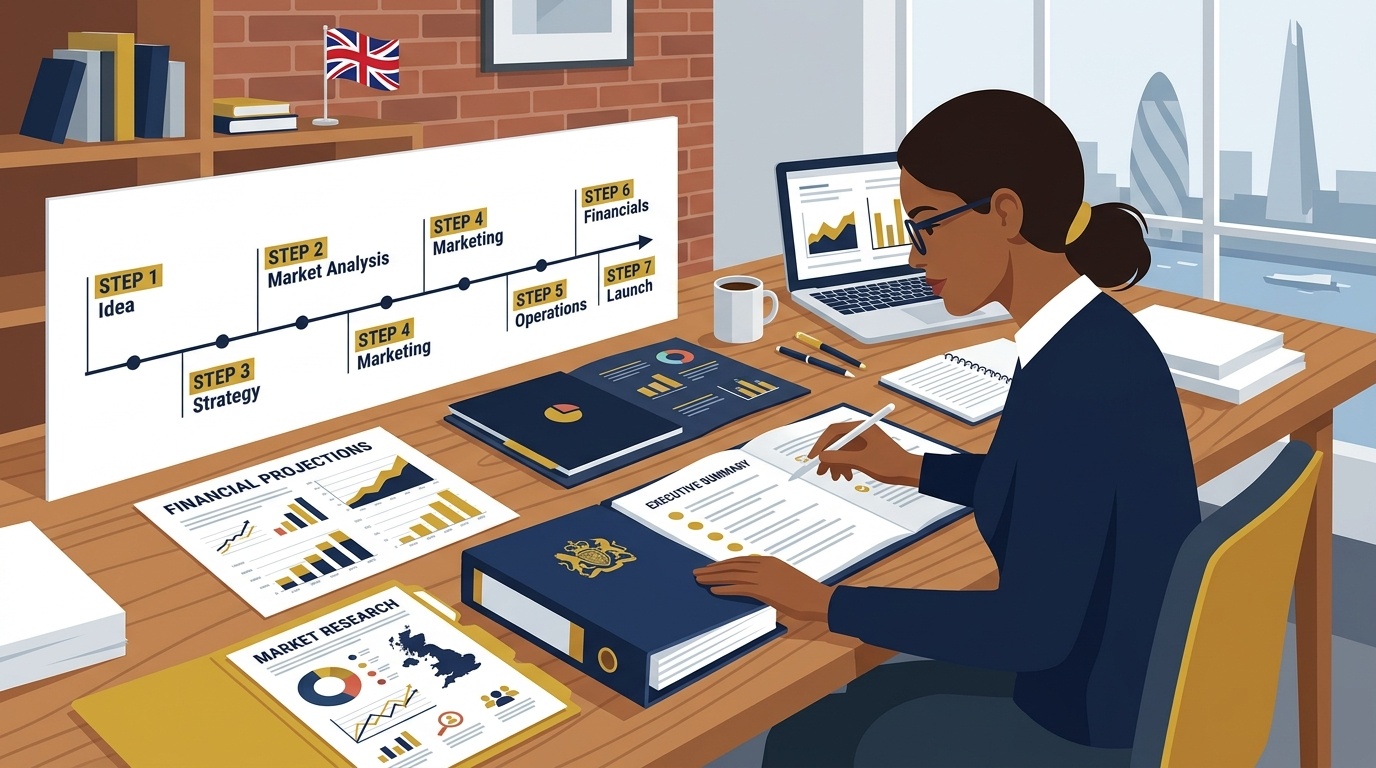
From there, work through each section in this order: company description, market analysis, products and services, marketing and sales plan, operations and team, financial projections, and then executive summary last. Set a goal to complete one section per day or per week, depending on how much time you have. A finished plan in four weeks is better than a perfect plan you never finish.
If you get stuck on financials, download a free template from SCORE and fill in only the numbers you can actually justify today. You can refine them later.
The One Thing That Makes or Breaks Your Plan
Knowing how to write a business plan is not the hard part. The hard part is being honest in it. Every section of a good business plan is an exercise in testing your assumptions and writing down only what you can actually support.
A plan full of optimistic guesses does not fool investors. It just tells them you have not done the work yet. A plan grounded in real customer conversations, real market data, and realistic financial assumptions tells them you are ready to build something worth backing.
Start with one section today. Write it honestly. Build from there.