
According to the HM Treasury comparison of independent forecasts published in July 2026, the average expectation for UK GDP growth this year is just 1.0%. That figure tells you almost everything you need to know about the environment business owners are operating in right now: the economy is moving, but barely.
The challenge is that “barely moving” does not mean stable. Beneath that headline number sit rising energy costs, employer National Insurance changes that took effect in April, a cooling labour market, and ongoing uncertainty from US trade tariffs. Each of those factors affects hiring decisions, pricing power, cash flow, and planning horizons in ways that a single percentage point of GDP growth cannot capture.
This guide unpacks the UK economic outlook for 2026 with the latest data from the Office for National Statistics (ONS), the International Monetary Fund (IMF), the Bank of England, and the Federation of Small Businesses (FSB). By the end, you will have a clear picture of what the macro environment actually means for your business, and what practical steps are worth taking now.
Key Takeaways
- UK GDP growth is forecast at 1.0% for 2026, according to both HM Treasury’s independent forecasts panel (July 2026) and the IMF’s Article IV Consultation.
- The Bank of England Base Rate currently stands at 3.75%, with the Monetary Policy Committee operating meeting-by-meeting; further cuts in 2026 are possible but not guaranteed.
- UK CPI inflation was 2.8% in May 2026 and is projected to peak above 3.5% toward Q4 2026, driven by a 13.5% rise in the energy price cap in early July.
- The UK unemployment rate reached 4.9% (February to April 2026, ONS), with 1.76 million people out of work.
- FSB surveys show that only 18% of small firms expect to grow over the next year, the lowest reading in over a decade.
- Employer NIC rose to 15% in April 2026, with the Secondary Threshold cut to £5,000, materially increasing payroll costs for most businesses.
Quick Answer
The UK economic outlook for 2026 is one of low but positive growth (1.0% GDP), with inflation running above target and interest rates still elevated at 3.75%. Business owners face a compressed operating environment: costs are higher, consumer caution persists, and confidence among small firms is at a decade low. The priority for most operators right now is margin defence and cash flow control, not expansion.
GDP Growth: Modest and Fragile

The International Monetary Fund confirmed a 1.0% GDP growth projection for the UK in its 2026 Article IV Consultation, broadly in line with the HM Treasury independent forecasts panel. That panel edged its estimate up slightly from 0.9% in June 2026 to 1.0% in July 2026, which sounds encouraging but reflects a very narrow band of movement.
Monthly ONS data tells a more volatile story. GDP grew by 0.1% in May 2026, recovering from a 0.1% contraction in April. Over the three months to May 2026, GDP grew by 0.7%. The picture is one of stall-and-recover rather than sustained momentum.
For business owners, this matters for one reason above all: when aggregate demand is this soft, pricing power is limited. Customers are cautious, discretionary spending is restrained, and competition for any available spend is tighter. Businesses that have been waiting for a demand-led recovery to solve their margin problems should not count on that in the second half of 2026.
Looking further ahead, independent forecasters see 2027 growth remaining similarly modest at around 1.0% to 1.1%. The OECD has cited elevated global energy prices, linked in part to ongoing Middle East tensions, as one of the primary headwinds suppressing UK growth alongside other major economies.
Inflation: Not Yet Beaten
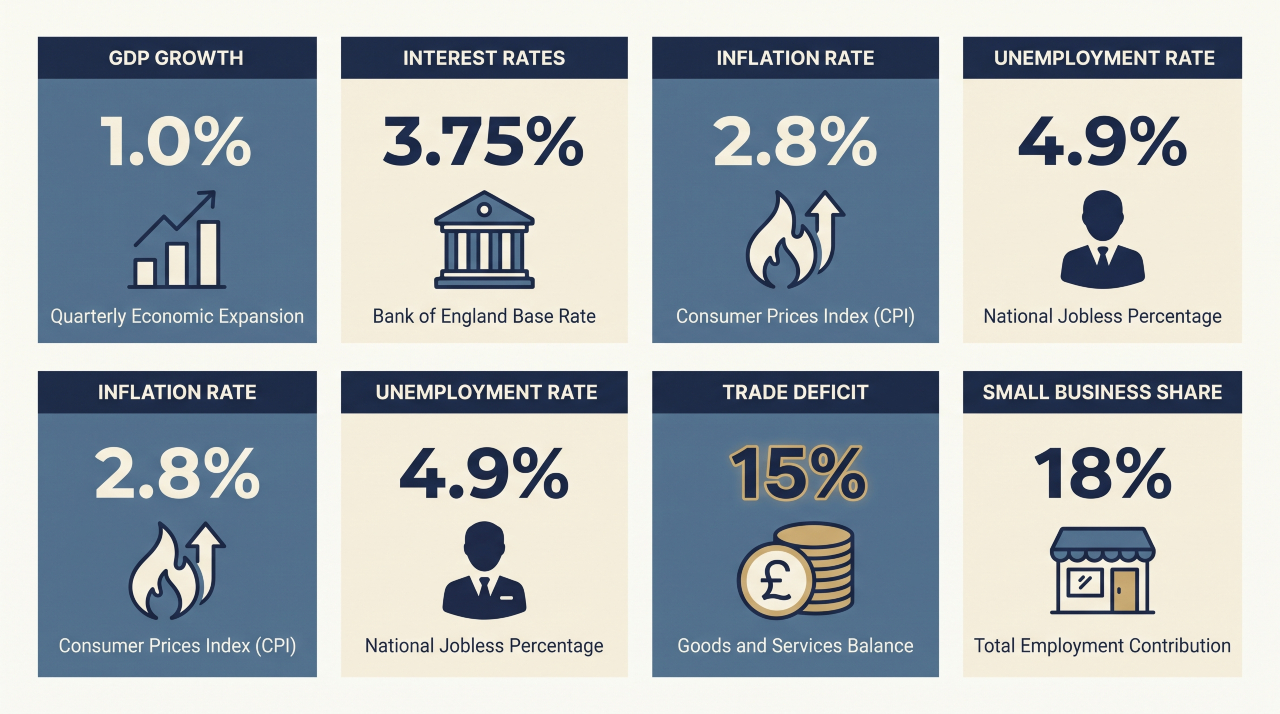
UK CPI inflation stood at 2.8% in May 2026, still above the Bank of England’s 2% target. The number that most analysts are watching is what happens from July onwards. The energy price cap rose by 13.5% in early July 2026, and the full impact of that increase will feed through into CPI data in the months ahead.
Independent forecasts published by HM Treasury project inflation averaging approximately 3.4% in Q4 2026, before beginning a gradual decline toward the Bank’s target by end of 2027. The risk of further upside surprises remains if energy markets remain volatile.
What this means practically for business operators is that cost pressures are not easing as quickly as many hoped. Suppliers facing higher energy bills will pass costs through the chain. Wage expectations among employees are shaped partly by headline inflation figures, so pay reviews that appeared settled earlier in the year may face renewed pressure. Businesses in energy-intensive sectors, such as manufacturing, hospitality, or food production, are carrying a heavier direct burden.
One thing to be clear about: the inflation numbers published by ONS measure the consumer price basket. Your business’s effective inflation rate may be higher or lower depending on your input mix. Treating CPI as a proxy for your own cost environment without checking your actual figures is a mistake worth avoiding.
Interest Rates: On Hold, Not in Retreat
The Bank of England’s Monetary Policy Committee has held the Base Rate at 3.75% through the first half of 2026. Earlier in the year, markets anticipated a clearer path of cuts; those expectations have been tempered.
The MPC is now operating on a data-dependent, meeting-by-meeting basis. Futures markets and analysts are split. Some see rates holding at 3.75% for the remainder of 2026 to suppress the second-round effects of the energy price shock on wages and services inflation. Others think a cut remains possible later in the year if labour market data continues to soften and services inflation edges back.
What is not on the table currently is a rapid return to the near-zero rates that characterised the 2010s. Business owners who took on variable-rate debt in recent years, or who are approaching refinancing points, should plan on rates remaining elevated for longer than earlier forecasts suggested.
For anyone considering new borrowing to fund growth or equipment, the cost of capital is a genuine constraint. Run the numbers on realistic rate scenarios before committing.
The Labour Market: Cooling but Not Collapsing
ONS data for February to April 2026 shows the UK unemployment rate at 4.9%, with approximately 1.76 million people out of work. That represents a year-on-year increase of 0.3 percentage points. The employment rate for 16-to-64-year-olds was 75.0%, largely unchanged.
Youth unemployment is a sharper concern: the unemployment rate for 16-to-24-year-olds stood at 16.2%, a figure that has long-run implications for skills pipelines and recruitment in sectors that rely on entry-level hiring.
Wage growth is moderating. Annual growth in regular earnings (excluding bonuses) ran at 3.4% for the period February to April 2026, with total earnings including bonuses at 4.4%. Adjusted for inflation at 2.8%, real wage growth is marginal at best, around 0.1% to 0.3% depending on the measure used. Public sector pay has grown faster, at around 5.1% to 5.2%, while private sector growth has softened to the 2.9% to 4.2% range.
The cooling labour market is a double-edged reality. On one side, it gives businesses more hiring options than they had during the acute shortages of 2022 and 2023. On the other hand, it signals weakening consumer confidence, as job security concerns directly suppress household spending and reduce demand for many goods and services.
The Employer NIC Hit: What the Numbers Mean for Your Payroll

The April 2026 employer National Insurance changes represent the most significant payroll cost shock in years. The employer NIC rate rose from 13.8% to 15%, and the Secondary Threshold (the salary level from which employer contributions apply) was reduced from £9,100 to £5,000 per year.
The combined effect is material. For a business employing ten people each earning £30,000 per year, the additional annual cost runs to several thousand pounds compared to the previous regime. The Employment Allowance, increased to £10,500 for 2026/27, offers partial relief, but FSB data indicates this is insufficient to offset the total increase for many firms, particularly those with larger workforces or those relying on part-time and lower-paid staff.
These payroll changes, layered on top of the National Living Wage increase in April 2026 and new statutory sick pay obligations, represent what many business groups have described as a significant cumulative burden. FSB Q2 2026 surveys show that only 18% of small firms expect to grow over the next year, with 32% anticipating shrinking or closing. The leading barriers cited are the domestic economy, tax burden, and labour costs.
If you have not already modelled the full-year impact of the NIC changes on your payroll, do it now. Factor in any planned hires, pay reviews, and the effect on your effective Employment Allowance position. Speaking to an accountant about salary sacrifice arrangements (for pensions, particularly) is worth considering, as these reduce the employer NIC base. This is general guidance: your specific situation will depend on your staff mix and business structure, so professional advice is appropriate here.
US Trade Tariffs: A Live Risk for Exporters
The international dimension of the UK economic outlook for 2026 is dominated by US trade policy. A baseline 10% tariff currently applies to many UK goods entering the US market. Some sectors, including steel, aluminium, and certain automotive components, have secured specific reductions or quotas, but compliance requirements and supply chain origin documentation demands are significant.
Beyond the direct cost, businesses face increased administrative complexity. Stricter customs enforcement, rules-of-origin documentation requirements, and potential inspection delays mean that the cost of exporting to the US is higher in time and process terms as well as in duty terms. Many firms have responded by compressing margins rather than raising export prices in a competitive market, which is not sustainable over the long run.
If any part of your revenue is US-facing, the advice from trade bodies including Make UK and the British Chambers of Commerce is consistent: keep your HS codes current, maintain meticulous origin documentation, and stay in close contact with your freight forwarder and customs broker as exemption frameworks continue to evolve.
UK-focused businesses are not immune either. Supply chains often run through companies with US exposure, and cost increases at any point in a chain eventually reach every business in it.
Data Comparison Table
| Indicator | Figure | Source | Date |
|---|---|---|---|
| UK GDP growth forecast 2026 | 1.0% | HM Treasury / IMF | July 2026 |
| Monthly GDP (May 2026) | +0.1% | ONS | July 2026 |
| CPI inflation (May 2026) | 2.8% | ONS / Bank of England | June 2026 |
| Inflation Q4 2026 forecast | ~3.4% | HM Treasury independent panel | July 2026 |
| Bank of England Base Rate | 3.75% | Bank of England | July 2026 |
| UK unemployment rate | 4.9% | ONS (Feb-Apr 2026) | June 2026 |
| Regular earnings growth | 3.4% | ONS | June 2026 |
| Employer NIC rate (from Apr 2026) | 15% | HMRC | April 2026 |
| Employment Allowance 2026/27 | £10,500 | HMRC | April 2026 |
| Small firms expecting growth | 18% | FSB Q2 2026 survey | Q2 2026 |
Sources: ONS, Bank of England, HM Treasury, IMF, HMRC, Federation of Small Businesses. Figures correct at time of publication, July 2026. Rates and thresholds may change; verify current figures with gov.uk or HMRC before making financial decisions.
Where the Opportunities Are
A difficult macro environment does not mean uniform difficulty across all sectors. Some areas are seeing genuine activity.
Public investment: The government’s infrastructure and clean energy commitments are generating procurement activity. Businesses in construction, engineering, environmental services, and professional services adjacent to these sectors have more pipeline visibility than those reliant on private consumption.
AI adoption: The pace of AI tooling adoption in UK business is accelerating. Firms using AI to reduce per-unit costs or process overhead are better positioned to sustain margins in a low-growth environment. If you are considering an AI-integrated approach to your business model, the guide to starting an AI-powered business in the UK in 2026 is worth reading.
Business grants: With investment appetite constrained by borrowing costs, non-dilutive funding has become more valuable. The complete guide to UK business grants in 2026 is worth reviewing if you have not already assessed your eligibility, particularly for regional development, innovation, or green transition funds.
Domestic services with pricing power: Businesses providing services where demand is relatively price-inelastic (specialist professional services, care sectors, niche B2B) have more room to pass costs through than businesses in high-competition consumer markets.
What Business Owners Are Getting Wrong in 2026
The most common strategic mistake right now is treating the current environment as a temporary disruption to wait out. The evidence suggests it is not. Forecasters expect 2027 growth at 1.0% to 1.1%. The Bank Rate is unlikely to return to pre-2022 levels in any scenario analysts are modelling. Employer NIC at 15% is the new baseline.
Businesses that are deferring pricing decisions, delaying restructuring of uneconomic products or customers, or planning for a demand recovery that restores their pre-2022 margins are likely to run into cash flow problems before that recovery arrives.
The firms doing better are operating with a shorter planning horizon, reviewing pricing quarterly rather than annually, managing working capital actively (including negotiating payment terms rather than accepting defaults), and being disciplined about which growth investments they pursue, favoring those with provable payback periods under two years.
The UK inflation 2026 real cost for small businesses article covers the margin mechanics in more detail if you want to go deeper on the cost side.
Frequently Asked Questions
What is the UK GDP growth forecast for 2026?
The average expectation among independent forecasters, as compiled by HM Treasury in July 2026, is 1.0% GDP growth for the full year. The IMF’s 2026 Article IV Consultation for the UK also projects 1.0% growth. Monthly ONS data shows the economy growing by 0.1% in May 2026 following a 0.1% contraction in April, indicating a fragile pattern of stall and recovery rather than sustained expansion.
How high is UK inflation in 2026?
UK CPI inflation was 2.8% in May 2026, still above the Bank of England’s 2% target. The energy price cap rose 13.5% in July 2026, and independent forecasts project inflation averaging around 3.4% in Q4 2026 before declining toward the Bank’s target during 2027. Businesses should not assume a near-term return to low inflation.
What is the UK unemployment rate in 2026?
ONS data for February to April 2026 shows the UK unemployment rate at 4.9%, with approximately 1.76 million people unemployed. Youth unemployment for 16-to-24-year-olds is considerably higher at 16.2%. The labour market is cooling but not collapsing, which means hiring conditions are improving for employers even as consumer confidence remains cautious.
How do the employer NIC changes affect small businesses in 2026?
From April 2026, employer National Insurance contributions rose from 13.8% to 15%, and the Secondary Threshold was reduced from £9,100 to £5,000 per year. The Employment Allowance increased to £10,500 for 2026/27, but FSB data indicates this relief is insufficient for many businesses to fully offset the cost increase. The impact is most acute for businesses with larger workforces, part-time staff, or lower-paid employees. Speak to an accountant about your specific position.
What is the impact of US tariffs on UK businesses in 2026?
A baseline 10% tariff currently applies to many UK goods imported into the US, with sector-specific arrangements for steel, aluminium, and some automotive parts. Beyond the direct duty cost, businesses face increased administrative burden from stricter customs enforcement and origin documentation requirements.
What should UK business owners prioritise in the current economic climate?
Based on current conditions, the priorities for most UK operators are: reviewing pricing and margins at least quarterly, managing cash flow actively rather than reactively, understanding the full payroll impact of the April 2026 NIC changes, assessing eligibility for business grants, and maintaining disciplined capital allocation focused on investments with clear short-term payback. Planning for a rapid recovery is a less reliable strategy than building resilience for continued low-growth conditions.
What to Do Next
The UK economic outlook for 2026 does not call for panic, but it does call for clarity. GDP is growing at 1.0%. Inflation is 2.8% and rising. Rates are at 3.75% with no clear cutting cycle ahead. Payroll costs have risen materially. Small firm confidence is at a ten-year low.
In that environment, the businesses that protect and grow their position share one characteristic: they are making decisions based on current data rather than optimistic assumptions about when conditions will normalise.
Review your cash flow position now, using real 2026 cost inputs. Model your payroll including the full NIC impact. Check your pricing against your current margin, not your pre-2022 margin. Assess whether your business is eligible for any of the 2026 grant schemes before application windows close.
If you want to go further on the strategic finance side, read our guide to cash flow tips every small business owner needs to know and the complete guide to UK business grants in 2026.
The macro environment will not solve your operational challenges. Sound financial management in a low-growth economy is what makes the difference between businesses that reach 2027 in better shape and those that do not.
This article is for general informational purposes. Specific tax, financial and legal decisions should be discussed with a qualified accountant, financial adviser or solicitor who knows your individual circumstances.