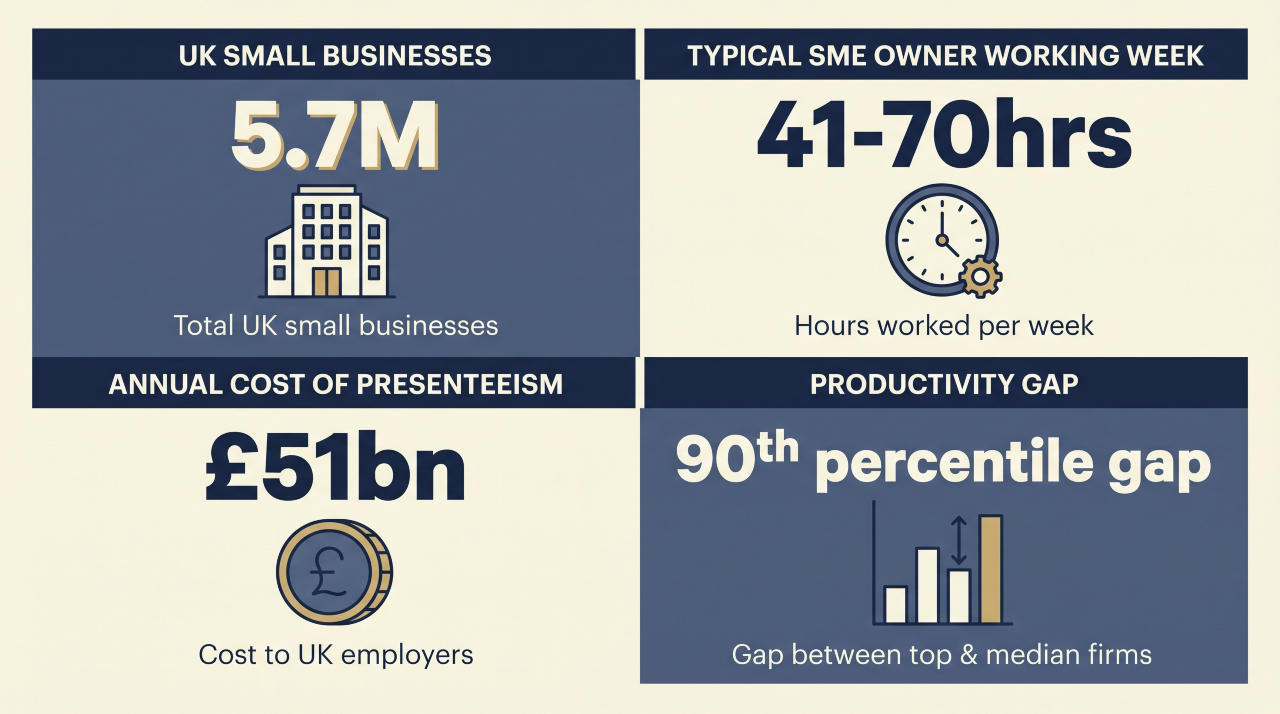
The UK now has approximately 5.7 million small businesses, accounting for 99.9% of the entire business population, yet the productivity gap between high-performing founders and the rest has never been wider. Research from the Enterprise Research Centre at Warwick Business School found that firms at the 90th percentile of productivity produce significantly more output per worker than those at the median — a gap that has widened consistently since 2008. The difference rarely comes down to working longer hours. Surveys suggest many UK SME owners already work between 41 and 70 hours per week, often absorbed by admin, chasing invoices, and operational firefighting rather than decisions that actually move the business forward.
What separates the most productive UK entrepreneurs from the rest is not the length of their schedules. It is the specific habits they protect, the decisions they batch, and the things they deliberately refuse to do. This article covers 10 productivity habits of highly successful UK entrepreneurs in 2026, drawn from current research and observable patterns across the UK founder community. Whether you run a two-person consultancy in Leeds or a scaling tech firm in London, these habits are practical, grounded in the UK business context, and worth stress-testing against your own current week.
Key Takeaways
- Successful UK entrepreneurs protect blocks of uninterrupted deep work, often scheduling them before 10am when cognitive load is lowest
- The highest-performing founders treat financial clarity as a weekly non-negotiable, not a quarterly catch-up with their accountant
- Deliberate delegation, not just task offloading, is consistently cited as the habit that unlocks scale
- Mental health is now being treated as a business input, not a personal issue, with direct implications for decision quality and leadership capacity
- AI tool adoption among UK entrepreneurs is accelerating sharply, but the most productive founders use it to protect thinking time, not to replace it
1. They Start the Day Before Email Does
The single most consistent finding across high-performing entrepreneur behaviour is that they do not begin the day reactively. Opening email or Slack first thing hands control of your first hour to other people’s priorities. Successful UK founders, whether running a growing e-commerce brand or a professional services firm, typically reserve the first 30 to 60 minutes for planning, physical movement, or focused thinking before any device demands their attention.
This is not a lifestyle preference. Cognitive research consistently shows that decision-making quality peaks in the early part of the day for most people and degrades as mental fatigue accumulates. Protecting that window is a direct business decision.
What this looks like in practice: A written list of three priorities for the day, prepared the night before or first thing in the morning, before any inbox is opened. Not ten priorities. Three.
Honest risk: If your business model requires genuine early-morning responsiveness (a retail operation with wholesale buyers in different time zones, for example), a rigid no-email rule may not be workable. The principle still applies — protect a block of proactive time, even if it shifts to mid-morning.
2. They Time-Block, and They Defend Those Blocks
Time blocking is widely discussed but rarely practised well. Most people fill their calendars with meetings and then slot deep work into whatever gaps remain. Highly productive UK entrepreneurs do the opposite: they schedule their high-value thinking work first, then fit meetings around it.
The distinction matters because meetings, particularly back-to-back ones, create cognitive fragmentation that makes focused output nearly impossible for the remainder of the day. Research from productivity studies consistently shows that it takes an average of 23 minutes to return to a state of deep focus after an interruption. A morning with three 30-minute meetings, even with gaps between them, can functionally eliminate meaningful concentrated work for the entire day.
What this looks like in practice: Blocking two to three hours each morning labelled “deep work” in the calendar, visible to anyone booking time with you. Meeting-free Fridays, or at minimum meeting-free mornings, are a common pattern among UK-based founders who manage their own schedules.
Common mistake: Time blocking a calendar but accepting meeting requests that override the blocks whenever a client or team member asks. A block that gets overridden is not a block; it is a suggestion. The defence of the block is the habit, not the act of creating it.
3. They Treat Financial Clarity as a Weekly Ritual
Poor cash flow management is one of the leading causes of UK small business failure, yet many founders only engage seriously with their numbers quarterly, when they meet their accountant. The most productive UK entrepreneurs review their key financial indicators every week — not in an anxious, reactive way, but as a structured 20-to-30-minute standing check.
This weekly review typically covers: current cash position, outstanding invoices (and their ages), upcoming liabilities in the next 30 days, and whether the current week’s revenue is tracking against the plan. Founders who do this consistently report fewer cash-flow surprises and significantly faster responses to margin pressure.
What this looks like in practice: A recurring Friday or Monday morning calendar entry for financial review, using accounting software such as Xero or QuickBooks, takes most founders under 30 minutes once the habit is established.
UK-specific note: HMRC’s Making Tax Digital requirements mean most VAT-registered businesses in the UK are already using compatible software. Using that same software for weekly financial health checks requires no additional cost, only the discipline to actually open it.
4. They Use the Eisenhower Matrix to Kill Low-Value Work

Successful UK entrepreneurs are not just productive. They are productive on the right things. The Eisenhower Matrix, which categorises tasks by urgency and importance, is a simple but genuinely powerful filter for anyone whose daily workload is a mix of operational noise and strategic decisions.
| Quadrant | What it contains | What to do |
|---|---|---|
| Urgent + Important | Client crisis, tax deadline, key hire decision | Do immediately |
| Important + Not Urgent | Business planning, team development, marketing strategy | Schedule with protected time |
| Urgent + Not Important | Many emails, routine admin, low-stakes requests | Delegate or batch |
| Not Urgent + Not Important | Unnecessary meetings, low-value scrolling | Eliminate |
Most founders who apply this honestly discover that a substantial portion of their week sits in the third quadrant: things that feel urgent but do not actually require their specific judgment or input.
Common mistake: Treating everything in the “urgent” row as equally important. Urgency is often manufactured by other people’s timelines or by procrastination on the important-but-not-urgent tasks that gradually become crises.
5. They Delegate Deliberately, Not Desperately
There is a meaningful difference between delegating because you are overwhelmed and delegating as a strategic act. The most productive UK entrepreneurs delegate specific outcomes, not just tasks. They hand over a result they want, give the person the authority and resources to achieve it, and then get out of the way until an agreed check-in point.
Reactive delegation, by contrast, tends to create more work than it removes. When a founder dumps a half-explained task on a team member under pressure, the result is usually a series of clarifying questions, rework cycles, and a growing belief on the team that delegated work will end up back with the founder anyway.
What this looks like in practice: Before handing something over, the founder can clearly state the outcome expected, the deadline, the standard of quality, and the decision-making authority the person has. If any of those four things are unclear, the delegation is not ready.
UK context: For sole traders and very early-stage founders who have no team to delegate to, the same principle applies to outsourcing. Virtual assistant services, UK-based bookkeepers, and specialist freelancers can absorb significant time once tasks are clearly specified.
6. They Batch Repetitive Decisions
Decision fatigue is real and measurable. The more decisions a person makes in a day, the lower the quality of later decisions becomes. Highly successful UK entrepreneurs reduce the number of active decisions they make each day by batching similar ones together and systematising as many recurring choices as possible.
Practical applications of this habit in a UK business context include: responding to all non-urgent emails in two fixed windows rather than throughout the day; scheduling all supplier calls on the same day of the week; reviewing and approving expenses in a single monthly block rather than ad hoc approvals; and setting standing monthly payment dates for regular costs so each invoice does not require a separate decision.
What this looks like in practice: One founder in a service business might set Tuesdays for all new business calls, Thursdays for team one-to-ones, and Friday mornings for financial and administrative review. The structure does not eliminate flexibility; it reduces the mental overhead of deciding when to do recurring things.
7. They Protect Sleep as a Business Asset
This is where the “hustle culture” narrative and the actual behaviour of the most productive UK entrepreneurs diverge most sharply. The evidence on sleep and cognitive performance is unambiguous. Sustained sleep deprivation degrades decision quality, reduces emotional regulation, and directly impairs the kind of strategic thinking that entrepreneurship demands.
Research from the ERC’s longitudinal study on workplace mental health found that presenteeism, working whilst unwell or beyond sustainable capacity, is at its highest recorded rate in UK businesses in 2025. Among sole founders and owner-managers, the pattern is particularly acute because there is no external structure requiring them to stop working.
What this looks like in practice: Treating a consistent sleep and waking time as a non-negotiable business input, not a lifestyle luxury. Most high-performing founders settle on seven to eight hours and plan their evening cut-off time backward from their preferred waking time, rather than working until they feel tired enough to stop.
Honest caveat: Early-stage founders managing cash-flow crises or product launches will sometimes run on less sleep. The point is that this should be a recognised exception with a recovery plan, not the structural baseline.
8. They Use AI to Protect Thinking Time, Not Replace It
AI tool adoption among UK entrepreneurs is accelerating. The British Chambers of Commerce reported that digital adoption, including AI-powered automation, is one of the clearest distinguishing factors between high-growth UK firms and those struggling with operational capacity. But there is a critical difference in how the most productive founders use these tools.
Less effective use: generating content at scale, automating decisions that require judgment, or using AI as a substitute for actual strategic thinking. More effective use: using AI to draft first versions of repetitive documents, summarise research, prepare meeting agendas, and clear administrative backlog — freeing up protected time for the high-judgment work that cannot be automated.
What this looks like in practice: A UK-based founder might use AI tools to draft initial client proposals for human review, transcribe and summarise meeting notes, prepare briefing documents from research, and handle first-pass responses to standard customer queries routed through a CRM system.
Common mistake: Spending more time prompting and reviewing AI output than the original task would have taken. The test is simple: if the AI-assisted process takes longer than doing it yourself, the process is not yet calibrated correctly.
9. They Invest in a Peer Group, Not Just a Network

A professional network and a peer group are different things. A network is a broad set of contacts you might call on occasionally. A peer group is a small number of people at a similar business stage who meet regularly, are honest about what is actually happening in their business, and hold each other accountable to commitments.
The most productive UK entrepreneurs almost universally have access to some version of this: a mastermind group, a sector peer network, a funded accelerator cohort, or a structured accountability partnership. The productivity benefit is not primarily motivational. It is structural. Knowing you will report on progress to a specific group of people at a fixed date creates a natural forcing function that individual discipline often does not.
UK-specific options: Peer communities such as those run by the Federation of Small Businesses (FSB), Enterprise Nation, or sector-specific trade bodies offer structured peer groups. Many local Growth Hubs, funded through the UK Shared Prosperity Fund, also facilitate peer learning programmes at no cost.
10. They Review the Week, Every Week
The weekly review is the habit that makes all the others sustainable. Without a structured review, plans drift, priorities blur, and reactive work gradually crowds out the strategic work that was meant to happen. The most productive UK entrepreneurs spend 30 to 60 minutes at the end of each working week asking four questions:
- What did I actually do this week versus what I planned to do?
- What is the single most important outcome I need to achieve next week?
- What is on my list that should not be on my list?
- What did I learn this week that changes how I am thinking about something?
This review is not a performance appraisal. It is a recalibration. The goal is to start the following week with a clear head and a realistic plan, not to carry forward an unexamined backlog.
What this looks like in practice: A 45-minute recurring calendar block, same time each week, with a standard set of prompts. Friday afternoon is common, since it allows the following week to start cleanly. Some founders prefer Sunday evening; the timing matters less than the consistency.
What Most Guides Get Wrong About Entrepreneur Productivity
Most content on this subject focuses on individual tactics in isolation: wake up earlier, use this app, follow this morning routine. The actual pattern among highly productive UK entrepreneurs is systemic rather than tactical. Each of these habits reinforces the others. Protected deep work time only works if decisions are batched. Delegation only works if financial clarity is maintained. The weekly review only works if there is a real plan to review against.
The other common omission is the honest acknowledgment that several of these habits take weeks to embed and will fail initially. Time blocking collapses when a client crisis appears. Financial reviews get skipped when work volumes spike. The founders who sustain these habits are not the ones with the strongest personal discipline. They are the ones who have made the habits structural — calendar entries that do not move, software that auto-generates weekly reports, peer groups that create external accountability.
Frequently Asked Questions
What are the most impactful productivity habits for UK entrepreneurs?
Protecting deep work time, batching decisions, and conducting a weekly review consistently appear across high-performing UK founders regardless of sector or business size. Financial clarity reviewed weekly, rather than quarterly, is also a distinguishing pattern.
Do successful UK entrepreneurs really follow strict morning routines?
Many do structure their mornings, but the specifics vary widely. The consistent pattern is starting the day proactively, completing focused work before reactive tasks such as email take over, rather than any particular sequence of activities.
How do UK entrepreneurs avoid burnout while staying productive?
The most effective approach treats rest, sleep, and mental health as business inputs rather than personal preferences. The Enterprise Research Centre’s research found that presenteeism, working while unwell or beyond capacity, cost UK employers an estimated £51 billion annually through reduced quality of output and increased turnover.
Is AI actually helping UK entrepreneurs become more productive?
British Chambers of Commerce data indicates that digital and AI adoption is a measurable differentiator for high-growth UK firms. The key is using AI to absorb repetitive, low-judgment work, freeing up time for strategic thinking, rather than generating output at scale without applying critical judgment to the result.
How many hours do successful UK entrepreneurs actually work?
Surveys suggest many UK SME owners work between 41 and 70 hours per week, but the most productive do not necessarily sit at the top of that range.
Should entrepreneurs use a single productivity system or combine methods?
A single consistent system works better for most people than switching between methods. The core elements are: a trusted place to capture all commitments, a weekly review process, and a daily priority-setting habit. The specific tools (digital or paper) matter less than the consistency of use.
What role do peer groups play in UK entrepreneur productivity?
Peer groups create external accountability that individual discipline alone rarely sustains. Structured peer networks, available through the Federation of Small Businesses, Enterprise Nation, and regional Growth Hubs, give founders a fixed reporting structure that reinforces the weekly planning habits that drive consistent output.
Conclusion
The productivity habits of highly successful UK entrepreneurs are not exceptional or inaccessible. They are deliberate, specific, and practised consistently enough to become structural rather than optional. The gap between a week of reactive firefighting and a week of focused, high-value output rarely comes down to talent or hours worked.
Start with one habit from this list this week. The weekly review is the most impactful starting point if you have never done it, because it makes every other habit visible and improvable. Set a recurring 45-minute block for Friday afternoon, write four honest answers to the questions in habit ten, and build from there. The compounding effect of several of these habits practised consistently for three months is substantially greater than any one-off productivity intervention.