The UK’s AI sector generated over £10.6 billion in 2024 — and analysts at Dealroom and the UK Department for Science, Innovation and Technology project that figure to accelerate sharply through 2026. Most of that growth won’t come from Google or Amazon. It’ll come from small, focused businesses built by ordinary founders who spotted a practical problem and used AI tools to solve it faster and cheaper than anyone else could.
You don’t need a computer science degree. You don’t need venture capital. What you do need is a clear idea, the right setup, and an honest understanding of how this actually works — including the parts other guides skip, like UK tax obligations, AI-specific regulation, and what happens when your chosen niche stops working.
This guide walks you through how to start an AI-powered business in the UK in 2026 — legally, practically, and profitably — even if you’ve never written a line of code.
Is 2026 a Good Time to Start an AI Business in the UK?
Yes — but the window for easy wins is narrowing. Early movers in AI services commanded premium prices in 2023 and 2024 because demand outstripped supply. That gap still exists in specific niches, but it’s closing fast. The founders who succeed in 2026 won’t be the ones who simply use ChatGPT. They’ll be the ones who build a repeatable process around AI tools and sell the outcome — not the technology.
According to the Office for National Statistics, around 68% of large UK businesses and 34% of small businesses were already using at least one AI tool. That creates two opportunities: serving the 66% of small businesses that haven’t adopted AI yet, and helping the 34% that have but are using it badly.
AI businesses are rapidly entering the top 10 most successful to start — and the market data backs that up.
6 AI Business Models That Actually Work in the UK
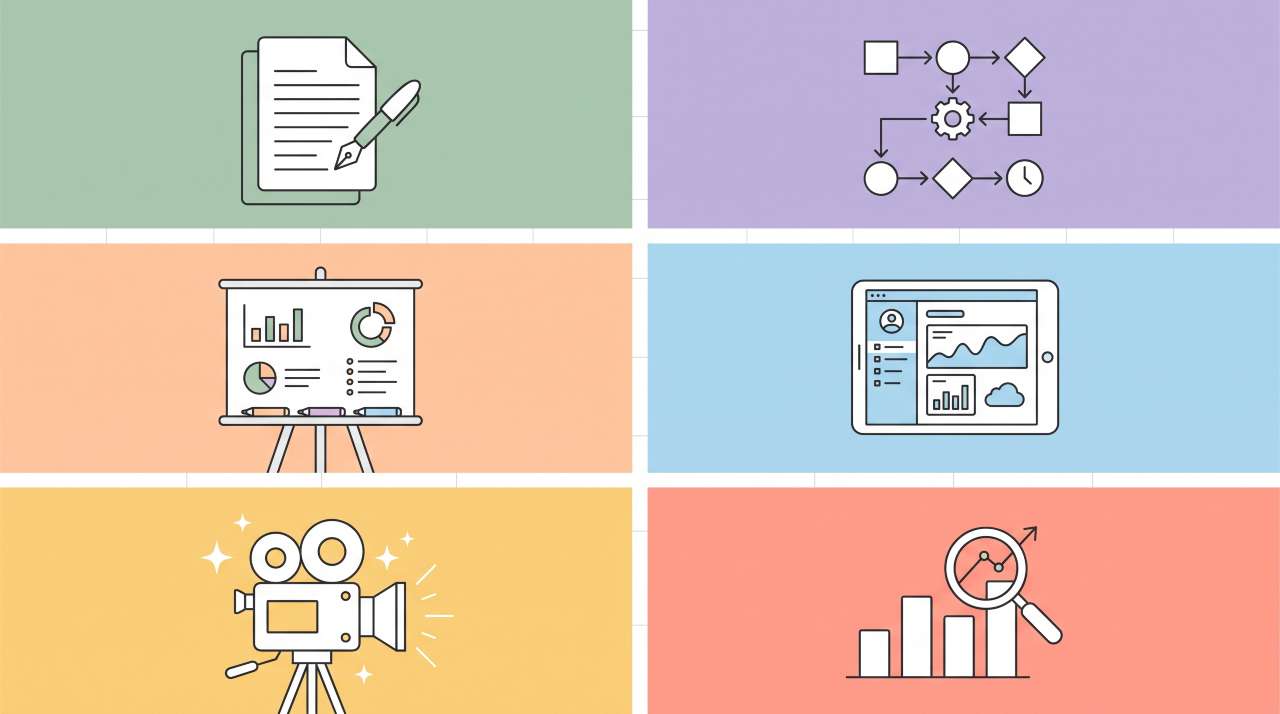
Not every AI business idea is viable. Some are too dependent on a single tool. Others are already commoditised. Here are the six models with the strongest fundamentals heading into 2026.
AI Content and Copywriting Agency
You use AI writing tools to produce blog posts, emails, ads, and social media content at scale. Clients pay for edited, brand-aligned content — not raw AI output. Margins are high and client demand is consistent. Your edge is quality control and turnaround time.
AI Automation Agency
You build automated workflows for small businesses using tools like Make (formerly Integromat), Zapier, and AI APIs. A typical project automates invoice chasing, lead follow-up, or customer onboarding. Retainer fees of £500–£2,000/month are standard in this model.
AI Consulting and Training
Many UK SMEs know they should be using AI but don’t know where to start. You audit their operations, recommend tools, and train their team. Day rates of £400–£800 are achievable once you have two or three case studies to show.
AI-Powered SaaS Product
This requires the most upfront work but offers recurring revenue and the highest ceiling. You build a niche software tool using AI APIs — a job description generator for a specific industry, or an AI review-response tool for hospitality businesses. No-code tools like Bubble or Webflow make this achievable without a developer.
AI Video and Visual Production
Tools like Runway, Sora, and ElevenLabs now produce broadcast-quality video and voiceovers. Agencies and brands need this content and many haven’t found reliable suppliers yet. You can productise this as a monthly content package.
AI-Powered Data Analysis Service
Small businesses collect data they never use. You analyse it using AI tools and deliver clear commercial recommendations. This model works especially well for e-commerce, retail, and hospitality clients who have customer data but no in-house analyst.
How to Choose the Right Niche
Picking the wrong niche is the single biggest mistake new AI founders make. The goal isn’t to pick the most exciting application of AI — it’s to find the intersection of three things: a problem people will pay to solve, an audience you can reach, and AI tools that give you a real speed or quality advantage.
Start by listing three industries you already understand. Previous employment, hobbies, and personal networks all count. An ex-estate agent who builds an AI property description tool has a credibility advantage that no generalist competitor can easily match.
Test your idea before you build anything. Post in relevant UK Facebook groups, Reddit communities like r/UKBusiness, or LinkedIn — describe the problem and ask if people would pay for a solution. If you get 10 genuine responses in 48 hours, you have enough validation to move forward.
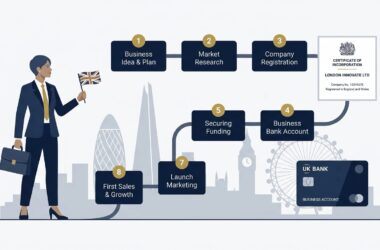
Registering Your AI Business in the UK
The legal setup is simpler than most people expect. You have two main options: sole trader or limited company.
Sole trader is the fastest route. You register with HMRC for self-assessment (free, done online at GOV.UK) and you’re operational. Tax is straightforward — you pay income tax and National Insurance on your profits. The downside is that you’re personally liable for any business debts.
Limited company offers liability protection and often looks more professional to corporate clients. You register through Companies House for a £50 one-off fee. You’ll then need to register separately with HMRC for Corporation Tax within three months of starting to trade.
VAT registration becomes mandatory once your turnover exceeds £90,000 in a 12-month rolling period (the 2024 threshold, unchanged for 2026). Many AI service businesses register voluntarily before that point to reclaim VAT on software subscriptions.
ICO registration is one most guides miss entirely. If your AI business processes personal data — and most do, even just through a contact form — you must register with the Information Commissioner’s Office. Annual fees start at £40 for micro-businesses. Ignoring this is a compliance risk, not a technicality.
UK AI Regulation: What You Need to Know in 2026
The UK took a deliberately lighter-touch approach to AI regulation compared to the EU’s AI Act. Rather than one sweeping law, the UK government tasked existing regulators — the ICO, FCA, CMA, and others — with applying their existing frameworks to AI within their sectors.
What does this mean for you in practice? If your AI business operates in financial services, healthcare, or handles significant personal data, you face sector-specific scrutiny. The ICO published its AI and Data Protection Guidance specifically for businesses using AI to process personal data — reading it takes two hours and could save you significant legal exposure.
For most content, marketing, and automation AI businesses, the regulatory burden in 2026 remains manageable. The key obligations are: transparency with clients about AI use, GDPR-compliant data handling, and not making automated decisions that significantly affect individuals without human oversight.
Watch the government’s AI Action Plan updates closely. The UK committed £14 billion in private AI investment through 2025, and regulatory direction is still evolving.
The No-Code Tech Stack for AI Founders
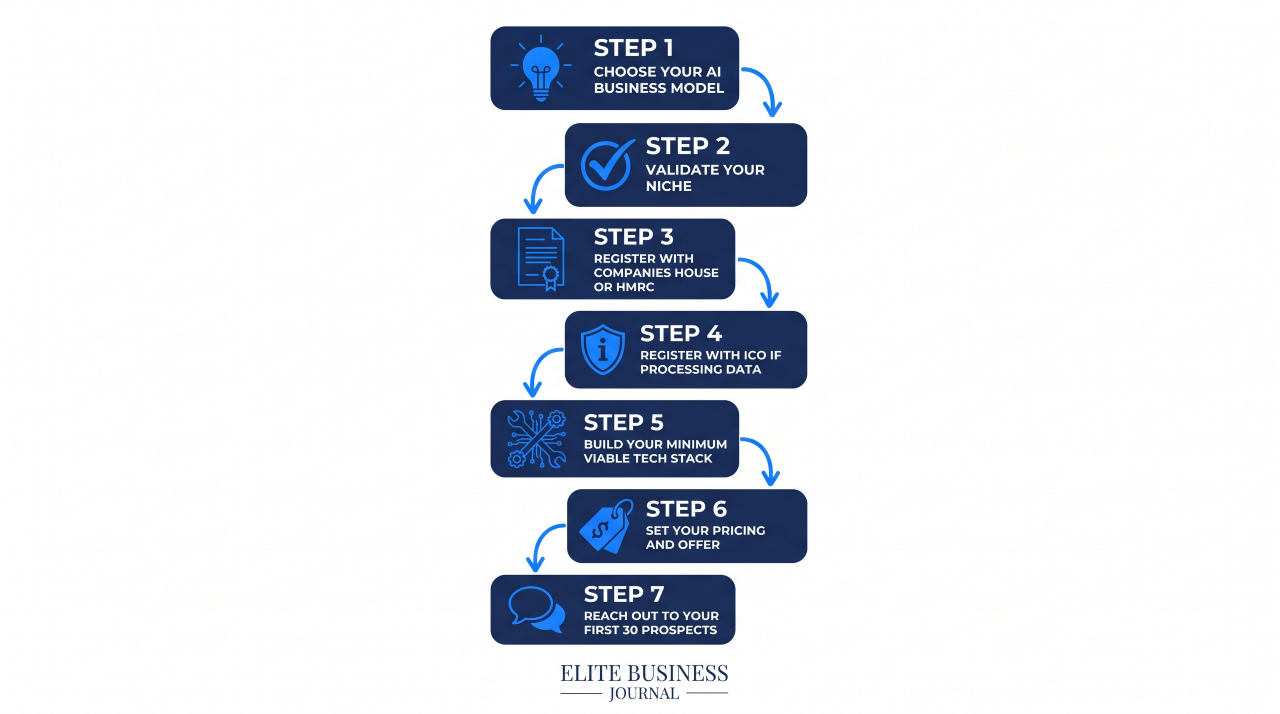
You don’t need to code to build a profitable AI business. Here’s a practical starting stack for each main model:
| Business Model | Core Tools | Monthly Cost (est.) |
|---|---|---|
| AI Content Agency | ChatGPT Plus, Jasper, Surfer SEO | £80–£150 |
| AI Automation Agency | Make.com, Zapier, OpenAI API | £60–£200 |
| AI Consulting | ChatGPT Plus, Notion AI, Loom | £50–£100 |
| AI SaaS Product | Bubble, OpenAI API, Stripe | £100–£300 |
| AI Video Production | Runway, ElevenLabs, CapCut | £80–£180 |
| AI Data Analysis | Julius AI, ChatGPT Plus, Airtable | £70–£130 |
Start with the minimum viable stack. Many founders overbuy tools before they have a single paying client. Prove the model first, then invest in better tools.
AI tools are transforming what digital marketing agencies can offer — and the same principle applies to every AI business model on this list.
Pricing Your AI Services
Pricing is where most new AI founders leave serious money on the table. The instinct is to charge low to win early clients. That’s often the wrong move.
Clients don’t buy AI tools — they buy outcomes. A client who saves 15 hours a week through your automation service isn’t comparing your price to a software subscription. They’re comparing it to the cost of a part-time employee. Price accordingly.
Three pricing models work well for AI service businesses. Project-based pricing suits one-off implementations and typically ranges from £500 to £5,000 depending on complexity. Retainer pricing (monthly recurring) suits ongoing content or automation maintenance and creates predictable revenue. Value-based pricing — charging a percentage of the measurable outcome you deliver — is the most profitable but requires confident positioning and clear metrics.
Don’t discount to win your first client. Instead, offer a smaller, lower-risk starting engagement — a £500 audit rather than a £3,000 full build. That’s a much easier yes for a cautious prospect.
How to Find Your First Clients

The fastest route to early clients for a UK AI business isn’t a website or paid ads — it’s direct outreach to people who already know and trust you. Write a clear message explaining what you do, who it’s for, and what problem it solves. Send it to 30 relevant contacts personally. Not a newsletter blast — individual messages.
LinkedIn is the most effective platform for B2B AI service businesses in the UK. Post one insight about AI applied to your target industry, three times a week. Engage with comments. Direct message anyone who engages with your content. This isn’t glamorous, but it works faster than any other channel for a new business.
Local business networks — chambers of commerce, BNI groups, Federation of Small Businesses events — put you in front of decision-makers who are actively looking to adopt AI and trust local suppliers. Many AI businesses in London, Manchester, and Birmingham built their first £5,000/month of recurring revenue entirely through these networks.
Cold email still works in 2026 when it’s specific and personalised. Find 20 businesses in your target niche, research them individually, and write one sentence that proves you’ve done your homework. Generic cold email gets ignored. Specific, relevant outreach gets responses.
The Honest Downsides You Should Know
This business model has real risks that most guides won’t tell you about. AI tools change fast — a service you build around one model’s capability can become obsolete when the next version ships. The automation services that commanded £2,000/month in 2023 now face clients who say “can’t I just do this in ChatGPT myself?”
Your defence against obsolescence is positioning. Build your reputation around outcomes and expertise, not tools. A client shouldn’t be able to replace you with a software update.
The learning curve is also steeper than “no-code” suggests. You’ll spend real time testing tools, building processes, and fixing things that break. Plan for two to three months before you land your first paid client, and keep some financial runway in reserve — at least three months of living expenses if you’re going full-time.
Client education is ongoing work. Many UK SME owners are skeptical of AI or worried about data privacy. You’ll need to address those concerns clearly and consistently, which takes patience and good communication skills.
FAQ: Your AI Business Questions Answered
Do I need coding skills to start an AI business in the UK?
No. The most profitable AI business models in 2026 — content agencies, automation agencies, and consulting — rely on no-code tools and process design rather than programming. Skills in communication, project management, and marketing matter far more than technical coding ability. That said, basic familiarity with how APIs work will help you scale faster.
Is AI a good business to start in 2026?
Yes, but your success depends heavily on niche selection and positioning. The market is large and growing, but generic “AI services” is already crowded. Founders who focus on a specific industry vertical — legal, hospitality, e-commerce, recruitment — and solve a clearly defined problem consistently outperform generalists.
Do AI businesses need a special licence in the UK?
Most don’t. Standard business registration with Companies House or HMRC self-assessment covers the majority of AI service businesses. However, if your business uses AI to process personal data, ICO registration is legally required. Businesses operating in regulated sectors like financial services or healthcare face additional obligations from sector-specific regulators.
What AI businesses make the most money?
AI automation agencies and AI-powered SaaS products tend to generate the highest revenue per founder, according to community data from groups like AI Entrepreneurs UK. Automation retainers of £1,000–£3,000/month per client are achievable within 12 months for a focused founder. SaaS products take longer to build but can generate recurring revenue without proportional time investment once established.
How do I protect my AI business from becoming obsolete?
Focus on deep niche expertise rather than tool dependency. Build proprietary processes, documented systems, and client relationships that don’t depend on any single AI platform. Diversify your tool stack so no single provider’s pricing change or product pivot eliminates your business model overnight.
How long does it take to make money from an AI business?
Most UK AI service founders land their first paying client within four to eight weeks if they follow a structured outreach process. Reaching consistent £3,000–£5,000/month revenue typically takes three to nine months, depending on niche, network, and how aggressively you pursue client acquisition. This is a real business, not a passive income scheme — effort and timeline are directly linked.
Your Clear Path Forward
Starting an AI-powered business in the UK in 2026 is genuinely achievable without technical expertise, large capital, or years of experience. The market is real, the tools are accessible, and the demand from UK SMEs is documented and growing.
The one thing that separates founders who make money from those who don’t is the speed of execution. Pick one business model. Register your business this week — it takes 30 minutes through GOV.UK. Build your minimum viable offer. Then spend 90% of your time talking to potential clients until you have your first three paying customers.
Everything else — the perfect website, the ideal tech stack, the polished brand — comes after you’ve proven someone will pay you. Start simple. Start now.