
More than 2 million people in the UK ran a side hustle in 2024, according to research by the Federation of Small Businesses research. Of those, fewer than one in five ever made the leap to full-time self-employment. That gap isn’t about talent or ambition — it’s about not having a clear, honest plan.
If you want to turn your side hustle into a full-time business, you don’t need to take a blind leap of faith. You need a structured process, realistic income targets, and an honest look at what the transition actually costs you. This guide gives you all of that, plus the steps most articles on this topic quietly skip.
By the end, you’ll know exactly when you’re ready, how much money you need in the bank, and what to set up before you hand in your notice.
Why Most Side Hustles Never Become Businesses
The gap between “making money on the side” and “running a real business” is wider than most people expect. Your side hustle works partly because it carries no pressure — you do it when you want, turn down bad clients guilt-free, and still have a salary as your safety net.
Remove that salary, and everything changes. You need consistent revenue, not occasional wins. You need systems, not improvisation.
The most common reason people stall is they wait for the “perfect moment” that never arrives. The second most common reason is that they quit too early, before their income is stable enough to survive the inevitable quiet months.
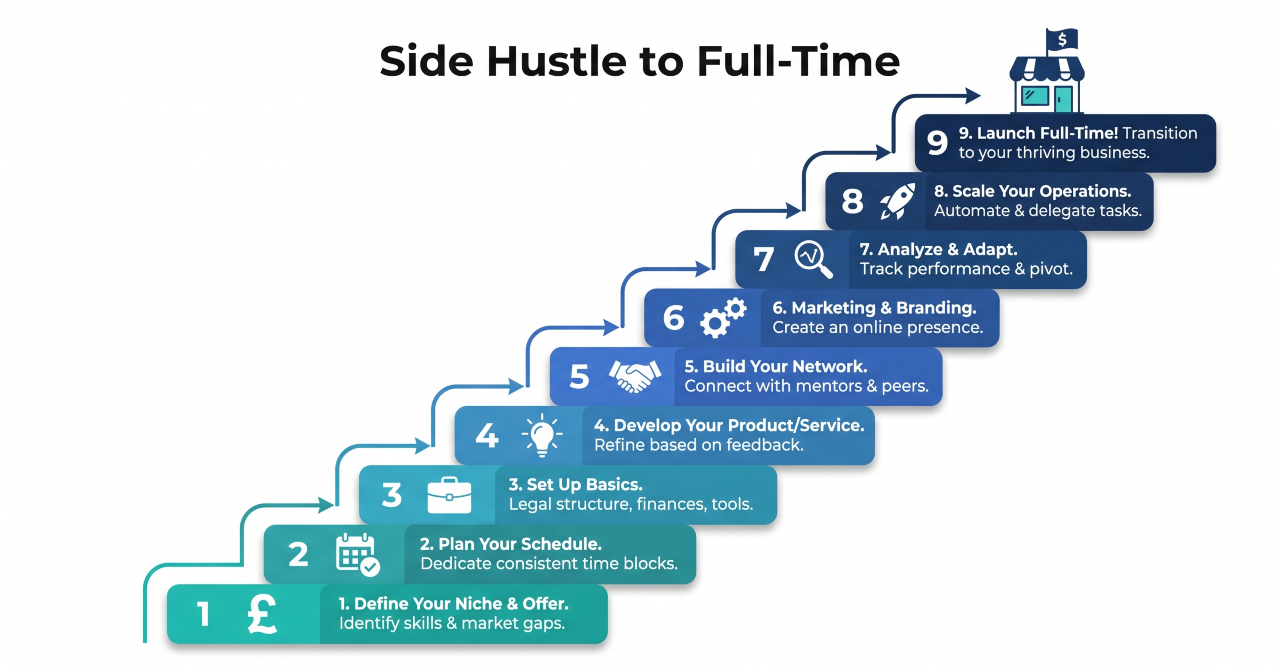
Step 1: Validate That You Have a Real Business — Not Just a Hobby
Before anything else, you need to know whether people will pay you consistently and reliably. One-off sales don’t prove a business. Repeat customers, referrals, and growing demand do.
Ask yourself these three questions right now:
- Have you made money from at least 10 different paying customers or clients?
- Do you get enquiries without actively chasing every single one?
- Would your current clients or customers recommend you to someone else?
If you can answer yes to all three, you have proof of a real market. If you can’t, your first job isn’t to quit — it’s to keep building proof while you still have income security.
Step 2: Use the Replace + Buffer Formula
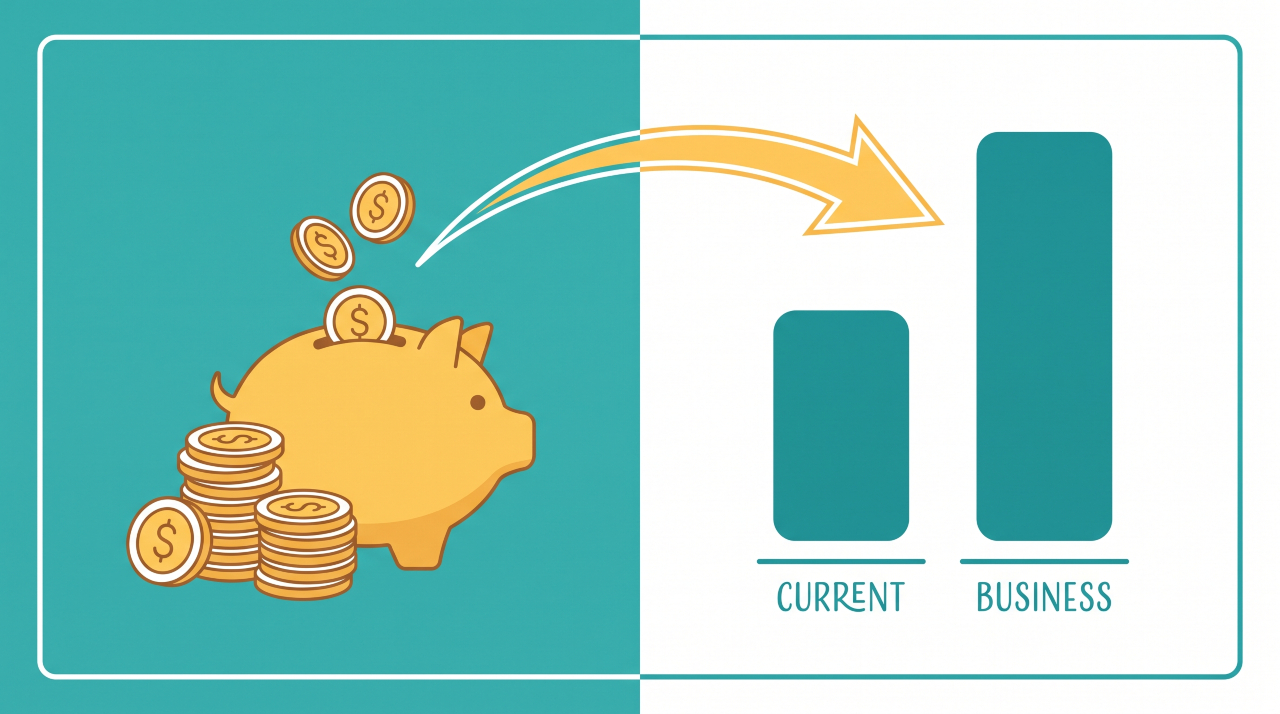
This is the single most important calculation you’ll make, and most guides skip it entirely. Don’t set an arbitrary savings target — calculate your specific number.
The Replace + Buffer Formula:
Monthly personal expenses × 12 months) + (3 months of business operating costs) = Your minimum buffer
So if your monthly expenses (rent, food, bills, subscriptions) total £2,500, you need £30,000 to cover a year of personal outgoings. Add your estimated business costs — software, insurance, marketing, equipment — for three months. If those total £3,000, your minimum buffer is £33,000.
That figure might feel large. It should — it’s supposed to protect you when a client cancels, a launch underperforms, or an invoice goes unpaid for 60 days. You can read more about the financial runway calculation method to refine this further for your situation.
The buffer isn’t pessimism. It’s what lets you make confident business decisions rather than desperate ones.
Step 3: Hit a Revenue Benchmark Before You Quit
A general rule used by many business advisers is the “75% rule.” Before quitting your job, your side hustle should consistently generate at least 75% of your current take-home salary — for a minimum of three consecutive months.
Why three months? Because one good month proves nothing. Three consecutive good months show a pattern.
If your take-home pay is £2,800 per month, your side hustle should be generating at least £2,100 per month, reliably, before you consider quitting. Aim for 100% replacement before you hand in your notice if you can manage it.
Step 4: Sort Your Legal Structure Early
Many people delay this step until after they quit. That’s a mistake — get it right before you’re in a rush.
In the UK, your two main options are:
Sole Trader — Simple to set up, minimal admin, you keep all profits after tax. The downside: you’re personally liable for any business debts. You can register as a sole trader with HMRC online in under 15 minutes.
Limited Company — More complex, but offers personal liability protection and can be more tax-efficient once you earn above approximately £30,000–£35,000 per year. You’ll need a separate business bank account, annual accounts filed with Companies House, and a basic understanding of directors’ responsibilities.
Most people starting out do well as sole traders. As your revenue grows, speak to an accountant about whether a limited company makes sense for your specific income level.
Step 5: Get Your Pricing Right Before Day One
One of the biggest mistakes new full-time business owners make is underpricing themselves when they go full-time. You think charging less will win more clients. In reality, it attracts bad clients and creates a race to the bottom.
Your target annual income ÷ billable hours per year = minimum hourly rate
If you want to earn £40,000 and you plan to work 1,000 billable hours per year (roughly 20 per week), your minimum rate is £40 per hour. Add 20–30% for overheads and you’re at £50–£52 per hour.
Don’t price for survival. Price for sustainability.
Step 6: Understand Your Tax Obligations
Tax surprises are one of the fastest ways to derail a new business. As a self-employed person in the UK, you pay Income Tax and National Insurance through Self Assessment — not automatically through PAYE.
You’ll pay self-employed National Insurance rates on your profits, plus Income Tax at the relevant bands. A rough guide for 2024–25:
| Profit | Income Tax Rate | NI Contribution |
|---|---|---|
| Up to £12,570 | 0% (Personal Allowance) | Class 2/4 applies above £12,570 |
| £12,571–£50,270 | 20% (Basic Rate) | Class 4: 9% |
| £50,271–£125,140 | 40% (Higher Rate) | Class 4: 2% |
| Above £125,140 | 45% (Additional Rate) | Class 4: 2% |
Source: HMRC, 2024–25 tax year. Rates subject to annual review.
Set aside 20–25% of every payment you receive into a separate savings account from day one. When your January Self Assessment bill arrives, you won’t panic.
You’ll also want to look at the best business bank accounts in the UK to keep your business and personal finances completely separate from the start.
Step 7: Build a Simple Business Plan
You don’t need a 40-page document. You need a clear, honest one-pager that forces you to think through the basics before emotions take over.
Your one-page plan should answer six questions:
- What exactly do I sell, and who buys it?
- How do I reach new customers?
- What does one month of expenses look like?
- What revenue target makes this viable?
- Who are my two or three biggest competitors?
- What’s my plan if revenue drops by 30% in month three?
That last question matters most. New business owners plan for growth and ignore contraction. Having a contingency plan on paper means you won’t freeze if things get difficult early on.
Step 8: Set Up Your Operations Before You Go Full-Time
Most people think of the “going full-time” moment as the starting line for setting things up. It isn’t — that moment is when you need to be running at full speed.
Before you quit, set up:
- A dedicated business bank account
- A simple invoicing system (FreeAgent, QuickBooks, or even Wave for free)
- A professional email address (not Gmail)
- A basic contract template for new clients
- Public liability and professional indemnity insurance, if your work requires it
None of these are optional. They’re the difference between a business and a hobby with a better marketing budget.
Step 9: Plan Your Announcement and Pipeline Together
The day you go full-time, your pipeline needs to be full — not building. Many people announce their transition publicly, then spend three months finding clients from scratch. Don’t do that.
Before you quit, aim to have:
- At least one anchor client who provides predictable monthly income
- Two or three warm leads in active conversation
- A waiting list or pre-launch interest list if you sell products
Your announcement — on LinkedIn, to your existing network, via email — should come with a specific offer or call to action. “I’m now available for X” works far better than “I’m excited to announce my new business.”
The Honest Part: What Nobody Tells You
Going full-time from a side hustle is one of the most rewarding things you can do. It’s also genuinely hard in ways that surprised most people who’ve done it.
The first 90 days are often the most psychologically challenging, not the most financially challenging. You lose the social structure of employment. You make every decision alone. You question yourself regularly, especially in quiet weeks.
That’s normal. Build a support network before you go solo — a mastermind group, a local networking event, or even one accountability partner who checks in weekly. Isolation is the quiet killer of many new businesses.
Also: your first year’s income will almost certainly be lower than year two. Plan for that financially and mentally.
Frequently Asked Questions
How much money should I save before going full-time with my side hustle?
At minimum, you should save enough to cover 6–12 months of personal living expenses, plus three months of business operating costs. Use the Replace + Buffer Formula in this article to calculate your specific number. A general starting point for most UK residents is between £15,000 and £35,000, depending on your lifestyle and business costs.
Do I need to register my side hustle as a business?
Yes — once you earn more than £1,000 per year from self-employment in the UK, you must notify HMRC and complete a Self Assessment tax return. You can operate as a sole trader (simplest option) or set up a limited company. Most beginners start as sole traders.
How do I know when my side hustle is ready to become a business?
Look for three things: consistent revenue over at least three consecutive months, a reliable source of new customers without constant cold outreach, and revenue that covers at least 75% of your current take-home salary. If you hit all three, you’re in a strong position to make the move.
Can I turn any side hustle into a full-time business?
Not every side hustle scales into a full-time income. Some are limited by the number of hours you can work, a narrow audience, or a low price ceiling. Before committing, calculate whether your side hustle can realistically generate your target annual income if you worked on it full-time.
What are the tax rules for going self-employed in the UK?
You’ll pay Income Tax and National Insurance on your profits through Self Assessment. The personal allowance (£12,570 for 2024–25) means you pay no tax on earnings below that threshold. Above it, basic rate tax of 20% applies up to £50,270. Always set aside at least 20–25% of every payment to cover your bill.
Is it better to stay part-time or go all-in straight away?
Most advisers recommend a phased approach: keep your job until you hit the revenue benchmarks above, then reduce to part-time if possible, then quit entirely. Going all-in before you’re financially ready increases stress and often leads to poor business decisions driven by desperation rather than strategy.
Your Next Step Starts Today
The most important takeaway from everything you’ve read is this: the transition from side hustle to full-time business is a process, not a single decision. You don’t quit and then figure it out — you figure it out, then quit.
Start this week with one concrete action. Calculate your Replace + Buffer number. Track your side hustle revenue for the next 90 days with your 75% target in mind. Set up your sole trader registration with HMRC. Choose one — and do it today.
The difference between people who make this transition successfully and people who stay stuck isn’t courage. It’s preparation. You now have the framework. What you do next is up to you.