
Only 26% of small businesses that are eligible for grants actually apply for one. That’s not because the money isn’t there — it’s because finding the right scheme, understanding the rules, and putting together a winning application feels like a full-time job on top of running your business.
You’re already stretched thin. The last thing you need is to spend hours on a grant that closed six months ago or doesn’t apply to your region.
This guide cuts through the noise. You’ll find out which UK business grants are active in 2026, how much funding is on offer, who qualifies, and what a strong application actually looks like. Whether you’re starting a new business, hiring your first employee, buying equipment, or making green upgrades, there’s a good chance a grant exists for exactly that — and this guide will help you find it.
What Is a Business Grant — and Is One Right for You?
A business grant is money you don’t pay back. Unlike a loan, you receive it to spend on a specific purpose — equipment, research, training, or expansion — and there’s no interest and no repayment schedule.
That sounds perfect. But grants come with real strings attached.
You’ll almost always need to show how you’ll spend the money, report on outcomes, and in many cases match the funding yourself (this is called “match funding” and can be 25%–50% of the total project cost). If you’re not yet sure how you’ll structure your finances, it’s worth reading about grants vs other funding options before you commit time to an application.
The UK Grant Landscape in 2026: What’s Changed
The grant landscape shifted significantly after 2021, when the UK took full control of funding previously managed through EU structural funds. In 2026, the key funding bodies are:
- UK Shared Prosperity Fund (UKSPF) — the main replacement for EU structural funding, administered locally
- Innovate UK — the government’s primary innovation funding agency
- British Business Bank — delivers several national schemes
- Devolved governments — Scotland, Wales, and Northern Ireland run their own separate schemes with different rules
One critical thing to know: most grant money in 2026 is not held centrally. Local authorities, combined authorities, Growth Hubs, and industry bodies each manage their own pots. That’s why so much grant information feels scattered — because it genuinely is.
National UK Business Grants Open in 2026
Innovate UK Smart Grants
Innovate UK runs the UK’s most prestigious business grant programme. Smart Grants fund game-changing ideas in science and technology, with awards typically ranging from £25,000 to £500,000 for SMEs and up to £2 million for larger collaborative projects.
You don’t need to be a tech startup to apply — projects in manufacturing, food science, energy, and healthcare all qualify. You do need to demonstrate genuine innovation: solving a problem in a way that doesn’t currently exist on the market.
Applications open in regular rounds throughout the year. Check the Innovate UK Funding Service for current open competitions — this is the official portal and the only one you should trust for live deadlines.
Who qualifies: UK-registered businesses of any size, though SMEs receive priority weighting. Your project must be technically ambitious and commercially viable.
Match funding required: Typically 30–50% from the applicant.
UK Shared Prosperity Fund (UKSPF)
The UKSPF replaced EU structural funds and runs through to March 2025 in its current phase, with successor arrangements for 2026 being managed at local authority level. In practice, this means your local council or combined authority is your point of contact.
Funding from this stream supports business productivity, skills, and community enterprise. Awards range from a few thousand pounds for micro-businesses to £100,000+ for larger projects.
How to find your local UKSPF scheme: Search “[your area] business support grant 2026” or contact your local Growth Hub — every English region has one, and they’re free to use.
Gigabit Broadband Voucher Scheme
If your business is in a rural or hard-to-connect area, you may qualify for a voucher worth up to £4,500 to upgrade to gigabit-capable broadband. This scheme runs through BDUK (Building Digital UK) and is available to SMEs across England, Scotland, Wales, and Northern Ireland.
It’s one of the simpler grants to apply for, with less paperwork than most. Your internet service provider handles most of the process once you have your voucher.
Energy Efficiency Grants for Business
The UK Government’s green business support landscape is evolving in 2026. Several schemes offer funding for energy audits, LED lighting upgrades, heating system improvements, and renewable energy installations.
The Industrial Energy Transformation Fund (IETF) remains one of the most significant, supporting manufacturers and heavy industry with grants of £100,000 to £30 million for energy efficiency and decarbonisation projects.
Smaller businesses should look at their local authority’s energy efficiency grants, many of which are funded through the UKSPF or the Net Zero Innovation Portfolio.
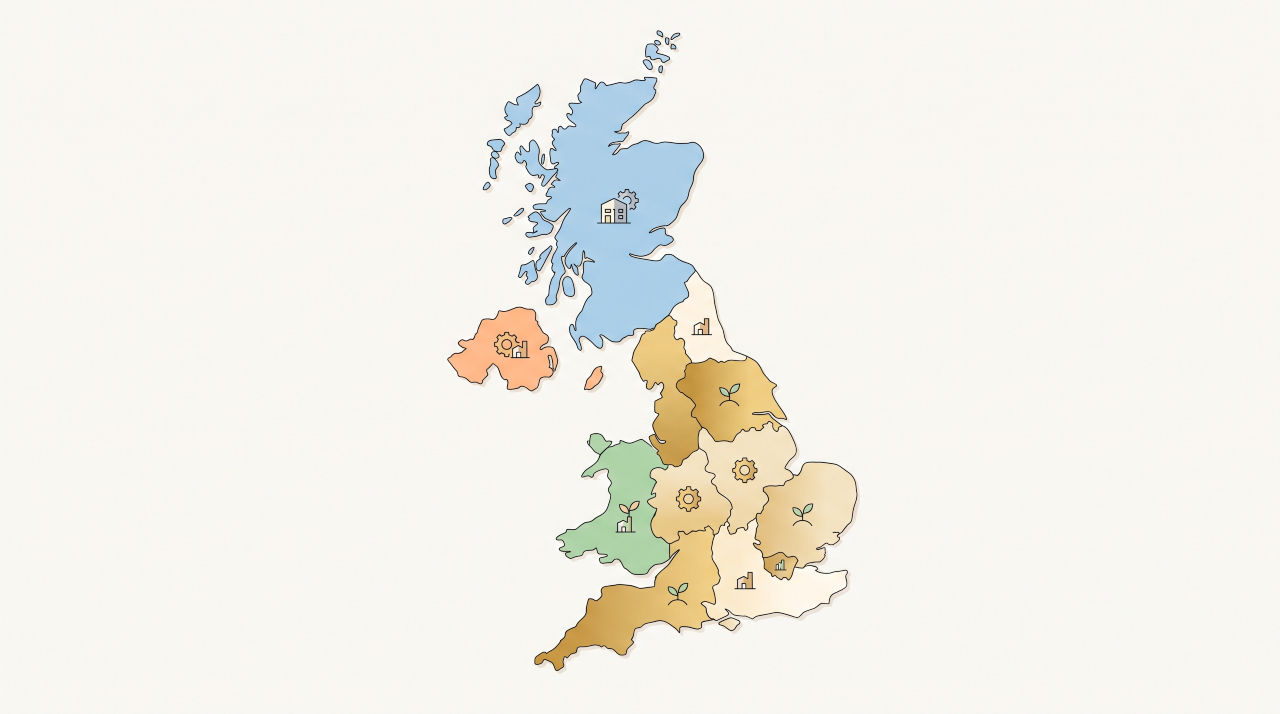
Regional & Devolved Grants: Where You Live Matters
This is the section that most grant guides skip — and it’s arguably the most important one.
Scotland
Business support in Scotland runs through Scottish Enterprise, Highlands and Islands Enterprise, and South of Scotland Enterprise. In 2026, active schemes include:
- Business Gateway grants for new and growing businesses
- R&D funding via Interface and Scottish Enterprise
- Just Transition grants for businesses decarbonising in fossil-fuel-dependent communities
The Scottish Government also offers the Growth Scheme and various sector-specific funds for food and drink, tourism, and life sciences.
Wales
Business Wales is the primary hub for Welsh grant support. Key schemes in 2026 include the Economic Resilience Fund successor programmes, Tourism Grants, and sector grants through the Welsh Government’s innovation agenda.
You can explore current open schemes at the Business Wales funding finder, which is regularly updated and organised by business type and sector.
Northern Ireland
Invest Northern Ireland manages most business grant funding in the province. Support ranges from small business development grants to large capital investment packages for manufacturers and exporters.
England
England’s system is the most fragmented. Your best starting point is your regional Growth Hub, which provides free, impartial advice and a live map of available funding. The Business Support Helpline connects you to your nearest Growth Hub at no cost.
Sector-Specific Grants Worth Knowing About
Some of the most accessible grants in 2026 are sector-specific — and competition for these tends to be lower than for headline national schemes.
- Hospitality and Retail: Local authority discretionary grants, often funded via UKSPF
- Agriculture and Rural Businesses: Farming Investment Fund (FIF) and Countryside Stewardship capital grants from DEFRA, offering up to £50,000 for equipment
- Creative Industries: Arts Council England project grants from £1,000 to £100,000; similar bodies in Scotland, Wales, and Northern Ireland
- Social Enterprises: Access to Impact Fund grants and Community Business Fund from Power to Change
- Exporting Businesses: UK Export Academy resources and Internationalisation Fund (Wales)
How to Apply: What a Strong Application Looks Like

Most grant applications fail for one of four reasons: vague project descriptions, no clear evidence of need, unrealistic budgets, or missing match funding. Knowing this before you start gives you a significant edge.
Here’s what assessors actually look for:
1. A clear problem and solution
Don’t describe your business — describe the specific problem your project will solve and why your approach works. Be precise.
2. A detailed, justified budget
Every line item needs a rationale. “£5,000 for equipment” won’t cut it. “£5,000 for a CNC router to increase production capacity from 200 to 500 units per month” will.
3. Evidence of viability
Show that your business can survive and grow. This means financial projections, customer data, or letters of intent from buyers. A solid business plan required for grant applications is not optional — it’s your foundation.
4. Measurable outcomes
Grants are public money. You’ll need to show how success will be measured — jobs created, revenue growth, carbon reduction, or units produced.
5. Match funding confirmed
If match funding is required, you need to show it’s available — not just promised. Bank statements or a loan approval letter will do.
Realistic Timeline: How Long Does a Grant Take?
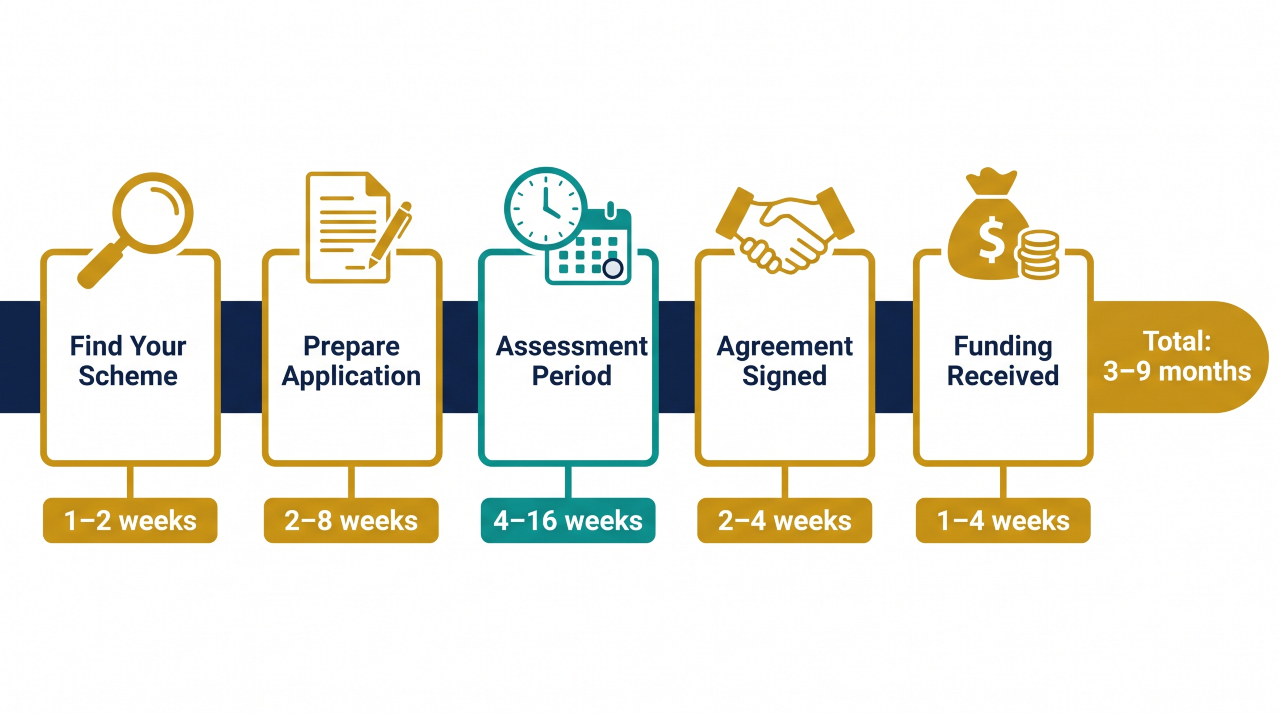
Be honest with yourself about this. Grant funding is not fast.
| Stage | Typical Timeframe |
|---|---|
| Finding the right scheme | 1–2 weeks |
| Preparing your application | 2–8 weeks |
| Assessment and decision | 4–16 weeks |
| Grant agreement signed | 2–4 weeks |
| First payment received | 1–4 weeks after first claim |
| Total from start to cash | 3–9 months |
If you need money quickly, a grant is the wrong tool. Look at financial support for new businesses for faster-access options like Start Up Loans, which can be completed in 6–8 weeks.
Why Grant Applications Get Rejected (And How to Avoid It)
This is the section no competitor guide bothers to include — and it could save you months of wasted effort.
The most common rejection reasons in 2026:
- Ineligible business type or size — read the eligibility criteria three times before starting
- Project already started — you cannot claim grant funding for work you’ve already paid for
- No additionality — you must show the project wouldn’t happen without the grant
- Weak commercial case — assessors need to believe the project will succeed
- Missed deadlines — grant portals close at the stated time, often to the minute
- Incomplete documents — a missing signature or financial statement kills an otherwise strong application
One practical tip: call the grant administrator before you apply. Ask them directly whether your project is eligible. Most schemes have a helpline or email contact precisely for this purpose. That five-minute conversation can save you 40 hours of work.
Where to Find Grants: The Best UK Databases
Don’t rely on a single source. Use multiple platforms to build a complete picture:
- gov.uk/business-finance-support — the official government finder
- GrantFinder / GrantNav — sector-searchable databases
- Your local Growth Hub — hands-on, human support
- Innovate UK Funding Service — for innovation-focused grants
- British Business Bank — for finance and investment schemes
Set up alerts where possible. Many schemes open without much advance notice, and early applications consistently perform better.
Frequently Asked Questions
Are there any grants available for small businesses in the UK in 2026?
Yes — dozens of grant schemes are open to UK small businesses in 2026, from national innovation funding through Innovate UK to regional grants managed by local councils and Growth Hubs. The key is finding the right scheme for your sector, location, and project type, which often takes research across multiple databases.
How much grant money can a small business get in the UK?
Amounts vary enormously. Micro-grants for small local businesses can start at £1,000, while innovation grants from Innovate UK can reach £500,000 or more for qualifying projects. Most SME grants fall in the £5,000–£50,000 range. Match funding requirements mean you’ll usually need to contribute a percentage of the total project cost yourself.
Can I get a grant to start a business in the UK?
Startup-specific grants do exist, but they’re less common than growth grants. The Prince’s Trust Enterprise Programme offers grants up to £5,000 for young entrepreneurs aged 18–30. Many councils and Combined Authorities also run small startup grant schemes through UKSPF funding. Start Up Loans (a government-backed loan, not a grant) remains the most accessible startup funding route at £500–£25,000.
How do I apply for a UK business grant?
Each scheme has its own application process. Start by identifying your eligible scheme, then register on that scheme’s portal (or contact the managing body directly). You’ll typically need a business plan, financial forecasts, project description, and evidence of match funding. Applying early in a funding round and speaking with an assessor before submitting both improve your success rate.
What is the Innovate UK grant and who can apply?
Innovate UK is the UK’s national innovation agency, operating under UK Research and Innovation (UKRI). It funds businesses working on ambitious science and technology projects through regular competitive rounds. Any UK-registered business can apply, though projects must demonstrate genuine innovation and commercial potential. According to UKRI’s published data, Innovate UK has invested over £3 billion in UK businesses since 2007.
Do I have to pay a grant back?
No — grants are not loans and don’t require repayment, provided you meet the conditions of your grant agreement. If you misuse the funds, fail to deliver the agreed project, or breach the terms, the grant body can reclaim the money. Always read your grant agreement carefully before signing.
The One Mistake That Costs Business Owners the Most
Waiting. Thousands of businesses miss out on grant funding every year not because they weren’t eligible, but because they didn’t apply before the funding pot closed.
Grant schemes run on fixed budgets. When the money’s gone, it’s gone — and there’s no appeal process for a scheme that closed last Tuesday. You don’t need to have everything perfect before you start exploring your options.
Your next step is simple: visit your local Growth Hub’s website today — or call the Business Support Helpline on 0800 998 1098 — and describe your project in plain language. They’ll tell you within minutes whether there’s a relevant scheme open right now. That one conversation could be the most valuable 10 minutes you spend this month.
The funding is out there. You just need to know where to look — and how to ask.