Did you know that 52% of job seekers say a poorly written job description makes them less likely to apply — even if the role itself is a great fit? (Source: LinkedIn Talent Trends Report.) When you’re hiring for a territory sales officer, that stat matters more than most. A vague or incomplete posting doesn’t just reduce applicants — it attracts the wrong ones.
You’ve probably landed here because you need a territory sales officer job description template you can use today, not tomorrow. Writing one from scratch is slow, uncertain work. What responsibilities are standard? What qualifications are reasonable and what about travel expectations, quota language, or legal requirements?
This article gives you a complete, ready-to-customise template — plus guidance on what each section means, what KPIs to include, and the mistakes most hiring managers make. By the time you finish reading, you’ll have everything you need to post a job listing that attracts qualified, motivated candidates.
What Is a Territory Sales Officer?
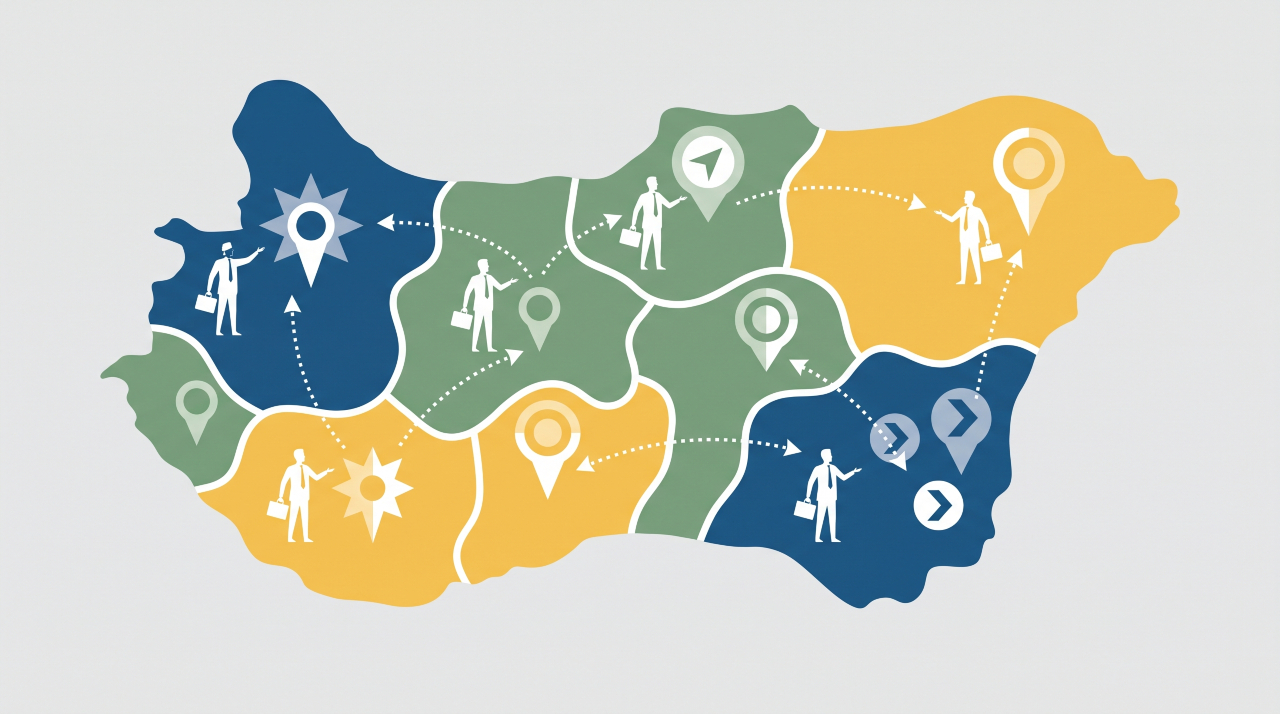
A territory sales officer is a field-based sales professional who owns a defined geographic region. Their job is to grow revenue within that region by acquiring new clients, managing existing accounts, and hitting specific sales targets.
This role sits between entry-level sales rep and senior territory manager. You’ll typically find it in industries like FMCG, pharmaceuticals, financial services, manufacturing, and B2B services — anywhere that requires face-to-face relationship building at scale.
Don’t confuse this role with an inside sales rep or a general sales executive. A territory sales officer is accountable for a specific patch of territory, which means their job description must reflect that geographic ownership clearly.
Why Your Job Description Template Matters More Than You Think
A weak job description costs real money. According to SHRM’s research on hiring costs, the average cost-per-hire across industries sits at over $4,700 USD — and a poor job posting increases your chances of a mis-hire, which multiplies that cost further.
When you get the job description right, you pre-qualify applicants before they ever speak to your team. You set expectations around travel, quota, and territory from day one. You also protect yourself legally by using consistent, compliant language.
The template below is structured to do all three of those things. Use it as your starting point, then customise the fields in brackets to match your company’s specifics.
Territory Sales Officer Job Description Template
[Company Name] — Territory Sales Officer
Location: [City, Region, or “Field-Based — [Territory Name]”]
Employment Type: [Full-Time / Permanent / Contract]
Reports To: [Regional Sales Manager / National Sales Director]
Salary / OTE: [Base Salary Range] + [Commission / OTE Structure]
Travel Required: [e.g., Up to 60% within the assigned territory]
About the Role
[Company Name] is looking for a driven and results-focused Territory Sales Officer to manage and grow our presence in [Territory Name]. You’ll take full ownership of a defined geographic patch, building relationships with new and existing clients to hit monthly and quarterly revenue targets.
This is a field-based role that suits someone who thrives working independently, enjoys face-to-face selling, and wants clear performance-linked earning potential.
Key Responsibilities
As a Territory Sales Officer at [Company Name], you will:
- Manage and develop a portfolio of [number] existing client accounts within [Territory Name]
- Prospect and acquire new business through cold outreach, referrals, and in-person visits
- Meet or exceed monthly, quarterly, and annual sales quotas of [insert target, e.g., $X revenue / X new accounts]
- Conduct regular territory reviews and update CRM records after every client interaction
- Prepare and deliver sales presentations, product demonstrations, and proposals
- Negotiate pricing and contract terms within company-approved parameters
- Collaborate with the marketing team to execute local campaigns and promotions
- Submit weekly sales activity reports and pipeline forecasts to [Reporting Manager]
- Monitor competitor activity within the territory and share market intelligence with the broader team
- Attend [e.g., monthly] regional sales meetings and national conferences as required
- Build and maintain strong, long-term client relationships to maximise retention and upsell opportunities
- Work cross-functionally with logistics, customer service, and product teams to resolve client issues
Required Qualifications
- Years of proven experience in field sales, territory sales, or a related B2B/B2C sales role
- Demonstrated track record of meeting or exceeding sales targets
- Strong communication, negotiation, and relationship-building skills
- Proficiency with CRM software (e.g., Salesforce, HubSpot, Zoho, or similar)
- Valid driver’s licence and access to a reliable vehicle [or specify if company car is provided]
- Ability to travel up to [X]% of the time within the assigned territory
- Self-motivated with strong time management and territory planning skills
- [Relevant industry knowledge, e.g., FMCG, pharma, financial services — optional but preferred]
Preferred Qualifications
- Bachelor’s degree in Business, Marketing, Sales, or a related field (preferred, not required)
- Experience using sales automation or data reporting tools
- Existing client network within [Territory Name or Industry]
- Familiarity with [specific product category or sector]
Key Performance Indicators (KPIs)

You’ll be measured on the following KPIs during your performance reviews:
| KPI | Target (Customise to Your Needs) |
|---|---|
| Monthly Revenue vs. Quota | 100% attainment minimum |
| New Client Acquisitions | [X] new accounts per quarter |
| Client Retention Rate | [e.g., 90%+] |
| CRM Activity Logging | 100% of visits logged within 24 hours |
| Sales Pipeline Value | [e.g., 3x quota in active pipeline at all times] |
| Customer Satisfaction Score | [e.g., NPS of 7+ or equivalent] |
What We Offer
- Competitive base salary: [Range]
- Uncapped commission / OTE of [£/$/€X]
- [Company car / car allowance / mileage reimbursement]
- [Mobile phone / laptop / expense account]
- [Pension / health insurance / life cover — region-dependent]
- [Annual leave entitlement]
- Ongoing sales training and career development
- A supportive team culture with regular coaching from senior management
Equal Opportunity Statement
[Company Name] is an equal opportunity employer. We celebrate diversity and are committed to creating an inclusive environment for all employees. All qualified applicants will receive consideration for employment without regard to race, colour, religion, gender, national origin, disability, or any other protected characteristic under applicable law.
How to Customise This Template
You don’t need to change everything — just the fields marked in brackets. Here’s what matters most.
Territory details: Be specific. “South West England” or “Greater Chicago Metro” is far more useful than “field-based.” Specificity reduces irrelevant applicants immediately.
Quota language: Always include a real number, even if approximate. Candidates want to know what “hitting target” actually means before they apply. Vague language like “meet sales goals” tells them nothing useful.
Travel percentage: State this clearly. A role requiring 70% travel is a fundamentally different lifestyle commitment than one requiring 20%. Burying or omitting this detail leads to early attrition — and expensive re-hiring.
OTE structure: For help with structuring compensation for sales roles, make sure you understand the difference between draw-against-commission, tiered commission, and flat-rate bonus structures before you fill in this section.
What Salary Should You Advertise?
Salary transparency in job postings is now a legal requirement in several jurisdictions — including parts of the US (Colorado, New York, California), the EU, and parts of Canada. Even where it isn’t legally required, LinkedIn’s research on salary transparency shows that listings with salary ranges receive significantly more qualified applications.
For territory sales officers globally, base salary ranges vary widely by industry and region. In the UK, typical base salaries run from £25,000 to £45,000 with OTE of £35,000–£70,000. In the US, base salaries commonly range from $45,000 to $75,000 with OTE reaching $90,000–$130,000 depending on sector.
Always benchmark against your specific industry, not just geography. Pharmaceutical and medical device territory roles typically pay 20–30% more than equivalent FMCG roles, for example.
Common Mistakes to Avoid in Your Job Posting
Most hiring managers repeat the same errors. Here’s what to watch for before you hit publish.
Listing 15+ responsibilities: Long bullet lists feel exhausting to read and signal a role with no clear focus. Keep your responsibilities list to 10–12 clear items. If you genuinely need more than that, consider whether this is two roles dressed up as one.
Forgetting the EEO statement: In the US, including an equal opportunity employer statement isn’t just good practice — it’s standard legal protocol. Your HR or legal team should approve your EEO language before posting.
Making every qualification “required”: When you mark 12 things as required, candidates with 11 of them self-select out. Research from Harvard Business Review on job description bias shows this disproportionately affects female and minority applicants. Split your list into “required” and “preferred” — as this template does.
No mention of territory size or complexity: If your territory covers 50 accounts spread across a two-hour drive radius, say so. If it’s 200 accounts in a dense urban area, that’s a very different job. Candidates need this context to self-assess fit.
A Note on Legal Compliance
This template is a starting point — not legal advice. Job description requirements vary by country, state, and industry. In regulated industries like financial services or pharmaceuticals, you may need specific disclosures or licensing requirements listed.
Always have your final job description reviewed by your HR team or a qualified employment lawyer before posting, particularly if you’re hiring across multiple jurisdictions. This is one area where cutting corners genuinely creates risk.
Industry-Specific Variations to Consider
The template above works across most industries, but you may need to adjust the language for specific sectors.
Pharmaceutical / Medical Devices: Add a requirement for relevant product knowledge or medical background, and include any regulatory compliance training the role requires. Clinical knowledge is often non-negotiable in this sector.
FMCG / Consumer Goods: Emphasise route management, in-store execution, and distributor relationship skills. Add a specific KPI for shelf visibility or product placement targets.
Financial Services: Include any licencing or certification requirements (e.g., CFA, FCA authorised, FINRA licenced). Regulatory compliance language becomes essential here.
B2B Technology / SaaS: Adjust “territory” to include both geographic and account-based definitions. Add familiarity with sales methodologies like MEDDIC, Challenger, or SPIN selling if your team uses them.
For teams scaling fast across multiple regions, you may also want to explore recruitment outsourcing for UK companies to understand how to manage volume hiring without overloading your internal HR team.
What Makes a Territory Sales Officer Succeed? (And What to Screen For)
Knowing what to look for in interviews is just as important as what you put in the job description. Research from the Sales Management Association consistently shows that territory planning skills and self-management discipline are stronger predictors of success than pure charisma or prior industry experience.
During screening, ask candidates to describe how they’ve previously managed a territory — specifically how they prioritised accounts, planned weekly schedules, and tracked their own pipeline. Strong answers will include specific numbers, tools used, and a clear sense of personal accountability.
Avoid hiring candidates who describe their previous success entirely in terms of team achievements or market conditions. A territory sales officer owns their patch. They need to own their results too.
FAQ — People Also Ask
What does a territory sales officer do?
A territory sales officer manages and grows sales within a defined geographic region. They prospect for new clients, manage existing accounts, hit sales quotas, and regularly visit customers face-to-face. They also report on pipeline activity and market conditions to their regional manager.
What qualifications do you need to be a territory sales officer?
Most employers look for at least 1–3 years of field sales experience, strong communication skills, and a valid driver’s licence. A degree in business or marketing is often preferred but rarely a hard requirement. CRM proficiency and a track record of hitting sales targets carry more weight than academic credentials in most hiring decisions.
What is the difference between a territory sales officer and a territory manager?
A territory sales officer focuses primarily on hitting sales targets through direct client-facing activity — prospecting, account management, and closing. A territory manager typically carries additional responsibilities like managing a small team of reps, setting regional strategy, and reporting upward to senior leadership. The manager role usually requires more experience and carries a higher salary band.
What are the duties of a sales officer?
A sales officer’s duties include identifying new business opportunities, managing existing client relationships, delivering sales presentations, negotiating contracts, maintaining CRM records, and hitting monthly or quarterly revenue targets. In a territory-specific role, they also manage the geographic distribution of their activity to maximise coverage and efficiency.
How do you write a job description for a sales role?
Start with the role title, reporting structure, and location. Then list 10–12 specific responsibilities, split qualifications into “required” and “preferred” categories, and include clear KPIs. Always state the travel requirement, compensation range, and OTE. Finish with an equal opportunity employer statement. The template in this article covers all of these elements.
Closing: Your Next Step Is Simple
The single most important thing you can take from this article is this: specificity is what makes your job description work. Generic postings attract generic candidates. When you’re clear about territory size, quota expectations, travel requirements, and OTE — you pre-qualify candidates before the first CV lands in your inbox.
Your next step is concrete. Open the template section above, copy it into a document, and fill in every field in brackets. If any field forces you to think — like the quota number or the travel percentage — that’s a good sign. It means you’re making decisions now that would otherwise cause confusion later in the hiring process.
Once your description is ready, post it on your primary recruitment platform and review applications against the KPI table you’ve set. That structure alone will sharpen your shortlisting process significantly.