
Official data published by the Ministry of Housing, Communities and Local Government confirms that over 500,000 Houses in Multiple Occupation operate across England and Wales, accommodating more than 1.5 million tenants. According to independent commercial lending research from Paragon Banking Group, professional multi-let properties generate average gross yields of 8.1% to 11.5%, compared to 4.5% to 5.8% for traditional single-family buy-to-let investments. This substantial yield premium has driven institutional developers, portfolio landlords, and commercial investors directly into the co-living and multi-let sector.
Operating a shared residential asset involves rigorous statutory governance. For commercial property investors and prospective landlords, understanding what is a hmo represents the boundary between generating lucrative rental returns and incurring severe civil penalties. Operating an unlicensed property can lead to unlimited tribunal fines, criminal records, and Rent Repayment Orders (RROs) that force landlords to refund 12 months of rental receipts. This guide details the legal definition of a House in Multiple Occupation, licensing classifications, Article 4 planning rules, fire safety mandates, and commercial mortgage financing.
Quick Answer: What Is a HMO (House in Multiple Occupation)?
What is an HMO? An HMO is a residential property rented out by at least 3 people who are not from 1 ‘household’ (for example, unrelated individuals) who share essential facilities like a bathroom, toilet, or kitchen. Under the Housing Act 2004, a household comprises family members, married couples, or cohabiting partners. When a property houses 5 or more tenants forming 2 or more households sharing amenities, it becomes a “Large HMO” and legally requires a Mandatory HMO License from the local authority. Operating an HMO requires compliance with statutory room-size minimums (at least 6.51 square metres for a single adult), commercial grade-A fire alarm systems, fire doors, and local Article 4 planning regulations.
Key Takeaways for UK Property Investors
- The 3-Tenant Rule: Any home rented to 3 or more unrelated tenants sharing a bathroom or kitchen qualifies legally as a House in Multiple Occupation.
- Mandatory Licensing Trigger: Properties with 5 or more occupants forming 2 or more households must obtain a mandatory five-year council licence.
- Strict Room Size Minimums: Sleeping rooms must measure at least 6.51 square metres for single adults or 10.22 square metres for cohabiting couples.
- Watch Article 4 Directions: Many local councils revoke permitted development rights, meaning converting a standard family home (C3) into a small HMO (C4) requires formal planning permission.
- Specialist Financing Required: Standard buy-to-let mortgages prohibit shared tenancies. Landlords must secure specialist commercial HMO mortgages, often unlocking commercial valuations based on yield rather than bricks-and-mortar.
The Legal Definition of a House in Multiple Occupation (Housing Act 2004)
The statutory definition of a House in Multiple Occupation is codified in Part 2 of the Housing Act 2004. Under British property law, a building or part of a building qualifies as an HMO if it satisfies the “standard test”, the “self-contained flat test”, or the “converted building test”.
In practice, a property constitutes an HMO when the following statutory conditions are met:
- Tenant Count: At least 3 tenants occupy the property as their main or only residence.
- Household Composition: The occupants form more than 1 separate household.
- Shared Basic Amenities: The tenants share one or more essential amenities, including a kitchen, bathroom, washbasin, or toilet. Alternatively, the accommodation lacks certain amenities internally, requiring shared facilities.
- Rent Obligation: At least one occupant pays rent or other consideration for their right of occupation.
Defining a “household” is central to understanding regulatory triggers. Under UK housing statutes, a single household consists of family members related by blood, marriage, civil partnership, adoption, or foster care. Two friends sharing a two-bedroom flat represent two households. A family of four sharing a house represents a single household. Therefore, renting a three-bedroom house to three unrelated university students or working professionals creates an HMO under housing law, even if no special council licence is yet required.
Section 257 of the Housing Act 2004 extends the HMO definition to certain converted blocks of flats. Buildings converted into self-contained flats before June 1992 that do not meet the Building Regulations 1991 standards, where less than two-thirds of the flats are owner-occupied, are classified as “Section 257 HMOs”. These buildings require special council oversight.
The Three Tiers of HMO Licensing in the UK
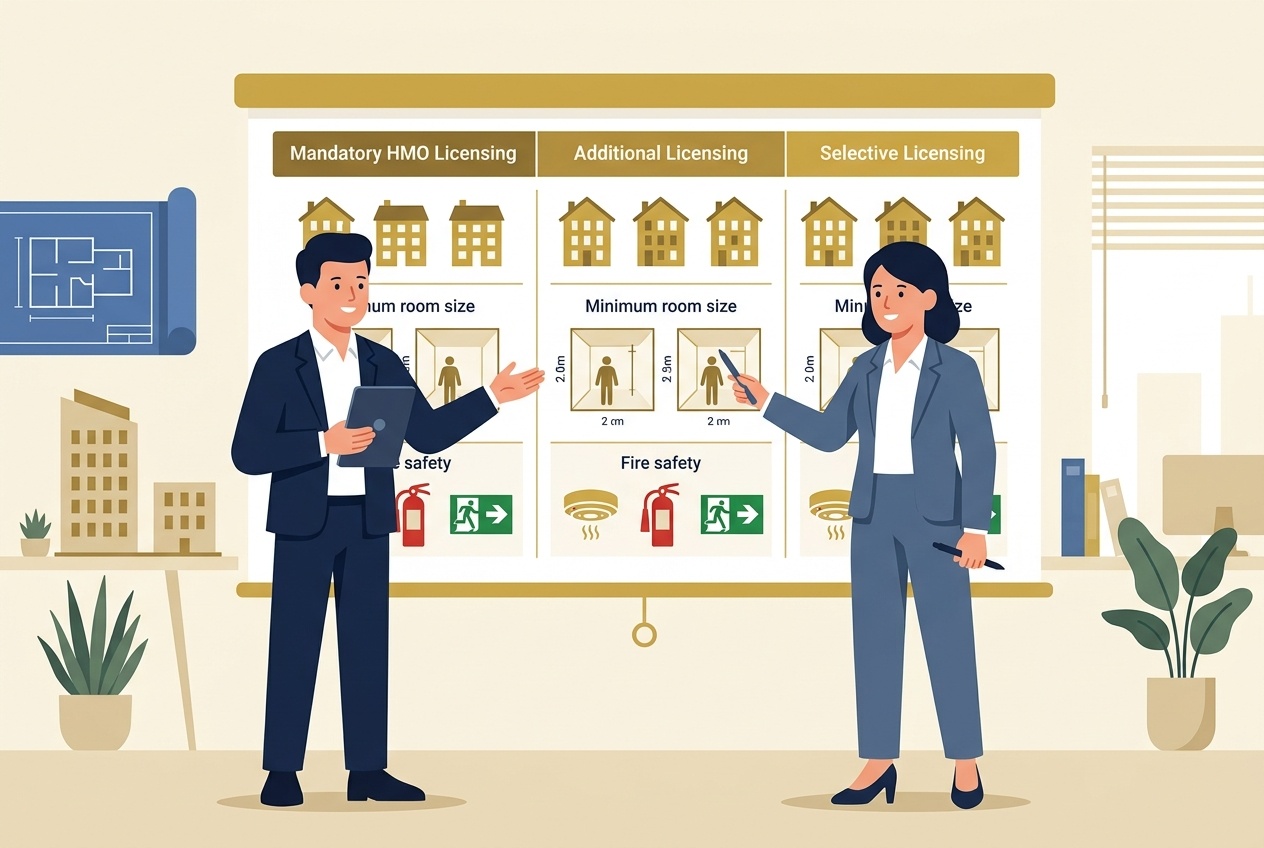
Property investors must differentiate between what constitutes an HMO and what triggers mandatory council licensing. While any property housing three unrelated people is an HMO, licensing schemes vary across local council borders:
| Licensing Category | Statutory Criteria | Enforcing Authority | Typical Licence Duration |
|---|---|---|---|
| Mandatory HMO Licensing | 5+ occupants from 2+ households sharing basic amenities (regardless of storeys) | Nationwide UK statute (All local councils) | Up to 5 years per property |
| Additional Licensing | Smaller HMOs (3 or 4 tenants from 2+ households) within designated zones | Discretionary local authority scheme | Up to 5 years (scheme dependent) |
| Selective Licensing | All privately rented residential properties in specified council wards | Designated local authority wards | Up to 5 years (scheme dependent) |
As set out in the GOV.UK HMO licensing guidance, Mandatory Licensing applies across all of England and Wales. Before October 2018, mandatory licensing applied only to buildings with three or more storeys. The modern legislation removed the storey criterion entirely. Today, single-storey flats, two-storey Victorian terraces, and large detached houses must all hold a mandatory licence if they house five or more occupants from two or more households.
Additional Licensing represents a discretionary power exercised by municipal authorities under Section 56 of the Housing Act 2004. Councils implement Additional Licensing across areas with high student populations or anti-social behaviour concerns. In these designated zones, councils must also inspect and license three-bed professional house shares. Investors must contact the relevant local housing department to confirm whether an Additional Licensing scheme applies before signing tenancy agreements.
Statutory Room Size Minimums and Amenity Standards
To eliminate overcrowding and protect tenant health, national legislation enforces strict floor area standards. Under the Licensing of Houses in Multiple Occupation (Mandatory Conditions of Licences) (England) Regulations, local authorities cannot grant licences for rooms that breach statutory dimensions:
| Occupancy Classification | Minimum Usable Floor Area | Ceiling Height Restriction |
|---|---|---|
| Single Adult (Aged 10+) | 6.51 square metres (70.07 sq ft) | Floor areas with ceiling height under 1.5m cannot be counted |
| Two Adults Sharing (Cohabiting) | 10.22 square metres (110.01 sq ft) | Floor areas with ceiling height under 1.5m cannot be counted |
| Child Under 10 Years Old | 4.64 square metres (49.94 sq ft) | Floor areas with ceiling height under 1.5m cannot be counted |
Any bedroom measuring less than 4.64 square metres cannot be used as sleeping accommodation under any circumstances. Furthermore, when measuring floor area, inspectors disregard awkward sloping eaves where ceiling clearance drops below 1.5 metres. En-suite shower cubicles and built-in wardrobes are also excluded from the net usable bedroom calculation.
Amenity ratios represent another compliance barrier. Most local authorities enforce strict kitchen and sanitary bathroom ratios. Typically, an HMO housing five occupants requires at least one full bathroom (bath/shower, toilet, and basin) plus an additional separate toilet with hand basin. If occupant numbers rise to six or seven, councils generally require two full bathrooms, dual kitchen cooking appliances, and dedicated food-preparation worktop allocations.
Planning Permission: C3 vs. C4 Use Classes and Article 4 Directions
Licensing and planning permission are separate legal regimes. Securing an HMO licence from the council housing team does not grant planning approval from the municipal planning department.
Under the Town and Country Planning (Use Classes) Order 1987, residential property is categorised under distinct use classes:
- Class C3 (Dwellinghouse): Standard residential use by a single family or household.
- Class C4 (Houses in Multiple Occupation): Small shared houses occupied by between 3 and 6 unrelated individuals as their only or main residence.
- Sui Generis (Large HMOs): Shared properties occupied by 7 or more unrelated individuals. Sui Generis properties never benefit from permitted development and always require full planning permission.
Under national permitted development rights, owners can convert a property from Class C3 to Class C4 without making a formal planning application. However, hundreds of UK local authorities have implemented Article 4 Directions across their urban boroughs. An Article 4 Direction revokes permitted development rights for HMO conversions within specified wards.
In an Article 4 area, converting a standard single-family home into a three-bed house share requires full planning permission. Councils often reject applications in areas where HMO concentration already exceeds 10% or 15% of total housing stock. Purchasing a property intended for multi-let use in an Article 4 zone without checking local development policies can leave an investor with an unusable asset.
Fire Safety Regulations and the Management Regulations 2006
Fire safety compliance represents the most heavily inspected aspect of HMO operations. Under the Regulatory Reform (Fire Safety) Order 2005 and the Management of Houses in Multiple Occupation (England) Regulations 2006, landlords carry statutory responsibility for common parts fire security.
Key fire safety mandates include:
- Commercial Grade Fire Alarm Systems: Standard battery smoke alarms are illegal in licensed HMOs. Properties require a Grade A (control panel, call points, and optical detectors) or Grade D (mains-powered interlinked detectors with tamper-proof lithium battery backup) alarm system conforming to British Standard BS 5839-6.
- Certified Fire Doors (FD30 / FD30S): All bedrooms, kitchens, and risk rooms leading onto protected escape routes must be fitted with certified 30-minute fire-resistant doors (FD30). Doors must include self-closing overhead devices, intumescent heat strips, and cold smoke brush seals.
- Thumb-Turn Exit Locks: Key-operated deadbolts on bedroom doors and main exit doors are prohibited. Occupants must be able to escape during an emergency without searching for a key, requiring the installation of thumb-turn escape locks.
- Emergency Lighting: Escape corridors, stairwells, and windowless hallways must feature mains-wired emergency backup illumination that activates automatically during power cuts.
- Annual Fire Risk Assessments (FRA): Landlords must commission or complete a written Fire Risk Assessment, identify potential ignition sources, and document evacuation protocols.
Landlords must also supply valid annual Gas Safety Certificates, 5-year Electrical Installation Condition Reports (EICR), and annual emergency lighting certificates to maintain compliance under National Residential Landlords Association standards.
Penalties for Non-Compliance: Civil Penalties and Rent Repayment Orders
Local authorities possess punitive enforcement mechanisms to punish non-compliant and unlicensed HMO operators. The Housing and Planning Act 2016 expanded council enforcement powers significantly:
- Civil Financial Penalties (Up to £30,000): Councils can levy civil penalties of up to £30,000 per statutory breach under Section 249A of the Housing Act 2004 without taking the landlord to court. Operating an unlicensed property with inadequate fire escapes can trigger multiple concurrent £30,000 penalties.
- Rent Repayment Orders (RROs): Tenants or local authorities can apply to the First-tier Tribunal (Property Chamber) for an RRO. If an HMO is proven to be unlicensed, the tribunal can order the landlord to repay up to 12 months of gross rent directly back to the occupants or council (for housing benefit payments).
- Criminal Prosecution: Local authorities can prosecute rogue operators in the Magistrates’ Court, which can impose unlimited criminal fines and criminal records on directors and letting agents.
- Section 21 Eviction Restrictions: Landlords cannot serve valid Section 21 eviction notices if the property requires an HMO licence but remains unlicensed.
- Banning Orders and Rogue Landlord Database: Serious or repeat offenders can be banned from letting property or managing residential housing across the United Kingdom for a minimum of 12 months.
Financing an HMO: Mortgages and Commercial Valuations
Financing a multi-let property differs substantially from funding a standard buy-to-let house. Traditional mortgage lenders will not lend against properties let to multiple unrelated occupants on individual tenancy agreements.
Landlords must secure specialist commercial HMO mortgages from specialist lenders (such as Paragon, Aldermore, Kent Reliance, or Shawbrook). Lending criteria depend on whether the property is small (under 6 beds) or large (7+ beds):
Bricks-and-Mortar vs. Commercial Yield Valuations
For standard small HMOs (3 to 6 bedrooms), mortgage valuers typically assess the property based on vacant possession bricks-and-mortar value. The valuer evaluates what the house would sell for as a normal family home on the open market, regardless of gross rental income.
For licensed, high-specification HMOs located in strong commercial rental hubs, specialist lenders will instruct a commercial investment valuation (often termed an investment value or commercial yield valuation). Under this methodology, the valuer capitalises the property’s net operating income using a market yield (typically 8% to 10%). A property generating £45,000 in net annual rent might achieve a commercial valuation of £450,000 to £500,000, despite having a standard residential bricks-and-mortar value of only £300,000. This higher valuation allows professional developers to refinance and pull out their initial development capital.
Operating multi-let properties within a corporate wrapper is standard practice. Navigating limited company buy to let mortgage rules allows landlords to hold HMOs inside a Special Purpose Vehicle (SPV), securing full mortgage interest tax deductibility while implementing corporate strategies to reduce corporation tax.
Pros and Cons of HMO Property Investment
While multi-let assets provide strong cash flow, they require intensive operational oversight. Investors should weigh the commercial advantages against the regulatory demands:
| Advantages | Disadvantages & Challenges |
|---|---|
| Significantly Higher Rental Yields: Gross yields of 8% to 12% provide superior net cash flow compared to single lets. | Heavy Regulatory Burden: Continuous compliance inspections, licensing renewals, and changing council rules. |
| Reduced Arrears Risk: If one tenant defaults or vacates, remaining tenants continue servicing operating overheads. | Higher Conversion & Setup Costs: Fire doors, interlinked alarms, en-suites, and acoustic insulation require substantial capital. |
| Commercial Refinance Potential: Commercial yield valuations allow capital extraction on high-income properties. | Utility Bill Management: Landlords typically pay gas, electric, water, broadband, and council tax, exposing profits to energy price spikes. |
| Consistent Urban Demand: Affordable individual room rents attract steady demand from young professionals and students. | Higher Tenant Turnover: Managing individual room check-ins, deposit disputes, and communal wear-and-tear increases management time. |
Managing utility overheads requires disciplined budgeting. Because landlords generally cover all utility bills in an all-inclusive room rate, adopting proactive property cash flow management tips (such as installing smart heating controls and fair-use energy clauses) prevents utility expenditure from eroding trading surplus.
Frequently Asked Questions
Can you rent to 3 friends without an HMO licence?
Renting to 3 unrelated friends legally creates an HMO under the Housing Act 2004 because they form 3 separate households sharing facilities. Whether you need a council licence depends on local regulations. If your local council operates an Additional Licensing scheme covering 3-bed properties, you must obtain a licence before letting the property. If only Mandatory Licensing applies in your area, a licence is not required for 3 people, but you must still obey national HMO safety and amenity standards.
What is the difference between a household and an occupant?
An occupant is an individual person living in the property. A household consists of family members related by blood, marriage, civil partnership, adoption, or long-term cohabitation. For example, a married couple with two children living in a house represents four occupants but only one household. Conversely, four unrelated young professionals living together represent four occupants and four separate households.
How much does a UK HMO licence cost?
Licence fees are determined independently by each local housing authority and vary widely across the country. Typically, a mandatory five-year HMO licence costs between £800 and £1,800 for up to five rooms, with additional per-room charges for larger buildings. The fee is split into two parts: an initial processing fee and a second enforcement fee payable upon licence approval.
Can I convert a family house into an HMO without planning permission?
Under national permitted development rights, changing a property from Class C3 (single dwellinghouse) to Class C4 (small HMO for 3 to 6 occupants) does not require planning permission. However, if the local authority has implemented an Article 4 Direction in that area, permitted development rights are revoked, meaning full planning permission is required before starting work or letting rooms.
Do HMO landlords have to pay council tax and bills?
Yes. In almost all shared HMO arrangements where tenants rent individual rooms on separate tenancy agreements, the landlord is legally liable for paying the property’s Council Tax under the Council Tax (Liability for Owners) Regulations 1992. Landlords also generally supply communal heating, electricity, water, and high-speed broadband within an all-inclusive monthly room rent.
What is an Article 4 Direction in simple terms?
An Article 4 Direction is a formal planning restriction issued by a local council that removes automatic permitted development rights. In the context of housing, it prevents property owners from converting standard family homes into shared HMOs without submitting a formal planning application to the council.
What to Do Next: Your HMO Property Launch Checklist
Launching a compliant, profitable House in Multiple Occupation requires structured operational planning. Prospective landlords should complete the following four-step action plan:
- Conduct Council Planning and Licensing Audits: Contact the local council’s planning and housing departments. Verify whether the target postcode sits inside an Article 4 Direction zone, and check whether Additional or Selective Licensing schemes apply to 3 or 4-person shared homes.
- Survey Bedroom Dimensions and Amenity Ratios: Measure usable bedroom floor areas with a laser measure, ensuring every single room exceeds 6.51 square metres (with ceiling clearances over 1.5 metres). Verify that bathroom, kitchen, and food storage ratios meet municipal environmental health guidelines.
- Install Commercial Grade Fire and Safety Systems: Commission a qualified electrician to install mains-wired interlinked smoke and heat detectors (BS 5839-6 Grade A or D). Fit certified FD30 fire doors with overhead closers and thumb-turn exit locks to all bedrooms and exit routes.
- Submit Formal Licence Applications Prior to Occupation: Complete your council licence application via GOV.UK HMO licence application rules before tenants move in. Operating without a submitted application exposes you to immediate civil fines and Rent Repayment Orders.
HMO operations require rigorous compliance management. Work with accredited commercial mortgage brokers, chartered building surveyors, and qualified legal counsel to structure your property portfolio securely.