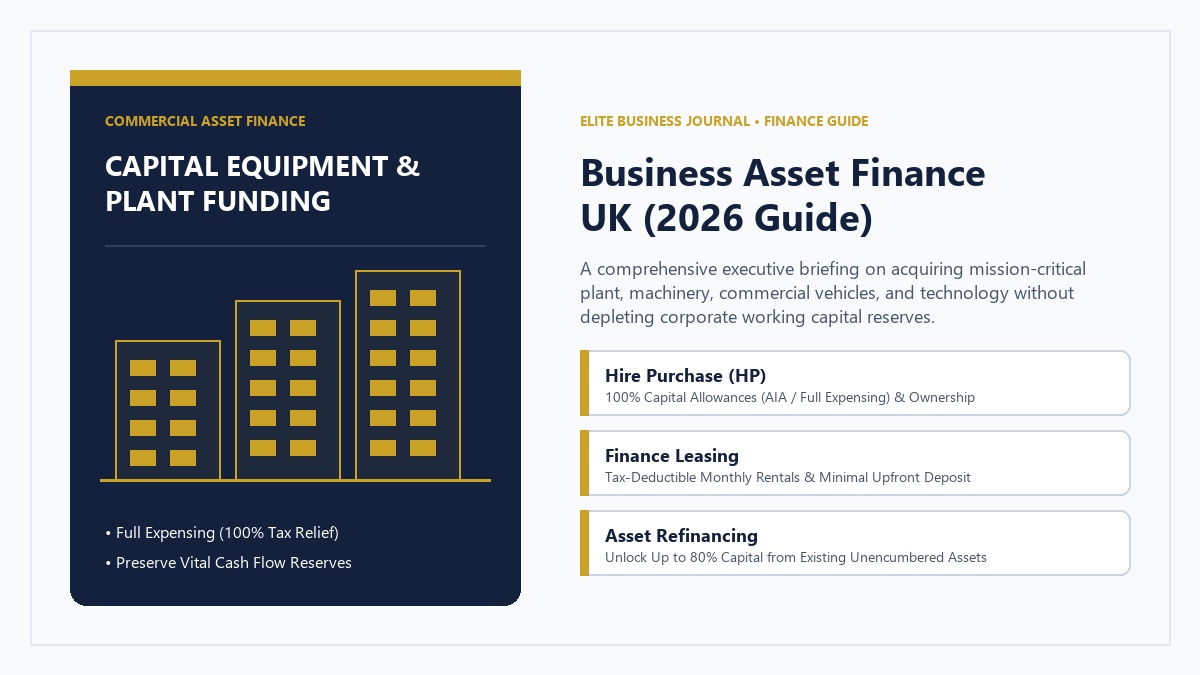
Quick Answer: Business Asset Finance UK 2026
Business asset finance is a specialized commercial funding mechanism that allows UK enterprises to acquire critical plant, machinery, commercial vehicles, and IT equipment without paying the full capital purchase price upfront. The two core facilities are Hire Purchase (HP)—where the business gains eventual legal ownership and immediately claims 100% Annual Investment Allowance (AIA up to £1m) or Full Expensing—and Finance Leasing, where rental payments are 100% tax-deductible as trading operational expenses. UK companies can also utilise Asset Refinancing (sale-and-leaseback) to unlock up to 80% of equity from existing unencumbered machinery to inject immediate liquidity into working capital.
Key Takeaways
- Asset finance spreads the capital expense of commercial equipment across 12 to 84 months, safeguarding vital operating cash reserves.
- Hire Purchase enables limited companies to claim 100% first-year capital allowances (Full Expensing or AIA) in the year of acquisition.
- Finance leasing structures spread VAT across monthly rentals rather than requiring an upfront lump sum.
- Asset refinancing releases immediate equity from mature plant and machinery to fund corporate mergers, acquisitions, or restructuring.
For growing UK enterprises, scaling operational capacity often requires substantial capital investment in mission-critical hardware—whether industrial CNC machinery, commercial logistics fleets, specialised medical apparatus, or high-performance enterprise IT infrastructure. However, funding large capital expenditure (CapEx) directly from cash reserves can severely strain liquidity and expose a business to unexpected cash flow shocks.
According to annual data from the Finance & Leasing Association (FLA), UK asset finance providers fund over £38 billion of business investment annually, supporting more than one-third of all UK SME investments in machinery, equipment, and commercial vehicles.
Under official statutory frameworks published on GOV.UK Capital Allowances and guidance from the British Business Bank, matching the right asset finance product to your equipment lifecycle delivers substantial Corporation Tax savings and optimises balance sheet efficiency.
This authoritative guide details the mechanics of business asset finance in 2026, comparing Hire Purchase, Finance Leasing, Operating Leases, and Asset Refinancing, while breaking down capital allowance rules, VAT treatments, and underwriting covenants.
1. The Four Primary Business Asset Finance Structures
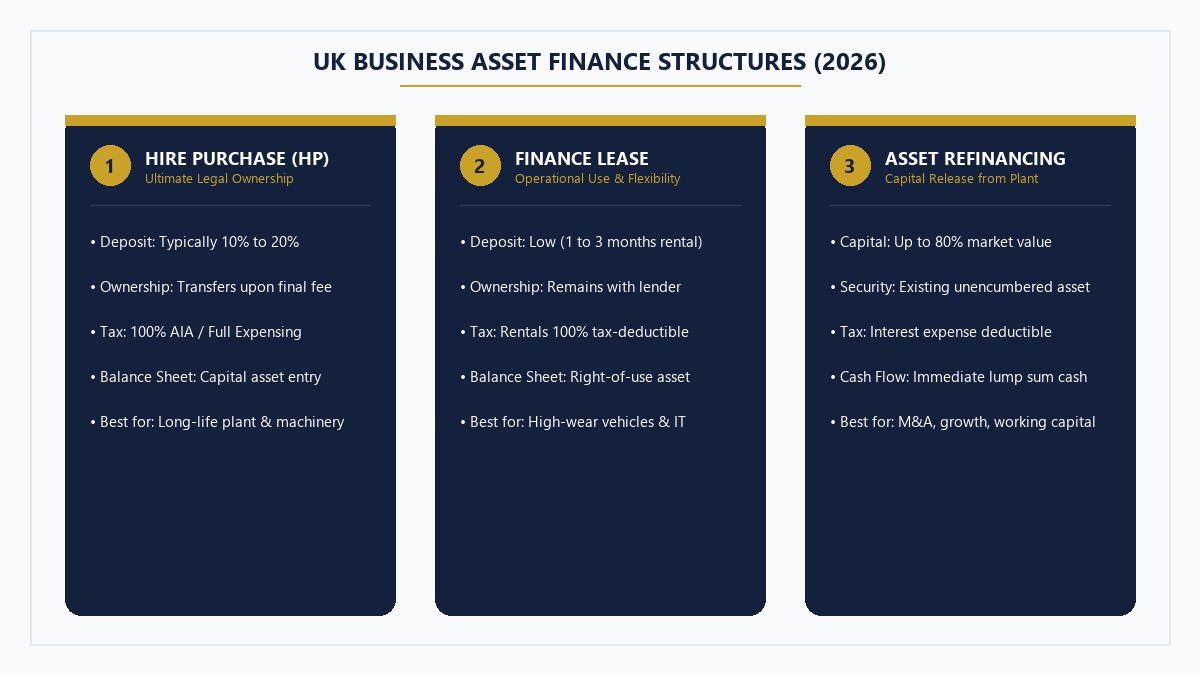
Selecting the optimal finance structure depends on whether your commercial goal is eventual asset ownership, minimal upfront cash outflow, or unlocking tied-up equity from existing machinery.
| Finance Structure | Legal Ownership | Tax & Capital Allowances | Primary Commercial Fit |
|---|---|---|---|
| Hire Purchase (HP) | Transfers to business upon final option fee payment | 100% AIA / Full Expensing on total asset value in Year 1; interest is tax-deductible. | Long-life plant, heavy industrial machinery, commercial vehicles intended for retention. |
| Finance Lease | Remains with the lessor throughout term | Monthly rental payments are 100% tax-deductible as trading expenses against profits. | Equipment with regular replacement cycles where cash preservation is critical. |
| Operating Lease | Remains with lessor; asset returned at term end | Rentals treated as off-balance sheet operating expense (OpEx). | High-depreciation technology, specialized IT servers, agricultural machinery. |
| Asset Refinancing | Temporarily assigned to lender via sale-and-HP | Finance interest charges deductible; existing capital allowance pools preserved. | Unlocking tied-up capital from owned machinery to fund acquisitions or debt consolidation. |
For enterprises establishing new trading divisions or Special Purpose Vehicles to house asset fleets, review our step-by-step guidance on how to register a company in the UK.
2. Tax Optimisation: Full Expensing vs. Annual Investment Allowance (AIA)
One of the most compelling advantages of asset finance—specifically Hire Purchase—is the ability to claim substantial upfront Corporation Tax relief on the entire capital value of the asset on day one, even though payments are spread over several years.
1. Full Expensing (Permanent 100% First-Year Allowance)
Under statutory provisions introduced in the Corporation Tax Act, UK limited companies can claim Full Expensing on qualifying new and unused plant and machinery. This delivers a 100% first-year tax deduction with no upper monetary cap. For companies paying the main 25% Corporation Tax rate, every £100,000 invested in qualifying machinery generates an immediate £25,000 Corporation Tax saving.
2. Annual Investment Allowance (AIA – £1,000,000 Cap)
The Annual Investment Allowance (AIA) remains fixed at £1,000,000 per accounting year. Unlike Full Expensing, AIA is available to sole traders, partnerships, and limited companies, and applies to both new and second-hand qualifying plant and machinery. When acquiring pre-owned commercial plant under Hire Purchase, AIA provides 100% tax write-off in the year of purchase up to the £1m threshold.
Asset Value: £200,000 | Deposit Paid: £20,000 (10%)
Year 1 Full Expensing / AIA Deduction: £200,000
Corporation Tax Relief (25% Rate): £50,000 Cash Tax Saving
To evaluate how capital allowance deductions reduce your corporate tax bracket and marginal relief calculations, explore our detailed analysis of UK corporation tax rates 2026.
Company directors balancing equipment investments against dividend drawings should review our guide on the optimal salary and dividend split for UK directors.
3. Asset Refinancing: Unlocking Capital from Existing Equipment
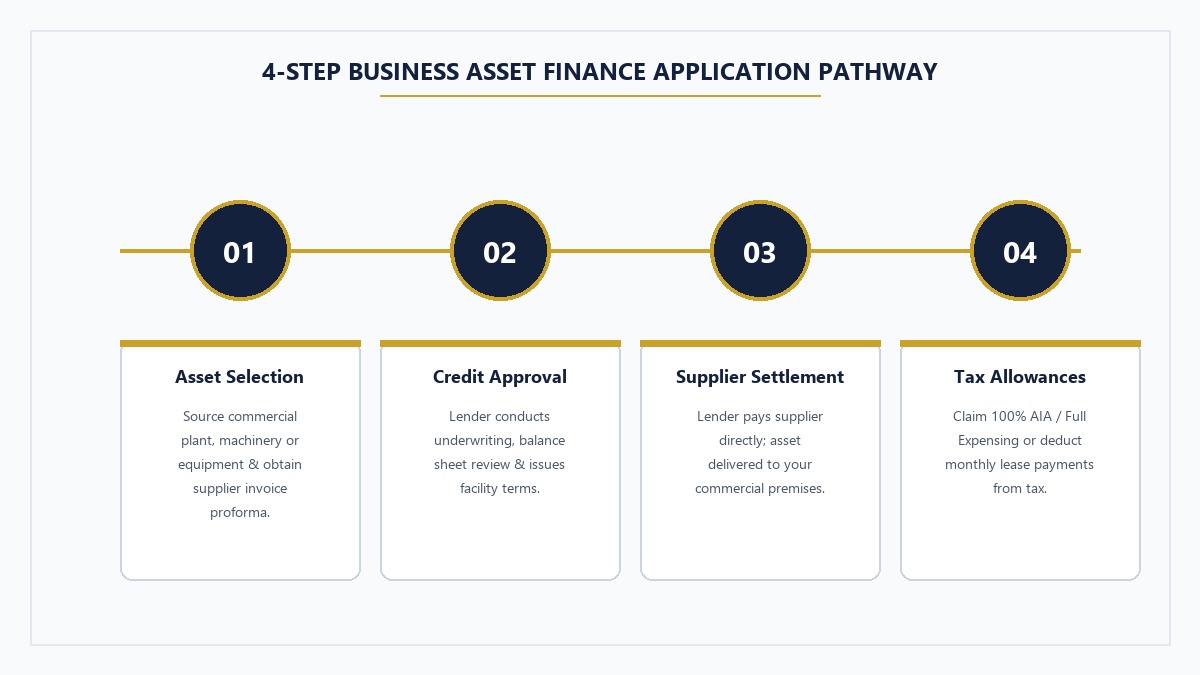
Many mature UK businesses own substantial plant, machinery, or vehicle fleets outright, effectively trapping significant liquidity on their balance sheet. Asset Refinancing (also termed capital release or sale-and-leaseback) allows a business to monetise these physical assets:
- Valuation & Advance: A specialist lender arranges an independent desktop or physical valuation of your machinery, advancing typically 70% to 80% of current open market value in cash.
- Operational Continuity: The business sells the asset to the lender and immediately enters a Hire Purchase or Finance Lease agreement. Physical possession and day-to-day operations remain entirely uninterrupted.
- Strategic Use of Funds: Refinancing capital can fund management buyouts (MBOs), bridge working capital gaps, finance business acquisitions, or settle expensive short-term debt.
If you are exploring capital release alongside broader debt facilities, compare terms in our guide to business expansion loans in the UK.
For short-term property conversions or real estate acquisitions, see our guide on commercial bridging loans in the UK.
4. VAT Treatment: Hire Purchase vs. Finance Leasing
The handling of Value Added Tax (VAT) differs significantly between asset finance structures and directly impacts short-term treasury management:
1. Hire Purchase VAT Rules
On standard Hire Purchase agreements, VAT on the total purchase price of the asset is payable upfront at the start of the agreement. For VAT-registered businesses, you can reclaim this VAT on your next quarterly VAT return via Form VAT100. Many asset finance lenders offer a VAT deferral facility (typically 3 months), allowing the business to reclaim the VAT from HMRC before paying it to the lender.
2. Finance Lease VAT Rules
Under a Finance Lease, VAT is not payable as a lump sum upfront. Instead, VAT is charged on each monthly rental payment over the lease term. This eliminates the initial VAT cash burden, making leasing highly advantageous for businesses managing tight quarterly cash flow.
To model cash flow impacts across VAT quarters and loan amortisation schedules, implement our framework for small business cash flow forecasting in 2026.
For commercial fleet operators, review the specific tax and Benefit-in-Kind distinctions in our guide on business vehicle finance: lease vs HP.
5. Frequently Asked Questions
Can a startup with no trading history secure asset finance?
Yes. Because asset finance is secured directly against the physical equipment being purchased, specialist lenders frequently approve new businesses and startups. Lenders may require a director’s personal guarantee or a slightly higher deposit (15% to 25%).
What happens if the equipment breaks down during a finance lease?
Under a standard Finance Lease, the lessee (your business) remains contractually responsible for the maintenance, servicing, and insurance of the equipment. Monthly lease obligations continue regardless of equipment downtime unless covered by an extended manufacturer warranty or service agreement.
Your Next Actions
- Audit Asset Requirements: Determine whether you require permanent long-term ownership (Hire Purchase) or operational flexibility with lower cash outflow (Finance Lease).
- Consult Your Accountant on Capital Allowances: Verify eligibility for 100% Full Expensing or AIA to maximise Corporation Tax deductions in your current accounting period.
- Request Supplier Proforma Invoices: Obtain detailed equipment quotes and model monthly financing costs across 36, 48, and 60-month terms.
- Explore Tools: Use resources in our Business Tools Hub.
Editorial Team & Signature
Written by Oliver Carpenter, Founder & Editor-in-Chief at Elite Business Journal. Published August 2026.
Financing office infrastructure often includes enterprise telecoms; find recommended VoIP setups in our guide to the best small business phone system in the UK.
For entrepreneurs evaluating specialized automated hardware investments, assess the economics of the cash machine ATM business model.