
According to comprehensive market data published in the British Business Bank’s Small Business Finance Markets analysis, over 68% of all external SME lending across the United Kingdom now originates outside the traditional Big Four high-street banks, representing a permanent structural transformation in how British commercial ventures secure capital. Simultaneously, recent quarterly data compiled by UK Finance reveals that gross SME commercial borrowing reached £68 billion, with nearly half (48%) of UK micro-businesses and scaleups citing persistent working capital timing gaps—driven by 50+ day corporate debtor payment terms, seasonal inventory commitments, and quarterly VAT deadlines—as their single primary motivation for seeking external funding.
In this economic climate, traditional secured bank borrowing, which demands unencumbered freehold commercial property or extensive plant and machinery as collateral, has proven too slow, inflexible, and restrictive for asset-light service firms, tech scaleups, and fast-growing trading operations. Consequently, cash flow lending for businesses has emerged as the premier financing vehicle for UK directors seeking rapid liquidity. By underwriting facilities based on verifiable forward revenue, trading bank transactions, and operating margins rather than physical asset debentures, cash flow finance provides agile, non-dilutive liquidity when opportunity knocks or market disruptions bite.
Quick Answer: What Is Cash Flow Lending for Businesses?
Cash flow lending for businesses is a form of unsecured or asset-light commercial financing where loan amounts and borrowing limits are determined by a company’s historical and projected cash inflows, rather than physical collateral like property or equipment. UK lenders assess trading performance using Open Banking feeds, accounting software integrations (Xero, QuickBooks), and VAT returns. Facilities typically range from £10,000 to £500,000+ through three primary mechanisms: fixed-term unsecured business loans (repaid over 6 to 36 months), revolving credit facilities (re-drawable lines of credit where interest is paid only on drawn capital), and merchant cash advances (repaid via an agreed percentage of daily debit and credit card takings). Because no physical assets are pledged, lenders typically require a director’s personal guarantee.
Key Takeaways for UK Business Directors
- No Fixed Asset Collateral: Borrowing capacity is benchmarked against turnover, operating profit, and customer receipts rather than commercial real estate.
- Rapid Fintech Underwriting: Open Banking API assessments enable modern alternative lenders to approve and disburse facilities within 24 to 48 hours.
- Flexible Repayment Options: Choose between structured monthly amortisation (term loans), interest-only standby lines (RCFs), or revenue-indexed splits (merchant cash advances).
- The Personal Guarantee (PG) Factor: Most unsecured cash flow facilities require majority directors to sign a personal guarantee, making PG risk assessment and insurance vital.
- Pricing Dynamics: While APRs are higher than secured mortgages (typically 8% to 24%), total interest costs remain manageable when facilities are utilized for short-term working capital cycles.
Asset-Backed vs. Cash Flow Lending: The Fundamental Contrast
Understanding how lenders evaluate corporate risk is crucial when structuring debt. Commercial finance in the UK broadly splits into two methodologies:
In asset-backed lending, the lender’s primary security is a physical, tangible asset—such as commercial premises, industrial machinery, or a vehicle fleet. If the borrower defaults, the lender liquidates the asset to recover capital. While interest rates on asset-backed debt are generally lower, facility setup is burdened by legal debentures, physical surveyor valuations, and months of administrative friction.
Conversely, cash flow lending evaluates the ongoing operating vitality of the business enterprise itself. Lenders evaluate how reliably your commercial operations generate cash from customers, analyze your gross margins, audit seasonal revenue dips, and measure your Debt Service Coverage Ratio (DSCR). Independent guidance provided via the British Business Bank working capital guidance framework emphasizes that cash flow lending enables service businesses, digital agencies, and consultancies—which possess minimal physical plant but strong contractual client cash flows—to access substantial institutional debt capital.
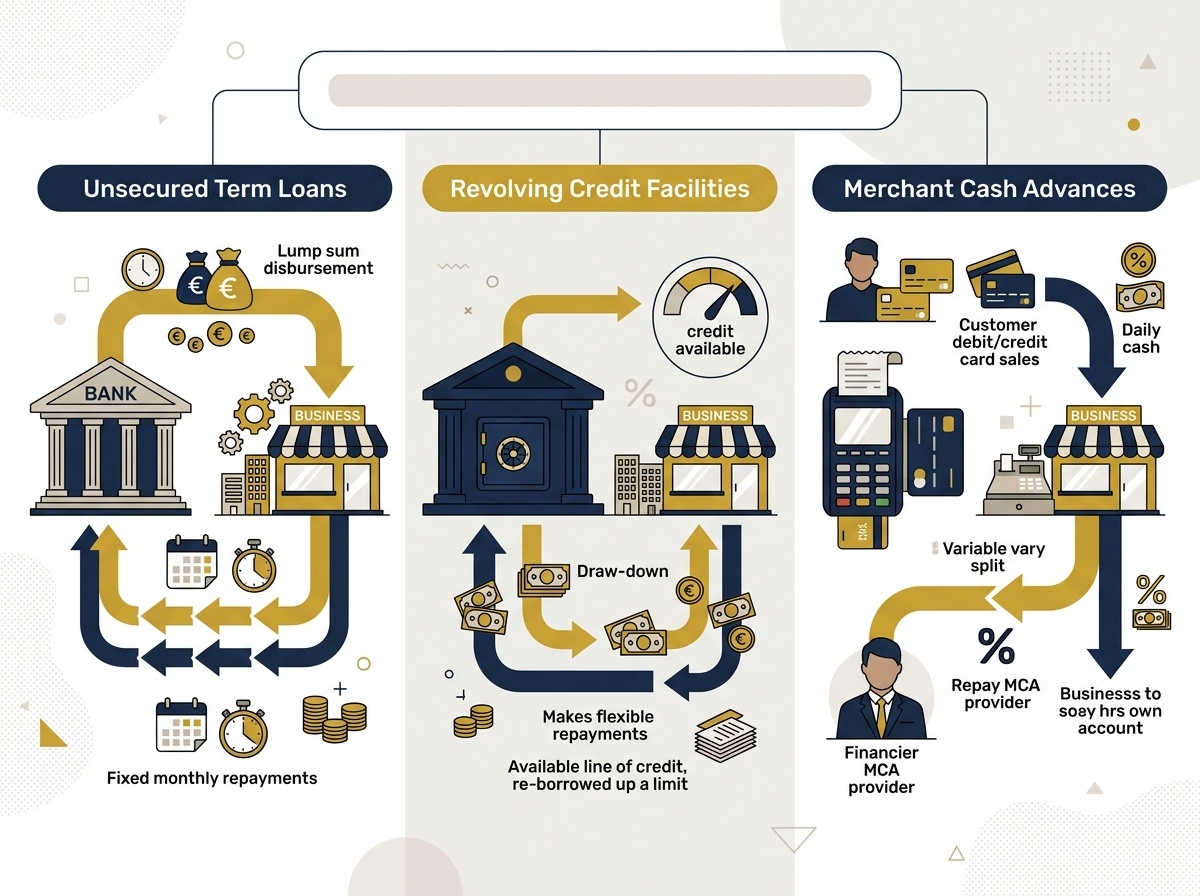
The 4 Primary Types of Cash Flow Lending Facilities in the UK
Cash flow finance is not a monolithic product. UK lenders offer distinct financial structures engineered for specific operational scenarios:
1. Unsecured Business Term Loans
The standard workhorse of commercial cash flow finance. An approved business receives a lump-sum capital disbursement (typically £25,000 to £500,000) deposited directly into its corporate account. The principal and fixed interest are repaid in equal monthly amortising installments over an agreed term of 12 to 36 months.
Best suited for: Discrete, planned capital outlays with predictable payback horizons—such as recruiting key personnel, executing a marketing campaign, or funding office relocations.
2. Revolving Credit Facilities (RCF)
An agile, dynamic credit line that operates similarly to a high-limit corporate bank overdraft. The lender approves an overall credit ceiling (e.g. £100,000). The business can draw down funds instantly whenever working capital dips, repay the balance when customer receivables land, and re-borrow as needed. Crucially, interest is charged only on the drawn amount for the exact number of days it is active.
Best suited for: Managing month-to-month cash flow volatility, bridge-funding delayed customer invoices, and holding pre-approved liquidity for unforeseen commercial opportunities.
3. Merchant Cash Advances (MCA) & Revenue-Based Financing
Designed specifically for retail, hospitality, e-commerce, and healthcare businesses that process high volumes of customer transactions via card terminals or online payment gateways (Stripe, Worldpay, Zettle). The lender advances a lump sum, which is repaid automatically via an agreed percentage (typically 8% to 18%) of daily card takings.
Best suited for: Seasonal businesses. During slow trading weeks, daily repayments drop automatically; during peak trading periods, the advance clears faster without fixed monthly default penalties.
4. Selective Working Capital & Trade Finance Lines
Short-term credit lines designed specifically to fulfill confirmed purchase orders or purchase bulk raw materials. The lender pays your suppliers directly upon receipt of pro-forma invoices, granting you 60 to 90 days of breathing room to receive, package, dispatch, and collect payment from end customers.
For organizations with significant trapped debtor books, our detailed companion guide on business invoice factoring rates in the UK details how to advance up to 90% of certified sales ledgers within 24 hours.
Comparative Matrix: Evaluating UK Cash Flow Finance Options
Regulatory oversight established under the FCA commercial lending principles ensures market transparency across alternative lending platforms. Use the following comparative matrix to evaluate borrowing parameters:
Real-World Financial Model: £50,000 Working Capital Comparison
To examine the true cost of borrowing in pounds and pence, consider a UK business requiring £50,000 in working capital over a 12-month period. Below is a direct comparison between a standard 12-month Unsecured Fixed Term Loan and an active Revolving Credit Facility (RCF) utilized strategically for 3 peak billing cycles (90 total days):
Strategic Insight: If your business requires capital for continuous 12-month capital deployment, the fixed term loan provides total budget certainty. However, if your cash flow strain is intermittent (such as bridging 45-day debtor payment cycles or funding quarterly stock purchases), a Revolving Credit Line cuts your financing expense by nearly 44% (£2,745 vs £4,873) because you only incur interest charges while capital is actively out of the bank.
For founders evaluating emergency same-day liquidity solutions, our guide on short-term business loans in the UK breaks down instant application workflows and alternative fintech lenders.
Underwriting Criteria: What UK Cash Flow Lenders Look For
Alternative commercial lenders have replaced bureaucratic loan committees with algorithmic risk assessments powered by secure Open Banking protocols. According to reporting from UK Finance Business Finance Review data, lenders assess four core viability pillars:
- Demonstrated Trading History: Most prime cash flow lenders require a minimum of 6 to 12 months of active trading history registered on Companies House. Startups with under 6 months of trading are generally redirected to government-backed Start Up Loans.
- Verifiable Turnover Thresholds: Lenders typically mandate a minimum annual turnover of £50,000 to £100,000 (£4,000 to £8,000 per month). Maximum borrowing limits are normally calibrated at 10% to 25% of annual turnover.
- Bank Statement Cleanliness (Volatility & Bounces): Open Banking integrations audit 3 to 6 months of corporate current account activity. Underwriters scrutinize the volume of unpaid direct debits, overdraft utilization, and days spent in credit. A business maintaining a steady buffer commands significantly lower interest margins.
- Affordability & Debt Service Coverage Ratio (DSCR): Lenders verify that net monthly operating cash flows comfortably exceed the proposed loan repayment by at least 1.25x to 1.5x.
The Director Personal Guarantee (PG): Mitigating Your Exposure
Because cash flow loans are unsecured against physical corporate assets, lenders almost universally require company directors holding 20% to 25%+ equity to execute a formal Personal Guarantee (PG). In the event of company insolvency or liquidation, the personal guarantee pierces the corporate veil, rendering the director personally liable for the outstanding debt.
Before executing an unsecured cash flow facility, commercial directors should take three proactive measures to insulate their personal balance sheet:
- Negotiate a Guarantee Cap: Rather than signing an open-ended personal guarantee, negotiate a capped guarantee (e.g. limited to 50% or 100% of initial principal), which burns down as the loan is repaid.
- Procure Personal Guarantee Insurance (PGI): In the UK, specialist insurers (such as Purbeck Insurance) underwrite PGI policies that cover up to 60% to 80% of a director’s personal liability in the event of default.
- Verify Cross-Guarantee Clauses: If your company operates within a corporate group structure, ensure the lender does not attach “all-monies” cross-guarantees to sister entities without board consent.
If your enterprise operates commercial vehicles or machinery that could provide physical collateral to lower borrowing costs without personal guarantees, explore our comprehensive analysis on business vehicle finance and asset leasing in the UK.
Leading UK Cash Flow & Unsecured Lenders in 2026
The UK lending ecosystem offers diverse platforms catering to distinct turnover tiers and speed requirements:
- Funding Circle: The UK’s largest SME fintech lending platform. Provides unsecured business loans from £10,000 to £500,000 over 6 months to 6 years, with decisions delivered in under 24 hours. Ideal for established profitable limited companies.
- Iwoca: Pioneering revolving credit lines up to £500,000 via its Flexi-Loan product. Zero early repayment fees, allowing businesses to draw and repay dynamically. Excellent for rapid inventory cycles and cash flow smoothing.
- Allica Bank: Named the UK’s fastest-growing fintech business, Allica Bank focuses on established mid-market SMEs (£1M+ turnover) offering structured cash flow loans alongside bespoke commercial banking.
- YouLend: Leading embedded revenue-based financing provider. Integrates directly with eBay, Amazon, Shopify, and payment processors to deliver instant merchant cash advances repaid via future digital card takings.
- Nucleus Commercial Finance: Offers versatile working capital solutions spanning unsecured business loans, business growth loans, and structured revenue facilities from £25,000 up to £2,000,000.
Frequently Asked Questions (FAQ)
Can a UK business secure a cash flow loan with poor credit?
Yes, though pricing and loan terms will reflect the increased risk profile. Specialist alternative lenders prioritize recent trading momentum, daily bank balances, and gross margins over historic credit score blemishes. If your business has past County Court Judgments (CCJs) that have been satisfied, or temporary credit dips during a seasonal lull, providing 6 months of strong Open Banking statements and a director personal guarantee can still secure approvals, typically at APRs between 18% and 28%.
How fast can a business receive cash flow lending funds?
Through modern Open Banking API integrations, automated credit decisions are frequently rendered within 1 to 4 hours. Once contracts and director personal guarantees are digitally signed via DocuSign, funds are transferred via CHAPS or Faster Payments within 24 to 48 hours of initial application.
What is the difference between an overdraft and a revolving credit facility?
A bank overdraft is tied directly to your primary business checking account and is technically repayable on demand at the bank’s sole discretion. A Revolving Credit Facility (RCF) is an independent standby credit line with an agreed contractual term (typically 12 to 24 months). RCFs provide greater stability because the lender cannot arbitrarily revoke the facility overnight, and they often offer substantially higher borrowing ceilings than traditional bank overdraft limits.
Are cash flow loan interest payments tax deductible?
Yes. In the UK, commercial loan interest, arrangement fees, and facility charges incurred solely for business trading purposes are fully allowable business expenses deductible against your company’s taxable profits for Corporation Tax purposes. However, the capital principal repayment is a balance sheet transaction and is not tax deductible.
Can I repay a cash flow loan early to save on interest?
This depends on your lender’s contract terms. Flexible alternative lenders like Iwoca charge daily interest and impose zero early settlement penalties, allowing you to repay the full balance immediately and save on future interest. Traditional fixed-term lenders (such as Funding Circle) may calculate total interest into a fixed repayment schedule or charge an early redemption fee. Always verify early repayment terms before executing the facility agreement.
How much can my business borrow based on turnover?
As a standard commercial underwriting rule of thumb, UK cash flow lenders typically cap unsecured borrowing at 10% to 25% of your annual gross turnover, or roughly 1.0x to 1.5x your average monthly bank deposits. For example, a business turning over £600,000 annually can typically secure an unsecured facility between £60,000 and £120,000, assuming healthy gross margins and strong debt service coverage.
Strategic Execution Checklist for Finance Leaders
Cash flow lending has revolutionized UK corporate finance by decoupling borrowing power from physical land and machinery. For modern British businesses operating in service delivery, digital trade, construction sub-contracting, and professional consulting, cash flow facilities provide the strategic financial horsepower required to navigate late payment cycles, bridge procurement milestones, and accelerate commercial growth.
When executing a cash flow lending strategy, focus on matching the facility structure to your exact operational need: deploy fixed-term loans for discrete, one-off growth investments; maintain a revolving credit facility as a flexible liquidity backstop; and leverage merchant cash advances for automated, revenue-indexed seasonal flexibility. By maintaining clean Open Banking records, auditing personal guarantee exposure, and benchmarking total borrowing costs against operating margins, business leaders can transform working capital finance into an engine of sustainable competitive advantage.