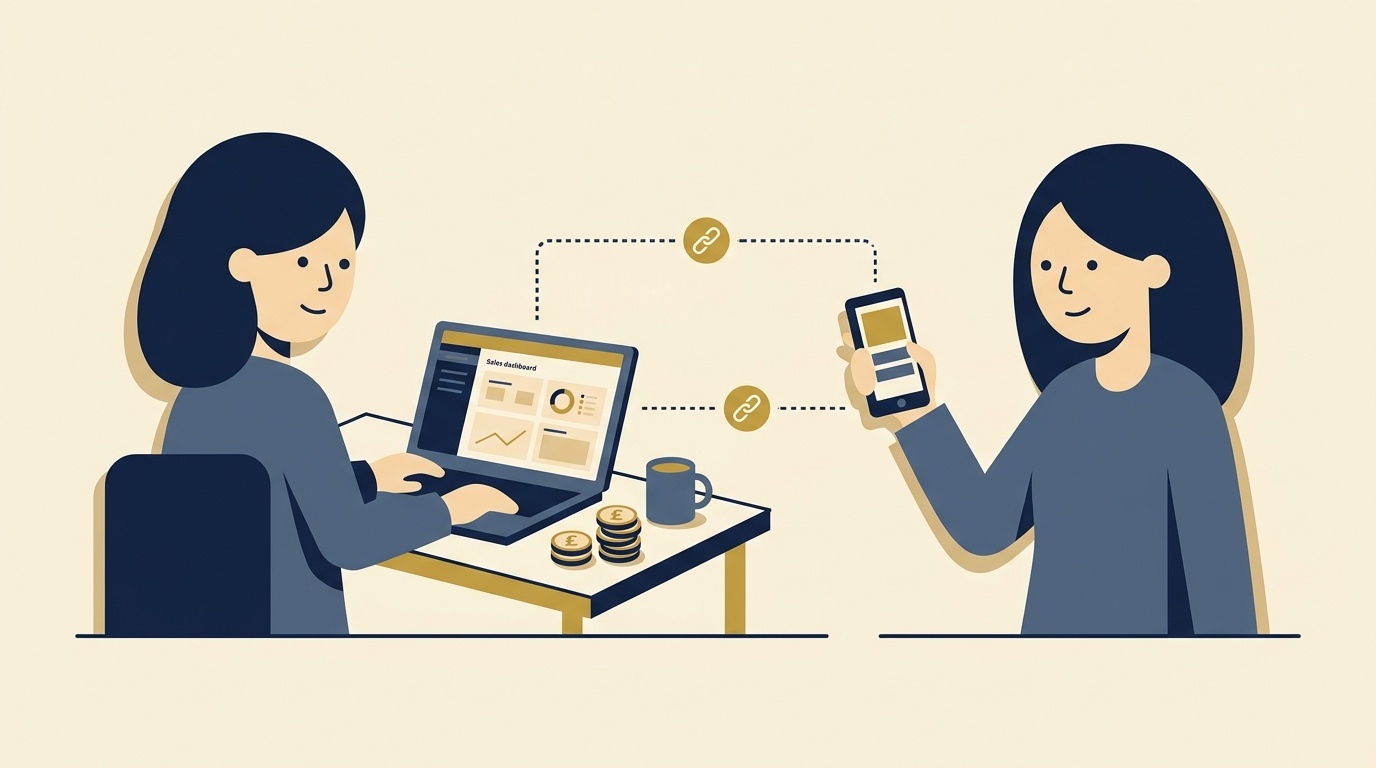
Affiliate activity generated £21bn of e-commerce revenue for UK brands in 2025, according to the Affiliate and Partner Marketing Association (APMA). The channel is growing at around 7% a year. That figure surprises people who still picture affiliate marketing as a few links on a coupon site. In reality, it now sits alongside paid search and social as a core sales channel for British retailers, travel firms, insurers and software businesses.
This guide explains how affiliate marketing works in the UK from both sides of the deal. You will see how a business sets up and pays for a programme, and how a publisher or creator earns commission. We also cover what the money realistically looks like and which UK rules apply (advertising disclosure, tax and cookie consent). By the end, you should be able to decide whether affiliate marketing deserves a place in your 2026 plans, and which role suits you.
Quick Answer: What Is Affiliate Marketing?
Affiliate marketing is a performance-based arrangement in which a business (the merchant) pays a third party (the affiliate or publisher) for results. Commission is earned on each sale, lead or sign-up that partner sends its way. Tracking happens through unique links or discount codes, usually managed by a network such as Awin or a brand-run scheme such as Amazon Associates. Merchants only pay when a result arrives, which keeps acquisition costs predictable. Affiliates earn without holding stock, but income depends on traffic, trust and the commission rate. In the UK, both parties are responsible under the CAP Code, so affiliate content must be clearly labelled as advertising. Affiliate income is taxable, though the first £1,000 of gross trading income each tax year can be covered by HMRC’s trading allowance.
Key Takeaways
- Affiliate activity drove £21bn of e-commerce revenue for UK brands in 2025 (APMA).
- Merchants pay on results, typically a percentage of each sale or a fixed fee per lead.
- Brands and affiliates share responsibility for clear ad labelling under the CAP Code.
- Affiliate income above £1,000 a year usually needs reporting to HMRC through Self Assessment.
- Most new affiliates earn little for the first six to twelve months while content and audience build.
Is Affiliate Marketing Worth It in 2026?
For a UK business with healthy margins and a product people already search for, yes, it is usually worth testing. You pay only for outcomes, and a good publisher can reach buyers your own ads miss.
For an individual hoping to earn, it can work, but it behaves like building a small media business rather than a side income switch. Expect months of unpaid effort before commission becomes meaningful.
How Affiliate Marketing Works, Step by Step
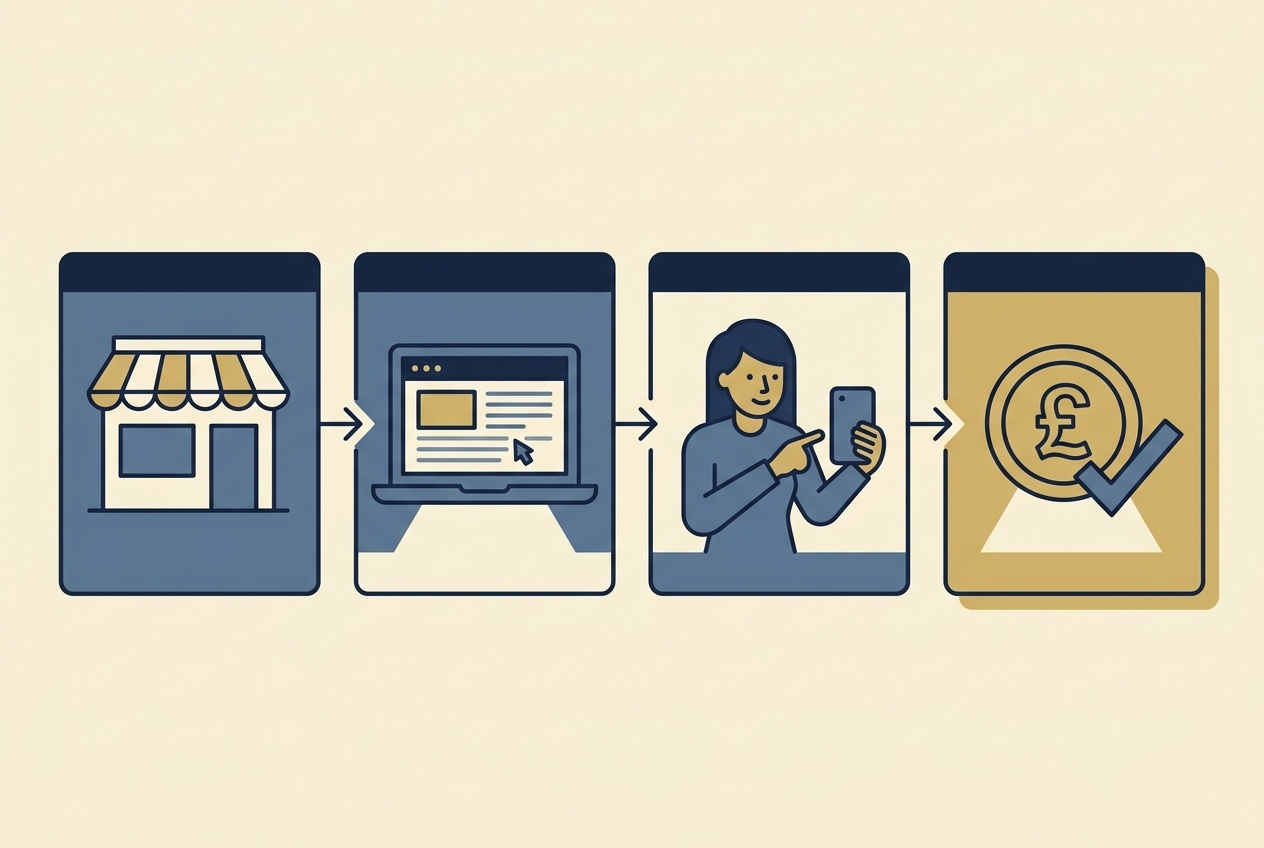
Every affiliate arrangement involves the same basic chain. A merchant offers a commission, an affiliate promotes the product, a customer clicks a tracked link, and a sale or lead is recorded and paid for.
Here is the sequence in practice:
- The merchant creates a programme. It sets commission rates, a cookie window (how long after a click a sale still counts), and rules on where and how affiliates may promote.
- Affiliates apply and get approved. Merchants review each applicant’s site, channel or audience before granting access.
- The affiliate gets unique tracking links or codes. These identify which partner referred each customer.
- A customer clicks and converts. The tracking platform records the sale, sign-up or lead against that affiliate.
- The merchant validates the transaction. Returns, cancellations and fraudulent orders are usually removed before payment.
- Commission is paid. Payment typically follows a set validation period, often 30 to 90 days after the sale.
The validation lag matters for both sides. A merchant gets protection against refunded orders, but an affiliate may wait two or three months to see cash from a busy period. Anyone relying on that money should plan around it, as our guide to managing small business cash flow explains.
Networks Versus In-House Programmes
Most UK merchants run their programme through a network such as Awin, CJ, Rakuten Advertising or Impact. The network handles tracking, publisher recruitment, payments and fraud checks, and charges the merchant a fee on top of commission.
Larger brands sometimes run an in-house scheme instead. Amazon Associates is the best-known example. It gives the brand more control, but it also means building the tracking, compliance checks and partner management yourself.
The Main Types of Affiliates
“Affiliate” covers a wide range of partners. Knowing which type you are working with, or which type you could become, shapes everything from commission rates to compliance risk.
| Affiliate Type | How They Drive Sales | Typical Strength | Watch Out For |
|---|---|---|---|
| Content and review sites | Product reviews, comparisons and buying guides | High-intent search traffic | Thin or biased reviews |
| Voucher and cashback sites | Discount codes and money-back rewards | Large audiences ready to buy | Claiming sales that would have happened anyway |
| Influencers and creators | Social posts, video and live content | Trust and reach with niche audiences | Missing or unclear ad labels |
| Comparison sites | Side-by-side price and feature tables | Strong in insurance, energy and finance | High cost per lead |
| Email and newsletter publishers | Curated offers sent to subscribers | Repeat exposure to a loyal list | Consent rules under PECR |
| B2B and SaaS partners | Referrals from consultants, agencies and tools | High-value, recurring customers | Long sales cycles and attribution disputes |
Content sites and creators are where most people start. Voucher and cashback partners tend to dominate retail programmes by volume. That is why many merchants now pay them a lower rate than partners who introduce genuinely new customers.
Commission Models and What They Cost
Merchants choose how to pay, and the model affects both risk and profit. There is no single standard rate in the UK; each programme sets its own terms, and rates vary widely by sector and margin.
| Model | Merchant Pays For | Common In |
|---|---|---|
| Cost per sale (CPS) | A percentage of each completed order | Retail, fashion, homeware |
| Cost per lead (CPL) | A fixed fee per qualified enquiry or quote | Insurance, finance, B2B services |
| Cost per acquisition (CPA) | A flat fee per new customer or account | Broadband, banking, subscriptions |
| Recurring commission | A share of monthly fees while the customer stays | SaaS, software, memberships |
| Hybrid or tenancy | A flat placement fee plus commission | Large publishers, seasonal campaigns |
For merchants, the real cost is more than the headline rate. Add network fees, any agency management charge, voucher-code discounts and staff time. A 10% commission can easily become a 15% to 20% total cost of sale once these are counted.
The sensible test is simple. Compare your all-in affiliate cost of acquisition against what the same customer costs through paid search or social, and against that customer’s lifetime value.
How UK Businesses Can Launch an Affiliate Programme
For a merchant, affiliate marketing works best as one part of a wider plan, not a quick fix for weak sales. If you are still shaping that plan, our small business marketing strategy guide is a useful starting point.
- Check your margins first. Work out how much you can pay per sale and still profit after returns, fees and discounts.
- Choose a network or platform. Compare set-up fees, monthly minimums and the strength of their publisher base in your sector.
- Write clear programme terms. Cover commission rates, cookie length, banned promotion methods (such as bidding on your brand name), and disclosure requirements.
- Prepare creative and product data. Affiliates need banners, product feeds, accurate prices and approved claims.
- Recruit deliberately. A handful of well-matched content partners often beats hundreds of inactive sign-ups.
- Review performance monthly. Track incremental sales, return rates and cost per customer by partner, then adjust rates accordingly.
Affiliate traffic also lands on your own pages, so your site, reviews and follow-up need to convert. Strong post-purchase emails help lift repeat sales from affiliate-referred customers, as covered in our piece on the benefits of email marketing.
How to Start Affiliate Marketing as a Publisher
If you want to earn as an affiliate, the asset you are building is an audience that trusts you. Commission follows trust, not the other way round.
- Pick a niche you can cover credibly. Specialist topics with clear buying decisions (business software, outdoor kit, home energy) tend to convert better than broad lifestyle content.
- Choose your main channel. A website built on search traffic compounds over time; social channels grow faster but depend on platform algorithms.
- Join relevant programmes. Apply through networks and direct schemes once you have some genuine content live, since many merchants reject empty sites.
- Create useful, honest content. Comparison tables, real testing notes and clear pros and cons outperform generic product lists.
- Label every promotion. Make the commercial relationship obvious before anyone clicks (see the rules below).
- Track and reinvest. Watch which pages and partners earn, then build more of what works.
Creators building on social platforms should read our guide on how to grow Instagram for business, since reach and engagement drive affiliate results on that channel.

How Much Can You Earn From Affiliate Marketing?
Earnings vary enormously, and anyone promising a fixed monthly figure is selling something. Income depends on four variables: traffic, conversion rate, average order value and commission rate.
A simple worked example shows how the maths plays out. Suppose a review page gets 5,000 visits a month, 4% of visitors click through, 3% of those buy, the average order is £80 and commission is 6%. That gives 6 sales and £28.80 a month. To reach £1,000 a month on the same numbers, you would need roughly 175,000 visits.
That is why most affiliate income is concentrated among established sites and creators. Higher-value niches (software, finance comparison, travel) can change the sums sharply, but they are also the most competitive and most tightly regulated.
UK Rules: Disclosure, Advertising and Cookies
This is where many guides written for a US audience fall short. In the UK, three sets of rules matter most.
Advertising Disclosure Under the CAP Code
The Advertising Standards Authority treats affiliate content as advertising. Its CAP guidance on affiliate marketing states that both the business and the affiliate are responsible under the Code, even when the affiliate created the ad alone.
In practice, affiliate content must be obviously identifiable as advertising. On social media, a clear label such as “#ad” placed upfront is the safe approach. Blogs and editorial pages are treated a little differently. There, the ASA may apply the Code only to the parts that mention the affiliate brand or carry the link, but those parts still need clear labelling.
Cookie Consent and Tracking
Most affiliate tracking relies on cookies or similar technologies. Under the Privacy and Electronic Communications Regulations, non-essential cookies generally need user consent. The ICO’s guidance on cookies and similar technologies sets out what that means for websites. Merchants should check that their consent banner and their network’s tracking work together, or valid sales may go unrecorded.
Consumer Protection and Honest Claims
Reviews and recommendations must reflect genuine opinion and accurate information. Fake or misleading reviews and hidden paid endorsements now carry real enforcement risk under UK consumer protection law, so merchants should vet what partners say about their products.

Tax on Affiliate Income in the UK
HMRC treats affiliate commission as trading income in most cases. The figures below apply to the 2026/27 tax year and should be checked against gov.uk before you file, as thresholds can change.
- Trading allowance: HMRC’s £1,000 tax-free trading allowance covers gross trading income up to £1,000 a year. Above that, you can deduct the allowance or your actual expenses, whichever is better.
- Self Assessment: If gross affiliate income exceeds £1,000, you will normally need to register for Self Assessment. The registration deadline is 5 October after the tax year ends, and the online return is due by 31 January.
- VAT: Registration becomes compulsory once VAT-taxable turnover passes £90,000 in a rolling 12-month period.
- Making Tax Digital: From April 2026, sole traders and landlords with qualifying income above £50,000 must keep digital records and send quarterly updates to HMRC.
Payments from overseas networks and programmes count too, even if they arrive in dollars or euros. Keep records of every payout, its sterling value and any related costs such as hosting, software and equipment.
Tax treatment depends on your full circumstances, especially if you also run a limited company or have other income. Speak to an accountant before your first return if affiliate earnings are becoming significant.
Risks and Common Mistakes
Affiliate marketing has real downsides on both sides of the deal, and ignoring them is how programmes lose money and publishers lose trust.
For merchants:
- Paying for sales you already had. Voucher sites and brand-term bidding can claim credit for customers who were already at checkout.
- Weak partner vetting. One affiliate making false claims can land your brand in an ASA ruling.
- Ignoring returns. High-return categories need a validation period long enough to reverse commission on refunded orders.
- Brand damage. Aggressive or spammy promotion reflects on you. Our guide to online reputation management covers how to protect your name.
For affiliates:
- Relying on one programme. Merchants can cut rates or close schemes with little notice.
- Chasing commission over quality. Pushing poor products erodes the audience trust that drives every future sale.
- Platform dependence. A search algorithm update or social policy change can cut traffic overnight.
- Skipping disclosure. Unlabelled affiliate posts risk ASA action and, increasingly, removal by platforms.
Frequently Asked Questions
How do I start affiliate marketing with no money?
You can join most networks for free and start on a free social account or a low-cost website. The real investment is time spent creating useful content and building an audience before commission arrives.
Can you really make money with affiliate marketing?
Yes, but most beginners earn very little in their first year. Meaningful income usually comes from sustained traffic in a niche with good commission rates, built over many months.
What are the three main types of affiliate marketing?
A common split is unattached, related and involved. Unattached affiliates run paid promotion with no personal connection, related affiliates promote products relevant to their niche without using them, and involved affiliates recommend products they have genuinely used. Involved affiliates tend to earn the most trust.
Do I need to declare affiliate income to HMRC?
If your gross trading income, including affiliate commission, is over £1,000 in a tax year, you will usually need to register for Self Assessment and declare it. Below that, the trading allowance often covers it, though some circumstances still require a return.
Is affiliate marketing legal in the UK?
Yes. It is legal provided the content complies with the CAP Code, consumer protection law and data protection rules, including clear advertising labels and proper cookie consent.
How much does it cost a business to run an affiliate programme?
Costs include commission, network fees, any set-up or monthly charges, and management time. Many small businesses find total costs land well above the headline commission rate once everything is counted.
What is a cookie window in affiliate marketing?
It is the period after a click during which a sale is still credited to the affiliate. Windows vary by programme, and longer windows favour affiliates whose audiences take time to decide.
Your Next Actions
Affiliate marketing rewards patience and honesty on both sides. For businesses, it offers a pay-on-results channel that can reach new customers, provided you control costs, vet partners and measure incremental sales rather than raw volume.
For would-be affiliates, it is a genuine way to earn from expertise, but it takes consistent content and a clear niche. Start small, label everything, and keep tax records from the first payout.
If you run a business, list your margins and three to five ideal publishers this week, then compare two networks before committing. Planning to become an affiliate? Pick one niche, publish your first ten genuinely useful pieces, and apply to programmes once they are live. Either way, build it into your wider plan for how to market a business online rather than treating it as a standalone shortcut.