
According to annual data published by UK Finance in its Invoice Finance and Asset-Based Lending Report, the commercial invoice finance sector provides over £22 billion in live funding advances to British industry, supporting more than £300 billion in corporate client turnover across 40,000 businesses. Despite this massive volume of deployed capital, late payment practices remain a persistent hurdle for growing enterprises. Data from the Federation of Small Businesses reveals that the average UK business-to-business transaction faces debtor collection cycles stretching between 45 and 65 days, leaving vast sums of liquid cash trapped inside accounts receivable.
For commercial directors striving to expand operations, meet strict month-end payroll commitments, or fund volume stock orders, waiting two months for corporate customers to settle balances stalls commercial momentum. Setting up an invoice discounting uk facility provides an agile solution, allowing commercial enterprises to release up to 90% of their sales ledger value within 24 hours of invoice generation. Unlike traditional debt factoring, invoice discounting operates confidentially, ensuring that client communications, credit control procedures, and commercial goodwill remain under internal management.
Quick Answer: What Is Invoice Discounting in the UK?
Invoice discounting is a confidential commercial finance agreement where a UK business borrows against the gross value of its unpaid business-to-business (B2B) sales invoices. A specialist finance provider advances between 75% and 90% of the invoice total immediately upon issuance, with the remaining 10% to 25% balance rebated once the debtor settles in full, minus an agreed discount fee. Because the facility is entirely confidential, customers pay into a designated trust bank account without knowing third-party funding is involved. The borrowing business maintains full control over customer relationships, invoicing, and payment collections. Pricing typically consists of a discount fee (1.5% to 3.5% over the Bank of England base rate) plus a service fee (0.2% to 1.5% of turnover).
Key Takeaways for UK Business Directors
- Invoice discounting releases up to 90% of unpaid B2B invoice value into company bank accounts within 24 hours of billing.
- The structure is completely confidential, meaning customers continue dealing exclusively with your internal credit control team.
- Finance costs consist of two components: a discount interest margin over the Bank of England base rate and a service administration fee.
- Facilities can be structured as recourse (business retains debtor default risk) or non-recourse (includes bad debt credit protection).
- Lenders typically require a minimum annual turnover of £100,000 to £250,000, clean B2B trading accounts, and low customer concentration.
What Is Invoice Discounting?
Invoice discounting is a revolving form of asset-based debt finance that converts outstanding accounts receivable into immediate liquidity. Instead of waiting thirty, sixty, or ninety days for commercial clients to remit payment, a company uses its verified sales invoices as collateral to secure fast working capital.
The core advantage of invoice discounting is confidentiality. In standard invoice factoring, the finance provider takes legal control of the sales ledger, issues statements under their own letterhead, and contacts your clients directly to chase payments. In contrast, confidential invoice discounting remains invisible to external stakeholders. Your buyers receive standard commercial invoices carrying your company branding, communicate with your existing accounts team, and remit settlement funds into a dedicated client trust bank account opened in your firm’s name.
This confidentiality makes invoice discounting the preferred cash flow mechanism for established mid-market enterprises, engineering firms, logistics operators, recruitment agencies, and wholesale distributors who want liquidity without signaling financial distress or introducing aggressive third-party collection agents to prized corporate clients.
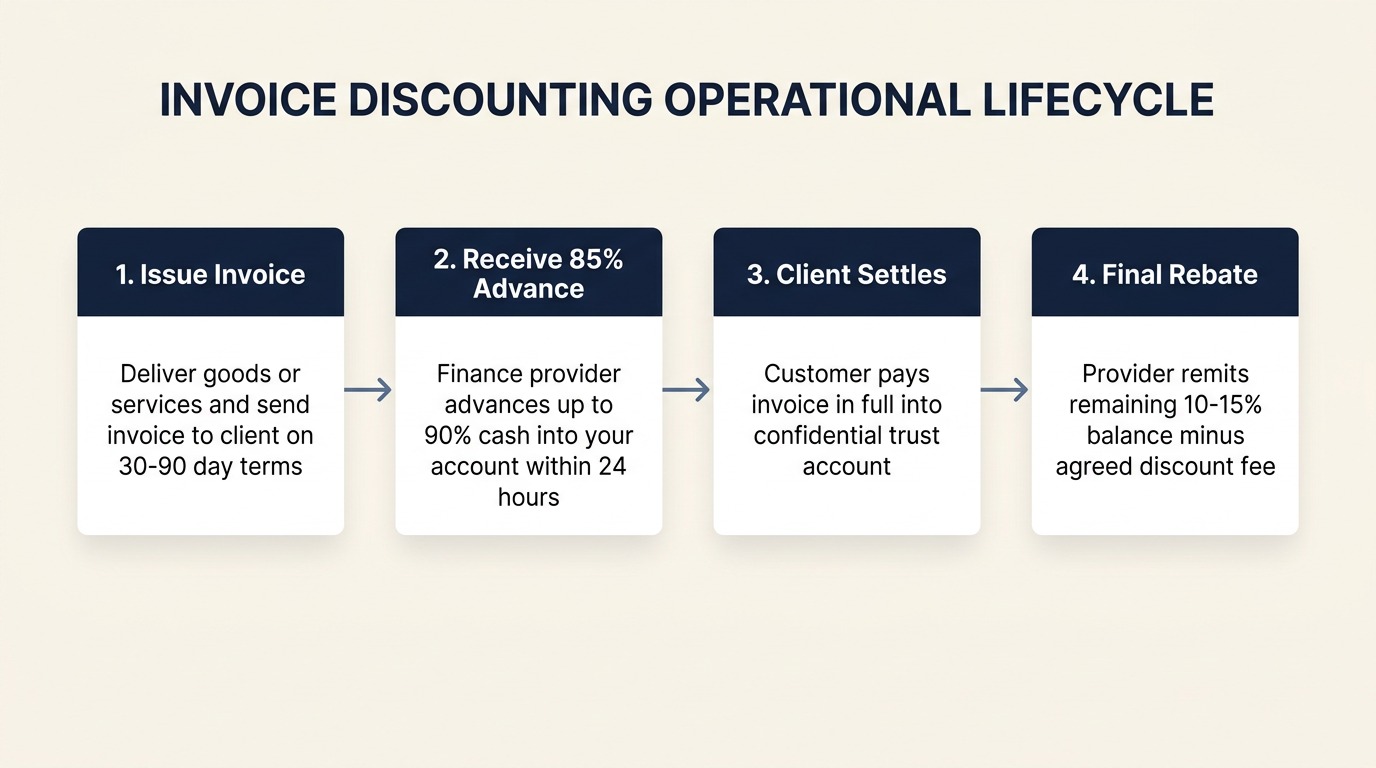
How Invoice Discounting Works: The 4-Step Operational Cycle
The operational rhythm of an invoice discounting facility is straightforward and integrates directly with modern cloud accounting software. Most modern finance providers connect via secure application programming interfaces (APIs) to Xero, QuickBooks, Sage, or Microsoft Dynamics, automating the funding lifecycle.
Step 1: Deliver Goods and Issue Invoices
Your business completes the contractual delivery of goods or performs the agreed commercial services. You issue standard B2B invoices to your client detailing payment terms, typically set at 30, 60, or 90 days. Simultaneously, your cloud accounting software synchronizes the newly raised sales ledger entries with your finance provider’s digital platform.
Step 2: Receive the Upfront Cash Advance
Within hours of verifying the uploaded invoices, the discounting provider deposits an agreed percentage of the gross invoice value directly into your business bank account. In the UK market, this advance rate ranges from 75% to 90%, with 85% representing the industry median. A £100,000 invoice batch generates an immediate cash injection of £85,000, providing immediate working capital to pay staff, settle supplier bills, or take on new contracts.
Step 3: Customer Settles the Invoice Confidentially
Your internal credit control department manages credit monitoring and payment collection exactly as before. When the invoice due date arrives, your customer pays 100% of the invoice amount into a “blind” trust bank account. This account is opened in your company’s name but legally held in trust for the discounting provider, ensuring the transaction remains completely invisible to the paying debtor.
Step 4: Provider Releases the Final Rebate
Upon confirming receipt of the cleared funds from your customer, the finance provider transfers the remaining balance (the 10% to 25% retention margin) back to your primary operating account. Before releasing this rebate, the provider deducts their accrued discount fee and any agreed service charges for the duration the capital was drawn.
Invoice Discounting vs Factoring: The Crucial Differences
While invoice discounting and factoring both belong to the invoice finance family, their legal and operational mechanics differ substantially. Choosing the wrong mechanism can create customer friction or unnecessary administration overhead.
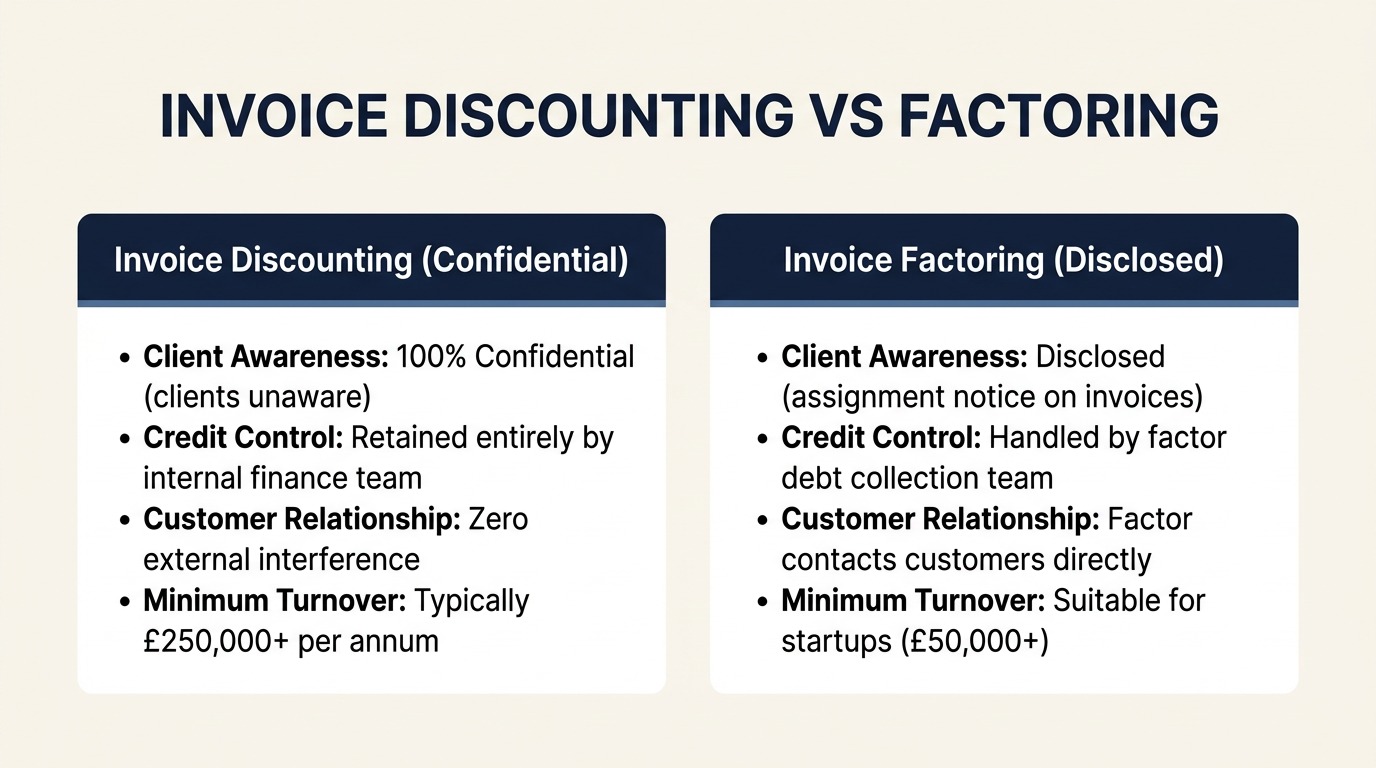
The choice between these two facilities hinges on whether your company possesses the internal credit control personnel to collect outstanding receivables independently, and whether confidentiality is paramount.
According to UK Finance invoice finance market data, invoice discounting represents over 70% of all funds advanced across the UK invoice finance sector. Larger enterprises consistently favour discounting because it allows them to protect customer trust while securing flexible, scalable capital.
The Cost Structure: Discount Fees, Service Charges and Hidden Costs
Accurately pricing an invoice discounting arrangement requires understanding two primary charges alongside potential ancillary fees. Because pricing scales alongside debtor turnaround time, faster-paying customers directly reduce your borrowing expenses.
1. The Discount Fee (Interest Charge)
The discount fee represents the cost of the borrowed capital. It functions identically to a bank overdraft interest rate, calculated on the daily drawn balance. Providers typically quote this as a margin over the Bank of England base rate, usually between 1.5% and 3.5%.
For example, with a Bank of England base rate at 4.5% and a lender margin of 2.5%, the annual borrowing rate is 7.0%. If you draw an advance of £50,000 for 45 days, the total discount charge equals approximately £431.50 (£50,000 x 7.0% x 45 / 365).
2. The Service Fee (Administration Charge)
The service fee covers ongoing platform management, ledger auditing, and account maintenance. Unlike the discount fee, which applies only to drawn funds, the service fee is calculated as a small percentage of your gross annual turnover, typically ranging from 0.20% to 1.50% depending on transaction volume and invoice frequency.
3. Ancillary Fees to Review
When reviewing commercial facility agreements, directors should examine the schedule of charges for ancillary costs:
- Audit Fees: Periodic field examinations where the lender inspects your physical or digital sales ledger (typically £400 to £1,000 per audit).
- Setup and Onboarding Fees: One-off documentation and legal preparation fees charged at facility inception.
- Refactoring Charges: Additional fees levied on overdue invoices that remain unpaid beyond 90 or 120 days.
- Minimum Usage Fees: Minimum monthly service charges applied if your monthly invoice volume falls below contracted projections.
The table below models realistic commercial costs across four typical UK turnover profiles using standard market parameters.
When balanced against commercial expansion, this cost structure is frequently far cheaper than equity dilution or high-interest unsecured borrowing. For alternative capital structures, review our comparison of instant business loan options.
Recourse vs Non-Recourse: Protecting Against Customer Insolvency
When negotiating an invoice discounting agreement, business owners must decide how credit risk is allocated if a debtor fails to settle their bill. This choice separates facilities into recourse and non-recourse structures.
Recourse Invoice Discounting
Under a recourse arrangement, your company retains ultimate liability for bad debts. If a commercial customer enters liquidation, declares administration, or defaults on an approved invoice, the lender has the right to “recourse” the debt back to you. You must either repurchase the invoice using liquid cash reserves or replace it with a fresh, performing sales invoice from another client.
Because the finance provider shoulders zero bad debt risk, recourse discounting carries significantly lower service and discount fees. It represents the best option for businesses dealing with creditworthy blue-chip clients, public sector bodies, or long-standing corporate counterparties with impeccable credit histories.
Non-Recourse Invoice Discounting (Bad Debt Protection)
Non-recourse discounting incorporates credit insurance, commonly termed bad debt protection. If an approved customer suffers formal insolvency before settling an eligible invoice, the finance provider absorbs the financial loss up to the pre-agreed credit limit on that specific account.
Non-recourse facilities provide peace of mind, especially for suppliers operating on tight profit margins where a single £50,000 bad debt could trigger catastrophic cash flow shocks. However, non-recourse facilities carry higher service fees (often an additional 0.3% to 0.8% of turnover) to fund the underlying credit insurance policy.
Crucially, non-recourse protection applies strictly to formal customer insolvency. If a debtor refuses payment due to a commercial dispute, damaged stock, or service disagreements, the invoice is deemed disputed and immediately recourses back to the supplier.
Eligibility Criteria for UK Companies
Invoice discounting providers maintain specific underwriting criteria to verify that an applicant’s sales ledger can support a secure revolving credit facility.
1. Strictly Business-to-Business (B2B) Trading
Invoice discounting is exclusively available to businesses selling goods or services to other corporate entities or government bodies on credit terms. Business-to-consumer (B2C) operations, cash retail businesses, and point-of-sale retail stores are ineligible, as individual consumers do not generate commercial credit invoices.
2. Minimum Turnover Thresholds
Mainstream UK providers, including high-street banks like Barclays, NatWest, and HSBC, generally require a minimum annual turnover of £250,000 to £500,000. Independent commercial lenders and digital fintech platforms are more flexible, supporting established firms with annual turnovers starting from £100,000.
3. Strong Internal Credit Management
Because invoice discounting is confidential, the provider relies entirely on your internal staff to collect receivables. Lenders conduct an initial audit to inspect your historical debtor days, dispute procedures, debt recovery routines, and cash allocation accuracy. Having organized accounts in platforms like Xero or Sage substantially accelerates approval.
4. Manageable Debtor Concentration
Lenders evaluate your customer spread to avoid concentration risk. If a single customer accounts for 50% or more of your total sales ledger, lenders will cap the allowable advance on that specific client (often at 20% to 30% of the facility limit). A diversified ledger with multiple independent corporate buyers yields the highest advance rates.
To reduce overheads and protect working capital before securing debt facilities, ensure your company optimizes statutory exemptions such as Small Business Rates Relief UK.
Strategic Risks and Common Pitfalls to Avoid
While invoice discounting provides rapid working capital, reckless implementation can create structural dependencies or operational disruptions.
1. The Debtor Concentration Trap
Many growing subcontractors build strong relationships with a single primary contractor. If that main buyer accounts for 60% of your invoicing, your discounting provider will likely impose a “concentration cap.” This restricts the advance on that buyer’s invoices, meaning you may only receive funding on half of your raised billing, defeating the purpose of the facility.
2. Contractual Restrictions and Pay-When-Paid Clauses
Discounting providers will not finance invoices that contain “pay-when-paid” clauses, staged construction contracts without certified sign-offs, or sales made on a sale-or-return basis. Invoices must represent completed, indisputable deliveries of goods or performed services.
3. Ledger Dilution and Credit Note Creep
Ledger dilution occurs when the actual cash collected from debtors falls short of the gross invoiced value due to credit notes, volume rebates, early payment discounts, or returns. If your historical dilution exceeds 5%, lenders will reduce your advance rate from 85% down to 70% to insulate their risk buffer.
4. Late Payment Enforcement and the Small Business Commissioner
Financing invoices solves cash timing bottlenecks, but it does not fix persistent late payers. The Small Business Commissioner prompt payment guidance provides formal statutory mechanisms for UK suppliers to challenge unfair 90-day payment terms, enforce late payment interest penalties, and demand adherence to the UK Prompt Payment Code.
Combining invoice discounting with proactive debt management is essential. For practical protocols on optimizing cash flow health, consult our guide to cash flow management strategies.
Choosing the Right UK Invoice Discounting Provider
The UK commercial finance market offers three distinct tiers of invoice discounting providers, each catering to different corporate scales and operational preferences.
1. High-Street Clearing Banks
Institutions such as Barclays Corporate, HSBC Invoice Finance, Lloyds Bank Commercial, and NatWest offer large-scale facilities backed by extensive balance sheets. Their discount margins are frequently the lowest in the market (often 1.5% to 2.2% over base rate). However, underwriting processes are rigorous, onboarding can take four to six weeks, and personal director guarantees or debentures are standard requirements.
2. Specialist Independent Finance Houses
Lenders such as Close Brothers, Novuna Business Finance, Skipton Business Finance, and Bibby Financial Services specialize in flexible commercial lending. They offer faster onboarding (seven to fourteen days), higher advance percentages, and practical commercial understanding for businesses with complex supply chains or modest trading track records. Their service fees are slightly higher than clearing banks, but their flexibility provides superior accessibility.
3. Digital Fintech Platforms
Fintech lenders connect directly to cloud accounting software to deliver selective invoice discounting. Instead of financing your entire sales ledger under an annual contract, digital platforms allow you to discount individual high-value invoices as needed. While pricing per invoice is higher, this “pay-as-you-go” structure eliminates annual minimum service fees and lengthy lock-in contracts.
The British Business Bank working capital guide emphasizes that business owners should compare at least three independent quotes and seek independent financial advice before committing to multi-year exclusive sales ledger agreements.
Frequently Asked Questions
What is the difference between invoice discounting and an overdraft?
A bank overdraft provides a fixed borrowing limit that remains static regardless of business growth, and banks can withdraw or reduce overdraft limits on demand. In contrast, an invoice discounting facility grows dynamically alongside your sales turnover. As your sales ledger expands, your available credit line increases automatically, providing scalable working capital without renegotiating bank limits.
Will my customers know I am using an invoice discounting facility?
Under a confidential invoice discounting agreement, your customers will not know that you are financing your invoices. Invoices carry your company branding, payments are collected by your internal staff, and customer remittances are paid into a client trust bank account in your company name.
What percentage of invoice value can I receive upfront?
Most UK invoice discounting providers advance between 75% and 90% of the gross invoice value within 24 hours of invoice generation. The exact percentage depends on your sector, your historical debtor collection speed, customer credit ratings, and your sales ledger dilution rates.
Can early-stage startups use invoice discounting?
True confidential invoice discounting generally requires a minimum of twelve months of trading history, an established sales ledger, and an annual turnover of at least £100,000. Startups with shorter trading track records are typically guided toward disclosed invoice factoring or selective digital invoice financing.
What happens if a customer disputes an invoice?
If a customer disputes an invoice due to delivery errors or service quality, that specific invoice is removed from the eligible funding pool. If the lender has already advanced cash against that invoice, your business must either resolve the dispute promptly or replace the invoice with an eligible, undisputed invoice from another customer.
Does invoice discounting require a personal guarantee?
For limited companies with strong balance sheets and proven trading track records, providers often structure invoice discounting facilities against a corporate debenture and book debts charge without requiring a personal guarantee. However, for smaller enterprises or facilities carrying higher credit limits, directors may be asked for a personal guarantee or fraud indemnity.
The Bottom Line: How to Proceed
Invoice discounting provides UK businesses with an efficient, scalable mechanism to bridge commercial cash flow gaps without relinquishing customer relationships or equity control. By unlocking capital from unpaid sales ledgers, companies can confidently take on larger corporate contracts, secure bulk supplier discounts, and stabilize operational liquidity.
Before executing an agreement, perform an honest audit of your debtor book, confirm that your cloud accounting data is pristine, and evaluate whether a recourse or non-recourse facility aligns with your risk tolerance. With transparent pricing, disciplined credit control, and the right commercial lending partner, invoice discounting turns sluggish accounts receivable into a powerful engine for sustained corporate growth.