
The official general HMRC contact number for Income Tax and PAYE enquiries is 0300 200 3300, while the Self Assessment helpline is 0300 200 3310. Businesses querying VAT should dial 0300 200 3700, and limited companies dealing with Corporation Tax should ring 0300 200 3410. All main HMRC lines operate Monday to Friday from 8:00 AM to 6:00 PM and remain closed on bank holidays and weekends. Calls to 0300 numbers cost the same as standard 01 or 02 geographic landline calls and are included in free mobile minute bundles. To reduce wait times, telephone between 8:30 AM and 11:00 AM Tuesday to Thursday with your 10-digit UTR or National Insurance number ready.
- Direct Routing Saves Time: Dialling department-specific 0300 numbers bypasses central switchboard queues and routes directly to trained tax specialists.
- Best Calling Windows: HMRC call volumes drop significantly midweek between 8:30 AM and 11:00 AM compared to peak Monday morning rushes.
- Security Verification: Have your 10-digit Unique Taxpayer Reference (UTR), National Insurance number, and recent postal address verified before connecting.
- Zero Scam Tolerance: HMRC will never ring from an automated mobile number demanding immediate gift cards, crypto transfers, or threatening sudden arrest.
- Digital First Policy: Simple administrative updates, address changes, and tax code checks take seconds via the official HMRC app or Business Tax Account.
According to the National Audit Office customer service report, UK taxpayers spent more than 798,000 hours on hold across HM Revenue & Customs telephone helplines over a single fiscal year. Average waiting times frequently exceeded 22 minutes during peak self-assessment deadlines. Finding the correct hmrc contact number for your specific tax issue remains the quickest way to resolve filing errors, dispute coding notices, and secure debt relief.
Many individuals waste hours listening to automated voice menus because they ring the wrong helpline. HMRC operates dedicated, ring-fenced phone teams for separate taxes including Self Assessment, PAYE, VAT, Corporation Tax, and the Construction Industry Scheme. Connecting directly to the right department avoids transfers that can drop mid-call.
This guide provides the complete, verified directory of official HMRC phone numbers. We explain call costs, optimal calling hours, automated speech recognition prompts, and essential scam defence protocols.
Complete HMRC Contact Number Directory (2026 Verified)
HMRC maintains individual phone lines for each core tax regime. Below is the complete directory of direct telephone lines verified against the official GOV.UK HMRC contact directory.
| Tax Department | UK Contact Number | Outside UK Line | Opening Hours | Best Time to Call |
|---|---|---|---|---|
| Income Tax & PAYE (Employees/P800) | 0300 200 3300 | +44 135 535 9022 | Mon–Fri 8am–6pm | 8:30am–10:30am |
| Self Assessment & Sole Traders | 0300 200 3310 | +44 161 931 9070 | Mon–Fri 8am–6pm | 8:30am–11:00am |
| Corporation Tax (Limited Companies) | 0300 200 3410 | +44 151 268 0571 | Mon–Fri 8am–6pm | 8:30am–11:00am |
| VAT Enquiries & Surcharges | 0300 200 3700 | +44 2920 501 261 | Mon–Fri 8am–6pm | 8:30am–11:00am |
| Employer Enquiries (Payroll / PAYE) | 0300 200 3200 | +44 151 268 0558 | Mon–Fri 8am–6pm | 8:30am–10:00am |
| Construction Industry Scheme (CIS) | 0300 200 3210 | +44 161 930 8706 | Mon–Fri 8am–6pm | 9:00am–11:00am |
| National Insurance (Class 1, 2, 3) | 0300 200 3500 | +44 191 203 7010 | Mon–Fri 8am–6pm | 8:30am–11:00am |
| HMRC Online Services Helpdesk | 0300 200 3600 | +44 161 930 8445 | Mon–Fri 8am–6pm | 8:30am–10:30am |
| Customs & International Trade | 0300 322 9434 | +44 300 322 9434 | Mon–Fri 8am–10pm | 8:00am–9:30am |
If you are self-employed or run a sole trader business, calculate your exact annual liability using our free Sole Trader Tax Calculator before contacting HMRC to discuss payments or adjustments.

Payment Problems & Time to Pay Helplines
When cash flow difficulties prevent your business from settling tax bills on time, you must contact HMRC before the statutory due date. Failing to make contact triggers automated late payment penalties, statutory interest charges, and potential enforcement action by debt management officers.
HMRC maintains specific direct lines under its Payment Support Service. These lines enable businesses to negotiate structured HMRC Time to Pay arrangements over manageable monthly instalments:
| Tax Type | Payment Support Phone Number | Operating Hours | Key Conditions |
|---|---|---|---|
| Self Assessment Arrears | 0300 200 3820 | Mon–Fri 8am–6pm | Debts under £30,000 can often be set up online |
| VAT Payment Arrears | 0300 200 3831 | Mon–Fri 8am–6pm | Call before standard payment deadline passes |
| Employer PAYE Arrears | 0300 200 3819 | Mon–Fri 8am–6pm | Require recent payroll summaries and cash flow forecasts |
| Corporation Tax Arrears | 0300 200 3840 | Mon–Fri 8am–6pm | Requires CT600 submission on file before agreement |
For detailed payment instructions, bank account details, and payment reference rules, consult our practical guides on how to pay VAT in the UK and how to pay Corporation Tax.
How Much Do Calls to HMRC 0300 Numbers Cost?
Many callers worry that dialling government agencies incurs premium-rate phone charges. Official HMRC contact numbers beginning with 0300 are not premium-rate lines. They follow statutory UK telecoms rules set by Ofcom.
- Inclusive Minutes: Calls to 0300 numbers are legally mandated to count toward inclusive call allowances on UK mobile contracts and landline packages. If your phone contract includes unlimited minutes, calling HMRC is free.
- Standard Geographic Rates: When calling outside contract bundles or from pay-as-you-go mobiles, 0300 numbers are charged at the identical rate as standard 01 and 02 landline numbers. Typical out-of-bundle rates range between 3p and 65p per minute depending on mobile providers.
- International Rates: If calling from overseas using the international lines (+44 numbers), charges depend entirely on your local carrier’s international long-distance rates.
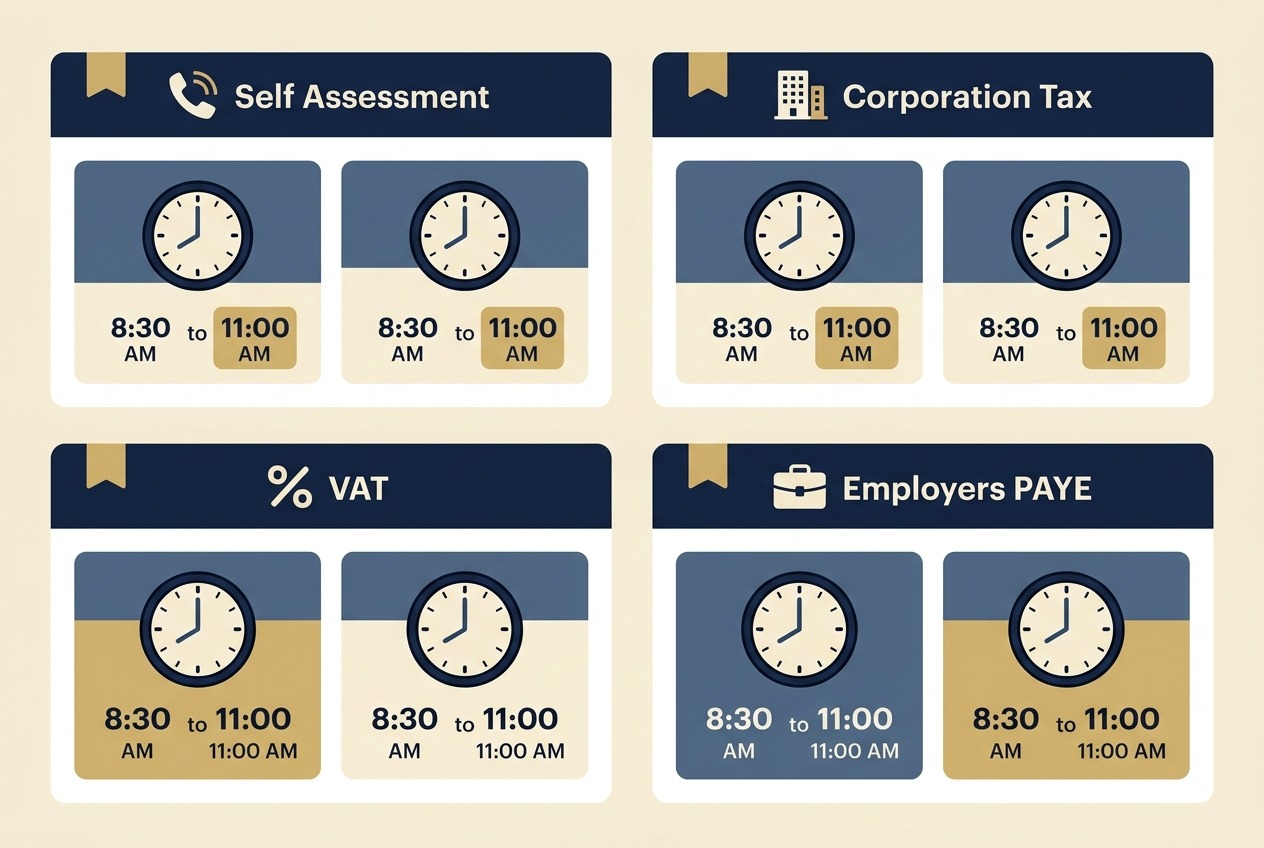
Best Times to Call HMRC and Avoid Long Queues
HMRC telephone traffic fluctuates sharply throughout the working week and across the tax calendar. Understanding these demand spikes allows you to reach an officer without enduring prolonged hold times.
Data from HMRC performance bulletins indicates that telephone queues follow predictable patterns:
- Early Morning Window (8:30 AM to 11:00 AM): Phone lines open at 8:00 AM. While there is an initial rush right at 8:00 AM from overnight callers, the window between 8:30 AM and 11:00 AM consistently exhibits the lowest wait times.
- Avoid Mondays Entirely: Monday is consistently the worst day of the week to call HMRC. Call centres handle accumulated weekend queries, resulting in peak hold times and frequent automated message deflections.
- Target Midweek Mornings: Tuesday, Wednesday, and Thursday mornings present the optimal opportunity for swift connections and attentive advisers.
- Beware Seasonal Deadlines: The final two weeks of January (leading up to the January 31 Self Assessment filing deadline) and late March see phone lines completely saturated. Where possible, handle queries in October or November.
How to Navigate the HMRC Voice Recognition System
When you ring any official hmrc contact number, you will not immediately connect with an agent. You will encounter an automated Speech Recognition system that asks you to describe your query in a few words.
Managing this automated gatekeeper requires a calm, structured approach:
- Use Direct Keywords: State clear, standard terms such as “Self Assessment payment”, “tax code dispute”, “VAT registration error”, or “speak to an adviser”. Avoid explaining complex narrative backstories to the robot.
- Speak Slowly and Clearly: Minimize background noise. Avoid speaking on speakerphone in crowded rooms, which distorts the audio recognition engine.
- Decline SMS Redirection: The automated system will repeatedly offer to send a text message linking to online GOV.UK guidance. If your issue requires human intervention, clearly answer “No” when asked if you want a text link.
- Voice Identification Security: HMRC uses voice recognition to verify returning callers. You may be invited to record your voice phrase (“My voice is my password”) to accelerate future identity verification.
What to Have Ready Before You Dial
HMRC security officers operate under rigorous data protection standards. If you cannot answer mandatory security verification questions within seconds, advisers are legally forbidden from discussing your file and will end the call immediately.
Assemble these documents before dialling:
- Personal Identification: Your full legal name, date of birth, and current registered home address including postcode.
- Tax References: Your 10-digit Unique Taxpayer Reference (UTR) for self-employment or company affairs, and your National Insurance (NI) number for PAYE matters.
- Business Details: Company registration number, 9-digit VAT registration number, and employer PAYE reference (format: 123/AB12345).
- Recent Paperwork: A recent P60, P45, P800 calculation notice, or payslip. Advisers frequently verify identity by asking for figures from your latest tax return or previous employment.
- Pen and Paper: Always write down the date, exact time, adviser’s first name, and unique call reference number before hanging up.
Phone vs Digital: When Should You Use the HMRC App?
HMRC has invested heavily in digital channels to divert routine administrative queries away from phone queues. For many basic tasks, using online services is substantially faster than waiting on hold.
| Task or Query | Recommended Channel | Typical Resolution Time |
|---|---|---|
| Check Tax Code / Claim Employment Expenses | HMRC App / Personal Tax Account | Immediate (under 3 minutes) |
| Find Lost National Insurance or UTR Number | HMRC App (Wallet feature) | Instant access |
| Update Home or Registered Business Address | Online Business Tax Account | Instant submission |
| Dispute Complex Tax Underpayment (P800 / PA302) | HMRC Phone Helpline | 20–45 minutes call |
| Negotiate Time to Pay for Debts over £30,000 | Payment Support Helpline | 30–60 minutes discussion |
For company directors wanting to centralize their filing and digital authorisations, our complete HMRC Business Tax Account setup guide explains how to link Corporation Tax, PAYE, and VAT in one dashboard.
Critical Warning: Beware HMRC Telephone Scams
Criminal gangs actively exploit taxpayer anxiety by impersonating HMRC officials. Tax scams cost British consumers millions annually, with fraudsters employing sophisticated phone spoofing technology that displays legitimate HMRC numbers on caller ID displays.
Remember these golden security rules:
- HMRC Never Threatens Sudden Arrest: Genuine HMRC officers will never leave aggressive recorded voicemails stating police will arrest you within two hours unless money is transferred.
- No Unusual Payment Methods: HMRC never demands payment via iTunes vouchers, Google Play gift cards, cryptocurrency, or direct transfer into personal bank accounts.
- Inbound vs Outbound Trust: Never trust inbound calls claiming to be HMRC where the caller demands immediate debit card numbers. Hang up immediately, wait five minutes for the line to clear, and dial the verified official 0300 number listed above.
- Reporting Fraud: Forward suspicious scam text messages to 7726 and report phishing calls or emails to phishing@hmrc.gov.uk.
Frequently Asked Questions About HMRC Contact Numbers
What is the main HMRC contact number for general tax enquiries?
The main phone number for general Income Tax and PAYE enquiries is 0300 200 3300. For Self Assessment tax returns and self-employment queries, call 0300 200 3310. Both lines operate Monday to Friday from 8:00 AM to 6:00 PM.
Is the HMRC contact number free from a UK mobile?
HMRC 0300 numbers are free if your UK mobile contract includes inclusive call minutes. Under Ofcom regulations, 0300 numbers cost the same as geographic landlines and must be included in call bundles. If you call outside inclusive allowances, standard landline rates apply.
How do I call HMRC from abroad?
If you are dialling HMRC from outside the UK, replace the 0300 prefix with the dedicated international lines. For Income Tax, call +44 135 535 9022. For Self Assessment, call +44 161 931 9070. For VAT, call +44 2920 501 261.
Can I speak to a real person at HMRC?
Yes. When dialling an official HMRC helpline, you must pass the automated speech recognition system. Answer the automated prompts with clear, direct keywords such as “speak to an adviser” or “payment issue” and answer “No” when offered automated text guidance.
What time does HMRC phone service open and close?
Most HMRC telephone helplines open at 8:00 AM and close at 6:00 PM Monday through Friday. Lines are closed on weekends and English bank holidays. The Customs and International Trade helpline offers extended hours until 10:00 PM.
What should I do if HMRC lines are busy and disconnect?
During extreme volume spikes, HMRC’s telephony exchange may play a recorded message advising all lines are busy before automatically disconnecting. If this occurs, avoid redialling continuously. Try calling back between 8:30 AM and 11:00 AM on Wednesday or Thursday, or use webchat inside your online tax account.
What to Do Next: Your Calling Checklist
Reaching an HMRC representative without frustration comes down to preparation and timing. Before dialling, follow this practical checklist:
- Confirm whether your query can be answered in under two minutes via the HMRC app or your Business Tax Account.
- Check the directory table above to ensure you dial the exact department line rather than a general switchboard.
- Retrieve your 10-digit UTR, National Insurance number, and recent tax documents before placing the call.
- Plan your call between 8:30 AM and 11:00 AM midweek to minimize hold times.
- Record the date, time, and full call notes in your accounting files for future audit verification.
Explore our full library of interactive financial resources in our UK Business Calculators & Tools hub to keep your enterprise compliant and financially optimized.