
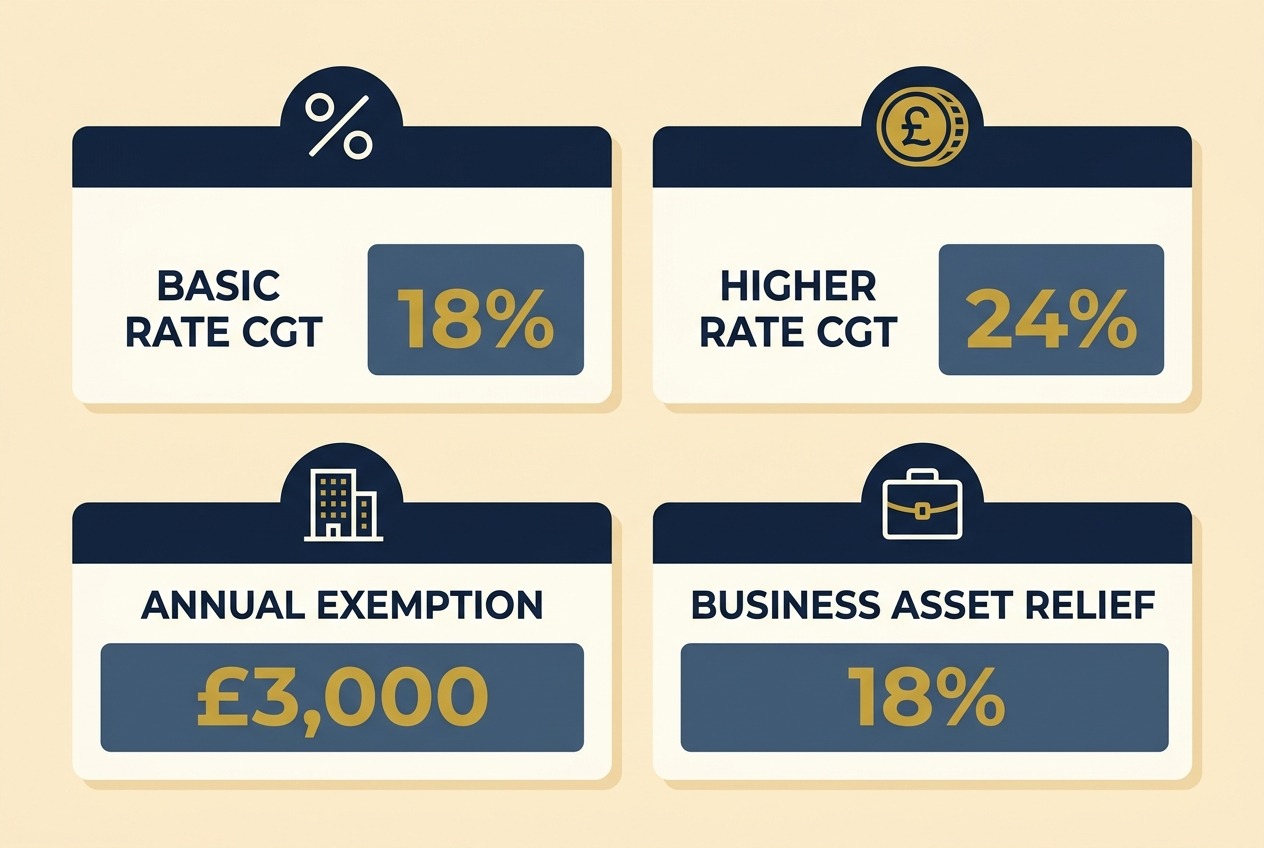
Capital Gains Tax UK Quick Answer (2026): Capital Gains Tax (CGT) is charged on the profit realised when disposing of an asset that has increased in value. For the 2026/27 tax year, basic-rate taxpayers pay 18% on taxable gains, while higher and additional-rate taxpayers pay 24% across all asset classes, including residential property and shares. Every individual receives a frozen annual tax-free exemption of £3,000 (£1,500 for trusts). Disposals of UK residential property generating a chargeable gain must be reported to HMRC and the tax settled within 60 days of completion. Entrepreneurs qualifying for Business Asset Disposal Relief (BADR) face an increased rate of 18% from 6 April 2026 up to a £1 million lifetime limit.
Key Takeaways for UK Taxpayers
- Unified Higher Rate: The higher rate of Capital Gains Tax is unified at 24% for both residential property and private investments, removing previous dual-rate complexity.
- Basic Rate Realignment: The standard basic rate sits at 18%, calculated by stacking taxable gains on top of earned income against the £37,700 basic-rate threshold.
- Reduced Annual Allowance: The personal tax-free allowance remains frozen at £3,000, having decreased from £12,300 in recent fiscal periods.
- Strict 60-Day Deadline: UK residential property sales incurring CGT require online reporting and full payment within 60 days of legal completion.
- BADR Relief Escalation: Business Asset Disposal Relief tax increases to 18% from 6 April 2026, requiring founders to re-evaluate business exit timing.
According to official HM Revenue and Customs (HMRC) reporting, UK taxpayers remitted £14.4 billion in Capital Gains Tax across 369,000 asset disposals in the latest fiscal cycle. Capital Gains Tax represents one of the most substantial revenue mechanisms for the Exchequer, and recent legislative reforms have reshaped the calculations for property owners, equity investors, and business founders alike.
When you dispose of an asset that has appreciated in value, tax is due on the gain you make rather than the total consideration received. If you acquire commercial machinery, shares in an unquoted venture, or an investment flat, and subsequently sell that asset for a surplus, HMRC treats that uplift as a taxable disposal. Navigating the rules demands a clear understanding of current rates, statutory allowances, and allowable acquisition deductions.
This comprehensive guide details the current rates, explains how taxable income interacts with your capital gains band, outlines mandatory property reporting timeframes, and highlights strategic reliefs designed to protect your hard-earned capital.
What Assets Are Subject to UK Capital Gains Tax?
Under the statutory framework established by the Taxation of Chargeable Gains Act 1992, Capital Gains Tax applies to the disposal of chargeable assets located in the United Kingdom or held by UK-domiciled tax residents worldwide.
A disposal occurs whenever you sell an asset, gift an asset to someone other than your spouse or civil partner, exchange an asset for another item of value, or receive capital compensation, such as an insurance payout for a destroyed possession.
Chargeable assets standardly include:
- Residential Property: Second homes, buy-to-let rental properties, holiday lets, and inherited residential real estate. Your primary residence remains standardly covered by Private Residence Relief (PRR).
- Commercial Land and Buildings: Freehold offices, industrial units, retail premises, and agricultural land not qualifying for specialized exemptions.
- Stocks, Shares, and Securities: Shares held outside of an Individual Savings Account (ISA) or a registered pension wrapper (SIPP), including private company equity.
- Business Assets: Plant, machinery, goodwill, trademarks, patents, and commercial premises held by sole traders or general business partnerships.
- Personal Possessions Valued Over £6,000: Works of art, antiques, fine jewellery, and collectables, excluding private motor cars.
- Cryptoassets: Exchange tokens, governance tokens, and non-fungible tokens (NFTs) disposed of at a surplus.
Assets exempt from UK Capital Gains Tax include your main private motor vehicle, British Government gilts and Premium Bonds, lottery prizes, assets held inside ISAs, and transfers between spouses or civil partners living together.
UK Capital Gains Tax Rates (2026/27 Tax Year)
Your applicable rate of Capital Gains Tax depends upon two distinct elements: your total taxable income from all sources (including employment, self-employment profits, rental receipts, and pensions) and the overall scale of your net capital gains.
The standard rates published by GOV.UK Capital Gains Tax guidance establish a clear division between basic-rate earners and higher-rate taxpayers across disposals.
| Asset Classification | Basic Rate Taxpayer (18%) | Higher / Additional Rate (24%) | Trusts & Personal Estates |
|---|---|---|---|
| Residential Property Disposals | 18% | 24% | 24% |
| Listed & Unquoted Shares | 18% | 24% | 24% |
| Commercial Property & Land | 18% | 24% | 24% |
| Personal Possessions (>£6,000) | 18% | 24% | 24% |
| Business Asset Disposal Relief (BADR) | 18% | 18% | 18% (qualifying) |
Historically, residential property was penalised with an 8% surcharge relative to other capital assets. Recent budgets harmonised the headline higher band at 24%, meaning the capital gains liability on selling an unquoted company share portfolio or an investment flat is identical for a 40% income taxpayer.
The Annual Exempt Amount: How Much Can You Realise Tax-Free?
Every individual UK taxpayer benefits from an annual tax-free allowance known as the Annual Exempt Amount. This allowance functions on a strict use-it-or-lose-it annual basis. It cannot be carried forward to subsequent tax years if left unused.
For the 2026/27 fiscal period, the statutory Annual Exempt Amount is fixed at £3,000 for individuals, personal representatives, and executors. For most trusts, the allowance is halved to £1,500.
The reduction of this allowance marks a structural change in UK taxation policy over recent years, as demonstrated in the historical trajectory below:
| Tax Year | Individual Annual Exemption | Trust Annual Exemption | Fiscal Impact |
|---|---|---|---|
| 2022/23 | £12,300 | £6,150 | Baseline pre-freeze threshold |
| 2023/24 | £6,000 | £3,000 | 51.2% reduction in tax-free buffer |
| 2024/25 to 2026/27 | £3,000 | £1,500 | Permanent fiscal compression |
Because the exemption is restricted to £3,000, modest disposals that once slipped comfortably under the reporting threshold now trigger mandatory compliance paperwork. Property investors and private shareholders must calculate their gains with meticulous precision to avoid unexpected late payment interest charges.
Step-by-Step Calculation: How Income Interacts with CGT Bands
Many investors believe that their overall income tax bracket strictly dictates their CGT rate. In reality, the mechanics function through a sequential stacking formula.
To determine your exact tax liability, HMRC applies a four-stage assessment:
- Calculate Total Taxable Income: Take your gross earnings, self-employment profits, and dividends, then subtract your £12,570 Personal Allowance and allowable pension relief.
- Calculate Net Chargeable Gain: Deduct your purchase price, acquisition costs, enhancement expenditure, and your £3,000 Annual Exempt Amount from the disposal proceeds.
- Stack Gain Above Taxable Income: Add your net taxable gain on top of your taxable income. Compare the combined figure against the basic-rate Income Tax threshold of £37,700 (which corresponds to gross earnings of £50,270).
- Apply Dual Rates: Any portion of the gain that falls within the unused basic-rate band is taxed at 18%. Any excess spilling above the £37,700 threshold is taxed at 24%.
Practical Worked Example: Split-Rate Liability
Suppose a self-employed consultant generates taxable income of £20,000 after claiming personal allowances. They dispose of shares generating a net capital gain of £22,000. After deducting the £3,000 Annual Exemption, their chargeable gain is £19,000.
Their total combined income and gain equals £39,000 (£20,000 + £19,000). The basic-rate ceiling is £37,700.
- Remaining basic-rate headroom: £37,700 minus £20,000 = £17,700 taxed at 18% = £3,186
- Higher-rate spillover: £19,000 minus £17,700 = £1,300 taxed at 24% = £312
- Total Capital Gains Tax payable: £3,498
If you have multiple asset disposals in a single tax year that attract differing rates, you are legally entitled to allocate your £3,000 tax-free exemption against the gains that attract the highest tax rate first, ensuring you minimise your overall liability.
Residential Property Disposals and the 60-Day HMRC Rule
When you dispose of UK residential real estate that is not covered entirely by Private Residence Relief, you enter a specialised reporting regime separate from standard annual Self Assessment.

Under legislation enforced by HMRC, vendors disposing of residential property must calculate, submit an online return, and pay their estimated Capital Gains Tax within 60 days of the completion date via the official HMRC UK property reporting service.
This 60-day requirement applies to:
- Landlords selling residential buy-to-let rental properties.
- Homeowners disposing of second homes or holiday retreats.
- Beneficiaries selling inherited residential homes where the value has risen between probate valuation and completion.
- Property owners whose primary home was let out or exceeded half a hectare of private grounds.
If you fail to submit your online return within 60 days of completion, HMRC imposes an immediate £100 late filing penalty. Delays exceeding 3 months trigger additional daily penalties of £10 per day, followed by percentage-based penalties at 6 and 12 months, accompanied by statutory late payment interest.
Landlords evaluating whether to hold residential assets in their personal name or transition to corporate ownership should review our interactive Buy to Let Mortgage Calculator UK to stress-test their mortgage payments, lender ICR hurdles, and post-tax retention profiles.
Business Asset Disposal Relief (BADR) in 2026
Formerly known as Entrepreneurs’ Relief, Business Asset Disposal Relief (BADR) offers a preferential rate of Capital Gains Tax to founders, partners, and business owners when selling all or part of a trading business.
To qualify for BADR, the following statutory criteria must be satisfied throughout a continuous qualifying period of at least two years prior to disposal:
- Sole Traders & Partners: You must have owned the trading business or been an active partner for at least 24 consecutive months up to the disposal date.
- Company Share Disposals: The business must be a trading company (or holding company of a trading group). You must hold at least 5% of the ordinary share capital and voting rights, and you must serve as an officer or employee of the enterprise.
- Associated Disposals: Disposals of personal assets used by your partnership or trading company may qualify if structured in conjunction with a material business withdrawal.
| Disposal Period | BADR Tax Rate | Lifetime Allowance Limit | Maximum Tax Saving vs 24% |
|---|---|---|---|
| Up to 5 April 2025 | 10% | £1,000,000 | £140,000 savings per individual |
| 6 April 2025 to 5 April 2026 | 14% | £1,000,000 | £100,000 savings per individual |
| From 6 April 2026 Onward | 18% | £1,000,000 | £60,000 savings per individual |
Entrepreneurs exiting their enterprise after 6 April 2026 pay an 18% rate on qualifying gains up to the £1 million lifetime ceiling. While 18% still represents a notable discount against the 24% headline rate, founders planning sales must incorporate this stepped rate into their gross-to-net proceeds modeling.
For high-growth startup operators raising venture finance, pairing business growth with equity incentives like the SEIS vs EIS tax relief schemes provides alternate avenues for investors to claim 100% Capital Gains Tax exemptions on exit gains.
Allowable Deductions and Capital Loss Rules
Under statutory accounting conventions, you do not pay tax on gross disposal proceeds. You are legally entitled to offset allowable costs incurred in acquiring, improving, and selling the asset.
Allowable Costs That Reduce Your Taxable Gain
- Acquisition Costs: The initial purchase price plus incidental buying fees (stamp duty / SDLT, commercial conveyancing, surveyor charges, valuation costs).
- Capital Enhancement Expenditure: Capital expenditure that adds identifiable enduring value to the asset, such as an extension to a rental property, structural reconfiguration, or new architectural additions. Routine maintenance and repairs (like decorating or replacing like-for-like broken tiles) are revenue expenses and cannot be deducted against capital gains.
- Incidental Disposal Costs: Estate agency fees, auction commissions, legal conveyancing, marketing charges, and advertising costs incurred to secure the sale.
Reporting and Carrying Forward Capital Losses
If you sell an asset for less than its allowable cost, you incur an allowable capital loss. Capital losses cannot be offset against ordinary employment or dividend income. However, they provide valuable tax relief against other capital gains.
You must offset capital losses against taxable gains realised in the exact same tax year. If your losses exceed your gains, the surplus loss can be registered with HMRC and carried forward indefinitely to reduce gains in future tax years.
To preserve your losses, you must formally report them to HMRC within four years of the end of the tax year in which the loss occurred. Once claimed and recorded, capital losses never expire.
7 Strategic Ways to Legally Minimise Your Capital Gains Tax
UK tax law provides several established mechanisms allowing investors and business owners to manage their disposals efficiently:
- Utilise Spousal Transfers: Assets transferred between spouses or civil partners living together take place on a no-gain, no-loss basis. Transferring an asset into joint ownership before sale doubles the accessible annual tax-free exemption to £6,000 and allows you to utilise a partner’s unused 18% basic-rate income tax band.
- Stagger Disposals Across Tax Years: If disposing of a substantial holding of unquoted shares or liquid securities, spreading the transaction across 5 April and 6 April secures two separate Annual Exempt Amounts across consecutive tax years.
- Maximise Registered Pension Contributions: Contributing surplus cash into a registered pension scheme (SIPP) extends your basic-rate income tax band upwards by the gross value of the contribution. This expansion creates additional headroom to absorb capital gains at the lower 18% rate rather than 24%.
- Reinvest via Enterprise Investment Schemes (EIS): Investors who realise a capital gain from any asset class can defer their CGT liability indefinitely by reinvesting the gain into qualifying Enterprise Investment Scheme shares within one year before or three years after the disposal.
- Incorporate Property Portfolios: Landlords holding multiple rental properties under their personal name face 24% CGT upon sale. Structuring acquisitions through an SPV corporate wrapper as detailed in our guide on limited company buy to let mortgages subjects profits to Corporation Tax (19% to 25%) rather than personal rates, preserving capital for portfolio expansion.
- Offset Registered Historical Losses: Always review previous HMRC self-assessment submissions to ensure all allowable capital losses from previous asset disposals are logged and deducted before computing your final tax payment.
- Monitor Director Loan Structures: When moving capital between trading businesses and holding companies, adhering to statutory director’s loan account rules avoids accidental Section 455 tax charges that complicate corporate capital restructuring.
Frequently Asked Questions
Do I pay Capital Gains Tax when selling my own home?
You do not usually pay Capital Gains Tax when selling your main residential home due to Private Residence Relief (PRR). To qualify for full relief, the property must have been your only or main home throughout ownership, the garden grounds must not exceed 0.5 hectares, and you must not have used any portion of the home exclusively for business purposes or let rooms out to lodgers beyond statutory allowances.
What is the difference between Capital Gains Tax and Income Tax?
Income Tax applies to recurring revenue flows you receive, such as monthly employment salaries, self-employed trading turnover, property rental receipts, and dividend payouts. Capital Gains Tax applies exclusively to the capital growth realized upon the disposal of a capital asset that has appreciated in monetary value above its allowable cost base.
How do I report and pay Capital Gains Tax to HMRC?
For residential property disposals, you must report and pay using the dedicated online Capital Gains Tax on UK property service within 60 days of legal completion. For other assets (such as private shares, commercial property, or collectables), you report your gains through your annual Self Assessment tax return or by using HMRC’s real-time Capital Gains Tax service by 31 January following the end of the tax year.
Can I gift an asset to my children to avoid Capital Gains Tax?
Gifting an asset to your children or anyone other than your legal spouse or civil partner is treated by HMRC as a deemed disposal at open market value. If the asset has appreciated in value since you acquired it, you must pay Capital Gains Tax on the theoretical gain, even if no cash proceeds changed hands. The gift also falls under the 7-year inheritance tax regime.
What happens if I sell cryptocurrency in the UK?
HMRC treats cryptocurrencies, stablecoins, and non-fungible tokens (NFTs) as capital assets. Disposing of cryptoassets, which includes selling tokens for fiat currency, exchanging one token for another cryptocurrency, or spending crypto on goods and services, triggers a Capital Gains Tax event. You must calculate your pooled acquisition costs using HMRC’s “same day” and “bed and breakfasting” share matching rules.
Can corporate entities pay Capital Gains Tax?
Limited companies in the UK do not pay Capital Gains Tax. When a limited company sells a capital asset (such as commercial land, equipment, or shares in a subsidiary), the gain is classified as a chargeable gain and included in the company’s total taxable profits subject to UK Corporation Tax at rates between 19% and 25%.
What records must I keep for HMRC capital gains compliance?
You must maintain clear documentation for at least one year after the Self Assessment filing deadline (or at least five years if you operate as a sole trader or business). Essential records include purchase and sale completion statements, legal invoices, conveyancing documents, surveyor valuations, receipts for allowable capital improvements, and records of any historical losses claimed.
Your Next Actions
Managing Capital Gains Tax effectively requires proactive planning before entering a binding sales contract. Once contracts are formally exchanged, your disposal date is legally locked, eliminating your ability to transfer shares to a spouse, make tax-relieved pension contributions, or restructure ownership.
Begin by compiling an exact audit of your allowable acquisition and enhancement expenditures. If you are disposing of residential real estate, engage your conveyancing solicitor early to ensure your completion figures and formal computations are prepared for the mandatory 60-day HMRC reporting deadline.
To evaluate broader financing, tax, and property scenarios across your business portfolio, explore our free interactive tools in the Business Calculators & Financial Tools Hub, or test individual mortgage ICR stress coverage directly using the Buy to Let Mortgage Calculator UK.