Quick Answer: How to Register a Company UK (2026)
To register a private limited company in the UK in 2026, submit your application via the GOV.UK portal to Companies House. The registration fee is £100 and you will receive your Certificate of Incorporation within 24 hours. You need a unique company name, a UK registered office address, at least one director (who must now verify their identity via GOV.UK One Login under November 2025 rules), at least one shareholder, a SIC code, and a completed PSC (Persons with Significant Control) register. New companies can be incorporated using the company’s Model Articles of Association or custom articles.
Key Takeaways
- The Companies House registration fee increased to £100 in 2024 and remains at that level for 2026.
- From November 2025, all new directors must verify their identity via GOV.UK One Login before or at the point of incorporation.
- Every limited company must register at least one SIC code from the official Companies House condensed list — including dormant companies.
- Directors face seven statutory legal duties under the Companies Act 2006 from the moment of incorporation.
Starting a business in the UK means making one of your earliest decisions count: choosing the right legal structure. For the vast majority of UK founders, a private limited company (Ltd) registered at Companies House offers the most credible, tax-efficient, and liability-protected vehicle for building a business.
In 2026, the registration process is faster than ever — but new identity verification requirements introduced in November 2025 mean the pre-registration checklist has grown. According to Companies House statistics, over 800,000 new companies were incorporated in the UK in the previous financial year, making the UK one of the most active startup incorporation jurisdictions in Europe.
This guide covers every step of the 2026 registration process, including the new director identity verification requirements, SIC code selection, PSC register obligations, and the seven statutory director duties that apply from day one of incorporation.
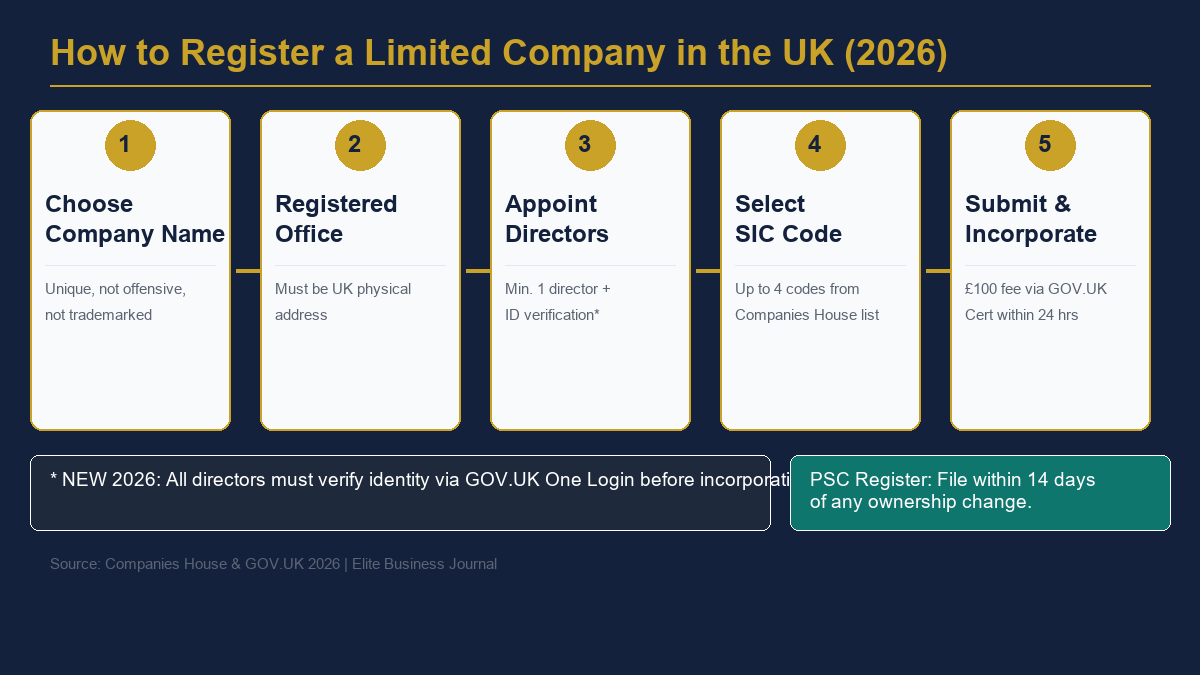
1. Choose Your Company Name
Your company name must be unique within the Companies House register and must not be:
- Identical or too similar to an existing registered company name.
- Offensive or containing a sensitive word without prior approval.
- Likely to mislead the public about the nature of the company.
All private limited companies must include “Limited” or “Ltd” at the end of the name. You can check name availability instantly on the Companies House name search tool.
2. Set Up a UK Registered Office Address
Every UK limited company must have a registered office address — a physical address (not a PO Box) in the same nation as your company’s incorporation (England & Wales, Scotland, or Northern Ireland).
The registered office is the official address where:
- Companies House and HMRC send statutory correspondence.
- Your company’s statutory registers are kept (or recorded as held elsewhere).
- Legal documents can be served on the company.
If you operate from home and prefer privacy, registered office services from accountants and company formation agents offer a professional address from around £30 to £100 per year.
3. Appoint Directors & Verify Identity (New 2026 Rule)
Your company must have at least one director. Directors are legally responsible for running the company and ensuring all filings with Companies House are accurate and on time.
Identity Verification — Mandatory from November 2025
Under the Economic Crime and Corporate Transparency Act 2023, all new directors must now verify their identity before or at the point of incorporation:
- GOV.UK One Login: Verify directly through the GOV.UK digital identity service (free).
- Authorised Corporate Service Provider (ACSP): Verification can be carried out by a registered accountant, solicitor, or company formation agent.
Unverified directors cannot be listed on the public register and cannot legally act as a director of the company.
4. Identify Your Shareholders & PSC Register
Your company must have at least one shareholder (who can also be the sole director). You must also identify all Persons with Significant Control (PSCs) — individuals who:
- Own more than 25% of shares.
- Hold more than 25% of voting rights.
- Have the right to appoint or remove the majority of directors.
PSC information must be filed with Companies House and is part of the public record. Any changes to PSC status must be updated in your internal register within 14 days and notified to Companies House within a further 14 days.
For founders considering issuing shares to early investors, understanding the SEIS and EIS investor schemes is critical — read our guide to SEIS vs EIS UK 2026 before your first funding round.
5. Select Your SIC Code(s)
Every company must provide at least one Standard Industrial Classification (SIC) code that describes its primary business activity. You can select up to four SIC codes if your business spans multiple sectors.
| Common SIC Code | Business Activity |
|---|---|
| 62012 | Business and domestic software development |
| 70229 | Management consultancy (not financial or HR) |
| 74909 | Other professional, scientific & technical activities |
| 47910 | Retail via mail order or internet |
| 99999 | Dormant company (no trading activity) |
6. Submit Your Application & Pay the £100 Fee
Once all information is prepared, submit your IN01 application through the GOV.UK Companies House portal:
- Complete the online form including company name, registered office, directors, shareholders, SIC codes, and PSC details.
- Upload or select your Articles of Association (Model Articles are pre-approved and accepted automatically).
- Pay the £100 registration fee by debit or credit card.
- Receive your Certificate of Incorporation via email — usually within 24 hours of a successful application.
7. Your Director Duties from Day One
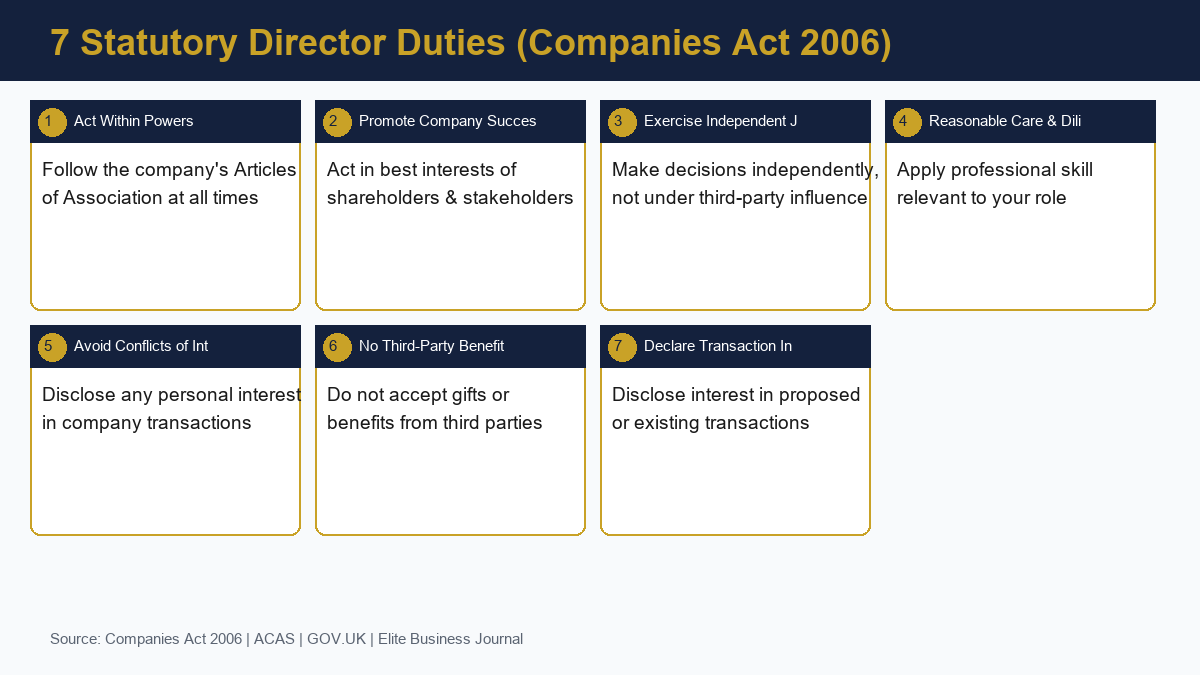
Once your company is incorporated, you are legally bound by seven statutory duties under the Companies Act 2006:
Beyond statutory duties, directors must also:
- File a Confirmation Statement with Companies House at least once a year.
- Submit annual accounts to Companies House and HMRC.
- Register for Corporation Tax with HMRC within 3 months of starting to trade.
- Register for VAT if turnover exceeds £90,000 in any 12-month period.
For founder-directors optimising their personal income structure post-incorporation, review our analysis of the optimal salary and dividend split for UK directors in 2025/26.
8. Frequently Asked Questions
Can I register a company in the UK if I live abroad?
Yes. Non-UK residents can incorporate a UK limited company provided the company has a UK registered office address. Directors must still verify their identity under the 2025 rules via an Authorised Corporate Service Provider if they cannot access GOV.UK One Login.
How long does it take to register a company with Companies House?
Online applications submitted via the GOV.UK portal are typically processed within 24 hours. Paper applications (form IN01) take longer — usually 8 to 10 working days — and cost £71.
Do I need an accountant to register a company?
No — you can register directly with Companies House yourself via GOV.UK. However, an accountant can help you select the correct SIC codes, structure your Articles of Association, and plan your tax position from day one.
What is the difference between a sole trader and a limited company?
A sole trader has unlimited personal liability for business debts. A limited company is a separate legal entity — shareholders’ liability is limited to the value of their shares. A limited company is generally more tax-efficient once profits exceed approximately £30,000 to £35,000 per year.
Your Next Actions
- Check Name Availability: Use the Companies House name search tool and the UKIPO trade mark database before reserving your company name.
- Arrange a Registered Office: Confirm your home address is suitable or subscribe to a professional registered office service.
- Verify Director Identity: Set up GOV.UK One Login for all directors before beginning your incorporation application.
- Plan Your Tax Structure: Before taking your first salary or dividend, read our guide to optimal salary and dividend split for UK directors to minimise your tax burden from the start.
Editorial Team & Signature
Written by Oliver Carpenter, Founder & Editor-in-Chief at Elite Business Journal. Published August 2026.