Nearly 70 percent of remote workers say poor communication from leadership is the biggest reason remote teams fail. That is not a technology problem. It is a leadership problem. Most managers were trained to lead people they could see, hear, and walk over to at any moment. Remote work took all of that away and left many leaders without a playbook.
The result is teams that feel disconnected, confused about expectations, and unsure whether their manager actually has their back. Productivity drops. Good people leave. And the leader wonders what went wrong.
This article gives you 11 clear strategies to learn how to lead a remote team well. These are not abstract ideas. They are practical habits that fix the real problems remote teams face every day.
Why Leading a Remote Team Is Not the Same as Leading in Person
In an office, a lot of leadership happens without anyone planning it. You read the room in a meeting. You notice someone seems off when they walk past your desk. You overhear a conversation that tells you a project is behind. None of that exists in remote work.
Remote leadership removes the natural feedback loop that in-person leaders rely on. You lose visibility into how your team is actually doing. You cannot read body language on a chat message. You do not know if someone is overwhelmed, disengaged, or quietly struggling unless you build systems to find out.
The fix is not more surveillance or tracking software. That approach destroys trust and morale faster than any communication problem ever could. The fix is better habits, clearer systems, and more intentional communication. That is what the rest of this article covers.
Set Crystal Clear Expectations From Day One
Remote teams fail when people are left guessing. Guessing what hours they should be online. Guessing how fast they need to respond to messages. Guessing what a finished deliverable actually looks like. All of that guessing creates anxiety, wasted effort, and missed results.
Set clear expectations early and put them in writing. Define your team’s core working hours and which hours overlap. Specify which communication tools are used for what. Clarify how long people have to respond to different types of messages. Describe what good work looks like for each role, not just what the job title says.
A simple team working agreement document covers all of this in one place. A simple team working agreement document covers all of this in one place and takes less than an hour to create. It takes an hour to create and saves hundreds of hours of confusion. Review it with every new hire and revisit it whenever something in the team changes. Clear expectations are the foundation everything else is built on.
Build a Communication System That Actually Works
Most remote teams have too many communication tools and no rules about how to use them. Messages get lost. People miss updates. The same conversation happens across three different platforms. This is not a tool problem. It is a system problem.
Pick a tool for each type of communication and stick to it. Use chat for quick questions and short updates. Use email for formal communications and anything that needs a paper trail. Use video calls for complex discussions, sensitive conversations, and team meetings. Use a project management tool for task updates and written handoffs. When everyone knows where to look, nothing falls through the cracks.
Here is a simple communication framework you can apply to your team right away:
| Channel | Best Used For | Response Time |
| Slack / Team Chat | Quick questions, fast updates, casual team conversation | Within 2 hours |
| Formal updates, external communication, detailed summaries | Within 24 hours | |
| Video Call | Complex discussions, sensitive topics, team meetings | Scheduled in advance |
| Project Tool (e.g. Asana) | Task updates, project status, written handoffs | As tasks progress |
| Async Video (e.g. Loom) | Walkthroughs, feedback, updates that do not need a live meeting | Within 24 hours |
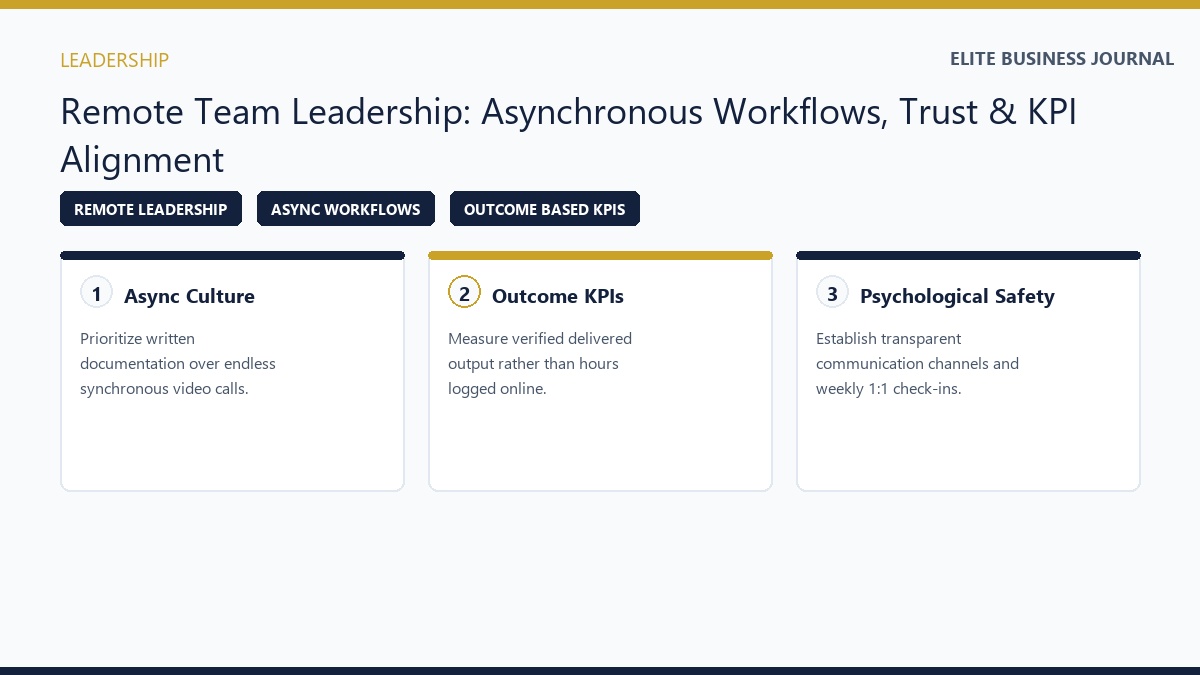
The second issue is overusing synchronous communication, meaning communication that requires everyone to be available at the same time. Not every update needs a meeting. Not every question needs a live answer. Build async habits into your team’s culture and watch productivity improve significantly.
Run Meetings That Are Actually Worth Attending
Remote meetings are often the biggest time drain on distributed teams. Back-to-back video calls leave people exhausted, behind on their actual work, and dreading the next week. However, this is fixable if you are disciplined about it.
Every meeting needs three things before it gets scheduled: a clear agenda, a specific purpose, and a defined outcome. If you cannot answer what decision will be made or what problem will be solved in this meeting, it should probably be an async update instead. Send a recorded video, write a summary doc, or post an update in your project tool.
The meetings worth keeping are your weekly team sync, regular one on ones, and key project check ins. Keep them short, focused, and start on time. Respect that your team’s calendar is their most limited resource in a remote environment.
Make Trust Your Top Priority
Trust is harder to build remotely and easier to break. However, you cannot see what your team is doing every minute of the day, and the temptation to monitor, track, and check up on people is real. Resist it. Micromanagement destroys remote teams faster than almost anything else.
Shift from hours-based thinking to output-based thinking. It does not matter when someone works or exactly how long a task took. What matters is whether they delivered quality work on time. When you manage by output, you signal that you trust your team to get the job done. Most people rise to that trust.
Three behaviors build trust consistently in remote settings. First, be transparent: share the context behind decisions, even hard ones. Second, follow through on what you say, every time. Third, assume good intent when something goes wrong before you assume negligence. Psychological safety, meaning the confidence that people can raise problems without being punished, is what separates teams that surface issues early from teams that hide them until they explode.
Stay Visible Without Micromanaging
Remote leaders who go quiet lose their team’s confidence fast. If your team rarely hears from you, they fill the silence with the worst-case version of what is happening. They assume things are bad, that they are being forgotten, or that leadership does not care.
Show up consistently. Be active in your team’s communication channels. In addition, respond to messages promptly. Acknowledge good work publicly. Share relevant updates even when nobody asked. Visibility is not about being online 24 hours a day. It is about showing up in ways your team can count on.
The key distinction is checking in versus checking up. Checking in means asking how someone is doing, removing blockers, and offering support. Checking up means monitoring every task and demanding status updates for your own reassurance. Your team knows the difference and responds accordingly.
Run One on Ones That Actually Help
One on ones are the single most powerful tool a remote leader has. They are the space where real conversations happen, problems get surfaced before they become crises, and your team members feel like individuals rather than headcount.
Do not use one on ones for status updates. You have other systems for that. Use them for genuine conversation. A simple structure works well: what is going well for you this week, what is getting in your way, and what do you need from me. Let the team member drive the agenda as much as possible. When people set the agenda, they bring the things that actually matter to them.
Meet weekly or biweekly depending on your team size and how much support each person needs. Never cancel one on ones unless it is unavoidable. Canceling sends the message that your team members are not a priority. In a remote environment where people already feel isolated, that message lands harder than you think.
Keep Your Team Connected as People, Not Just Coworkers
Remote work strips away the casual moments that build real relationships. The coffee before a meeting. The lunch conversation that has nothing to do with work. The small talk that makes a colleague feel like a person and not just a name on a screen. Leaders need to create these moments intentionally because they will not happen on their own.
Start small. Create a non-work channel in your team chat where people can share things they are interested in. Open your weekly sync with a quick personal check in before getting into business. Recognize birthdays, work anniversaries, and personal milestones. Celebrate team wins publicly and specifically.
Avoid forcing connection. Virtual happy hours and mandatory team games often feel awkward and create more resentment than belonging. Make social moments optional, low pressure, and genuinely enjoyable. The goal is for people to feel like they belong to something, not to check a box.
Manage Across Time Zones Without Burning Anyone Out
Time zone spread is one of the hardest parts of leading a distributed team. No matter how you schedule things, someone is always at the edge of their workday or outside it entirely. Left unmanaged, this creates resentment, burnout, and a two-tier team culture where some people are always inconvenienced.
Define your team’s overlap hours: the window where everyone is expected to be available at the same time. Keep this window as small as necessary and protect it for the things that genuinely require real-time collaboration. Rotate meeting times regularly so the same person is not always the one joining at 7am or 9pm.
Outside of overlap hours, lean hard on async communication. If your team is still figuring out async workflows, these async communication best practices from Harvard Business Review give you a solid starting framework. Record meetings for people who could not attend live. Document decisions in writing so no one is left out of the loop. Set a clear expectation that responses outside of someone’s working hours are never required. Respecting time zones is not just a courtesy. It is how you keep your best people long term.
Onboard Remote Employees the Right Way
A bad remote onboarding experience can cost you a great hire within 90 days. Starting a new job is disorienting enough in an office. However, doing it remotely, where you cannot tap someone on the shoulder or read the room, makes it exponentially harder. Most companies get this wrong by treating remote onboarding as a digital version of handing someone a stack of forms.
Good remote onboarding has four elements. First, give new hires a clear first-week plan so they know exactly what to do and who to talk to each day. Second, assign a buddy or mentor who is not their direct manager. Someone they can ask the small, awkward questions without worrying about how it looks. Third, design early wins: small, achievable tasks in the first two weeks that build confidence and momentum. Fourth, over-communicate in week one because new remote employees will not ask for help unless you make it easy.
Document everything your team does so new hires can find answers without waiting on someone. A well-organized team wiki or knowledge base pays for itself many times over in time saved and frustration avoided.
Measure Output, Not Hours
Tracking how many hours a remote employee spends online is a poor measure of performance and a fast way to destroy trust. It signals that you do not trust your team to manage their own time. It also rewards the wrong thing: looking busy instead of delivering results.
Output-based management works differently. You define what success looks like for each person and each project. You set clear goals with realistic deadlines. You measure whether those goals were met, and if not, you have a conversation about why. This approach treats your team like professionals and focuses energy on what actually matters: results.
Tools like OKRs or simple weekly goal tracking make this easy to implement without requiring complex systems. The mindset shift is the hard part, especially for leaders who are used to managing by presence. But once you make it, you will find that most remote employees perform better when they are trusted to own their results rather than monitored on their hours.
Lead Your Remote Team With Intention, Not Just Tools
Remote leadership is not about finding the right software or the perfect meeting schedule. It comes down to the habits you build, the systems you create, and the trust you earn over time. However, the gap between a struggling remote team and a high-performing one almost always comes down to the leader.
The good news is that every strategy in this article is learnable. However, none of it requires a special personality or a management degree. It requires consistency, honesty, and a genuine commitment to showing up for your team even when no one is watching.
Pick one strategy from this article and put it into practice this week. Start with expectations, or trust, or one on ones. Build from there. Small, consistent improvements compound into a team culture people actually want to be part of.
Read more practical leadership guides in the Leadership section of Elite Business Journal to keep building the skills your team needs from you.
Solo practitioners building initial customer traction can implement the client-acquisition strategies in how to get your first client as a freelancer.
Whether operating as a sole trader or limited company, protecting against legal liability is paramount; review the essential policies in business insurance requirements.
Operating physical trading premises involves local authority overhead; understand rate exemptions with our small business rates relief guide.