More than 60% of employees say they would leave their current job for better pay. For large companies managing thousands of workers across multiple locations, getting compensation right is not just an HR problem. It is a business survival problem.
Enterprise compensation management is the process of planning, delivering, and reviewing how a company pays its people. This covers base salaries, bonuses, stock options, benefits, and more. When this process works well, companies attract top talent, reduce turnover, and keep budgets under control. When it breaks down, the costs are enormous.
This guide covers everything large organizations need to know about building a solid compensation system. You will learn what enterprise compensation management actually includes, why it matters, what tools make it easier, and how to avoid the biggest mistakes companies make. Whether you work in HR, finance, or leadership, this article gives you clear, practical answers.
What Enterprise Compensation Management Actually Means
Enterprise compensation management refers to how large organizations design and manage pay for all employees. It is not just about writing a paycheck. It covers the entire system of decisions that determine how much people earn and why.
At the enterprise level, this becomes very complex. A company with 5,000 employees across 10 states or 15 countries cannot rely on spreadsheets or gut decisions. There are legal requirements, budget limits, market data, and equity concerns to manage all at once. Every pay decision connects to dozens of other decisions.
The key parts of enterprise compensation management include base pay structure, variable pay programs, merit increases, incentive plans, executive compensation, and pay equity analysis. Some companies also include benefits and perks in this framework as part of a total rewards strategy. The goal is to make sure every dollar spent on pay is doing real work for the business.
Why Large Companies Cannot Afford to Ignore This
Bad compensation management costs money in ways that are hard to see at first. High turnover is one of the most expensive results. It costs between one half and two times an employee’s annual salary to replace them, according to SHRM. For a company with thousands of employees, that adds up fast.
There is also the risk of legal trouble. Pay discrimination lawsuits are expensive and damaging to a company’s reputation. The Equal Pay Act and other laws require companies to pay people fairly regardless of gender, race, or age. Without a solid system in place, it is hard to even know if you have a problem.
Beyond legal risk, there is the competitive threat. If your pay is below market, your best people will leave for competitors. If your pay is above market without a plan, you burn through budget without getting the results you need. Enterprise compensation management gives companies the tools to stay competitive while spending wisely.
The Core Components of a Strong Compensation Strategy
Base Pay and Salary Bands
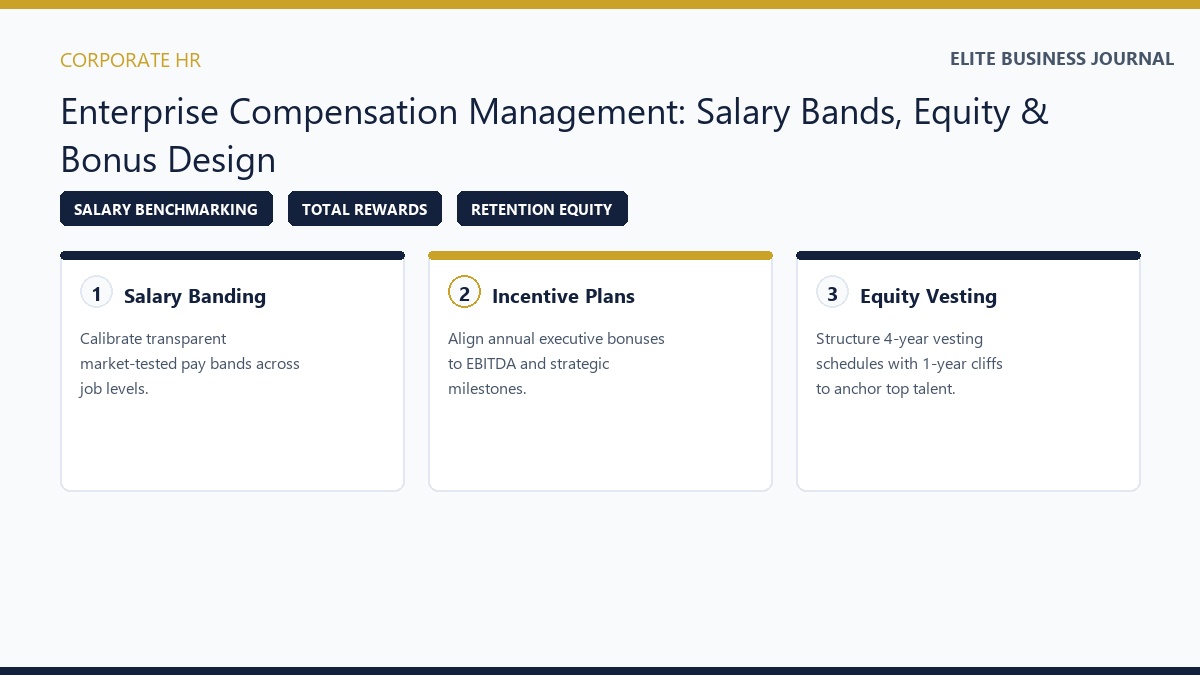
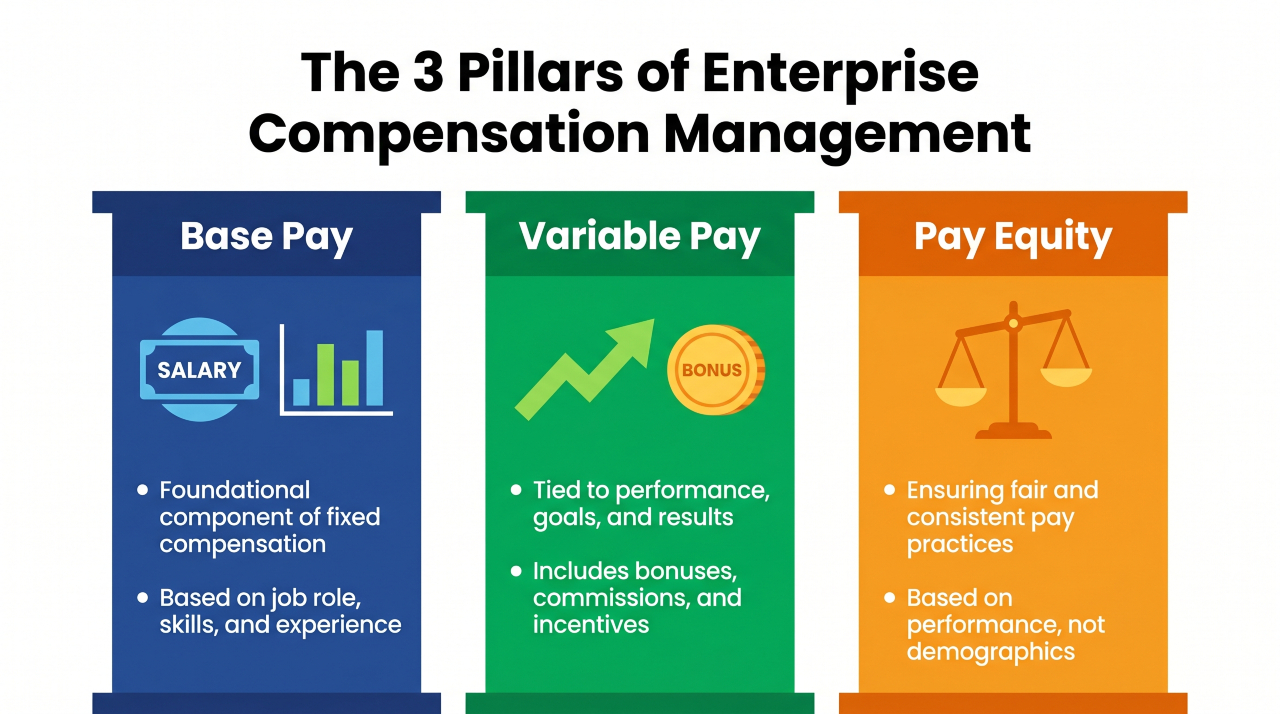
Every enterprise compensation system starts with a clear base pay structure. This means defining salary ranges for different job levels and roles across the company. These ranges are called salary bands or pay grades.
Salary bands tell managers how much flexibility they have when making offers or giving raises. They also make sure that people in similar roles are paid within a fair and consistent range. Without clear salary bands, pay decisions become random and hard to defend.
Building good salary bands requires real market data. Companies use salary surveys and benchmarking tools to compare their pay to what similar companies offer. This process is called salary benchmarking, and it should happen at least once a year to stay current.
Variable Pay and Incentive Programs
Variable pay is any compensation that changes based on performance. This includes bonuses, commissions, profit sharing, and stock options. For large companies, designing these programs requires careful planning.
The goal of variable pay is to connect employee effort to business results. When it works well, high performers earn more and stay motivated. When it is designed poorly, it creates confusion, resentment, and sometimes unethical behavior. Clear rules and transparent communication are essential.
Enterprise organizations often have multiple variable pay programs running at the same time. Sales teams may earn commissions. Executives may receive stock grants. Frontline workers may earn performance bonuses. Managing all of these together requires a system that tracks, calculates, and reports on all programs consistently.
Pay Equity and Fairness
Pay equity means making sure employees are paid fairly for equal work. This is both a legal requirement and a business priority. Studies show that companies with strong pay equity practices have higher employee satisfaction and lower turnover.
Pay equity analysis involves comparing salaries across different groups of employees. The goal is to find and fix any gaps that cannot be explained by legitimate factors like experience, performance, or job level. This analysis should be done regularly and treated as ongoing work, not a one time project.
Many large companies now publish pay equity reports as part of their commitment to transparency. This is becoming more common as employees and investors demand more openness about pay practices. Being proactive about pay equity builds trust and reduces legal risk at the same time.
How Compensation Management Software Changes Everything
Managing compensation for thousands of employees by hand is nearly impossible. Spreadsheets break. Errors are made. Data gets lost. That is why most large organizations use dedicated compensation management software to run their programs.
Good compensation software automates the most time consuming parts of the process. It pulls in salary data, applies salary bands, tracks budget usage, calculates merit increases, and generates reports. This frees up HR teams to focus on strategy rather than data entry.
Modern platforms also include analytics tools that help leaders make smarter decisions. You can see which departments are over budget on pay, which roles are falling below market, and where pay gaps might exist. This kind of visibility is simply not possible with manual methods.
What to Look for in Compensation Management Software
Choosing the right software is a big decision. The wrong platform creates more problems than it solves. Here are the most important features to look for when evaluating options for large organizations.
Integration: The software must connect with your existing HR, payroll, and financial systems. Data that lives in separate places causes errors and slows everything down. Good integration means one source of truth for all compensation data.
Scalability: Your software needs to handle your current size and your future size. A platform that works for 1,000 employees may break down at 10,000. Make sure the vendor has proven performance at enterprise scale before you commit.
Compliance Tools: The software should help you stay compliant with local, state, and federal pay laws. This includes support for pay transparency requirements, which are becoming more common in states like Colorado, California, and New York. Compliance features reduce legal risk and save your team hours of manual checking.
Reporting and Analytics: Strong reporting tools let you see what is happening across your compensation programs in real time. Look for dashboards that are easy to read and flexible enough to answer the questions your leadership team will ask.
Salary Benchmarking: Knowing What the Market Is Paying
You cannot design a competitive compensation strategy without knowing what your competitors pay. Salary benchmarking is the practice of comparing your pay rates to market data so you can make informed decisions.
Large companies typically use a mix of purchased salary surveys, government labor data, and third party benchmarking platforms. Sources like Mercer, Willis Towers Watson, and the Bureau of Labor Statistics provide detailed data broken down by industry, location, and job level. This data helps HR teams know if their pay is below, at, or above the market.
Once you have the data, you need to decide where you want to position your company. Some companies aim to pay at the 50th percentile, meaning right at the middle of the market. Others aim for the 75th percentile to attract and retain top talent. Your positioning depends on your budget, your talent strategy, and the roles you are trying to fill.
Benchmarking should not happen just once. Markets move fast. A salary that was competitive two years ago may be well below market today. Most HR experts recommend reviewing market data at least once a year and updating salary bands accordingly.
The Total Rewards Framework: Pay Is Only Part of the Picture
Smart companies know that pay is only one part of what attracts and keeps great employees. The total rewards framework looks at everything an employee receives in exchange for their work. This includes salary, bonuses, benefits, work life balance, career development, and company culture.
For enterprise organizations, building a strong total rewards strategy means thinking beyond the paycheck. Health insurance, retirement plans, flexible work options, learning programs, and recognition matter a great deal to employees. When these elements are strong, companies can sometimes attract talent even if their base pay is not the highest in the market.
Communicating total rewards clearly is just as important as having them. Many employees do not know the full value of what they receive from their employer. Total rewards statements that show the full picture, including benefits, paid time off, and employer contributions to retirement, help employees see their real compensation clearly. This transparency builds appreciation and loyalty.
Building a Compensation Planning Process That Actually Works
A good compensation planning process is organized, consistent, and tied to business goals. For large companies, this usually happens once or twice a year during what is called a compensation cycle. During this time, managers submit pay increase recommendations, HR reviews them against budgets and policy, and final approvals are given.
The process sounds simple, but it can get very messy at scale. Managers have biases. Budgets get stretched. Communication breaks down between departments. A well designed process with clear guidelines, good software, and strong oversight prevents most of these problems.
The key to a successful compensation cycle is starting early. Most large companies begin planning three to four months before merit increases go into effect. This gives time to gather market data, set budgets, train managers, and review recommendations before anything is communicated to employees.
Managers play a huge role in how well the process works. They need training to make fair, consistent pay decisions. They need clear guidelines about what factors to consider, how to use salary bands, and what approval steps are required. Investing in manager training pays off in better decisions and fewer complaints.
Pay Transparency: The New Expectation
Pay transparency is changing how companies manage compensation. More states and countries now require companies to post salary ranges in job listings. Employees are increasingly comfortable talking about pay with their coworkers. This shift changes the rules of compensation management significantly.
For companies that have not been managing pay carefully, transparency can be uncomfortable. Hidden pay gaps become visible. Inconsistencies that were once overlooked become sources of conflict. Companies that get ahead of this by fixing their pay practices now are in a much stronger position.
Pay transparency done well builds trust. When employees know how pay decisions are made and where they fall in their salary band, they feel respected. They also have a clearer path to understanding how to earn more. This clarity reduces anxiety about pay and increases focus on performance.
Leading companies are going further than the minimum legal requirements. They share their pay philosophy openly with all employees. They explain what drives pay decisions and how the company benchmarks against the market. This level of openness is not easy, but it creates a culture of trust that is very hard for competitors to copy.
Executive Compensation: A Special Case
Executive compensation works differently from compensation for other employees. Senior leaders typically receive a mix of base salary, annual bonuses, long term incentives like stock, and benefits packages that are far more complex than standard employee plans.
For publicly traded companies, executive compensation is subject to strict reporting rules. The Securities and Exchange Commission requires detailed disclosure of executive pay. Shareholders vote on executive compensation packages in what is called a “say on pay” vote. This level of scrutiny means executive compensation must be carefully designed and clearly justified.
The goal of executive compensation is to align leadership incentives with company performance and long term shareholder value. When designed well, executives are rewarded for growing the company, managing risk responsibly, and creating sustainable results. When designed poorly, it can encourage short term thinking and excessive risk taking.
Boards of directors typically rely on compensation consultants to help design executive pay packages. These consultants bring market data and technical expertise that most internal HR teams do not have. They also provide an independent perspective that helps boards defend their decisions to shareholders.
Common Mistakes in Enterprise Compensation Management
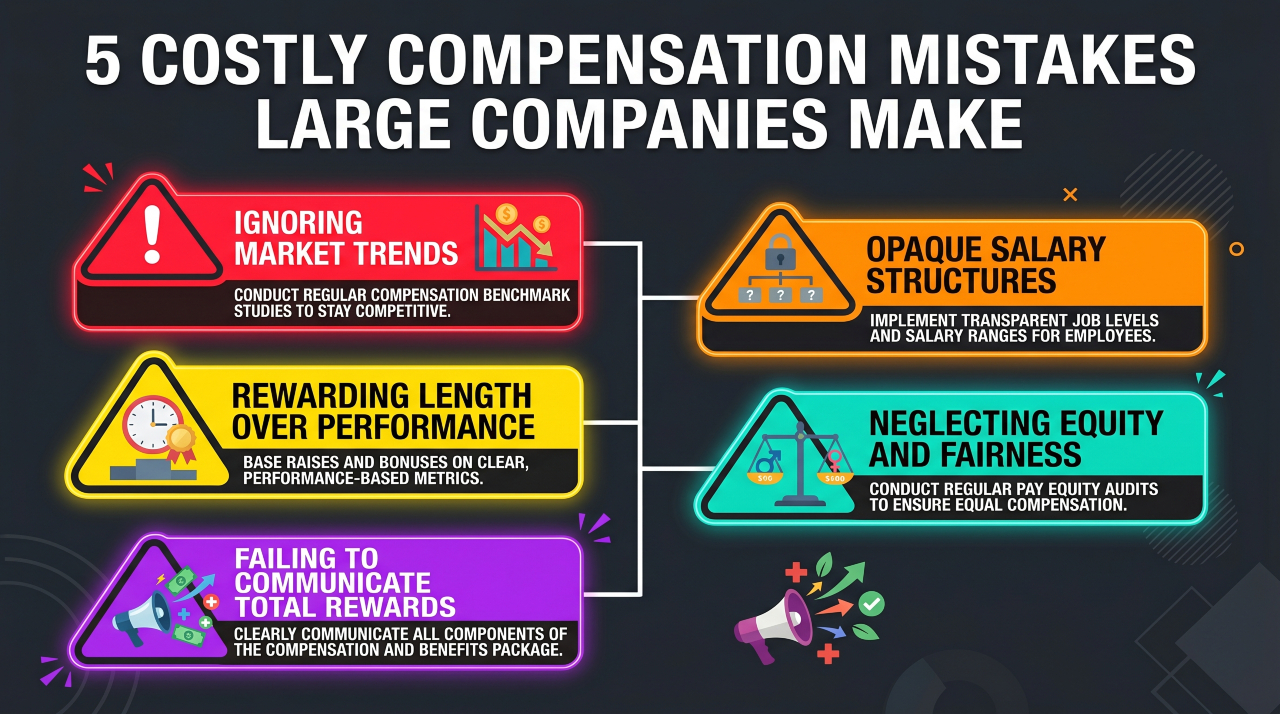
Even large, well resourced companies make serious mistakes in how they manage compensation. Knowing what these mistakes are helps you avoid them.
| Common Mistake | Why It Happens | How to Fix It |
|---|---|---|
| Using outdated salary data | Annual benchmarking is skipped | Schedule reviews every 12 months |
| Letting managers decide pay without guidelines | No clear salary band policy | Create and enforce pay grade structures |
| Ignoring pay equity | No regular analysis process | Run equity audits twice per year |
| Poor communication about pay decisions | HR treats pay as confidential | Share pay philosophy and ranges openly |
| Not aligning pay with performance | Variable pay is poorly designed | Redesign incentive programs with clear metrics |
One of the most common mistakes is treating compensation as a once a year task. Pay is a living system that needs regular attention. Market conditions shift, business priorities change, and individual performance evolves. Companies that check in on compensation regularly make smaller adjustments more often instead of making big, disruptive changes all at once.
Another frequent problem is inconsistency between departments. When different managers apply different standards for pay increases, employees notice. Even if the overall budget is fair, inconsistent application feels unfair. Strong central oversight and clear policy help prevent this.
How to Measure If Your Compensation Program Is Working
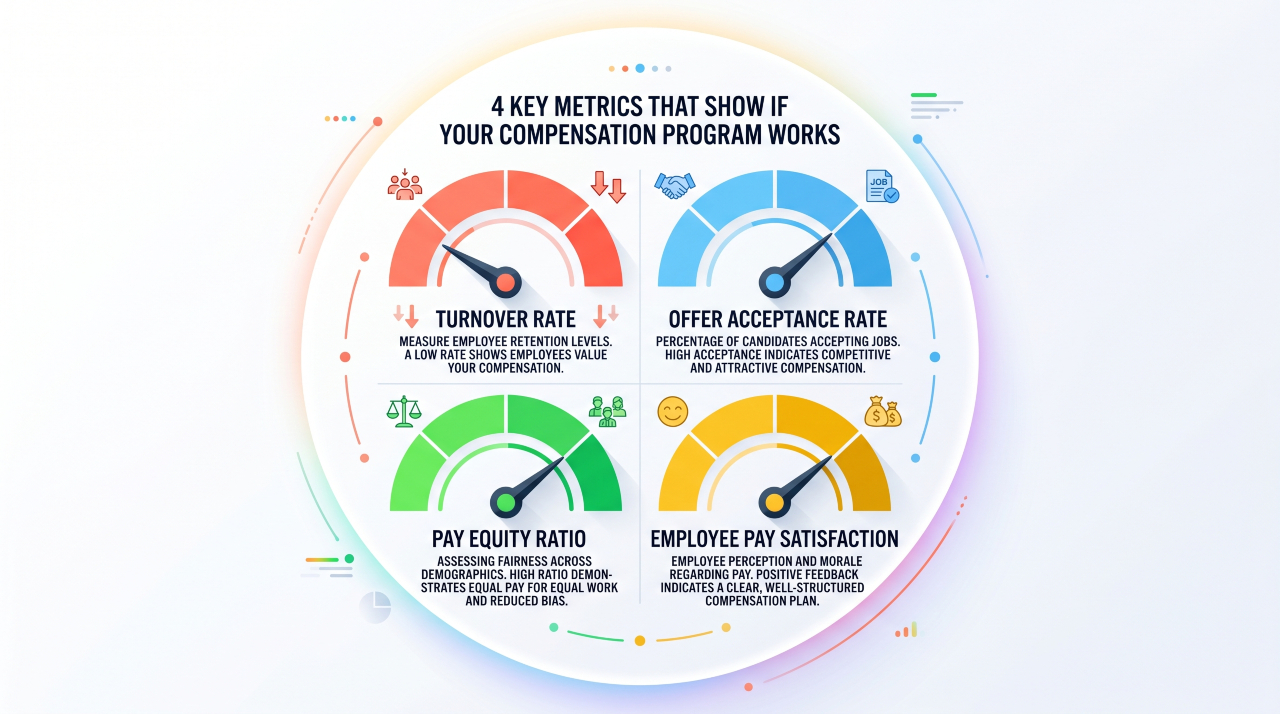
You cannot improve what you do not measure. Tracking the right metrics tells you if your compensation program is doing its job. Here are the most important indicators to watch.
Turnover rate is one of the clearest signals of compensation health. If skilled employees are leaving at a high rate, pay may be part of the problem. Tracking turnover by department, role, and pay level helps you spot where the issues are. Exit interview data can confirm whether pay was a factor in the decision to leave.
Offer acceptance rate tells you how competitive your pay is in the hiring market. If candidates are regularly turning down your offers, your compensation may be below market for those roles. Tracking this by job family and location helps you target your benchmarking efforts and adjust where needed.
Pay equity ratios measure fairness across different employee groups. Regular analysis of pay by gender, race, age, and other characteristics shows whether your system is working fairly. Companies that track this consistently are better at catching problems early before they become legal or reputational issues.
Employee satisfaction with pay is harder to measure but very important. Engagement surveys that include questions about compensation give you a sense of how employees feel about their pay. A high satisfaction score does not always mean you are paying above market. It can also mean that your communication and pay processes are clear and trusted.
Technology Trends Shaping the Future of Compensation Management
The tools available for managing compensation are getting significantly better and faster. Several technology trends are reshaping how enterprise HR teams work.
Artificial intelligence is being built into compensation platforms to help with benchmarking, pay equity analysis, and merit increase recommendations. These tools can analyze large amounts of data much faster than any human team. They can flag potential equity issues, suggest market adjustments, and model the budget impact of different pay scenarios. This gives HR teams more time to focus on the decisions that require human judgment.
Real time data is replacing annual salary surveys in some areas. Platforms that aggregate compensation data from millions of job postings and employee reported salaries give HR teams more current information to work with. While traditional surveys still have value, real time data helps companies react faster to market changes.
Skills based pay is gaining attention as a new model for compensation. Instead of paying purely based on job title or level, companies look at the specific skills an employee has. This approach can be more flexible and better aligned with actual value delivered. For large organizations, implementing skills based pay requires significant investment in skills data and job architecture redesign.
Steps to Build or Improve Your Enterprise Compensation System
If your current compensation system is not working well, the good news is that you can fix it. The process takes time, but the steps are clear and proven.
Start with a complete audit of your current state. Look at your salary bands, your market position, your pay equity, and your variable pay programs. This audit gives you a clear picture of where the gaps are and what needs the most attention first. Without this baseline, you will not know if your changes are actually working.
Next, gather good market data. Invest in at least one credible salary survey for your industry and geographic markets. Compare your current pay rates to the market data and identify the biggest gaps. Prioritize the roles that are hardest to fill or most critical to your business.
Then redesign your salary structure based on what you learned. Create clear salary bands for all job levels. Make sure the bands are wide enough to give managers flexibility but tight enough to prevent large inconsistencies. Communicate the new structure to managers and train them on how to use it.
After that, build or improve your compensation planning process. Choose software that fits your size and complexity. Define the steps, the timelines, and the approval requirements for each compensation cycle. Test the process before you roll it out company wide to catch any problems early.
Finally, communicate clearly with employees. Tell them about your pay philosophy. Explain how salary bands work. Let them know where they fall in their range and what factors influence pay decisions. Good communication makes the whole system more effective and builds employee trust over time.
Get Compensation Right and Your Business Benefits
Enterprise compensation management is not just an HR function. It is a core business strategy. When large companies get it right, they attract better talent, keep more of their best employees, and use their compensation budget more effectively. When they get it wrong, the costs in turnover, legal risk, and lost productivity are enormous.
The good news is that this is a solvable problem. With the right data, the right tools, and a clear process, any large organization can build a compensation system that works. It requires investment and ongoing attention, but the return is absolutely worth it.
If your compensation system feels broken or outdated, now is the time to act. Start with an audit. Bring in good data. Choose the right technology. Train your managers. And commit to being honest with your employees about how pay works at your company.
Your people are your most valuable asset. Paying them well, fairly, and consistently is one of the best things you can do for your business.