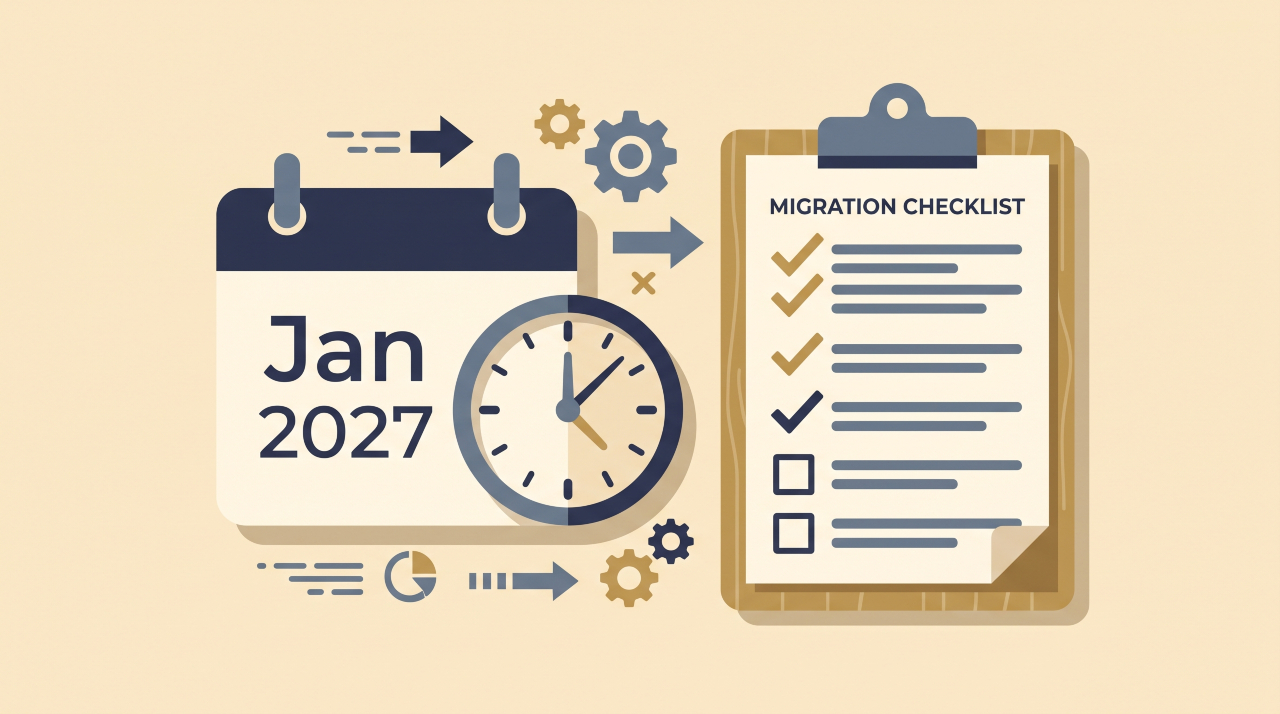
As of May 2026, approximately 500,000 UK business premises had not yet migrated away from traditional copper-line telephony, according to industry data reported to Ofcom. The UK’s Public Switched Telephone Network (PSTN) and Integrated Services Digital Network (ISDN) are scheduled for full retirement on 31 January 2027. That date is confirmed with no extensions planned. When the deadline passes, any business still relying on a traditional analogue phone line will lose service entirely.
The migration is not optional, and it affects more than desk phones. Card payment terminals, fire alarms, door entry systems, and CCTV units connected via copper lines must all be assessed and moved to IP-based alternatives before the cutoff. For the 500,000 business premises still on legacy lines, the decision about which phone system to move to is now time-critical, not theoretical.
This guide sets out the complete picture for UK small businesses in 2026: what types of phone systems are available, how UK pricing actually works, which providers suit which business sizes, what a migration from PSTN looks like in practice, and what mistakes to avoid during the process.
Key Takeaways
- The UK PSTN and ISDN networks will shut down permanently on 31 January 2027. VoIP or cloud-based systems are the only viable path forward for any business currently on copper lines
- VoIP systems for UK small businesses typically cost £7 to £30 per user per month, with most small teams finding fully functional entry-level plans between £10 and £15 per user per month
- The correct system for your business depends on team size, call volume, CRM integration needs, and whether your team works from fixed desks, remotely, or across multiple locations
- Number porting from your existing business landline to a new VoIP provider is standard and typically costs £20 to £30 as a one-off fee
- Before signing any contract, check the term length carefully. Some established providers lock small businesses into 36 to 60-month agreements with built-in annual price increase clauses
Quick Answer
For most UK small businesses in 2026, a cloud-hosted VoIP system is the best choice. It requires no physical on-site hardware, scales as your team grows, and costs between £10 and £20 per user per month. RingCentral is the strongest all-round option for teams needing a unified communications platform. Air Landline or a similar lightweight provider suits sole traders who need a professional business number forwarded to their existing mobile. BT Cloud Voice suits businesses that prefer a single established UK telecoms provider, provided you read the contract terms carefully before signing.
Understanding Phone System Types: What UK Small Businesses Actually Need
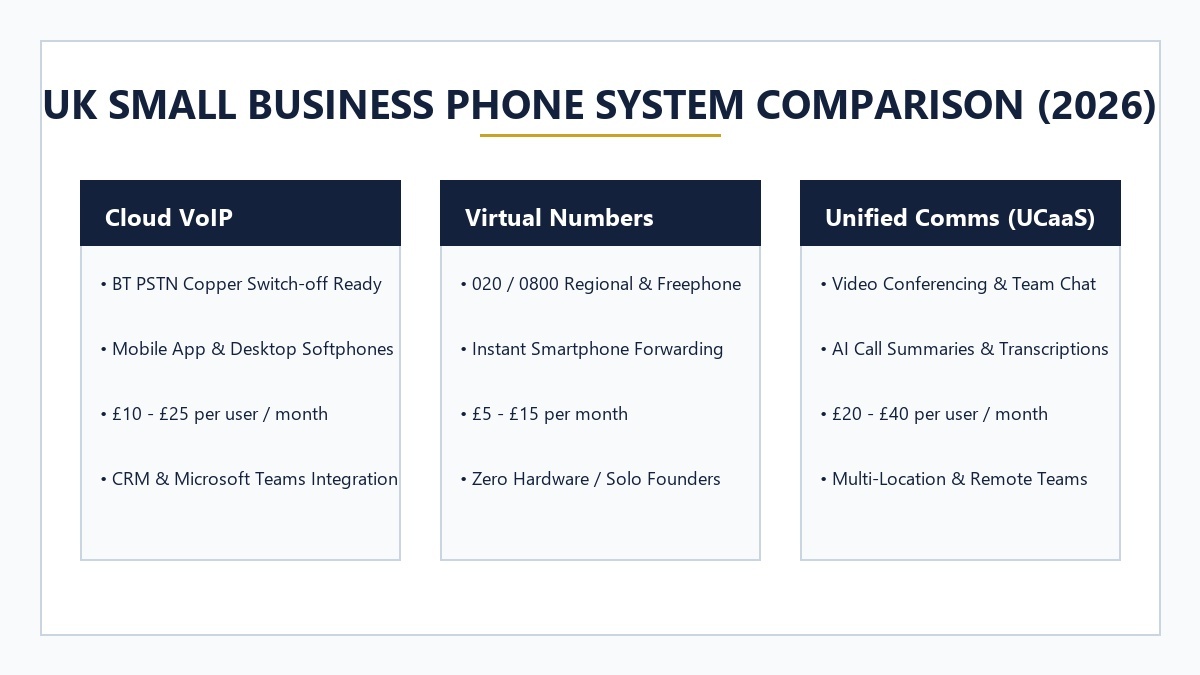
Before comparing providers, it helps to understand the three main categories of phone system available to UK small businesses in 2026 and what distinguishes them operationally.
Cloud-Hosted VoIP
Voice over Internet Protocol transmits calls as data packets over your existing broadband connection rather than a physical copper line. A cloud-hosted VoIP system means the provider manages all the infrastructure remotely. You access it through a desktop app (softphone), a mobile app, or a desk handset connected to your broadband router.
This is the most common choice for UK SMEs in 2026 because it requires minimal upfront hardware investment, works for hybrid and remote teams without additional configuration, and allows you to add or remove lines in minutes through an online dashboard.
Minimum broadband requirement: 100 Kbps upload bandwidth per simultaneous call, sustained. A standard UK business fibre connection handles most small team requirements without issue.
On-Premise IP PBX
A private branch exchange (PBX) hosted on physical hardware at your own premises. You own the hardware and control the system entirely. This approach is more expensive to install (hardware costs typically run from £500 to several thousand pounds depending on capacity) but gives complete control over call routing, data, and configuration.
This model suits larger UK businesses or those with specific data compliance requirements, where keeping call data on-premises matters. For most small businesses with five to fifty employees, a cloud-hosted VoIP system offers identical functionality at a fraction of the cost and with zero hardware maintenance burden.
Hosted PBX (Hybrid Model)
Some providers, including Yeastar, offer systems that run either fully cloud-hosted or with an on-premise hardware unit acting as the controller while calls are still managed via internet. This suits businesses that want the redundancy of on-site equipment but still need multi-location or remote-worker support.
UK Provider Comparison: Pricing, Features, and Best-Fit Business Size
Provider Comparison Table
| Provider | UK Pricing (Per User/Month) | Contract | Best For |
|---|---|---|---|
| RingCentral | From £12.99 (annual billing) | Monthly or annual | Teams of 5-100 needing unified comms (calls, video, messaging) |
| 8×8 | Quote-based (~£18-£30 mid-tier) | Quote-based | Businesses with international calling needs or contact centre requirements |
| BT Cloud Voice | From £10.52 (licence) + £10.47 (call plan) on 60-month terms | 36-60 months | Businesses wanting a single established UK provider with managed setup |
| Air Landline | From £5/month (flat rate) | Monthly | Sole traders needing a business number forwarded to a mobile |
| CloudTalk | From approx £20 (Starter) | Monthly or annual | Sales and support teams needing deep CRM integration and AI call features |
| Yeastar | Quote-based (cloud or on-premise) | Flexible | Businesses wanting hybrid cloud-plus-hardware deployment |
Pricing based on publicly available UK provider information as of July 2026. Always request a current quote directly from the provider before purchasing.
RingCentral (RingEX)
RingCentral is the most established all-in-one unified communications platform operating in the UK market. Its entry-level plan (around £12.99 per user per month on annual billing) includes unlimited UK calls, messaging, video conferencing, and basic call management features. Advanced tiers that unlock features such as deep CRM integrations, call recording storage, and analytics start from around £22 to £29.99 per user per month.
What most buyers miss: Monthly billing without an annual contract is typically around 33% more expensive than the equivalent annual rate. If you are confident in your team size for the next year, committing to annual billing delivers meaningful savings.
Best for: UK businesses with 5 to 100 employees who need calls, video, team messaging, and basic CRM connectivity in a single platform.
Honest risk: The sheer number of features on higher-tier plans creates complexity. Teams who only need basic call handling will find the interface unnecessarily dense. Start with the lowest tier that covers your actual requirements.
8×8
8×8 has moved away from publicly listed pricing to a quote-only model for most of its UK plans. Mid-tier plans typically fall between £18 and £30 per user per month based on independent market estimates, but actual pricing depends on your volume and contract negotiation. 8×8 is particularly strong for businesses with significant international calling requirements, offering unlimited calls to up to 48 countries on certain plans.
Best for: UK businesses with regular international calling needs or those running customer support contact centre operations.
Honest risk: The quote-only pricing model makes direct comparison difficult before you enter a sales conversation. Always request an itemized breakdown of all fees, including regulatory recovery charges and early termination penalties, in writing before signing.
BT Cloud Voice
BT Cloud Voice is the primary cloud telephony product from BT for UK SMEs. Its licensing structure separates the seat licence cost (starting from approximately £10.52 per user per month for a Basic tier on a 60-month term) from the call plan cost (approximately £10.47 per month for a UK unlimited calls add-on). Total effective costs therefore start from around £20 to £21 per user per month at entry level on long-term contracts.
BT is sold predominantly through local reseller partners who handle installation and support. This suits businesses that prefer a managed setup with a dedicated UK-based account contact.
Best for: UK businesses with an established preference for a single traditional telecoms provider, or those with complex multi-site setups requiring managed on-site installation.
Honest risk: BT Cloud Voice contract terms of 36 to 60 months are among the longest in the market. BT has also standardized annual price increases into its contracts. Read the full terms before committing, particularly the price escalation clauses and early exit penalties.
Air Landline
Air Landline is a UK-specific provider targeting sole traders and very small businesses that need a professional separate business phone number without purchasing a desk phone or changing their existing mobile setup. Calls to your Air Landline number are forwarded to your existing mobile. Plans start from around £5 per month.
Best for: UK sole traders and single-person businesses who want a professional business number that rings on their existing mobile.
Honest risk: Air Landline and similar forwarding services do not offer call conferencing, team messaging, CRM integrations, or the collaborative features of a full VoIP platform. As your team grows beyond one person, you will outgrow this model quickly.
How to Choose the Right System: A Business-Type Matching Guide
Not all small businesses have the same communications requirements. The correct system depends on your team structure, call volume, and operational model.
Sole trader or single-person business: A lightweight forwarding service such as Air Landline provides a professional separate number at minimal cost. If you handle frequent client calls and want call recording or voicemail-to-email, consider an entry-level VoIP plan from RingCentral or a similar provider at around £12 to £15 per user per month.
Remote-first team of 2-20 people: A cloud-hosted VoIP platform is the natural fit. Every team member accesses the system through a mobile or desktop app regardless of location. No desk phones, no physical hardware, no office required. RingCentral’s entry-level plan or a comparable platform covers this scenario at under £15 per user per month.
Office-based team with desk phones: Most VoIP providers are compatible with standard SIP-enabled desk handsets from manufacturers such as Yealink, Polycom, or Cisco. You purchase the handsets separately (typically £30 to £150 per unit depending on features) and register them with your VoIP provider. This gives you a traditional desk phone experience on a modern IP infrastructure.
Multi-site or multi-location business: Cloud-hosted VoIP handles multiple office locations natively through a single account dashboard. Calls between sites are typically free, and staff can transfer calls between locations without any additional configuration. This is a significant operational advantage over legacy PBX systems that required separate hardware at each site.
High inbound call volume or customer support teams: Look for providers with built-in call queue management, Interactive Voice Response (IVR) menus, and CRM integration. CloudTalk and RingCentral’s higher tiers are both designed for this use case.
The PSTN Switch-Off: What Every UK Business Needs to Do Before January 2027
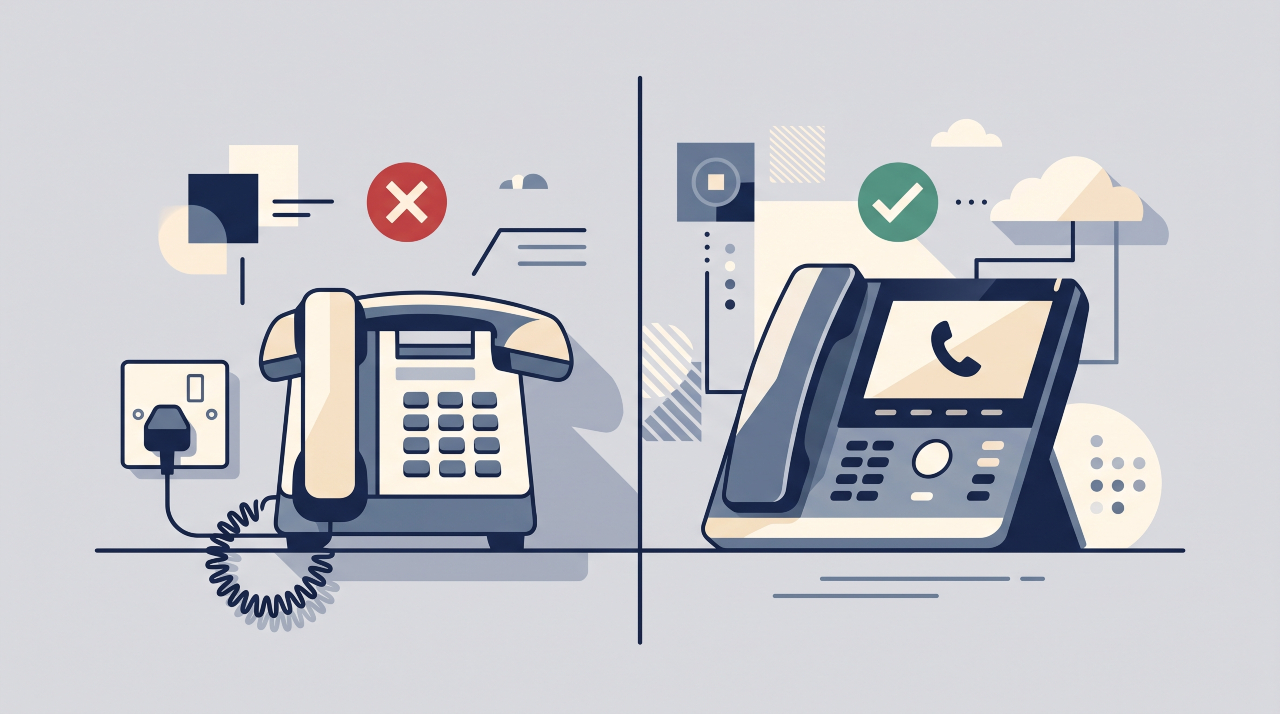
The UK’s copper telephone network, which has carried analogue voice calls since the 1870s, is being retired permanently. Ofcom has confirmed the 31 January 2027 deadline is final. New orders for traditional PSTN and ISDN lines have already been unavailable in most UK exchange areas since September 2023. Migration to IP-based telephony is mandatory for any business still on copper lines.
What the switch-off affects beyond your phone:
Many businesses discover during an audit that their copper line carries services they had not connected to their phone system. These include fire alarm panels that dial the monitoring centre over a phone line, older PDQ card payment terminals with modem-based connectivity, door entry and intercom systems using analogue signals, CCTV systems with remote monitoring via phone line, and older ADSL and FTTC broadband services that run over copper infrastructure.
Each of these systems requires a separate assessment and migration plan before January 2027.
Practical migration checklist:
Before selecting a VoIP provider, work through the following:
- Audit every device in your business that connects to a wall socket via a traditional phone cable. This includes equipment that does not look like a phone.
- Confirm your business broadband connection speed and reliability. VoIP requires a stable upload connection. If your current broadband is copper-based, a fibre-only alternative (FTTP) may be needed as part of the same migration.
- Contact your existing line provider to initiate number porting to your chosen VoIP provider. Porting typically takes 7 to 14 working days and costs £20 to £30 as a one-off fee.
- Plan for power resilience. Unlike traditional phone lines that carry their own electrical current, VoIP handsets and routers require mains power. During a power cut, your phone system will not function unless you have an Uninterruptible Power Supply (UPS) unit in place.
- Run a parallel period of two to four weeks where both systems operate simultaneously before disconnecting the legacy line, to catch any configuration issues before the cutover.
Common Mistakes to Avoid
Choosing a system based on features you will not use. Many small businesses pay for advanced tiers loaded with CRM automation, call analytics, and AI features they never activate. Start with the lowest tier that covers your actual daily call workflow and upgrade only when you identify a specific need.
Signing a long-term contract without reading the price escalation clause. Some established UK telecoms providers include automatic annual price increases written into multi-year contracts. A contract that looks affordable at £20 per user per month in year one may cost £24 or more by year three. Always ask the provider to state in writing the maximum annual increase they can apply.
Skipping the broadband check before switching. VoIP call quality is entirely dependent on your internet connection. A business running on a congested shared broadband line will experience poor call quality regardless of the provider chosen. Ensure your upload speed is stable and adequate before signing up.
Assuming your business number will transfer automatically. Number porting requires you to actively initiate the process with your new provider. It does not happen automatically when you sign up. Start the porting process at least three weeks before your planned cutover date.
Not auditing all copper-connected devices. Several UK businesses discovered after their phone line migration that a fire alarm or payment terminal had also stopped working, because both shared the same copper circuit. A complete audit of all wall-socket-connected equipment before the switch prevents this.
Frequently Asked Questions
What is the cheapest business phone system available in the UK?
For sole traders, forwarding services such as Air Landline start from around £5 per month and provide a professional business number that rings on your existing mobile. For teams requiring a full VoIP platform with call management, team messaging, and video conferencing, entry-level plans from providers such as RingCentral start from approximately £12.99 per user per month on annual billing.
Does my small business have to switch to VoIP in 2026?
If your business still uses a traditional PSTN or ISDN telephone line, you must migrate before the UK network shutdown on 31 January 2027. New orders for traditional lines have been unavailable since September 2023 in most areas. The deadline is confirmed and will not be extended. Businesses that have not migrated will lose phone service on 1 February 2027.
How much does a small business phone system cost per month in the UK?
Costs range from £5 per month for a basic forwarding service to £30 or more per user per month for enterprise-level unified communications platforms. For most UK small businesses running cloud-hosted VoIP with a team of 5 to 20 people, a realistic monthly cost is £10 to £20 per user per month on an annual contract.
Can I keep my existing business phone number when switching to VoIP?
Yes. Number porting allows you to transfer your existing UK landline or geographic number to a VoIP provider. The process typically takes 7 to 14 working days and costs £20 to £30 as a one-off fee. Inform your chosen VoIP provider that you want to port your number when you sign up, and they will manage the transfer with your existing line provider.
What broadband speed do I need to run a VoIP phone system?
The general minimum is 100 Kbps of stable upload bandwidth per simultaneous call. A standard UK business fibre broadband connection easily handles this for most small teams. If you currently use ADSL or FTTC copper-based broadband, note that this service is also being retired as part of the broader PSTN migration. Upgrading to a full-fibre (FTTP) connection is recommended as part of your telephony migration.
What happens to my phone during a power cut if I use VoIP?
Unlike traditional copper phone lines, which carry their own electrical current and continue working during power cuts, VoIP systems require mains power for both the router and any IP handsets. During a power outage, your VoIP system will not function unless you have an Uninterruptible Power Supply (UPS) unit keeping your router and handsets powered. For businesses where telephone continuity during power cuts is critical, a UPS is an essential addition to the migration plan.
Is VoIP secure for business calls in the UK?
Reputable VoIP providers use Transport Layer Security (TLS) and Secure Real-time Transport Protocol (SRTP) encryption to protect calls in transit. For regulated industries such as financial services or healthcare, check whether your chosen provider’s call data storage and processing arrangements comply with your specific regulatory requirements, including UK GDPR obligations on data residency and retention.
What to Do This Week
The UK PSTN migration deadline is set. Half a million business premises still need to act. If your business is among them, the single most valuable thing you can do this week is complete a full audit of every device connected to your phone line, including equipment that does not look like a phone.
Once that audit is complete, shortlist two or three providers based on your team size and the business-type matching guide in this article. Request free trials from each, run calls on your actual broadband connection during your peak business hours, and confirm number porting terms before you sign. The January 2027 deadline leaves meaningful time to migrate properly if you begin now. Waiting until the final quarter of 2026 risks supply pressure from a surge of last-minute migrations and fewer installation appointment slots from managed providers.
If you are also reviewing your broader business infrastructure as part of this process, our guide on marketing a business online covers the digital tools that complement a modern communications setup.