According to ONS data, the UK economy grew by 0.6% in Q1 2026 while the Bank of England held its base rate at 3.75%. Against that backdrop, the tax decisions founders make in their first few years of trading can either protect their cash flow or quietly erode it.
Business tax in the UK is not one single tax. It is a layered system: Corporation Tax for limited companies, Income Tax and National Insurance for sole traders, VAT once turnover crosses the registration threshold, and Business Rates for premises occupiers. Each layer has its own HMRC deadlines, rate structures, and planning opportunities.
This guide breaks down every layer of UK business tax for 2026/27, explains who pays what and when, highlights the decisions that catch founders off guard (particularly the Marginal Relief band), and tells you when to stop reading guides and call an accountant.
Key Takeaways
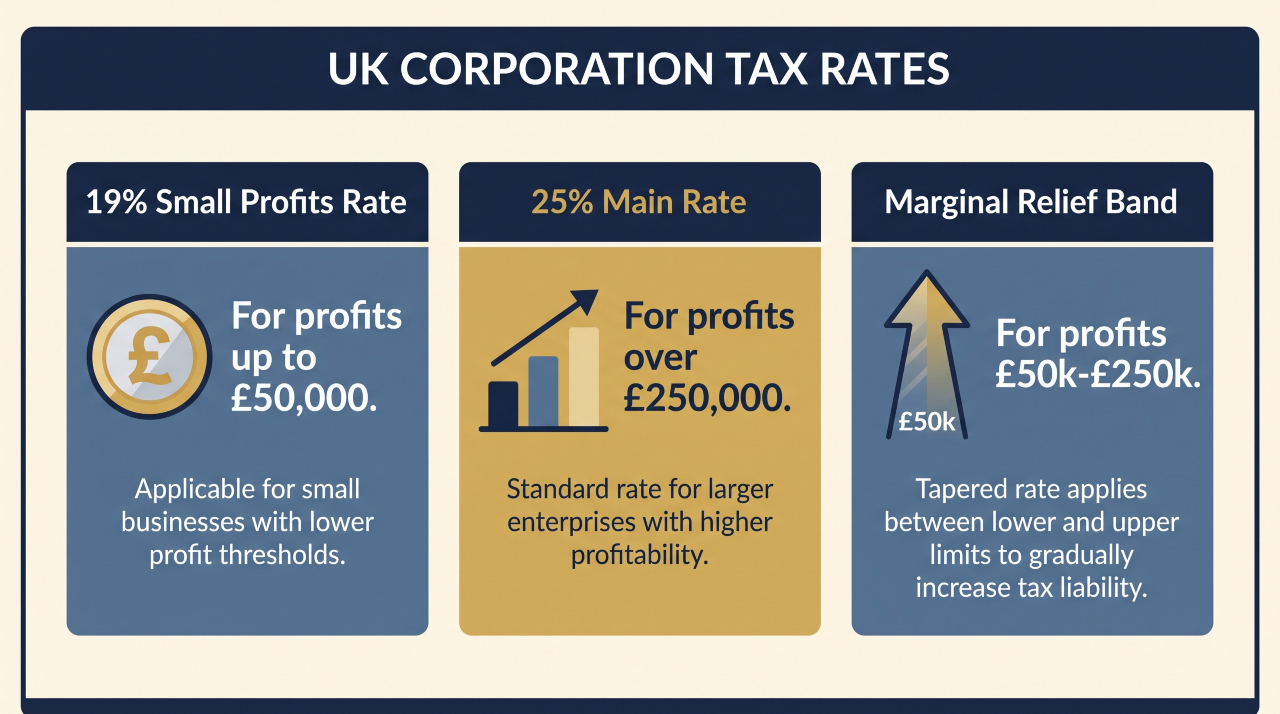
- Limited companies pay Corporation Tax at 19% (profits up to £50,000) or 25% (profits above £250,000), with Marginal Relief between those thresholds.
- Sole traders pay Income Tax and National Insurance through Self Assessment, not Corporation Tax.
- From 6 April 2026, Making Tax Digital (MTD) for Income Tax applies to sole traders and landlords with qualifying income above £50,000.
- The VAT registration threshold for 2026/27 is £90,000 of taxable turnover in any rolling 12-month period.
- Employer National Insurance rose to 15% from April 2025, increasing the cost of taking on staff for UK SMEs.
- Tax planning is legal, expected by HMRC, and directly affects how much cash your business retains for growth.
Quick Answer
Business tax in the UK covers several distinct taxes. Limited companies pay Corporation Tax on profits (19% or 25% depending on size). Sole traders pay Income Tax and National Insurance on their business profits through Self Assessment. VAT applies once turnover exceeds £90,000 per year. The right structure for your business significantly affects your total tax bill, and getting it wrong costs more than getting professional advice.
The Two Main Business Structures and How They Are Taxed
Understanding business tax in the UK starts with one question: are you a sole trader or a limited company? The answer determines which tax types apply to you, how you report, and when you pay.
Sole Traders
A sole trader runs their business as an individual. You and the business are the same legal entity. HMRC taxes your business profits through the Self Assessment system alongside any other personal income you have.
You pay Income Tax at the standard personal rates: 20% (basic rate), 40% (higher rate), or 45% (additional rate), depending on your total income for the year. Your personal allowance of £12,570 applies before tax kicks in.
You also pay National Insurance on your profits. For 2026/27:
- Class 4 NIC: 6% on profits between £12,570 and £50,270
- Class 4 NIC: 2% on profits above £50,270
- Class 2 NIC: £3.65 per week (voluntary if profits fall below £7,105)
The Self Assessment deadline for online filing is 31 January each year, covering the previous tax year (April to April).
Limited Companies
A limited company is a separate legal entity from its owners. The company pays Corporation Tax on its profits, not you personally. You then draw income from the company as a salary (subject to PAYE Income Tax and NI) or as dividends (taxed at dividend rates, which are lower than income tax rates for most directors).
This separation is why many founders choose to incorporate: the total tax bill is often lower once profits reach a certain level. However, the administrative requirements are higher.
Corporation Tax: Rates, Thresholds, and the Marginal Relief Trap
Corporation Tax is the primary business tax for UK limited companies. For 2026/27, two rates apply depending on your company’s annual taxable profits.
| Profit Level | Corporation Tax Rate | Effective Rate |
|---|---|---|
| Up to £50,000 | 19% (Small Profits Rate) | 19% |
| £50,001 to £250,000 | 25% (Main Rate with Marginal Relief) | 19% to 25% (tapered) |
| Over £250,000 | 25% (Main Rate) | 25% |
The Marginal Relief Band: Where Founders Get Caught
If your company profits land between £50,000 and £250,000, you pay the 25% Main Rate but can claim Marginal Relief. This tapers your effective tax rate gradually from 19% toward 25% across that band. The practical effect: every extra pound of profit in this range is taxed more heavily than profits at either end.
Founders who do not know about this band often take a distribution, invoice a large client, or receive a one-off payment that pushes them into it at year end. The fix is straightforward but requires planning before year end, not after: accelerating pension contributions, bringing forward capital purchases (using Full Expensing or the Annual Investment Allowance), or timing invoicing carefully can keep profits below the higher threshold legitimately.
An accountant who understands your business cycle is worth considerably more than their fee here.
Corporation Tax Deadlines and How to Pay
Missing HMRC deadlines triggers automatic penalties and interest. These two deadlines apply to every UK limited company each accounting period:
- Payment deadline: 9 months and 1 day after the end of your accounting period. For a company with a 31 December 2025 year end, this means 1 October 2026.
- Filing deadline (CT600): 12 months after the end of your accounting period. For the same company: 31 December 2026.
Large companies (taxable profits above £1.5 million) pay Corporation Tax in quarterly instalments rather than a single lump sum. This catches some fast-growing companies off guard in the year they first cross the threshold.
Payments are made directly to HMRC via your company’s online tax account. Your accountant can handle this, but the ultimate responsibility for filing correctly and on time sits with the company directors.
Income Tax and Self Assessment for Sole Traders
Sole traders do not have a CT600 or a company tax return. Their reporting tool is the Self Assessment tax return, filed annually through HMRC’s online service.
Payment on Account
One element that surprises many new sole traders is the Payment on Account system. HMRC does not wait until you file your return to collect tax. If your Self Assessment tax bill exceeds £1,000, HMRC requires you to make two advance payments toward the following year’s tax bill:
- First Payment on Account: 31 January (alongside the balancing payment for the previous year)
- Second Payment on Account: 31 July
Each payment is 50% of last year’s total tax bill. In a high-earning year, this means you can owe two years’ worth of tax in a single January. Founders who are not expecting this find January extremely difficult to navigate without a cash reserve.
VAT: The £90,000 Threshold Decision
VAT (Value Added Tax) applies when your taxable turnover exceeds £90,000 in any rolling 12-month period (2026/27 threshold). At that point, registration with HMRC is mandatory and must happen within 30 days of crossing the threshold.
| VAT Rate | When It Applies |
|---|---|
| Standard rate 20% | Most goods and services |
| Reduced rate 5% | Domestic energy, children’s car seats, certain property conversions |
| Zero rate 0% | Food (most), children’s clothing, books, some medical supplies |
| Exempt | Financial services, insurance, education |
Once registered, you charge VAT on your sales invoices and reclaim VAT on eligible business purchases. The difference is paid quarterly (or monthly, or annually under the Annual Accounting Scheme) to HMRC via a VAT return.
VAT and Making Tax Digital
From April 2022, all VAT-registered businesses have been required to use Making Tax Digital (MTD) compatible software to keep digital records and file VAT returns. If you are VAT-registered and still filing returns manually, you are already non-compliant. HMRC’s MTD requirements are expanding: from 6 April 2026, MTD for Income Tax applies to sole traders and landlords earning above £50,000 in qualifying income, requiring quarterly digital updates to HMRC throughout the year rather than a single annual return.
National Insurance for Employers: A Significant Cost Change
If you employ staff, Employer Class 1 National Insurance is a direct business cost, not a personal one. From April 2025, the Employer NI rate rose to 15% on all employee earnings above the Secondary Threshold of £5,000 per year. This is a meaningful increase from the previous 13.8%.
The Employment Allowance for 2026/27 is £10,500, which eligible employers can offset against their Employer NI liability. Most small businesses with a total NI bill under £10,500 pay nothing in Employer NI at all. Businesses that have grown beyond that threshold feel the 15% rate on every pound above it.
For a business with 5 employees each earning £35,000, the employer NI bill on those salaries (above the £5,000 threshold) runs to approximately £22,500 per year before Employment Allowance. Factoring this into hiring decisions is essential.
Business Rates: The Tax Most Online Businesses Miss
Business Rates are a property tax levied by local authorities on non-domestic properties: offices, retail units, warehouses, and workshops. They do not apply to businesses operating entirely from home.
A major revaluation of non-domestic property took effect from 1 April 2026, with new multipliers for 2026/27:
| Category | Multiplier |
|---|---|
| Small business (Retail/Hospitality/Leisure) | 38.2p per £1 rateable value |
| Standard (Retail/Hospitality/Leisure) | 43.0p per £1 rateable value |
| Small business (Non-RHL) | 43.2p per £1 rateable value |
| Large business supplement | 50.8p per £1 rateable value |
Small Business Rate Relief applies if your property’s rateable value is £12,000 or less: you pay nothing. The relief tapers to zero at £15,000.
Do New Businesses Pay Tax in Year One?
Yes, but the timing depends on your structure and how quickly you start trading.
Sole traders: If you register with HMRC and start trading in the 2026/27 tax year, your Self Assessment return is due by 31 January 2028, covering earnings from April 2026 to April 2027. You owe tax on whatever profits you made, minus allowable expenses. If your total tax bill exceeds £1,000, Payment on Account starts immediately.
Limited companies: Corporation Tax is due 9 months and 1 day after your accounting period ends, regardless of how new the company is. If your company was incorporated in March 2026 and had a year-end of March 2027, your first CT payment would be due January 2028. You can, however, owe tax in year one if the business is profitable from the start.
The common misconception is that new businesses get a tax holiday. They do not. What new businesses do get is a relatively long runway between earning income and paying the first tax bill, which is why cash flow planning from day one matters.
Common Business Tax Mistakes to Avoid
Mixing personal and business finances
HMRC does not require a separate business bank account, but mixing funds makes it nearly impossible to identify allowable expenses accurately. Disallowed personal expenses inflated into business costs are one of the most common triggers for HMRC compliance checks.
Missing the VAT threshold by surprise
Turnover is measured on a rolling 12-month basis, not per tax year. A quiet January followed by a strong February can push you over £90,000 without warning. Check your rolling 12-month figure monthly once you are approaching £75,000.
Taking the wrong salary and dividend split
Many director-shareholders set up a salary and dividend structure when they incorporate and then never revisit it. The optimal split changes when dividend tax rates change, when NI thresholds shift, or when your personal income changes. What was efficient in 2023 may not be in 2026.
Underestimating the cost of growth
Hiring your first employee adds 15% Employer NI on top of their salary from pound one above £5,000. Moving to business premises triggers Business Rates. Crossing the VAT threshold creates quarterly reporting obligations. Growth is positive; not pricing in its tax costs in advance is where cash flow problems start.
Frequently Asked Questions
What is the Corporation Tax rate for small businesses in the UK in 2026?
Small UK companies with taxable profits of £50,000 or less pay Corporation Tax at 19% under the Small Profits Rate. Companies with profits above £250,000 pay the Main Rate of 25%. Profits between these thresholds are subject to the Main Rate with Marginal Relief applied, resulting in an effective rate that tapers between 19% and 25%.
Do sole traders pay Corporation Tax?
No. Sole traders are not separate legal entities from their owners. They pay Income Tax on their business profits through the Self Assessment system, along with Class 4 National Insurance Contributions. Corporation Tax only applies to limited companies.
What is the VAT registration threshold in the UK for 2026?
The mandatory VAT registration threshold is £90,000 of taxable turnover in any rolling 12-month period for 2026/27. You must register with HMRC within 30 days of crossing this threshold.
How much is business tax in the UK for a company making £100,000 profit?
A limited company with £100,000 in taxable profits falls in the Marginal Relief band (between £50,000 and £250,000). The effective tax rate sits between 19% and 25% in this range. At £100,000, the Corporation Tax bill would be approximately £22,750, based on HMRC’s Marginal Relief calculation. You should use HMRC’s Marginal Relief Calculator on GOV.UK for a precise figure.
When is Corporation Tax due in the UK?
Corporation Tax payment is due 9 months and 1 day after the end of your company’s accounting period. The CT600 tax return must be filed within 12 months of the accounting period end. Missing either deadline results in automatic penalties and daily interest charges from HMRC.
What is Making Tax Digital and who does it affect in 2026?
Making Tax Digital (MTD) is HMRC’s programme requiring businesses to keep digital records and submit tax information through approved software. From 6 April 2026, MTD for Income Tax applies to sole traders and landlords with qualifying income above £50,000, requiring quarterly digital submissions to HMRC rather than a single annual return. All VAT-registered businesses have been covered by MTD since 2022.
Should I be a sole trader or a limited company for tax purposes?
There is no single correct answer. Limited companies tend to be more tax efficient once profits consistently exceed around £30,000 to £40,000 per year, because Corporation Tax rates are lower than higher-rate Income Tax. However, limited companies carry higher administrative costs and obligations. The optimal choice depends on your profit level, personal income requirements, growth plans, and risk appetite. Consult a UK accountant or tax adviser who works with businesses at your stage.
What to Do Next
Business tax in the UK rewards founders who understand the system early and penalises those who engage with it only at deadline time. The rates are set: 19% or 25% Corporation Tax for companies, Income Tax and NI for sole traders, 20% VAT on most sales above the £90,000 threshold. What you can control is your structure, your timing, and your planning.
If you are yet to incorporate, use the resources at GOV.UK’s business setup guide to understand your registration obligations. If you are already trading, use HMRC’s Marginal Relief Calculator to check whether your projected profits for the current year put you in the tapered band, and act before your accounting period closes.
For the broader financial picture, our guide to cash flow tips every small business owner needs to know covers the operational side of managing the gap between tax bills and available funds. If you are weighing up whether to stay as a sole trader or incorporate, our breakdown of how to start a consulting business in the UK in 10 steps covers the structure decision in detail.
This article provides general guidance on business tax in the UK and is accurate to the best of our knowledge as of July 2026. It does not constitute professional tax advice. Consult a qualified accountant or tax adviser for guidance specific to your circumstances.