
Quick Answer: Commercial Lease Agreements UK 2026
A UK commercial lease agreement is a legally binding contract granting a business tenant the right to occupy commercial property. Under Part II of the Landlord and Tenant Act 1954, business tenants automatically enjoy Security of Tenure (the statutory right to renew the lease at expiry) unless formally “contracted out” via a Section 38A notice. Most UK commercial leases are structured as Full Repairing and Insuring (FRI) leases, making the tenant responsible for all repairs, insurance, and service charges. Tenants should attach a formal Schedule of Condition to cap terminal dilapidations claims and negotiate clear, unconditional break clauses.
Key Takeaways
- Part II of the Landlord and Tenant Act 1954 provides statutory security of tenure unless the tenant signs a formal contracting-out declaration.
- In a Full Repairing and Insuring (FRI) lease, the tenant is liable for ongoing maintenance and end-of-lease dilapidations.
- Attaching a surveyor-prepared Schedule of Condition prevents landlords from demanding repairs for pre-existing building defects.
For UK business owners, retailers, and corporate directors, signing a commercial lease represents one of the largest and most inflexible contractual liabilities on the company balance sheet. Unlike residential tenancies, commercial property law in England and Wales affords businesses substantial contractual freedom — meaning the terms agreed upon in the lease govern your legal rights with minimal statutory consumer protection.
According to official guidance on business tenancies published on GOV.UK and commercial property case law under the Landlord and Tenant Act 1954, hidden lease covenants regarding structural maintenance, upwards-only rent reviews, and break clause preconditions cause substantial financial friction for growing SMEs.
This comprehensive guide details everything business tenants must understand before signing a UK commercial lease in 2026, including security of tenure, FRI repairing obligations, break clause execution, rent reviews, and Stamp Duty Land Tax (SDLT) calculations.
1. Security of Tenure: The Landlord & Tenant Act 1954
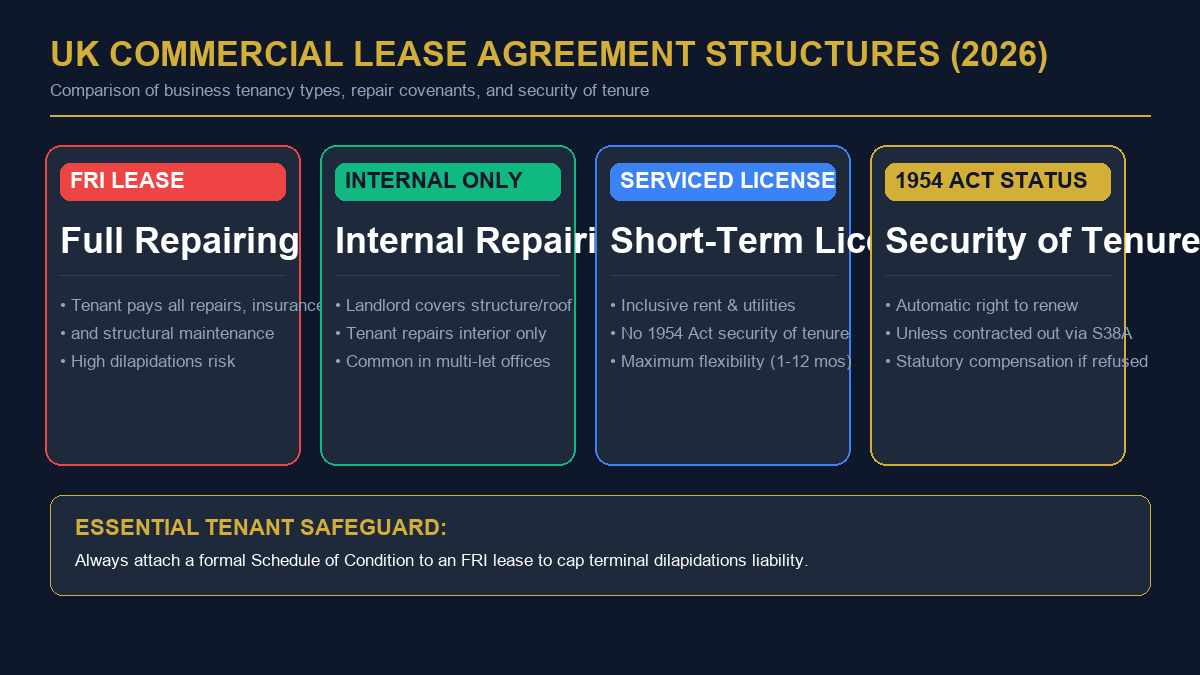
The most important statutory protection for business tenants in England and Wales is Part II of the Landlord and Tenant Act 1954. This legislation grants commercial tenants the legal right to remain in the property when the contractual lease term expires and request a new lease on market terms.
Lease “Inside” the 1954 Act:
- Automatic Renewal: The tenancy does not automatically end on the contractual expiry date. It continues under statutory protection until terminated in accordance with the Act.
- Limited Landlord Grounds for Refusal: The landlord can only oppose renewal on strict statutory grounds (e.g., persistent rent arrears, substantial breach of repair obligations, or intent to demolish/redevelop the building).
- Statutory Compensation: If the landlord successfully opposes renewal for redevelopment, the tenant is entitled to statutory compensation based on the rateable value of the property.
Lease “Contracted Out” (Outside the 1954 Act):
If a lease is contracted out under Section 38A of the 1954 Act, the tenant has zero statutory right to renew at expiry, must vacate on the final day of the term, and is not entitled to any financial compensation. The landlord must serve a formal health warning notice, and the tenant must sign a statutory declaration before the lease is executed.
If you are establishing a new business vehicle to hold your tenancy, follow our guide on how to register a company in the UK.
2. Full Repairing and Insuring (FRI) Leases & Dilapidations
The standard commercial lease structure in the UK is the Full Repairing and Insuring (FRI) lease. Under an FRI lease, the tenant is legally responsible for maintaining, repairing, and insuring the premises.
The Dilapidations Trap:
A standard repairing covenant requires the tenant to “keep the premises in good and substantial repair and condition.” Under English property law, if the premises were in poor condition when you took the lease, this wording legally obligates you to put the property into good condition at your own expense upon lease exit.
Always insist that your repairing obligation is qualified by a professional Schedule of Condition prepared by an independent chartered surveyor (RICS). This photographic and written document is annexed to the lease, ensuring you are not required to return the property in any better state of repair than it was at the commencement date.
3. Break Clauses: Pitfalls and Conditions
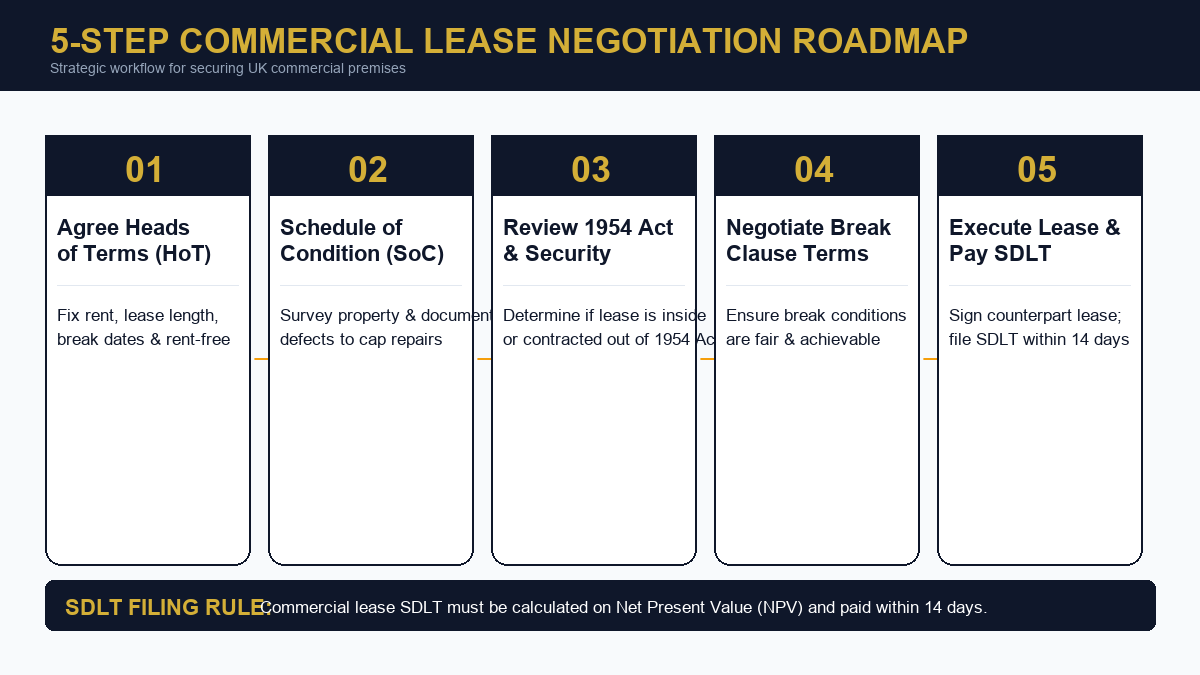
A break clause grants the tenant (and sometimes the landlord) the contractual right to terminate the lease early at a designated milestone (e.g., at Year 3 or Year 5 of a 10-year lease).
Common Break Clause Preconditions:
- Written Notice: Typically requires 6 to 9 months advance formal written notice served in strict compliance with the lease service provisions.
- Payment of Rents: All principal rent, insurance rent, and service charges must be paid up to date on the break date.
- Vacant Possession: The tenant must completely remove all staff, equipment, furniture, and internal demountable partitions by the break date.
For growing SMEs securing debt capital to fund commercial premises fit-outs, read our guide to business expansion loans in the UK.
4. Rent Reviews & Service Charges
Commercial leases spanning 5 years or longer usually feature rent review clauses every 3 to 5 years:
- Open Market Rent Reviews (OMR): Adjusts rent to the prevailing market rate for comparable local premises. Almost universally structured as “upwards-only,” meaning rent can increase or remain unchanged, but will never decrease if market rates fall.
- Index-Linked Reviews: Adjusts rent in line with inflation metrics (CPI or RPI), often subject to agreed percentage caps and collars (e.g., min 2%, max 5% per year).
- Service Charges: In multi-let buildings, tenants pay a proportionate share of landlord operational costs (heating, security, lift maintenance). Tenants should always negotiate a fixed service charge cap.
Accurate overhead forecasting is essential before committing to commercial lease rent reviews. Learn how to model upcoming liabilities in our guide on small business cash flow forecasting in 2026.
5. Stamp Duty Land Tax (SDLT) on Commercial Leases
In England and Northern Ireland, commercial tenants are legally responsible for calculating and paying Stamp Duty Land Tax (SDLT) on newly granted leases. Unlike buying a freehold, leasehold SDLT is calculated on the Net Present Value (NPV) of the total rent payable over the entire lease term:
| Net Present Value (NPV) Band | Commercial Lease SDLT Rate |
|---|---|
| Up to £150,000 NPV | 0.0% (Zero) |
| £150,001 to £5,000,000 NPV | 1.0% on portion above £150,000 |
| Over £5,000,000 NPV | 2.0% on portion above £5,000,000 |
SDLT returns must be submitted and paid to HMRC within 14 days of lease completion to avoid late filing penalties.
If you are purchasing commercial property through a corporate structure rather than leasing, see our comprehensive guide on limited company mortgages in the UK.
6. Frequently Asked Questions
What is the difference between a commercial lease and a license to occupy?
A lease grants exclusive possession of property for a defined term, creating a legal estate in land with statutory rights (such as potential 1954 Act protection). A license merely grants personal permission to occupy (e.g., a hot desk or serviced office) with no exclusive possession and no security of tenure.
Can a landlord evict a commercial tenant for late rent?
Yes, through forfeiture. Most commercial leases contain a forfeiture clause allowing the landlord to peaceably re-enter and terminate the tenancy if rent is unpaid for 14 or 21 days, without needing a court order in certain circumstances.
Your Next Actions
- Draft Clear Heads of Terms: Agree on rent, term length, break clauses, and rent-free periods before instructing solicitors.
- Commission a Schedule of Condition: Hire an independent RICS surveyor to inspect the building and annex condition photos to the lease.
- Confirm 1954 Act Status: Decide whether your business requires automatic security of tenure or can accept a contracted-out lease.
- Explore Tools: Use resources in our Business Tools Hub.
Editorial Team & Signature
Written by Oliver Carpenter, Founder & Editor-in-Chief at Elite Business Journal. Published August 2026.
For commercial landlords and property investors purchasing premises through corporate holding structures, explore our guide to securing a limited company buy to let mortgage with full Section 24 tax relief.
When negotiating commercial lease terms, verify whether your property qualifies for 100% discount under our guide to small business rates relief eligibility.