Quick Answer: Commercial Property Insurance UK 2026
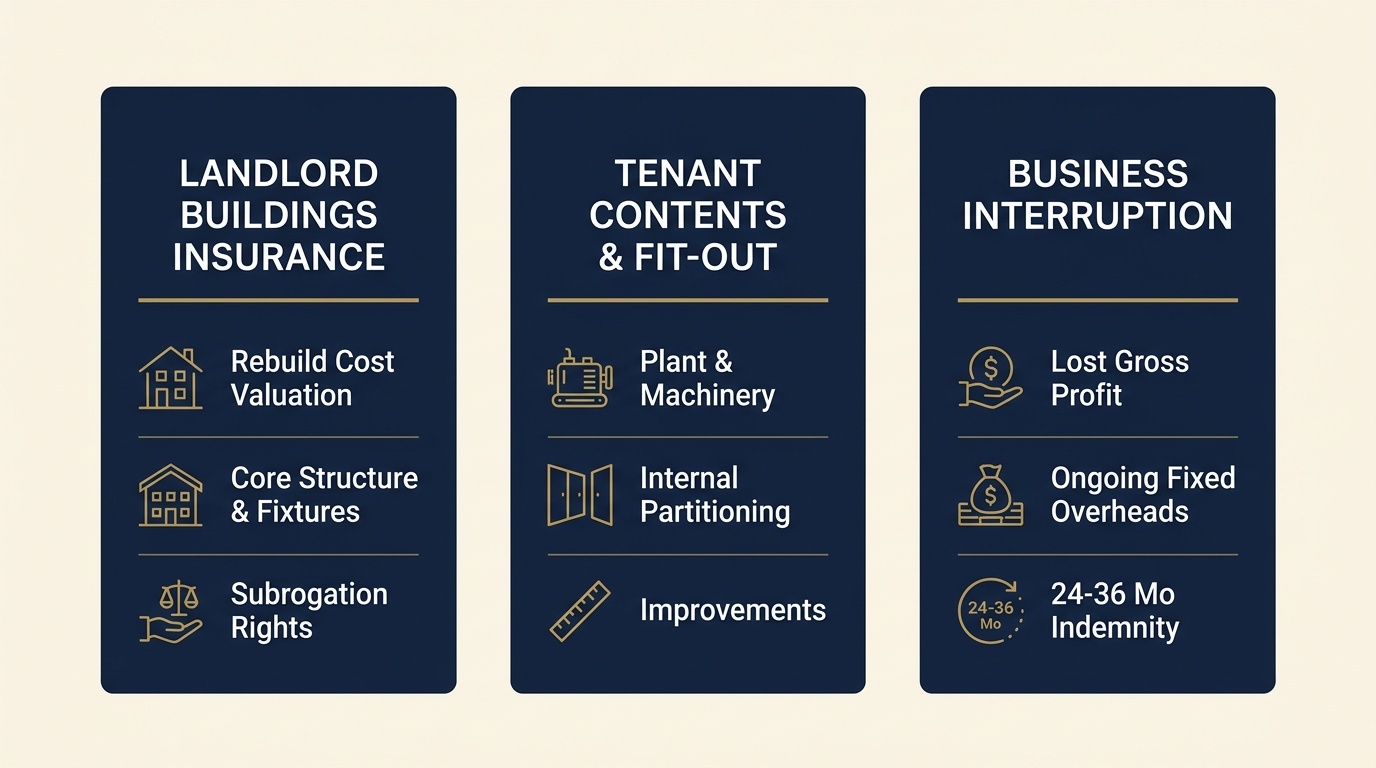
Commercial property insurance in the UK protects business premises, physical assets, and ongoing trading revenue against perils such as fire, flood, structural collapse, and storm damage. Policies are divided into three core pillars: Commercial Buildings Insurance (covering the physical structure based on RICS reinstatement rebuild cost, not market value), Commercial Contents & Tenant Fit-Out Cover (protecting machinery, IT equipment, internal partitioning, and stock), and Business Interruption (BI) Insurance (replacing lost gross profit and fixed costs during rebuilding). Under standard UK Full Repairing and Insuring (FRI) leases, the landlord arranges structural buildings insurance while recharging 100% of the premium to the tenant. Underinsurance triggers the severe Condition of Average, reducing claim settlements proportionally across both partial and total losses.
Key Takeaways
- Always base building insurance sums on professional RICS Reinstatement Cost Assessments (RCA), never market sale values.
- The “Condition of Average” slashes claim payouts in direct proportion to underinsurance, even on minor repairs.
- In FRI commercial leases, landlords hold structural policies but legally recharge premiums to occupying tenants.
- Set business interruption indemnity periods to at least 24 to 36 months to allow for complex planning and construction.
For UK property investors, commercial landlords, and corporate occupiers, commercial real estate represents one of the most substantial capital investments and operational commitments on the balance sheet. According to underwriting statistics published by the Association of British Insurers (ABI) and the Royal Institution of Chartered Surveyors (RICS), between 70% and 75% of commercial properties in the UK are currently underinsured.
This widespread underinsurance stems from a fundamental misunderstanding of policy definitions: conflating market value (which includes non-insurable land value) with reinstatement rebuild cost (which reflects current construction inflation, planning demolition, architect fees, and environmental building standards). When disaster strikes, businesses that miscalculated their rebuild values face the devastating Condition of Average, leaving them with catastrophic funding shortfalls.
This authoritative guide details the legal and commercial mechanics of UK commercial property insurance in 2026, comparing landlord versus tenant responsibilities under Full Repairing and Insuring (FRI) leases, evaluating policy components, breaking down business interruption calculations, and outlining how to protect corporate assets against underinsurance.
1. Rebuild Cost vs. Market Value: The RICS Reinstatement Rule
The single most dangerous error in commercial property insurance is calculating policy sums based on the purchase price or open-market commercial valuation of the property.
| Valuation Concept | What It Reflects | Role in Property Insurance |
|---|---|---|
| Market Value | What a buyer would pay for the land, location, and building combined. | Irrelevant for insurance. Land cannot be destroyed by fire or structural storm damage. |
| Reinstatement Rebuild Cost (RCA) | Full cost to demolish, clear hazardous debris, hire architects/engineers, and reconstruct modern premises. | The exact sum insured. Must be certified by an RICS-registered chartered surveyor. |
Construction materials, labour wages, and environmental compliance standards under the UK Building Safety Act have driven commercial rebuild costs up significantly over recent years. A commercial warehouse purchased for £1.2 million in Birmingham may cost £2.4 million to clear and reconstruct under current UK building regulations.
If you are structuring property acquisitions through dedicated corporate entities, review our strategic analysis of limited company buy to let mortgages.
2. The Dreaded “Condition of Average” (Underinsurance Penalty)
Every standard UK commercial property policy contains an Average Clause. This contractual condition stipulates that if a property is underinsured at the time of loss, the policyholder is deemed to be their own insurer for the difference, and claim settlements are reduced proportionally.
• True RICS Rebuild Cost: £2,000,000
• Insured Sum (Underinsured): £1,000,000 (50% underinsured)
• Claim Event (Minor Electrical Fire): £200,000 in structural damage
• Insurer Payout: £100,000 (50% of the claim, minus excess)
Result: Even though the £200,000 damage was well below the £1,000,000 policy limit, the business must pay £100,000 out of operating capital due to the Condition of Average.
To avoid this penalty, ensure your commercial policy includes an “Agreed Value” or an “Index-Linking” provision, supported by a formal RICS Reinstatement Cost Assessment (RCA) updated every 3 years.
For independent commercial contractors operating on-site, align your premises cover with public liability through our guide to sole trader insurance in the UK.
3. Landlord vs. Tenant: FRI Commercial Leases
In the UK commercial leasing market, most office, retail, and industrial properties are governed by a Full Repairing and Insuring (FRI) lease. Under an FRI agreement, the division of insurance responsibilities is strictly defined:
- The Landlord’s Responsibility: The landlord arranges the master commercial buildings insurance policy to protect the structural asset (foundations, roof, load-bearing walls, external cladding, and common areas). The landlord also maintains Property Owner’s Liability insurance.
- The Tenant’s Cost: Although the landlord selects the insurer, the tenant is contractually obligated to reimburse 100% of the premium through an “Insurance Rent” or service charge.
- The Tenant’s Separate Policies: The landlord’s building insurance does not cover tenant property. The tenant must arrange:
- Tenant Fit-Out Insurance: Mezzanine floors, internal partitions, suspended ceilings, and trade lighting.
- Business Contents & Equipment: Computers, servers, trade machinery, and office furniture.
- Stock in Trade: Raw materials and finished goods.
- Public & Employers’ Liability: Mandatory statutory protection for staff and visiting clients.
Before executing long-term tenancy commitments, audit leasehold repairing covenants using our analysis of commercial lease agreements in the UK.
Review mandatory statutory insurance requirements across all UK business formats in our foundational guide on what business insurance do you actually need in the UK.
4. Business Interruption (BI) & Indemnity Periods
Property damage insurance repairs the physical building; Business Interruption (BI) insurance ensures the business survives while repairs take place. BI replaces lost gross profit, covers continuing fixed overheads (such as employee salaries and finance charges), and reimburses the increased cost of working (ICOW) from temporary premises.
The Maximum Indemnity Period (MIP) Trap:
Many businesses default to standard 12-month indemnity periods to save on premiums. In the UK today, a 12-month period is dangerously inadequate:
- Planning Approvals: Securing local council planning permission for commercial rebuilding frequently takes 6 to 9 months.
- Debris & Site Clearance: Removing hazardous materials (such as asbestos or fire debris) can require 2 to 4 months.
- Construction & Fit-Out: Procuring specialist contractors, structural steel, and building materials averages 12 to 18 months.
- Revenue Recovery: Winning back commercial clients and rebuilding footfall requires additional trading time after reopening.
- Recommendation: Commercial businesses should mandate a minimum 24 to 36-month maximum indemnity period on all business interruption policies.
5. Frequently Asked Questions
What is the Condition of Average in UK commercial property insurance?
The Condition of Average (or Average Clause) penalises underinsurance. If your property is insured for less than its full rebuild cost, the insurer reduces any claim payout in direct proportion to the underinsurance. For example, insuring a building with a £2m rebuild cost for only £1m means the insurer pays only 50% of any claim, even on small partial losses.
Under an FRI commercial lease, who pays for building insurance?
Under a Full Repairing and Insuring (FRI) lease, the landlord typically arranges and holds the master buildings insurance policy, but the tenant pays for it in full via an insurance rent or service charge. The tenant remains directly responsible for insuring their own internal fit-out, machinery, stock, and business interruption.
How long should a commercial business interruption indemnity period be?
While 12-month indemnity periods were historically common, modern UK commercial standards recommend at least 24 to 36 months. This accounts for planning approvals, specialist contractor availability, site clearance, structural rebuilding, and the time required to restore customer revenues to pre-loss levels.
Your Next Actions
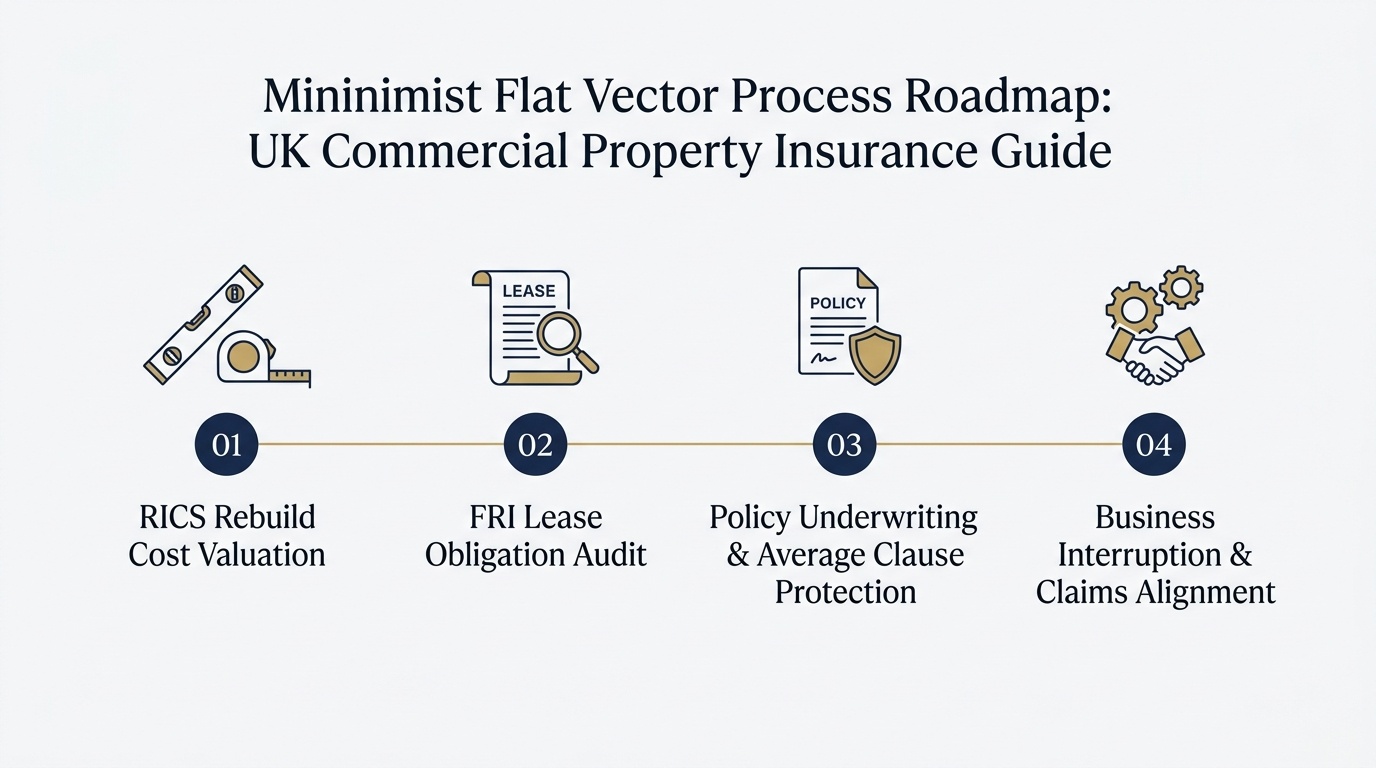
- Commission an RICS Valuation: Obtain an updated Reinstatement Cost Assessment (RCA) to establish your true rebuild value.
- Audit Your FRI Commercial Lease: Identify whether tenant fit-outs and internal fixtures are your responsibility to insure.
- Extend Indemnity Horizons: Increase your Business Interruption maximum indemnity period to 24 or 36 months.
- Explore Tools: Use resources in our Business Tools Hub.
Editorial Team & Signature
Written by Oliver Carpenter, Founder & Editor-in-Chief at Elite Business Journal. Published September 2026.