Executive Brief: Early-stage venture capital in the United Kingdom is driven by one of the most generous equity tax relief frameworks in the global startup ecosystem. According to investment data from the British Business Bank Equity Finance Portal, venture capital tax schemes support over £2 billion in seed and scaleup equity annually. At the heart of this funding engine is the Seed Enterprise Investment Scheme, a government initiative that allows early-stage UK companies to raise up to £250,000 while granting qualifying private investors 50 percent immediate income tax relief and complete capital gains exemptions.
Quick Answer: What Is the Seed Enterprise Investment Scheme (SEIS)?
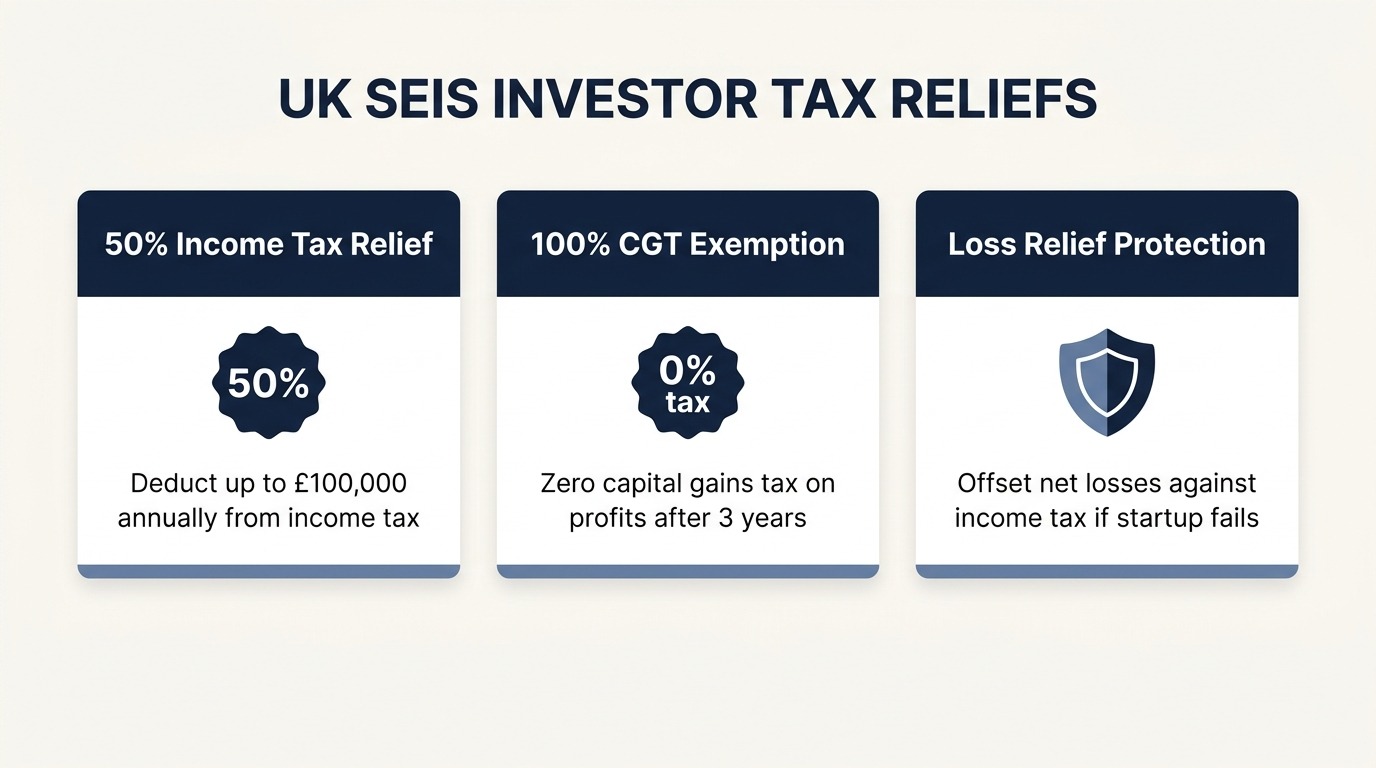
The Seed Enterprise Investment Scheme (SEIS) is a UK government tax relief initiative designed to stimulate private investment into high-risk, early-stage enterprises. Under current statutory rules, qualifying UK companies can raise up to a lifetime maximum of £250,000 in seed equity. Individual investors can invest up to £200,000 per tax year into SEIS-qualifying shares, claiming 50 percent income tax relief against their annual UK tax liability.
In addition to income tax reduction, SEIS shares held for at least three years are 100 percent exempt from Capital Gains Tax (CGT) upon sale. Investors also benefit from 50 percent Capital Gains Reinvestment Relief, Business Relief for Inheritance Tax, and loss relief that significantly buffers downside investment risks.
Key Takeaways for UK Startup Founders and Angel Investors
- 50% Income Tax Relief: Investors deduct half their investment value directly from their UK income tax bill, up to a £100,000 annual tax saving.
- 100% Tax-Free Gains: Capital gains realized on SEIS shares held for at least three years incur zero Capital Gains Tax.
- Downside Protection: If an early-stage startup fails, investors can claim loss relief against income tax, limiting effective capital exposure to as little as 13.5p per £1 invested.
- Company Thresholds: Companies must have traded for less than three years, hold less than £350,000 in gross assets, and employ fewer than 25 staff members at share issue.
- Advance Assurance Priority: Securing Advance Assurance from HMRC prior to fundraising is practically essential for attracting institutional business angels and syndicates.
The Anatomy of SEIS Tax Reliefs: Why Investors Back Seed Rounds
Angel investing is inherently volatile; industry research consistently shows that a large proportion of early-stage startups fail to return initial capital. The UK government engineered the Seed Enterprise Investment Scheme specifically to rebalance this risk equation. By combining upfront tax deductions, capital gains exemptions, and loss write-offs, SEIS creates an exceptional safety net for individual investors.
To evaluate how SEIS alters angel investment economics, founders and high-net-worth investors must understand the four distinct layers of statutory tax relief:
1. 50% Upfront Income Tax Relief
Qualifying UK taxpayers can claim income tax relief equal to 50 percent of the amount invested in SEIS shares in the tax year of investment. With the statutory annual investor allowance set at £200,000, an angel investor allocating the full allowance can reduce their personal income tax bill by up to £100,000.
Investors also have the option to “carry back” all or part of the investment to the preceding tax year, provided they have unused SEIS allowance for that prior year. This allows investors to offset income tax paid in previous periods and secure immediate tax refunds from HMRC.
2. 100% Capital Gains Tax Exemption on Share Disposal
If an investor holds their SEIS shares for the statutory minimum holding period of three years, all capital gains generated from the eventual sale of those shares are 100 percent exempt from Capital Gains Tax. In contrast to standard private equity exits (where higher-rate taxpayers face significant CGT liabilities), an SEIS exit returning 10x or 50x on invested capital remains entirely tax-free.
3. 50% Capital Gains Reinvestment Relief
If an investor disposes of an unrelated asset (such as commercial property, quoted equities, or art) and realizes a taxable capital gain, they can shelter 50 percent of that gain by reinvesting the proceeds into SEIS qualifying shares within the same tax year. This relief effectively halves the investor’s CGT bill on the prior asset sale, providing powerful incentive to recycle capital into early-stage British enterprise.
4. Loss Relief Protection: Minimizing Downside Exposure
If an SEIS-backed startup unfortunately becomes insolvent or is wound up, the investor does not lose 100 percent of their capital. Instead, statutory loss relief allows the investor to offset their net loss against either their capital gains or their taxable employment and trading income in that year.
The net loss is calculated by subtracting the initial 50 percent income tax relief from the gross investment. For an additional-rate taxpayer paying 45 percent income tax, the financial mechanics operate as follows:
- Gross initial investment: £10,000.
- Upfront income tax relief (50%): £5,000 returned immediately.
- At-risk capital balance: £5,000.
- In the event of total failure, loss relief at 45% on the remaining £5,000: £2,250.
- Total tax relief secured: £7,250 (£5,000 + £2,250).
- Maximum net capital lost: £2,750 (representing just 27.5 percent of the original £10,000 investment).
If the investor also utilized 50% CGT reinvestment relief, total downside exposure drops to approximately 13.5p per £1 invested, making SEIS one of the most effective risk-mitigation structures in venture finance. This downside protection is a core reason why learning how to find UK angel investors starts with mastering SEIS structuring.
| Investment Outcome Scenario | Gross Angel Investment | Upfront Income Tax Relief (50%) | Exit Value / Return | Tax Payable / Loss Relief | Net Investor Cash Position |
|---|---|---|---|---|---|
| Startup 10x Unicorn Exit | £20,000 | +£10,000 | £200,000 | £0.00 (100% Tax Free) | +£190,000 net profit |
| Modest 2x Trade Sale | £20,000 | +£10,000 | £40,000 | £0.00 (100% Tax Free) | +£30,000 net return |
| Break-Even Return | £20,000 | +£10,000 | £20,000 | £0.00 | +£10,000 (from tax relief) |
| Total Startup Liquidation | £20,000 | +£10,000 | £0.00 | +£4,500 (Loss relief @ 45%) | -£5,500 (Effective loss 27.5%) |
Company Eligibility Rules: Qualifying Criteria for Founders
To issue SEIS-qualifying shares, a company must satisfy rigorous statutory conditions set out in the official GOV.UK Venture Capital Schemes Guidance. Failing any single test will invalidate investor tax relief and trigger tax clawbacks by HMRC.
1. Maximum Capital and Trading Age Limits
Following government legislation implemented to expand seed funding, the statutory limits for SEIS eligibility stand as follows:
- Lifetime SEIS Funding Cap: A company can raise a lifetime maximum of £250,000 under SEIS. Any equity capital raised beyond £250,000 must be issued under the Enterprise Investment Scheme (EIS) or standard non-tax-relieved equity.
- Trading Age Rule: The company must have been carrying on a qualifying trade for less than three years at the time the shares are issued. If the company carried on another trade previously, the three-year clock starts from the earliest commercial activity.
- Gross Assets Cap: The company’s gross assets must not exceed £350,000 immediately before the SEIS shares are issued. Gross assets include cash in the corporate bank account, equipment, and debtors.
- Full-Time Employee Limit: The company must employ fewer than 25 full-time equivalent employees at the date of share issue. Part-time staff are counted on a pro-rata basis.
2. Qualifying Trade Requirements
The company must exist to carry on a qualifying trade on a commercial basis with a view to generating profit. Most technology, software, manufacturing, consumer product, and engineering businesses qualify without friction. However, statutory legislation explicitly excludes certain industries from SEIS eligibility:
- Property development, construction contracting for speculative sale, and commercial landlord operations.
- Banking, insurance, money lending, debt factoring, and hire-purchase financing.
- Legal, accountancy, and professional actuarial services.
- Farming, market gardening, and commercial forestry.
- Operating hotels, nursing homes, or guest houses.
- Electricity generation, solar farms, and renewable energy production subsidized by government tariffs.
3. Independence and Corporate Structure Rules
The company must be an independent entity. It cannot be under the legal control of another corporate company, and no more than 50 percent of its shares can be owned by a single corporate entity. In addition, the company must maintain a permanent establishment in the United Kingdom (such as an active physical office, laboratory, or development facility).
Investor Qualification Criteria: The Substantial Interest Rule
Not every individual who writes a cheque can claim SEIS tax relief. HMRC enforces strict investor independence rules to prevent business owners from extracting profits tax-free under the guise of seed investment:
- The 30% Substantial Interest Rule: An investor cannot hold a “substantial interest” in the company. Substantial interest is legally defined as owning or having the entitlement to acquire more than 30 percent of the company’s ordinary share capital, voting power, or assets upon winding up. Crucially, the 30 percent threshold includes holdings of an investor’s “associates” (spouses, parents, grandparents, children, and business partners). Brothers, sisters, and cousins are not considered associates under SEIS law.
- Employment Restrictions: An investor cannot be an employee of the company during the period starting two years before the share issue and ending three years after. However, investors can serve as company directors, and they are permitted to receive reasonable commercial remuneration for their directorship duties.
- Cash Payment and Full-Risk Ordinary Shares: Shares must be issued for full cash payment upfront. They must be standard full-risk ordinary shares with no preferential rights to dividends or assets upon winding up, and they cannot carry any guaranteed buyback agreements or pre-arranged exits. Founders cannot convert existing founder debt into SEIS shares unless structured under strict commercial terms, making compliance with director loan account rules essential before closing a seed round.
Step-by-Step Founder Guide: Securing Advance Assurance and Issuing SEIS3 Certificates
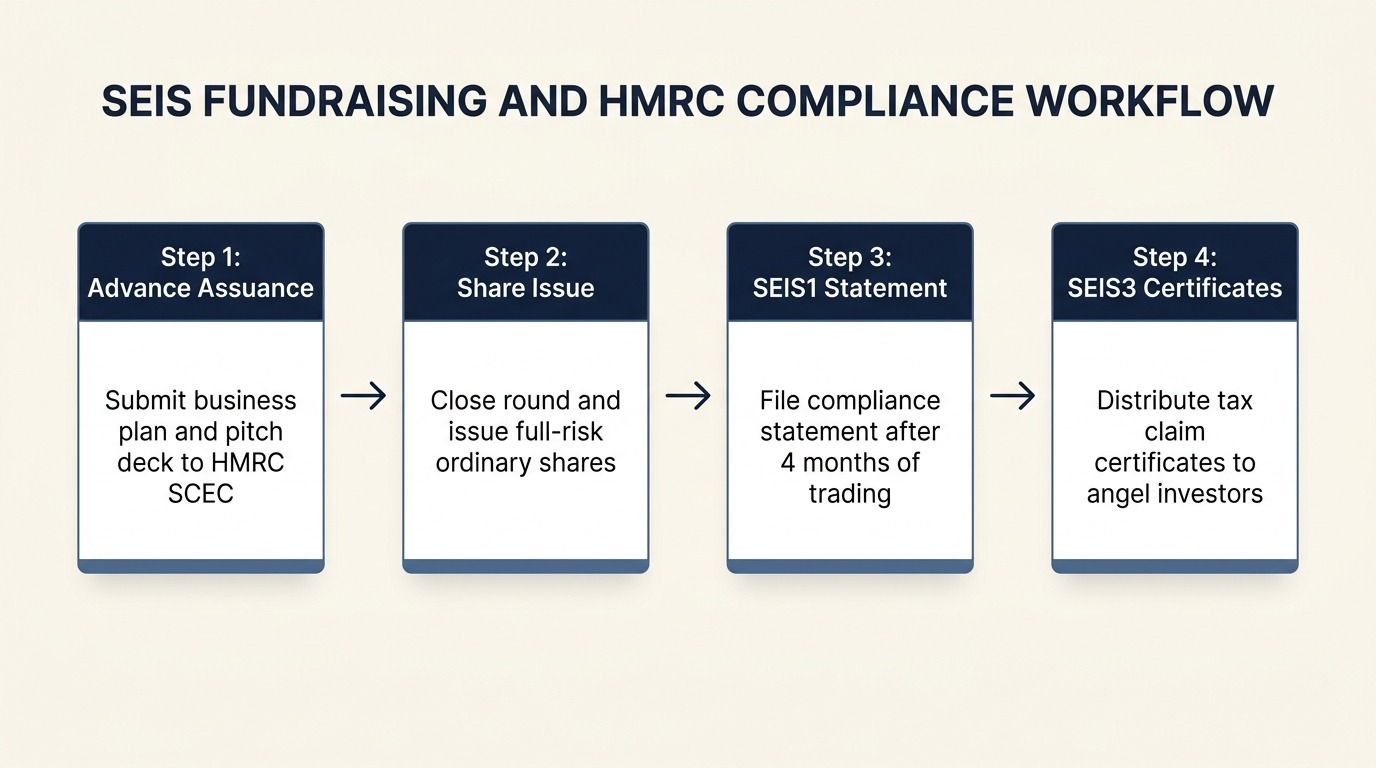
To successfully execute an SEIS fundraising round and deliver valid tax certificates to your angel investors, founders must navigate a four-stage administrative process governed by the HMRC Venture Capital Schemes Manual:
Step 1: Secure HMRC Advance Assurance (AA)
Advance Assurance is an official written confirmation from HMRC’s Small Companies Enterprise Centre (SCEC) stating that, based on the information provided, the company meets the statutory requirements to issue SEIS shares. While not legally mandatory, over 95 percent of UK angel syndicates require Advance Assurance before releasing investment funds.
To apply for Advance Assurance, founders must submit:
- A detailed business plan and investor pitch deck outlining the commercial trade, customer market, and growth milestones.
- Three-year financial forecasts demonstrating how the £250,000 seed funds will be deployed for commercial growth.
- A draft cap table showing pre-money and post-money equity ownership, confirming no single investor breaches the 30% substantial interest rule.
- Names and addresses of prospective angel investors who have expressed conditional interest in subscribing for shares.
- The company’s Articles of Association and draft Shareholders’ Agreement.
HMRC typically processes Advance Assurance applications within 15 to 30 working days.
Step 2: Close the Round and Issue Shares
Once Advance Assurance is granted and terms are agreed, investors transfer funds into the company’s corporate bank account. The company board formally resolves to issue new ordinary shares. The shares must be issued and entered into the register of members on the exact date funds are received. Crucially, shares cannot be issued prior to receiving cleared funds.
Step 3: Submit the SEIS1 Compliance Statement
Before investors can claim tax relief, the company must submit a formal SEIS1 Compliance Statement to HMRC. The company can only submit this statement once it has either:
- Carried on its qualifying trade for at least four continuous months following the share issue, or
- Spent at least 70 percent of the funds raised on qualifying business activities.
Step 4: Distribute SEIS3 Certificates to Investors
Upon reviewing and approving the SEIS1 statement, HMRC issues the company a formal authorization letter containing an SEIS unique reference number. The company generates official SEIS3 Claim Certificates (using HMRC templates) and distributes them to each angel investor. Investors submit the certificate details on their annual Self Assessment tax returns to claim their 50 percent tax relief and claim rebates.
SEIS vs. EIS: Key Strategic Differences for Growing Startups
As companies mature and outgrow their initial £250,000 seed allocation, they transition to the Enterprise Investment Scheme (EIS). While both schemes share similar tax exemption philosophies, their parameters differ significantly:
| Structural Dimension | Seed Enterprise Investment Scheme (SEIS) | Enterprise Investment Scheme (EIS) |
|---|---|---|
| Investor Income Tax Relief | 50% of invested capital | 30% of invested capital |
| Annual Investor Investment Limit | £200,000 (£100k max relief) | £1,000,000 (£2m for Knowledge-Intensive) |
| Lifetime Company Funding Cap | £250,000 total lifetime limit | £12,000,000 (£20m for Knowledge-Intensive) |
| Maximum Trading Age | Less than 3 years from first commercial trade | Less than 7 years (10 for Knowledge-Intensive) |
| Maximum Gross Assets Before Issue | £350,000 | £15,000,000 |
| Maximum Full-Time Staff | Fewer than 25 employees | Fewer than 250 employees (500 for KIC) |
When structuring a funding round that exceeds £250,000 (such as a £500,000 seed round), founders frequently execute a dual SEIS/EIS round. Under HMRC rules, SEIS shares must be issued on a separate date prior to issuing the EIS shares, ensuring that the initial £250,000 tranche receives the full 50 percent SEIS relief before EIS shares are created.
Frequently Asked Questions About SEIS Investment
Can founders claim SEIS on their own shares?
Founders can only claim SEIS if they hold 30 percent or less of the company’s ordinary shares and voting rights, and are not classed as employees. Because most early-stage founders hold significantly more than 30 percent of the equity and work full-time in the business, founders are generally excluded from claiming SEIS on their own initial shares.
What happens if an investor sells SEIS shares within three years?
If an investor sells or transfers their SEIS shares before the three-year holding period expires, HMRC will claw back the initial 50 percent income tax relief. In addition, any capital gains realized on the disposal will be subject to standard UK Capital Gains Tax rates.
Can foreign investors living outside the UK claim SEIS relief?
Foreign investors can invest in SEIS-qualifying UK companies, but they can only claim SEIS tax reliefs if they have a UK income tax or capital gains tax liability to offset. If a non-resident investor has no UK tax liabilities, the tax reliefs provide no practical financial value, although the company remains free to accept their capital.
Can an SEIS company spend funding on overseas expansion?
Yes, provided the UK company maintains its permanent establishment in Britain and the overseas activities directly support the growth and development of the qualifying UK trade. However, the company cannot use SEIS funds to acquire another corporate company or purchase property assets.
Does SEIS relief impact Corporation Tax?
SEIS relief applies strictly to individual investors, not to the company itself. The funds raised through an SEIS share issue are treated as equity capital on the balance sheet, not as taxable income. Companies must continue to manage corporate profits and tax planning in accordance with standard rules for reducing UK corporate tax liability.
The Bottom Line: Accelerating Early-Stage Growth with SEIS
The Seed Enterprise Investment Scheme represents a cornerstone of the British entrepreneurial economy. By aligning the incentives of ambitious startup founders with the tax mitigation objectives of private angel investors, SEIS dramatically de-risks seed capital allocation. For UK entrepreneurs seeking their first institutional or angel round, securing HMRC Advance Assurance, mastering investor independence rules, and maintaining meticulous compliance records transforms early-stage fundraising from an uphill battle into a powerful, tax-advantaged commercial proposition.