Executive Brief: Millions of British taxpayers across the United Kingdom are opening unexpected brown envelopes from HM Revenue and Customs demanding unpaid tax on bank interest. Following multiple base rate increases by the Bank of England, typical retail savings yields rose from near-zero to over 5 percent. According to data monitored by the Financial Conduct Authority Banking Standards, this interest rate shift pushed an estimated 2.7 million individuals over their statutory tax-free savings thresholds. If you recently received an HMRC savings tax letter, understanding how HMRC tracks your interest, how to verify the figures, and whether you owe a P800 or Simple Assessment payment is critical to protecting your personal cash flow.
Quick Answer: What Is an HMRC Savings Tax Letter?
An HMRC savings tax letter is an official tax demand or calculation notice issued by HM Revenue and Customs informing you that you earned untaxed savings interest exceeding your statutory Personal Savings Allowance (PSA). In the UK, banks and building societies do not deduct tax automatically; instead, they report your annual interest earnings directly to HMRC at the close of each tax year.
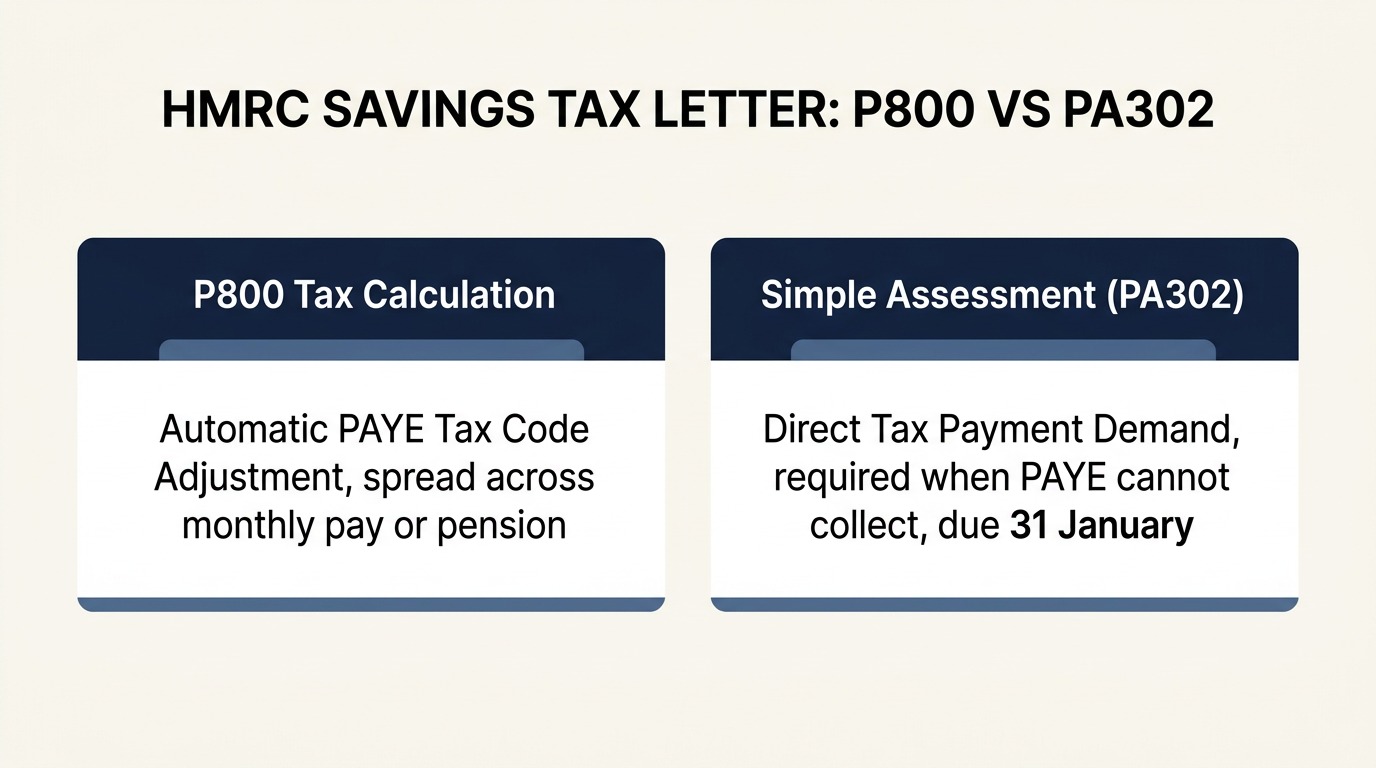
Depending on your employment and tax profile, HMRC issues this notice either as a P800 Tax Calculation (which automatically adjusts your PAYE tax code for the following tax year) or a Simple Assessment (PA302) notice requiring direct payment by 31 January. Taxpayers who earned over £10,000 in savings interest are required to complete a formal Self Assessment tax return.
Key Takeaways: What to Do When You Receive an HMRC Savings Tax Letter
- Automatic Bank Reporting: UK banks and building societies report your interest earnings to HMRC automatically under the Bank and Building Society Interest (BBSI) regulations.
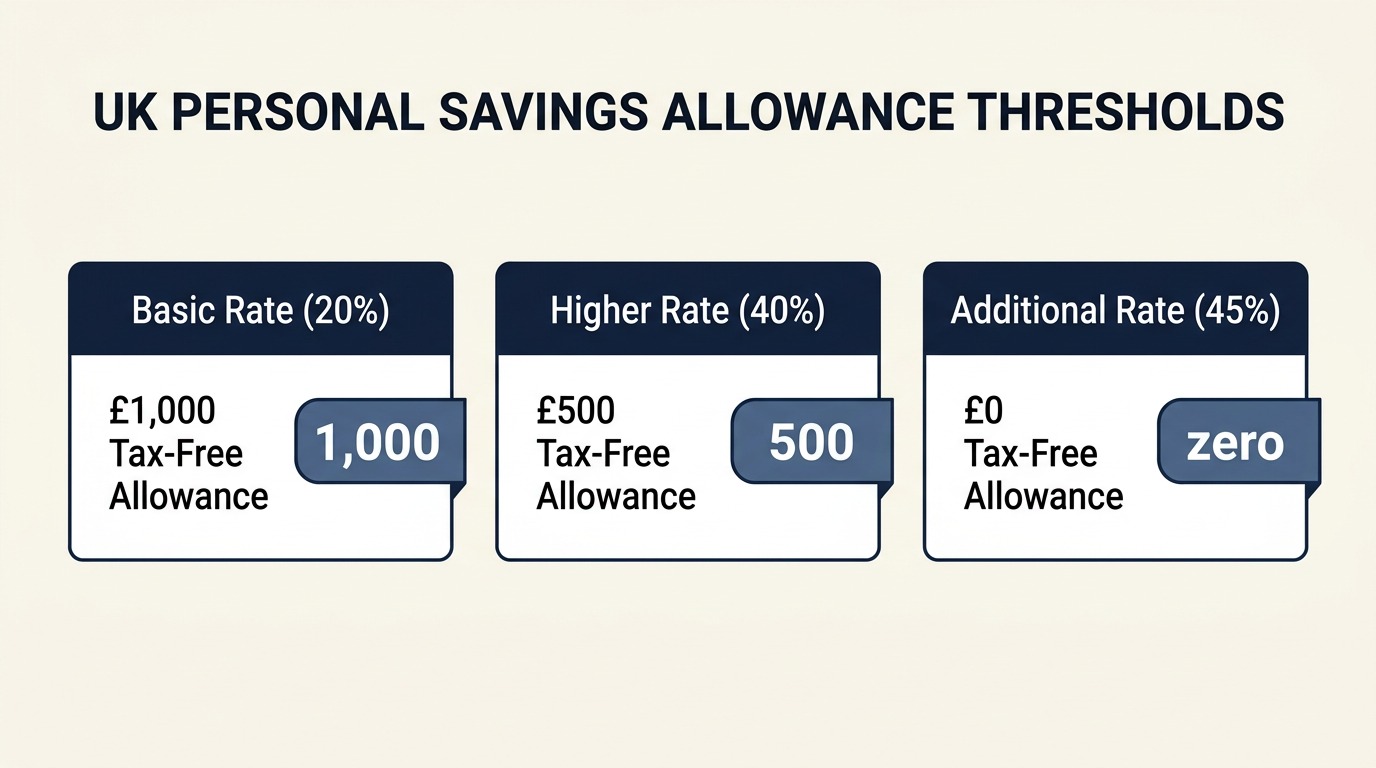
- Personal Savings Allowance Caps: Basic-rate taxpayers can earn £1,000 in interest tax-free; higher-rate taxpayers have a £500 cap; additional-rate taxpayers have £0 allowance.
- P800 vs. PA302: Employed or pensioned taxpayers usually have their tax collected via a reduced PAYE tax code; non-PAYE individuals receive a PA302 demand payable by 31 January.
- Audit Your Bank Statements: Always reconcile HMRC’s reported interest total against your actual annual bank interest certificates, checking for joint account splitting errors and ISA exemptions.
- Future Tax Sheltering: Maximize your annual £20,000 Cash ISA allowance and National Savings & Investments (NS&I) Premium Bonds to eliminate future savings tax liabilities.
Why Are Millions of UK Savers Receiving HMRC Savings Tax Letters?
Between 2009 and 2021, the Bank of England base rate remained at historic lows, often hovering below 0.5 percent. Under those economic conditions, an individual needed substantial cash reserves (often over £100,000) before earning enough interest to trigger a tax charge. Most savers never had to consider the tax implications of their cash savings.
When the central bank rapidly increased interest rates to combat inflation, commercial high street banks and challenger providers raised easy-access and fixed-term deposit rates to between 4.5 percent and 5.5 percent. However, the government chose to freeze income tax thresholds and the Personal Savings Allowance. This fiscal drag suddenly exposed millions of ordinary savers, pensioners, and modest retail investors to unexpected tax liabilities.
For example, a higher-rate taxpayer with just £12,000 deposited in a one-year fixed bond earning 5 percent generates £600 in interest. Because their higher-rate allowance is capped at £500, the excess £100 is taxable at 40 percent, triggering a £40 tax charge and an official communication from HMRC.
How the Personal Savings Allowance (PSA) Functions
Introduced in April 2016, the Personal Savings Allowance allows individuals to earn a specific threshold of interest on their savings without paying any UK income tax. The exact threshold depends strictly on your overall taxable income band for the tax year:
1. Basic-Rate Taxpayers (20% Income Tax Band)
If your total annual taxable income (including salary, pension, trading profits, and savings interest) falls between £12,571 and £50,270, you are a basic-rate taxpayer. You receive a £1,000 Personal Savings Allowance. Any savings interest earned above £1,000 is taxed at your marginal rate of 20 percent.
2. Higher-Rate Taxpayers (40% Income Tax Band)
If your taxable income is between £50,271 and £125,140, you are classed as a higher-rate taxpayer. Your allowance is cut in half to £500 per tax year. Any interest earned above £500 is taxed at 40 percent. Importantly, earning significant savings interest can inadvertently push a taxpayer whose salary is £49,800 into the higher-rate bracket, instantly slashing their allowance from £1,000 to £500 and doubling their tax rate on the excess.
3. Additional-Rate Taxpayers (45% Income Tax Band)
If your taxable income exceeds £125,140, you receive £0 Personal Savings Allowance. Every single pound of savings interest earned in non-ISA accounts is subject to 45 percent income tax.
4. The Starting Rate for Savings (0% Band for Low Earners)
Low-income earners and retirees often qualify for an additional tax shield known as the Starting Rate for Savings. If your other taxable income (such as wages or state pension) is less than £17,570, you can earn up to £5,000 in savings interest completely tax-free. Every £1 of other income earned above the personal allowance of £12,570 reduces your starting rate for savings by £1.
| Taxpayer Income Band | Annual Taxable Income Threshold | Personal Savings Allowance (PSA) | Tax Rate on Excess Interest | Approximate Savings Pot Yielding Excess at 5% |
|---|---|---|---|---|
| Basic Rate | £12,571 to £50,270 | £1,000 tax-free | 20% | Over £20,000 |
| Higher Rate | £50,271 to £125,140 | £500 tax-free | 40% | Over £10,000 |
| Additional Rate | Over £125,140 | £0 (No allowance) | 45% | Any non-ISA savings balance |
Decoding the Letter: P800 vs. Simple Assessment (PA302)
When HMRC calculates that you owe tax on savings interest, they do not initiate legal action or dispatch bailiffs. Instead, they issue one of two standard statutory administrative notices outlined in official GOV.UK Tax on Savings Interest Guidance:
Type 1: The P800 Tax Calculation Letter
The P800 is the most common notice received by employed individuals and occupational pensioners taxed via Pay As You Earn (PAYE). If you owe less than £3,000 in unpaid tax on savings interest, HMRC will not ask you to make an immediate bank transfer. Instead, they automatically adjust your tax code for the upcoming tax year.
By lowering your tax-free personal allowance in your PAYE tax code, your employer or pension provider will deduct slightly more tax from your monthly pay packet across the twelve-month tax year, spreading the repayment gradually without disrupting household budgets.
Type 2: Simple Assessment (PA302) Letter
A Simple Assessment letter, designated as Form PA302, is issued when HMRC cannot collect the tax through an adjusted PAYE tax code. This situation occurs if:
- You owe more than £3,000 in tax.
- You are fully retired and living on a state pension with no private PAYE pension scheme attached.
- Your employment income is insufficient to collect the underpayment through payroll deductions without breaching statutory minimum take-home pay limits.
A Simple Assessment is a direct legal demand for payment. The letter will detail the exact amount owed, the calculation breakdown, and a strict statutory payment deadline (typically 31 January following the end of the tax year). Failing to pay a Simple Assessment by the deadline triggers statutory interest charges and late-payment penalties.
Type 3: The Self Assessment Notification Letter
If your untaxed savings interest exceeded £10,000 in a single tax year, HMRC will not deal with the matter via P800 or Simple Assessment. Under UK tax law, earning more than £10,000 in gross savings and investment income mandates registration for Self Assessment. HMRC will send a letter instructing you to register for a Unique Taxpayer Reference (UTR) and submit a formal Self Assessment return.
How Did HMRC Get Your Savings Information?
Many taxpayers are shocked by the detail contained in their HMRC letter, believing their bank accounts to be confidential. Under the statutory Bank and Building Society Interest (BBSI) regulations, all FCA-regulated UK financial institutions are legally required to submit detailed electronic data files to HMRC at the end of each financial year (typically by 30 June).
These reports include your full legal name, date of birth, National Insurance number, residential address, account number, and the exact gross interest credited to your accounts during the preceding tax year (6 April to 5 April). HMRC’s automated Connect data-matching system aggregates this information across all your banking providers, matches it against your PAYE employment records, and calculates your net tax position automatically.
Step-by-Step Action Plan: What to Do When the Letter Arrives
Do not panic, but do not ignore an HMRC savings tax notice. Follow this four-step verification plan:
Step 1: Verify the Letter’s Authenticity
Tax scams and fraudulent phishing letters are widespread across the UK. Check that the letter displays your correct National Insurance number and direct reference codes. Never call telephone numbers printed on suspicious letters; instead, log into your verified HMRC Online Income Tax Check Service via your personal Government Gateway account to confirm whether an official P800 or Simple Assessment calculation has been posted to your digital file.
Step 2: Reconcile Interest Totals Against Your Bank Statements
HMRC’s automated data ingestion is efficient, but data matching errors frequently occur. Log into your online banking accounts and download your official “Certificate of Interest” for the relevant tax year from every bank and building society you hold funds with. Check for common errors:
- Joint Account Splitting Errors: Interest earned on joint accounts is legally split 50/50 between both account holders. Banks sometimes report 100 percent of the interest under the primary account holder’s National Insurance number, doubling your apparent tax liability.
- Erroneous ISA Inclusions: Cash ISAs and Stocks & Shares ISAs are strictly tax-free. If a bank accidentally categorized an ISA deposit as an ordinary savings account, notify HMRC immediately to strike the sum from your calculation.
- Timing Discrepancies on Fixed-Term Bonds: Interest is taxable in the tax year it becomes accessible to you (“arising basis”). If you hold a three-year fixed bond that pays interest only upon maturity, all three years of interest arise in the final year, which can push you into a higher tax bracket unexpectedly.
Step 3: Query Incorrect Calculations Promptly
If you identify an error on a P800 or PA302 notice, you have 60 days from the date of the letter to contact HMRC and dispute the figures. Provide copies of your bank interest certificates and joint account agreements. HMRC will review the documentation and issue a revised calculation.
Step 4: Execute Payment or Check Your Revised Tax Code
If the calculation is accurate:
- For P800: Review your new PAYE coding notice to ensure the deduction aligns with the agreed underpayment. No lump sum payment is required.
- For Simple Assessment (PA302): Pay the balance through your online Government Gateway, via the official HMRC mobile app, or via telephone banking before the 31 January deadline.
- Business Owners & Directors: Ensure personal savings interest is segregated from corporate treasury yields, maintaining compliance with director loan interest rules and broader strategies for reducing UK tax liabilities.
How to Legally Eliminate Savings Tax in Future Years
Receiving an unexpected tax demand should prompt an immediate review of your personal wealth structuring. British taxpayers have access to several legitimate, government-approved tax shelters to protect their cash returns:
1. Maximize Your £20,000 Annual ISA Allowance
The most effective shield against savings tax is the Individual Savings Account (ISA). Every UK adult has an annual ISA allowance of £20,000. Interest earned within a Cash ISA or capital gains generated inside a Stocks & Shares ISA are 100 percent exempt from UK income tax and capital gains tax, and does not count toward your Personal Savings Allowance.
2. National Savings & Investments (NS&I) Premium Bonds
UK residents can hold up to £50,000 in government-backed NS&I Premium Bonds. While Premium Bonds do not pay regular guaranteed interest, all prize winnings (ranging from £25 up to two monthly £1 million jackpots) are completely tax-free by statute.
3. Utilize Inter-Spouse Asset Transfers
If you are married or in a civil partnership and your partner earns a lower income, you can transfer savings accounts or income-generating cash deposits to your spouse without triggering any tax charges. Moving savings into the name of a spouse who is in the basic-rate bracket (or whose income is below the personal allowance) allows your household to utilize their full £1,000 PSA and 0% starting rate for savings.
4. Salary Sacrifice Pension Contributions
If savings interest threatens to push your total taxable income above the £50,270 higher-rate threshold (which would instantly slash your PSA from £1,000 to £500), making additional gross pension contributions via salary sacrifice reduces your adjusted net income, keeping you in the basic-rate band and preserving your higher tax-free savings allowance.
Frequently Asked Questions About HMRC Savings Tax Letters
Will HMRC fine me for not telling them about my savings interest?
No, provided your untaxed savings interest was under £10,000 and you are taxed under PAYE. Because banks report interest to HMRC automatically, HMRC does not penalize taxpayers for failing to declare standard savings interest below the £10,000 Self Assessment threshold. However, you will be charged statutory interest if you fail to pay a Simple Assessment demand by the stated deadline.
Can I pay my Simple Assessment tax bill in instalments?
Yes. If you owe less than £30,000 and cannot afford to pay the full lump sum immediately, you can set up a “Time to Pay” arrangement online with HMRC. This facility allows you to spread the tax liability over up to twelve monthly direct debit payments, subject to statutory interest charges.
Does interest in a Lifetime ISA (LISA) trigger an HMRC tax letter?
No. Lifetime ISAs, Junior ISAs, and standard Cash ISAs are fully tax-exempt. Any interest or government bonuses accrued within an official ISA account are completely invisible to the Personal Savings Allowance calculation.
What happens if my bank reported the wrong interest amount to HMRC?
You must obtain an official end-of-year tax certificate from your bank confirming the correct gross interest figure. Once in hand, contact HMRC either by phone or via your digital HMRC online tax account to request a manual adjustment of your P800 or PA302 notice.
Is interest on foreign bank accounts covered by the Personal Savings Allowance?
Yes, foreign savings interest is generally eligible for the Personal Savings Allowance. However, foreign interest is not reported automatically by UK banks under BBSI. You must declare foreign interest income on a Self Assessment tax return or report it directly to HMRC, as overseas accounts are subject to international Common Reporting Standard (CRS) information sharing.
Taking Control of Your Savings Tax Liability
Opening an unexpected tax bill from HMRC is never pleasant, but an HMRC savings tax letter is simply the administrative consequence of higher interest rates colliding with frozen tax thresholds. By verifying the figures against your bank certificates, understanding whether your tax will be collected through PAYE or Simple Assessment, and taking immediate steps to shelter future capital in ISAs and tax-exempt accounts, you can resolve your current tax liability efficiently and ensure your hard-earned wealth remains protected in future financial years.