
According to comprehensive industry data released by UK Finance in their latest Business Finance Review, outstanding advances across the UK invoice finance and asset-based lending sector reached a staggering £23.4 billion, delivering over £22.7 billion in essential working capital to more than 40,000 businesses across the British economy. At the same time, commercial payment data from the Federation of Small Businesses (FSB) reveals that average B2B payment terms across the UK continue to hover past 52 days, leaving tens of billions in hard-earned revenue trapped in outstanding accounts receivable ledgers while operational overheads, payroll, and supplier commitments demand immediate cash.
For UK company directors, managing directors, and chief financial officers navigating high interest rates and tight commercial lending conditions, business invoice factoring has transitioned from an emergency funding stopgap into a mainstream strategic liquidity tool. By monetizing unpaid client invoices within 24 to 48 hours of dispatch, companies can eliminate debilitating debtor payment gaps, protect balance sheet solvency, and finance rapid commercial expansion without taking on restrictive fixed-debt liabilities or diluting equity.
Quick Answer: What Is Business Invoice Factoring?
Business invoice factoring is a form of asset-based commercial finance where a UK business sells its unpaid B2B accounts receivable ledger to a specialist finance provider (the factor). The factor immediately advances between 75% and 90% of the gross invoice value within 24 hours of issuance. Crucially, the factoring company takes over credit control and collections, communicating directly with debtors to recover payment. Once the customer settles the invoice, the factor releases the remaining 10% to 25% balance to the business, minus an administrative service charge (typically 0.5% to 2.5% of turnover) and a discount financing fee (typically Bank of England base rate plus a margin of 1.5% to 4.5% per annum). It provides immediate cash flow without requiring fixed asset collateral.
Key Takeaways for UK Business Owners
- Rapid Capital Release: Advance rates range from 75% to 90% of certified invoice value deposited into your corporate bank account within 24 hours.
- Credit Control Management: Factoring providers manage debtor communications, credit checks, and collections, freeing internal teams from late payment chasing.
- Transparent Two-Part Cost Structure: Pricing consists of an administrative service charge (0.5%–2.5%) plus a discount finance margin (1.5%–4.5% over base rate).
- Recourse vs. Non-Recourse: Non-recourse contracts include bad debt protection if customers become insolvent, whereas recourse facilities require invoice buyback if unpaid after 90 days.
- Factoring vs. Discounting: Factoring involves direct debtor notification and outsourced collections; invoice discounting remains confidential with credit control retained in-house.
How Business Invoice Factoring Works: The 4-Stage Operational Cycle
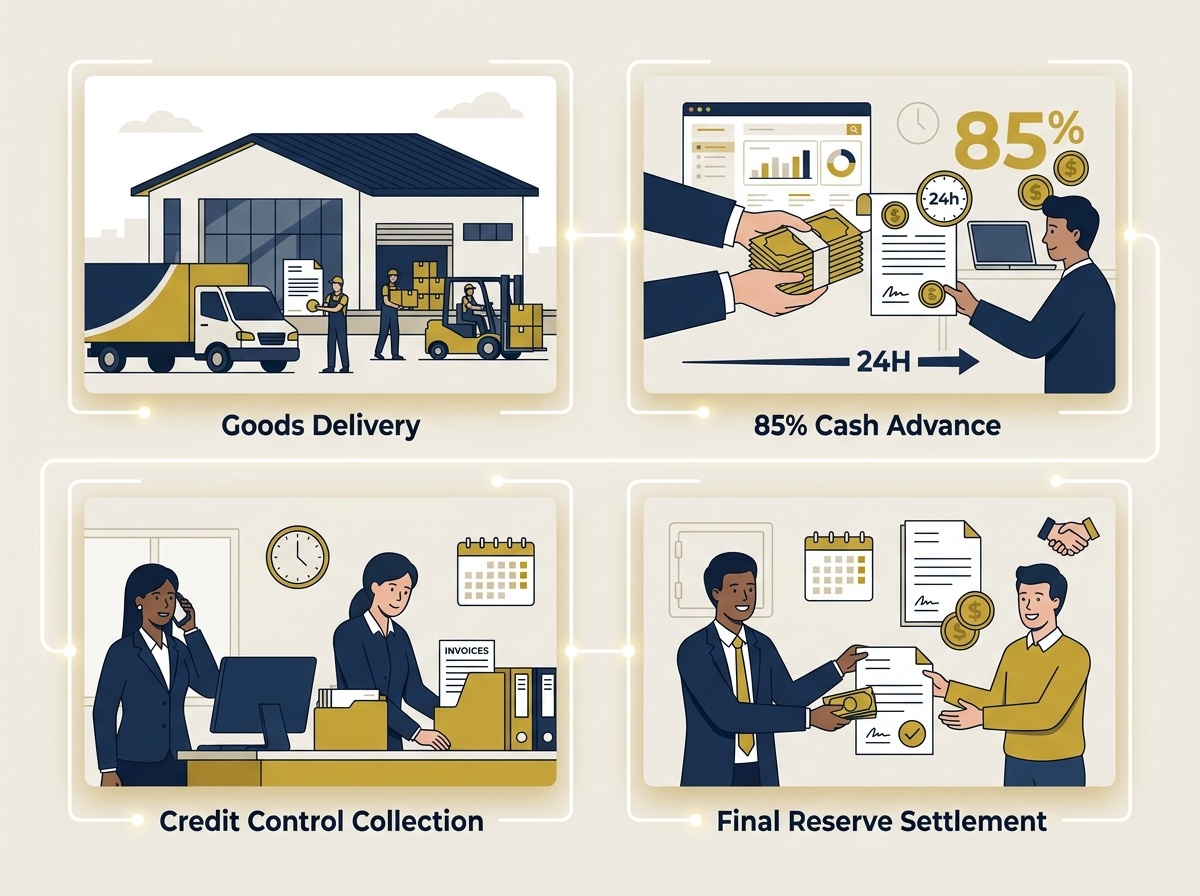
Unlike a traditional business bank loan or fixed overdraft, business invoice factoring is directly linked to your commercial trading volume. As your turnover expands, your available credit facility scales organically in parallel. The entire process follows a disciplined four-stage operational cycle:
Stage 1: Goods Delivered and Invoice Issued
Your business delivers goods or completes contracted services for a verified business-to-business (B2B) client under standard commercial trade credit terms (such as 30, 60, or 90 days). You generate the official VAT sales invoice, dispatch it to the customer, and upload a copy directly to your factoring provider’s digital portal (integrated seamlessly with platforms like Xero, QuickBooks, or Sage).
Stage 2: Cash Advance Released Within 24 Hours
Upon verifying the legitimacy of the invoice and confirming credit limits, the factoring provider releases the agreed advance rate—typically between 75% and 90% of the gross invoice amount—straight into your commercial account. For example, on a £50,000 invoice with an 85% advance rate, your company receives an immediate cash injection of £42,500 the following business morning.
Stage 3: Professional Credit Control & Debtor Collection
Under a standard factoring agreement, the facility is disclosed. Each invoice bears a formal “Notice of Assignment” notifying the client that payment rights have been transferred to the factoring partner. The factor’s professional credit control team assumes responsibility for issuing statement reminders, tracking due dates, and securing payment upon maturity in accordance with established UK commercial standards.
Stage 4: Balance Settlement & Final Reconciliation
When your customer pays the full invoice amount into the designated trust account managed by the factor, the factor settles the transaction. They deduct their agreed service fee and accumulated finance charge, and immediately remit the remaining balance (the 10% to 25% “reserve”) to your company bank account.
Invoice Factoring vs Invoice Discounting: Core Differences
Business owners evaluating accounts receivable finance frequently confuse invoice factoring with invoice discounting. While both mechanisms fall under the umbrella of asset-based lending regulated under the UK Finance Business Finance Review data framework, their operational models, customer visibility, and eligibility profiles differ significantly.
According to UK Finance market analyses, invoice discounting accounts for approximately 85% of total advanced volume in the UK, predominantly utilized by larger established mid-market enterprises with dedicated in-house finance departments. Conversely, invoice factoring accounts for roughly 15% of the market, serving rapidly growing SMEs, startups, and labor-intensive sectors that gain massive operational value from outsourced debtor credit management.
For growing enterprises seeking general commercial debt structuring alongside asset finance, our companion guide on business asset finance in the UK breaks down complementary capital equipment funding strategies.
Real-World Cost Breakdown: Fees, Charges, and Worked Calculations
Pricing in business invoice factoring consists of two primary cost elements, supplemented by administrative and ancillary fees depending on contract specifications. Understanding these components is essential for calculating your effective Annual Percentage Rate (APR) and protecting operating profit margins.
1. The Service Charge (Administration Fee)
The service charge covers the ongoing cost of account management, ledger maintenance, credit vetting, and professional debt collection. Expressed as a percentage of your total gross invoice turnover factored through the facility, it typically spans:
- Large Turnover (>£1M annual): 0.50% to 1.25% of turnover
- Mid-Market (£300k–£1M annual): 1.00% to 1.80% of turnover
- Smaller SMEs (£100k–£300k annual): 1.75% to 2.50% of turnover
2. The Discount Rate (Financing Fee)
The discount fee represents the cost of borrowing the advanced cash while the invoice remains outstanding. It is calculated on the net cash drawn on a daily pro-rata basis, benchmarked against the Bank of England Base Rate plus a commercial margin (usually 1.5% to 4.5% per annum).
Ancillary Charges to Audit in Factoring Contracts
Before executing an agreement, commercial directors must scrutinize the lender’s fee schedule for ancillary expenses, including:
- Facility Setup & Legal Onboarding: £250 to £1,000 one-off fee for setting up trust accounts and completing Companies House Debenture registration.
- CHAPS / Faster Payments Transfer Fees: £10 to £25 per same-day capital drawdown.
- Debtor Credit Limit Refresher Fees: £10 to £40 per international or non-standard credit check.
- Refactoring / Overdue Surcharge: Penalty rates applied if an invoice remains unpaid past 90 days.
Complete Worked Financial Example: £50,000 UK Sales Invoice
To demonstrate exactly how the financial flow works in practice, examine the following real-world scenario for a UK precision engineering manufacturer delivering commercial components on 45-day payment terms:
For an effective financing cost of less than 2% of gross contract value, the company eliminated 45 days of acute liquidity strain, met trade payroll on schedule, and secured early-settlement supplier discounts of 3% on raw materials, generating an overall net positive financial return.
Recourse vs. Non-Recourse Factoring: Insuring Against Bad Debt
When selecting a business invoice factoring facility, one of the most critical structural decisions is choosing between recourse factoring and non-recourse factoring. The distinction dictates who shoulders the ultimate financial liability if a debtor fails to pay.
Recourse Factoring (Standard / Lower Cost)
Under a recourse arrangement, your business retains full credit risk. If an invoice remains unpaid after an agreed long-stop period (typically 90 to 120 days from invoice date) due to debtor insolvency, cash flow failure, or protracted dispute, your company must buy back the unpaid invoice from the factor or replace it with a fresh invoice of equivalent value. Because the factor assumes zero credit default risk, recourse factoring carries substantially lower service fees.
Non-Recourse Factoring (Includes Bad Debt Protection)
With non-recourse factoring, the factor incorporates formal credit insurance into the facility. If a designated commercial debtor enters liquidation, administration, or formal bankruptcy, the factoring company absorbs the financial loss and cannot reclaim the advanced funds from your business. However, non-recourse facilities command a higher service fee (often 0.3% to 0.75% higher) and strictly require that all invoices fall within pre-approved credit limits set by the underwriter.
Crucial Legal Caveat: Bad debt protection under non-recourse contracts only applies to verified customer insolvency or protracted default. It does not protect your business if the debtor withholds payment due to a commercial dispute, breach of contract, or substandard delivery.
Top UK Invoice Factoring Companies in 2026
The UK commercial finance market is populated by a blend of major high-street retail banks, specialist independent factoring institutions, and agile fintech balance sheet lenders. Independent oversight and industry guidance are provided through the British Business Bank invoice finance guidance portal.
Eligibility Criteria: What UK Lenders Require to Approve a Facility
Because invoice factoring is secured against the creditworthiness of your commercial customers rather than your company’s historic balance sheet, underwriting criteria are far more accessible than standard bank loans. Even newly formed startups or companies with historic balance sheet losses can secure factoring approvals, provided they meet four fundamental criteria:
- Business-to-Business (B2B) Trade Only: Factoring companies do not finance consumer invoices (B2C). You must supply products or services to verified UK or international corporate entities, public sector bodies, or limited companies.
- Verifiable, Unencumbered Invoices: Work must be completed, delivered, and accepted. Factoring cannot fund speculative orders, retainers, or disputed delivery milestones. In specialized industries like construction, lenders use specialist construction factoring to evaluate JCT/NEC framework contracts and certified milestone applications.
- Debtor Book Spread & Diversity: Lenders evaluate customer concentration risk. If a single commercial client accounts for more than 30% to 40% of your total turnover, the factor may impose a credit limit cap on that debtor to prevent systemic exposure.
- Standard Commercial Credit Terms: Trade credit terms must typically range between 30 and 90 days. Contracts extending beyond 120 days require specialist structured asset-based finance.
For entrepreneurs structuring emergency short-term cash reserves while awaiting facility approval, our detailed analysis on instant short-term business loans in the UK outlines non-dilutive bridge financing alternatives.
Strategic Advantages and Potential Pitfalls of Factoring
Evaluating an invoice factoring facility requires weighing substantial operational liquidity benefits against customer perception and long-term contract commitments.
Key Advantages
- Accelerated Cash Flow Without Debt Growth: Factoring does not create fixed monthly repayment liabilities on your balance sheet; it merely accelerates cash you have already earned.
- Unlimited Scalability: Your borrowing limit expands automatically as your invoice sales volume increases, eliminating the need to constantly renegotiate bank overdraft limits.
- Professional Credit Management: Late payment chasing is transferred to specialized credit controllers, significantly shortening Days Sales Outstanding (DSO) under statutory rights defined by the Late Payment of Commercial Debts legislation.
- Supplier Early-Settlement Discounts: Having reliable immediate liquidity enables your purchasing team to negotiate 2% to 5% early payment discounts with suppliers, often entirely offsetting factoring fees.
Potential Pitfalls & Operational Considerations
- Loss of Direct Customer Communication: Because factoring is disclosed, an overly aggressive third-party credit controller could irritate valuable clients. Always verify that your chosen factor provides a dedicated relationship manager who respects customer rapport.
- Contractual Lock-in & Termination Notice: Traditional whole-turnover factoring contracts often carry 12-to-24-month minimum commitments and require 3 to 6 months’ written notice of termination.
- Restrictions on Encumbered Invoices: If an existing commercial bank holds an all-assets floating charge (Debenture) over your business, they must grant a formal Deed of Priority or Waiver of Book Debts before a factoring provider can register its security interest at Companies House.
Frequently Asked Questions (FAQ)
Can a small business factor a single invoice instead of the whole ledger?
Yes. This is known as spot factoring or selective invoice finance. Platforms such as Kriya and Novuna allow businesses to select specific high-value invoices to fund without locking their entire debtor ledger into a whole-turnover contract. While selective factoring provides complete flexibility, it carries higher transactional service fees (typically 1.5% to 5% per invoice) compared to annual contract rates.
Will my customers know I am using an invoice factoring facility?
Under standard invoice factoring, yes. The agreement is disclosed, and all sales invoices feature an assignment notice directing payment to the factor’s designated client trust account. If complete confidentiality is essential for your brand, you should apply for confidential invoice discounting, where collections remain entirely with your internal team and customers never see third-party lender involvement.
What happens if a customer refuses to pay or enters liquidation?
The outcome depends on whether your agreement is recourse or non-recourse. Under a recourse contract, your business must buy back the unpaid invoice or replace it with a fresh sales ledger entry after 90 to 120 days. Under a non-recourse contract with bad debt protection, the factor’s credit insurance absorbs the capital loss, provided the non-payment is caused by verified customer insolvency rather than a quality-of-service dispute.
How does invoice factoring affect my company balance sheet?
Invoice factoring improves balance sheet liquidity by converting sluggish accounts receivable into immediate cash at bank, thereby elevating your quick ratio and working capital position.
What is the minimum turnover required by UK factoring companies?
Entry-level fintech and specialist providers support businesses with annual turnovers as low as £50,000 to £100,000. Mainstream independent lenders such as Bibby Financial Services typically prefer £100,000+, while high-street banking divisions like Barclays require a minimum annual turnover of £500,000.
Is invoice factoring cheaper than an unsecured business bank overdraft?
In pure headline interest terms, an invoice factoring discount fee (Bank base rate + 1.5%–4.5%) is often lower than unsecured commercial overdraft rates (which can exceed 10%–16%). However, when you factor in the administrative service charge (0.5%–2.5%), total factoring costs may appear comparable.
Implementation Roadmap for Finance Leaders
For UK businesses operating in B2B supply chains, transport, recruitment, manufacturing, or wholesale trade, late invoice payments represent the single greatest operational drag on commercial momentum. Business invoice factoring delivers a disciplined, self-liquidating funding architecture that transforms trapped debtor balances into immediate growth capital.
When selecting a factoring partner, avoid fixating solely on the lowest headline discount rate. Scrutinize service charge structures, verify whether credit control staff operate with customer-friendly professionalism, insist on transparent termination clauses, and demand non-recourse bad debt protection if your sector faces heightened insolvency risks. Deployed strategically, invoice factoring provides the financial agility required to scale your client book, fulfill larger contracts, and capture market share across Britain’s competitive commercial landscape.