Quick Answer: Short Term Business Loans UK 2026
Short term business loans are commercial debt facilities designed to provide rapid working capital over terms ranging from 1 to 24 months. In 2026, automated underwriting powered by Open Banking enables UK digital lenders to issue approvals within minutes and deploy funds between £5,000 and £500,000 on the same day. Key structures include Unsecured Fixed-Term Loans, Merchant Cash Advances (MCAs)—which utilize factor rates (typically 1.15 to 1.35) repaid via a fixed percentage of daily card terminal sales—and Revolving Credit Facilities. Facilities under £25,000 rarely require physical collateral, though director personal guarantees are standard on larger unsecured advances.
Key Takeaways
- Open Banking integration allows alternative lenders to analyze live transaction feeds, approving funding in minutes without business plans.
- Merchant Cash Advances scale repayments flexibly with revenue, charging factor rates rather than standard compounding APR.
- Revolving credit lines provide flexible on-demand cash reserves where interest is charged only on drawn capital.
- Unsecured commercial borrowing preserves company balance sheet flexibility but typically requires personal guarantees for loans over £25,000.
For fast-growing UK enterprises, working capital gaps can emerge rapidly. Whether navigating sudden supply chain disruptions, settling quarterly VAT liabilities, securing bulk inventory discounts, or bridging client payment delays, conventional high-street bank loans—with underwriting processes taking up to three months—are rarely practical for urgent liquidity requirements.
According to commercial market data from the British Business Bank and the Financial Conduct Authority (FCA), alternative fintech lenders originate billions in short-term working capital annually, offering digital-first facilities structured specifically for agile cash management.
This authoritative guide details the landscape of short term business loans in 2026, comparing unsecured term loans, merchant cash advances, and revolving credit, while analyzing factor rates, Open Banking underwriting, and personal guarantee liabilities.
1. The Three Primary Short Term Business Loan Structures
Understanding the distinction between fixed-term facilities, revenue-based funding, and revolving facilities ensures your business borrows at the lowest total cost of capital.
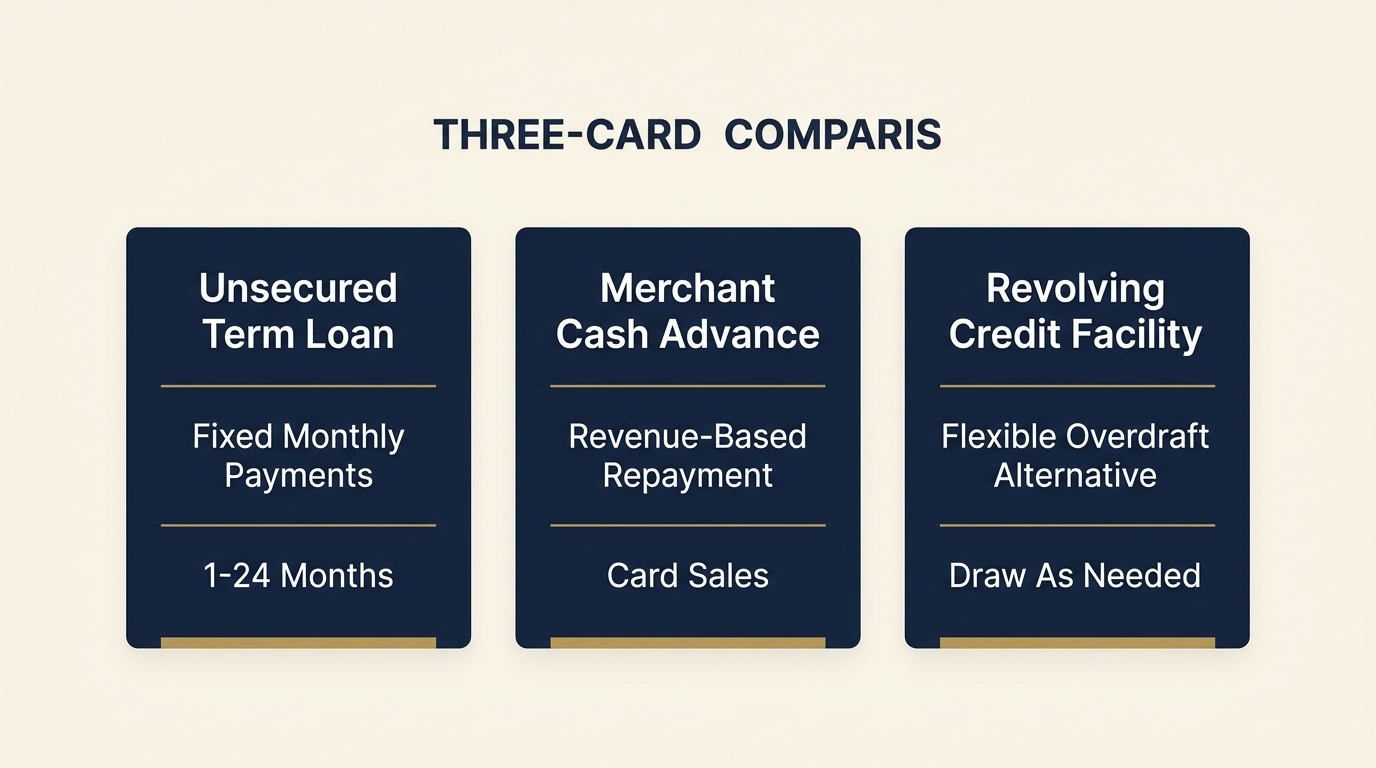
| Loan Structure | Repayment Mechanism | Typical Pricing Model | Best Commercial Application |
|---|---|---|---|
| Unsecured Term Loan | Fixed weekly or monthly direct debit | Fixed interest rate (8% to 24% APR) | Predictable growth investments, renovations, or marketing campaigns. |
| Merchant Cash Advance (MCA) | Percentage of daily card terminal / e-commerce sales (e.g. 10%-15%) | Factor rate (1.15 to 1.35x borrowed sum) | Seasonal retail, hospitality, cafes, and e-commerce stores with high card volume. |
| Revolving Credit Facility | Flexible interest-only payments on drawn funds; capital repaid as convenient | Monthly rate (0.75% to 2.5% per month on drawn balance) | Emergency cash reserve, managing late supplier invoices, or tax bills. |
If you are comparing short-term liquidity with long-term asset acquisition, explore our detailed guide to business asset finance in the UK.
For larger commercial capital projects requiring 3 to 10-year debt, review our analysis of business expansion loans in the UK.
2. Factor Rates vs. APR: Calculating the Real Cost of Borrowing
One of the most frequent points of confusion for business owners is evaluating factor rates against standard annual percentage rates (APR).
How Factor Rates Work (Merchant Cash Advances)
Unlike conventional loans where interest compounds over time, a factor rate applies directly to the principal advance to determine the total fixed repayment figure:
Advance Amount: £50,000 | Factor Rate: 1.20
Total Fixed Repayment: £50,000 × 1.20 = £60,000
Total Finance Charge: £10,000 (Repaid via 12% of daily card takings)
Because there is no compounding interest, an MCA offers certainty: if trading slows down during winter months, your daily repayment decreases proportionally without triggering late payment fees. However, if your sales surge and you clear the balance in three months, the effective annualized APR increases significantly.
Ensure your company preserves cash flow predictability by modeling repayments with our guide on small business cash flow forecasting in 2026.
3. How Open Banking Delivers Instant Decisions
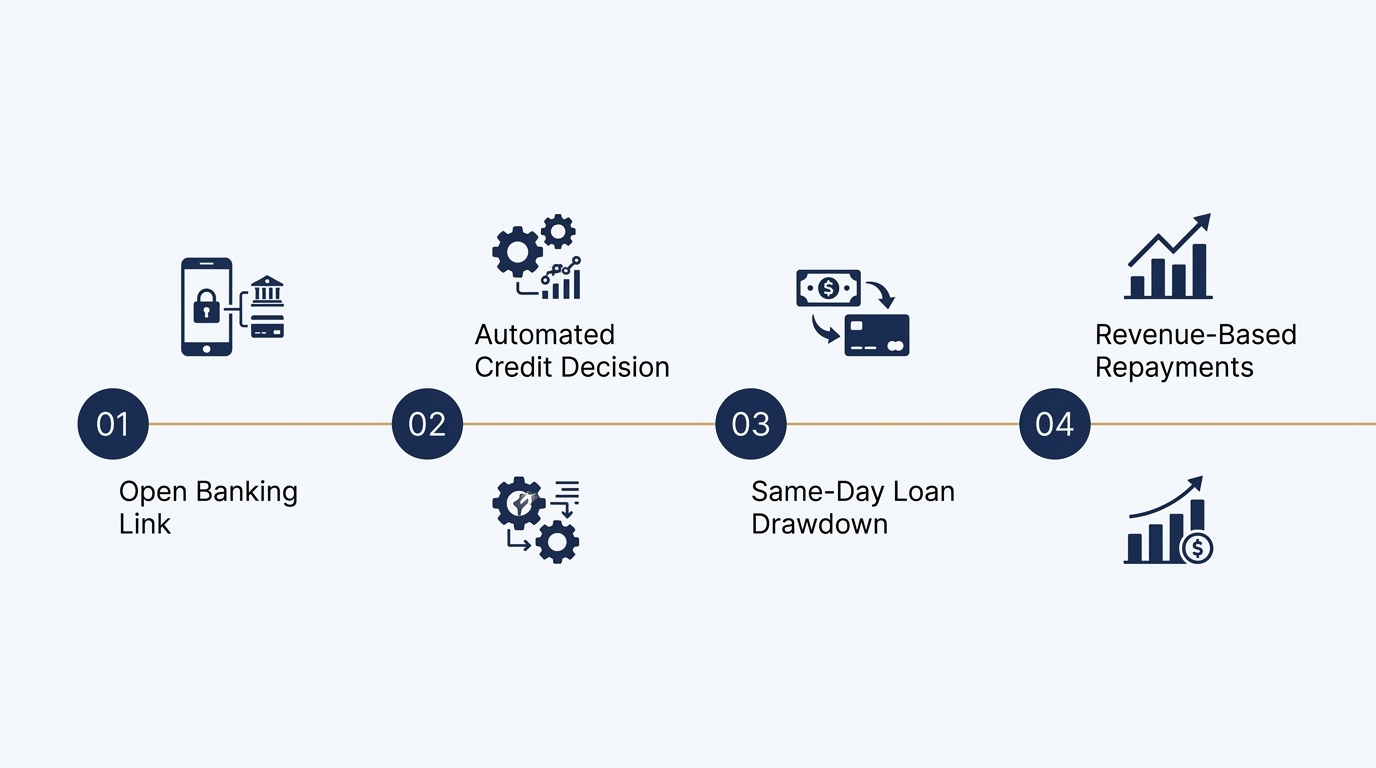
In 2026, the traditional loan underwriting process—requiring audited accounts, cash flow projections, and bank statements submitted by post or email—has been replaced by Open Banking API integration:
- Read-Only Financial Feeds: The applicant authorizes a secure, read-only connection to their business bank account (Barclays, HSBC, NatWest, Lloyds, Monzo, Revolut, etc.) via FCA-regulated data providers.
- Automated Affordability Scoring: Algorithms analyze real-time inflows, revenue volatility, average daily balances, and existing debt obligations in under 60 seconds.
- Instant Approval & Drawdown: Once approved, legal loan agreements are executed via digital signature, and funds are disbursed via the Faster Payments network within hours.
If you are registering a new corporate vehicle or subsidiary to isolate debt liabilities, read our guide on how to register a company in the UK.
4. Personal Guarantees (PGs) & Security Considerations
While short-term business loans are classified as “unsecured” (meaning no legal charge is registered against specific commercial property or fixed machinery), lenders manage credit risk through alternative covenants:
When Personal Guarantees Are Required:
- Borrowing Above £25,000: Most commercial lenders mandate a personal guarantee from company directors for unsecured loans exceeding £25,000.
- Legal Implications: Under a Personal Guarantee, the director becomes personally liable if the limited company defaults or enters insolvency. Personal assets (savings, vehicles, personal residential equity) can be pursued by the lender.
- Personal Guarantee Insurance (PGI): Business owners can mitigate this exposure by taking out specialized PGI policies, which cover up to 80% of the guaranteed sum in the event of default.
For real estate investors securing property transactions on short notice, compare bridging terms in our guide to commercial bridging loans in the UK.
Learn how finance charges and interest deductions reduce your Corporation Tax liability in our guide to UK corporation tax rates 2026.
5. Frequently Asked Questions
Can a business with adverse credit secure a short-term loan?
Yes. Revenue-based lenders and Merchant Cash Advance providers focus primarily on recent trading turnover (typically requiring £5,000+ in monthly revenue over the last 3-6 months) rather than historical credit file blemishes.
Are short-term business loan repayments tax-deductible?
Yes. The interest charges, facility fees, and finance costs on commercial loans are 100% tax-deductible as trading business expenses, reducing your net profit liable for UK Corporation Tax.
Your Next Actions
- Audit Cash Flow Timing: Identify the exact capital deficit and ensure projected future revenue comfortably covers weekly or monthly debt service.
- Enable Open Banking Feeds: Prepare clean, reconciled digital bank accounts for instant algorithmic underwriting.
- Compare Factor Rates vs. APR: Calculate the total repayable sum across multiple lender quotes before signing agreements.
- Explore Tools: Use resources in our Business Tools Hub.
Editorial Team & Signature
Written by Oliver Carpenter, Founder & Editor-in-Chief at Elite Business Journal. Published September 2026.