
Nearly 82% of small businesses fail because of cash flow problems, not because they lacked customers or sales. That number hits different when you realize most of those business owners were making money on paper. They just didn’t know what their numbers actually meant.
If you’ve ever looked at your total sales and felt proud, then looked at your bank account and felt confused, you already know this feeling. Revenue and profit are two completely different things, and mixing them up is one of the most common and costly mistakes new business owners make.
This article breaks down the real difference between revenue and profit in plain language. You’ll see exactly how each number works, why both matter, and what to do with that knowledge starting today.
Who Gets the Most Out of This Article
This is for you if you’ve recently started a business, picked up freelance work, or launched a side hustle and you’re starting to see real money come in. Maybe you just landed your first few clients or made your first batch of sales online.
You’re not an accountant. You didn’t study finance. But you want to stop guessing and start actually knowing what your numbers mean.
If you’ve ever said something like “I made $10,000 last month, why do I feel broke?” — this is exactly where you need to be. Getting clear on the difference between revenue and profit will change how you think about your business money from this point forward.
What These Two Words Actually Mean (And Why People Get Confused)
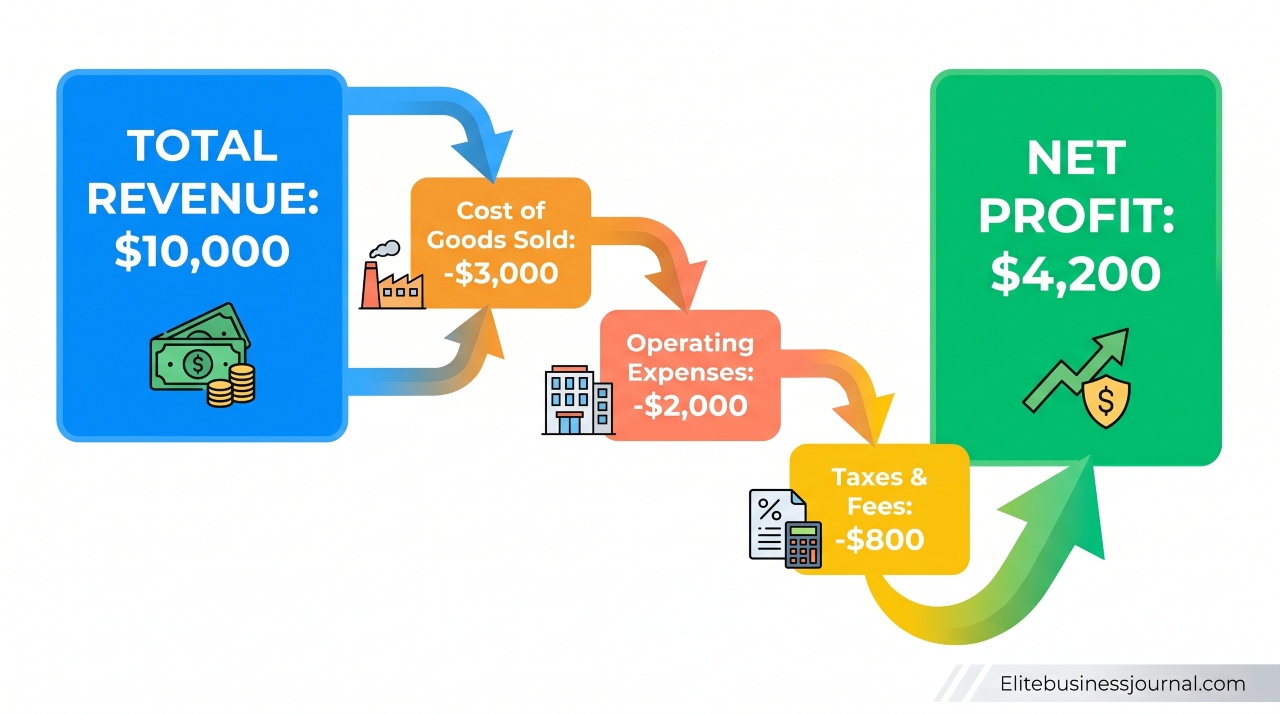
Most people hear “revenue” and “profit” and assume they’re just different words for the same thing. They’re not. They measure completely different parts of your financial picture, and confusing them can lead to some painful decisions.
Revenue is every dollar that comes into your business from sales or services before anything gets taken out. If you sold $15,000 worth of products this month, your revenue is $15,000. Simple. No math needed yet. Revenue is also called “top line” income because it sits at the very top of any financial statement. Learn how the IRS defines gross income for small businesses.
Profit is what’s left after you subtract all your costs from that revenue. Those costs include things like materials, software tools, shipping, payment processing fees, advertising, and anything else you spent to run the business. Profit is the real number. It tells you whether your business is actually working or just staying busy.
Here’s a simple way to think about it: Revenue is what you earn. Profit is what you keep.
People get confused because revenue is the exciting number. It’s big. It sounds impressive. But a business can have massive revenue and still lose money every single month. That’s why both numbers matter, and why you need to track them separately.
The Real Difference Between Revenue and Profit, Broken Down
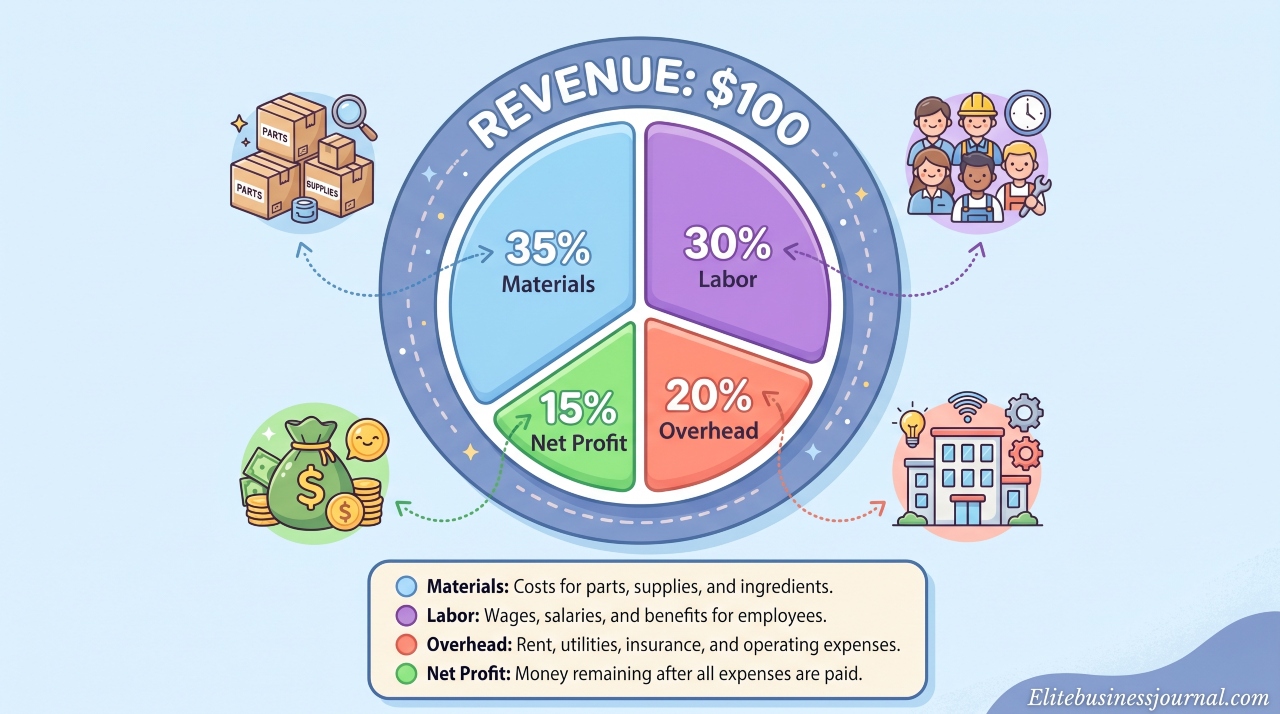
Revenue: The Total Money Coming In
Revenue captures all the money your business brings in before any costs are removed. It includes every sale, every invoice paid, every service fee collected.
Say you run a small bakery. You sell 500 cupcakes in a week at $5 each. Your revenue for that week is $2,500. That’s it. You haven’t paid for flour, sugar, packaging, or your oven’s electric bill yet. Revenue doesn’t care about any of that.
This number matters because it tells you how much demand there is for what you’re selling. A growing revenue number means people want what you offer. A shrinking revenue number is an early warning sign that something needs to change. But revenue alone never tells you if the business is healthy.
What to do with this: Track your revenue every week or month so you can see trends. Is it growing, shrinking, or staying flat? That pattern gives you useful information even before you look at costs.
Profit: The Money You Actually Keep
Profit is what remains after you subtract all expenses from your revenue. There are actually a few types of profit worth knowing, but the two most common are gross profit and net profit.
Gross profit = Revenue minus the direct cost of making your product or delivering your service. Using the bakery example: if your ingredients and packaging for those 500 cupcakes cost $800, your gross profit is $1,700.
Net profit = Revenue minus all costs, including indirect ones like rent, software subscriptions, advertising, and taxes. If your bakery also paid $400 in rent, $100 in utilities, and $50 in card processing fees that week, your net profit drops to $1,150.
Net profit is the number that tells you the truth. It’s what you actually made after everything is paid. Check profit margin benchmarks by industry to see if your numbers are healthy.
What to do with this: Calculate your net profit every month. If you’re not doing this yet, start now. A business running on thin or negative net profit can’t survive long, no matter how strong the revenue looks.
Why a High Revenue Number Can Be Misleading
Here’s a scenario that plays out all the time. A freelance web designer charges $8,000 per month in client fees. That sounds solid. But they’re paying $1,200 for software subscriptions, $600 for a virtual assistant, $300 for advertising, and $800 in self-employment taxes. That’s $2,900 in monthly costs, leaving a net profit of $5,100.
Still good. But the designer doesn’t see it that way because they’re mentally spending the $8,000 number. They buy new equipment, take on fewer clients for a “slower month,” and then wonder why they’re short on rent.
Revenue is not your paycheck. Net profit is much closer to what you can actually spend. That distinction alone can protect you from a lot of financial stress.
What to do with this: Never make a major spending decision based on your revenue number. Always check your profit first.
Profit Margin: The Number That Puts Both Together
Profit margin is a percentage that shows how much of your revenue actually becomes profit. It’s calculated like this:
(Net Profit ÷ Revenue) × 100 = Profit Margin %
Using the bakery example: $1,150 ÷ $2,500 × 100 = 46% profit margin. That’s actually strong for a small food business.
Profit margin lets you compare your efficiency across different months or against other businesses in your industry. A $500,000 revenue business with a 2% profit margin is in a much shakier position than a $100,000 revenue business with a 40% margin.
What to do with this: Calculate your profit margin once a month. If it’s dropping, find out why before the problem gets serious.
How the Difference Between Revenue and Profit Shows Up on Paper
Every basic financial statement separates these two numbers clearly. At the top, you see total revenue. Then you subtract costs step by step until you reach net profit at the bottom. Here’s how to read a basic income statement so you can follow this yourself without needing an accountant to explain it every time.
Looking at a real income statement, even a simple one, makes the difference between revenue and profit much easier to see. The visual layout alone often clears up the confusion that words can’t.
What Most Articles Get Wrong About This Topic
Most articles stop at the definitions. They tell you revenue is total sales and profit is what’s left. That’s true but incomplete.
What they skip is this: many new business owners have solid profit on paper but still run out of cash. This happens because profit and cash flow are also different things. If you invoice a client for $5,000 and they don’t pay for 60 days, your profit statement says you made $5,000 this month. Your bank account tells a different story.
This is called an accounts receivable gap, and it trips up small business owners constantly. You can be profitable and still be unable to pay your bills on time. The fix is to watch both your profit numbers and when money actually hits your account. Knowing the difference between revenue and profit is the first step. Tracking cash timing is the second.
How to Take Action Starting Today
Here’s exactly what to do right now. Open a simple spreadsheet or use free accounting software like Wave or QuickBooks Self-Employed.
Create three columns: Revenue, Total Expenses, Net Profit. Enter your numbers from the last 3 months. Calculate your net profit for each month by subtracting expenses from revenue. Then calculate your profit margin for each month using the formula above.
Look at what you see. Is your profit growing with your revenue? Is your margin staying steady or shrinking? Those answers will tell you more about your business health than your revenue number ever could. Once you’ve done this for past months, make it a habit to do it at the end of every month going forward. It takes less than 30 minutes and it gives you real information to make real decisions.
The Single Most Important Takeaway
Revenue tells you how much business you’re doing. Profit tells you whether that business is actually working for you. You need both numbers, but you can’t treat them as the same thing.
The difference between revenue and profit is not just a vocabulary lesson. It’s the foundation of every smart financial decision you’ll make as a business owner.
Start tracking both numbers today. Not next month, not when things get bigger. Right now, with whatever data you already have.