
Data published by the British Vehicle Rental and Leasing Association (BVRLA) confirms that more than 1.4 million corporate cars operate across British commercial fleets. Yet figures from HM Revenue and Customs reveal that thousands of company car drivers pay excessive tax each year because their employers misunderstand the tax treatment of company vehicle fuel. Managing business travel expenses demands absolute precision under United Kingdom tax legislation. Understanding how HMRC assesses private motoring subsidies protects your company balance sheet and shields your workforce from unexpected tax penalties.
This comprehensive guide examines HMRC fuel charges 2026, detailing current Advisory Fuel Rates (AFR), the statutory Car Fuel Benefit Charge multiplier, calculation formulas, electric vehicle charging guidelines, and repayment deadlines. By reviewing the exact numbers and compliance structures below, business directors and fleet managers can implement tax-efficient reimbursement processes that eliminate unnecessary tax liabilities.
Quick Answer: How HMRC Fuel Charges Work in 2026
In the 2026/27 tax year, HMRC fuel charges operate under two separate mechanisms. For employees driving company cars who pay for their own business fuel or repay private fuel, employers apply quarterly HMRC Advisory Fuel Rates (ranging from 11p to 27p per mile depending on engine displacement and fuel category). When an employer funds private fuel without full reimbursement, HMRC levies the Car Fuel Benefit Charge calculated by multiplying the statutory figure of £29,200 by the vehicle’s Benefit-in-Kind (BIK) carbon dioxide percentage. Fully electric vehicles incur £0 fuel benefit charge, with business electricity reimbursed at the Advisory Electricity Rate of 7p per mile for home charging or up to 15p per mile for verified public charging.
Key Takeaways for UK Business Owners
- Advisory Fuel Rates (AFR) are updated quarterly: HMRC reviews rates on 1 March, 1 June, 1 September, and 1 December to reflect fluctuating forecourt fuel prices.
- The Car Fuel Benefit Charge is all-or-nothing: Allowing an employee even £1 of subsidised private fuel triggers tax on the full £29,200 multiplier multiplied by their BIK percentage.
- Zero fuel benefit charge on electric vehicles: Electricity is not defined as fuel under UK tax law, eliminating the car fuel benefit charge completely for pure battery electric cars.
- Reimbursement deadline is 6 July: Employees must settle all outstanding private fuel liabilities for the previous tax year by 6 July to prevent P11D Benefit-in-Kind assessments.
- AMAP applies to personal cars: Approved Mileage Allowance Payments (45p for first 10,000 miles, 25p thereafter) apply strictly to personal cars used for work, not company-owned vehicles.
Understanding HMRC Fuel Charges: AFR vs Fuel Benefit Charge
Commercial motoring expenses fall into distinct categories under UK tax rules. When company directors evaluate business motoring costs, confusion often arises between two completely different tax concepts: Advisory Fuel Rates and the statutory Car Fuel Benefit Charge.
Advisory Fuel Rates serve as benchmark figures published by the government. When staff members drive company-owned vehicles, employers use these pence-per-mile rates to reimburse them for genuine business travel without creating a taxable benefit. Alternatively, if the business pays for all fuel upfront using commercial fuel cards or commercial business credit cards, the employee uses AFR rates to repay the employer for their private mileage. Using these exact government figures guarantees that neither the company nor the worker pays income tax or National Insurance on the fuel.
In sharp contrast, the Car Fuel Benefit Charge represents a punitive Benefit-in-Kind tax. It applies whenever an employer provides fuel for an employee’s private motoring in a company car without requiring 100% reimbursement at or above the official AFR rate. Private motoring includes daily home-to-work commuting, weekend leisure trips, and personal errands. Understanding this legal distinction is fundamental when structuring business vehicle finance agreements and company fleet policies.
Current HMRC Advisory Fuel Rates for 2026
HMRC calculates Advisory Fuel Rates using mean UK forecourt fuel prices published by the Department for Energy Security and Net Zero, combined with modern vehicle fuel economy statistics. Employers can review official figures via official HMRC Advisory Fuel Rates guidance to verify updates each quarter.
The table below outlines the current statutory rates applicable across England, Scotland, Wales, and Northern Ireland. Employers have the option to adopt previous quarter rates for up to one calendar month following any adjustment date.
| Engine Displacement | Petrol Rate (Per Mile) | Diesel Rate (Per Mile) | LPG Rate (Per Mile) |
|---|---|---|---|
| 1400cc or less | 14p | 15p (1600cc or less) | 11p |
| 1401cc to 2000cc | 17p | 16p (1601cc to 2000cc) | 13p |
| Over 2000cc | 27p | 22p | 20p |
| Fully Electric (AER) | 7p per mile (domestic home charging) | Up to 15p per mile (public charging with receipt evidence) | ||
Hybrid models are treated under standard combustion engine categories for AFR calculations. Plug-in hybrid electric vehicles (PHEVs) and full hybrid vehicles must apply the petrol or diesel rate corresponding to the internal combustion engine displacement under their bonnet.
Employers have legal permission to reimburse employees at a rate higher than the standard AFR if they can demonstrate that the vehicle’s genuine business fuel cost per mile is higher. Conversely, if an employer pays an employee more than the AFR without evidentiary proof of higher running costs, the excess amount constitutes taxable earnings subject to PAYE income tax and Class 1 National Insurance contributions.
The Car Fuel Benefit Charge: Statutory Multiplier and Formulas
When an employer provides free or subsidised fuel for private travel in a company car, HMRC treats this perk as remuneration. The taxable benefit is calculated using a national statutory multiplier rather than the actual cash amount spent at petrol forecourts.
For the 2026/27 tax year, the car fuel benefit multiplier is set at £29,200. This figure represents the government benchmark for car fuel. To establish the taxable Benefit-in-Kind value, the employer must multiply this £29,200 figure by the vehicle’s official CO2 emissions BIK percentage.
Statutory Fuel Benefit Calculation Formula
Taxable Benefit = £29,200 × Vehicle BIK CO2 Percentage
Employee Tax Payable = Taxable Benefit × Employee Marginal Income Tax Rate (20%, 40%, or 45%)
Employer Class 1A NIC = Taxable Benefit × Class 1A NIC Rate
Consider a senior manager driving an executive diesel company car emitting 142g/km of CO2, which commands a 35% BIK bracket. The calculations unfold as follows:
- Taxable Fuel Benefit Value: £29,200 × 35% = £10,220.00
- Basic Rate Taxpayer (20%): Pays £2,044.00 per year in personal income tax (£170.33 deducted monthly).
- Higher Rate Taxpayer (40%): Pays £4,088.00 per year in personal income tax (£340.67 deducted monthly).
- Additional Rate Taxpayer (45%): Pays £4,599.00 per year in personal income tax (£383.25 deducted monthly).
- Employer Class 1A NIC: The enterprise pays Class 1A National Insurance contributions on the £10,220 taxable value.
Reviewing GOV.UK company car tax regulations clarifies that the fuel benefit tax exists completely separate from the company car tax itself. Both liabilities apply concurrently if fuel is provided.
The All-or-Nothing Rule: The Private Fuel Trap
The single most dangerous aspect of HMRC fuel charges is the strict statutory “all-or-nothing” rule. Unlike many other employment benefits, HMRC does not allow proportionate reductions for partial fuel provision.
If a company car driver uses an employer-funded fuel card to purchase £50 of petrol for a private weekend trip and fails to reimburse the employer in full, HMRC treats the arrangement as full private fuel provision for the entire tax year. The driver becomes liable for the full £29,200 calculation, triggering thousands of pounds in tax for a trivial personal purchase.
This trap often catches small business directors and sales personnel who assume that occasional personal journeys do not matter. The rule applies with complete rigidity: either the employee repays 100% of all private fuel costs based on accurate mileage records and official AFR rates, or the full annual benefit charge applies.
| Scenario | Annual Private Miles | Actual Forecourt Cost | Higher Rate Tax Cost (40%) | Effective Cost Per Mile |
|---|---|---|---|---|
| Low Private Mileage | 2,500 miles | £425 (at 17p/mile) | £3,504 (30% BIK car) | £1.40 per mile in tax |
| Average Private Mileage | 6,000 miles | £1,020 (at 17p/mile) | £3,504 (30% BIK car) | 58p per mile in tax |
| High Private Mileage | 22,000 miles | £3,740 (at 17p/mile) | £3,504 (30% BIK car) | 16p per mile in tax |
As demonstrated in the comparison table, providing free private fuel is financially inefficient for anyone driving fewer than 20,000 private miles per year. For an employee driving 2,500 private miles, accepting free fuel forces them to pay £1.40 per mile in personal income tax, compared to paying just 17p per mile directly at the petrol pump.
Commercial Vans and the Van Fuel Benefit Charge
Rules governing commercial light goods vehicles (vans) differ markedly from passenger cars. Under HMRC definitions, a van qualifies as a vehicle constructed primarily for the conveyance of goods or burden, with a design gross laden weight not exceeding 3,500kg.
If an employee uses a company van for business travel and incidental private journeys (such as stopping to pick up lunch during a working route or making a minor detour on the way home from an assignment), HMRC categorises this as “insignificant private use.” Insignificant private use generates zero Benefit-in-Kind tax on both the vehicle and the fuel.
However, if the employee uses the company van for regular private travel, such as weekend family trips or personal hobbies, both the Van Benefit Charge and the Van Fuel Benefit Charge apply. For the 2026/27 tax year, the Van Fuel Benefit Charge is a flat fixed charge of £815. Unlike cars, there is no percentage multiplication linked to CO2 emissions. The employee pays tax on £815 at their marginal tax rate (£163 for 20% taxpayers, £326 for 40% taxpayers), and the employer pays Class 1A NIC on £815.
Zero-emission electric vans attract a £0 Van Benefit Charge and £0 Van Fuel Benefit Charge, making them exceptionally tax-advantageous for trade enterprises.
Approved Mileage Allowance Payments (AMAP) vs AFR
Another area where payroll teams make costly errors is confusing Advisory Fuel Rates (AFR) with Approved Mileage Allowance Payments (AMAP). Each system serves a distinct legal category of vehicle ownership:
- AMAP (Approved Mileage Allowance Payments): Applies strictly when an employee or business director uses their own personal vehicle for company business journeys. The statutory AMAP rate is 45p per mile for the first 10,000 business miles in a tax year, dropping to 25p per mile thereafter. This payment covers fuel, insurance, depreciation, maintenance, and MOT wear and tear.
- AFR (Advisory Fuel Rates): Applies strictly to company-owned or company-leased cars. The rate covers only the fuel consumed (e.g. 14p to 27p per mile), because the employer already finances the vehicle lease, maintenance, tyres, and road tax.
Applying the 45p AMAP rate to a company-owned car is an immediate tax breach. If an employer reimburses a company car driver 45p per mile instead of the 17p AFR rate, HMRC treats the 28p difference as taxable income subject to PAYE and National Insurance.
Electric Vehicles and Hybrid Fleets in 2026
The rapid shift toward corporate fleet electrification has transformed the tax implications of HMRC fuel charges. Under Section 149 of the Income Tax (Earnings and Pensions) Act 2003, electricity is legally recognized as a form of energy rather than a combustion fuel. This definition creates substantial tax savings for British enterprises.
Because electricity is not fuel under tax law, providing free electricity to an employee for their company electric car triggers £0 Car Fuel Benefit Charge. An employer can install workplace electric vehicle charging points, permit employees to charge their company electric cars free of charge for both business and private journeys, and incur zero P11D benefit-in-kind liabilities.
For business journeys where the employee pays for electricity themselves, employers reimburse drivers using the Advisory Electricity Rate (AER):
- Home Charging Reimbursement: The standard AER rate is 7p per mile. Employers can pay this amount tax-free without collecting electricity meter receipts.
- Public Network Charging: Because ultra-rapid public charging tariffs frequently exceed 70p to 85p per kWh, actual charging costs can reach 15p to 20p per mile. Employers can reimburse the genuine verified cost per mile above 7p tax-free, provided the driver retains detailed charging session VAT receipts demonstrating that the reimbursement reflects exact running costs.
Adopting electric vehicles eliminates the administrative complexity of managing fuel cards while contributing directly to sound corporate cash flow management strategies across your vehicle fleet.
3-Step Mileage Audit & Reimbursement Framework
To eliminate the risk of unexpected P11D tax assessments, businesses should replace company-paid private fuel with a disciplined mileage reimbursement framework. Implementing an automated mileage protocol ensures complete compliance with HMRC audits.
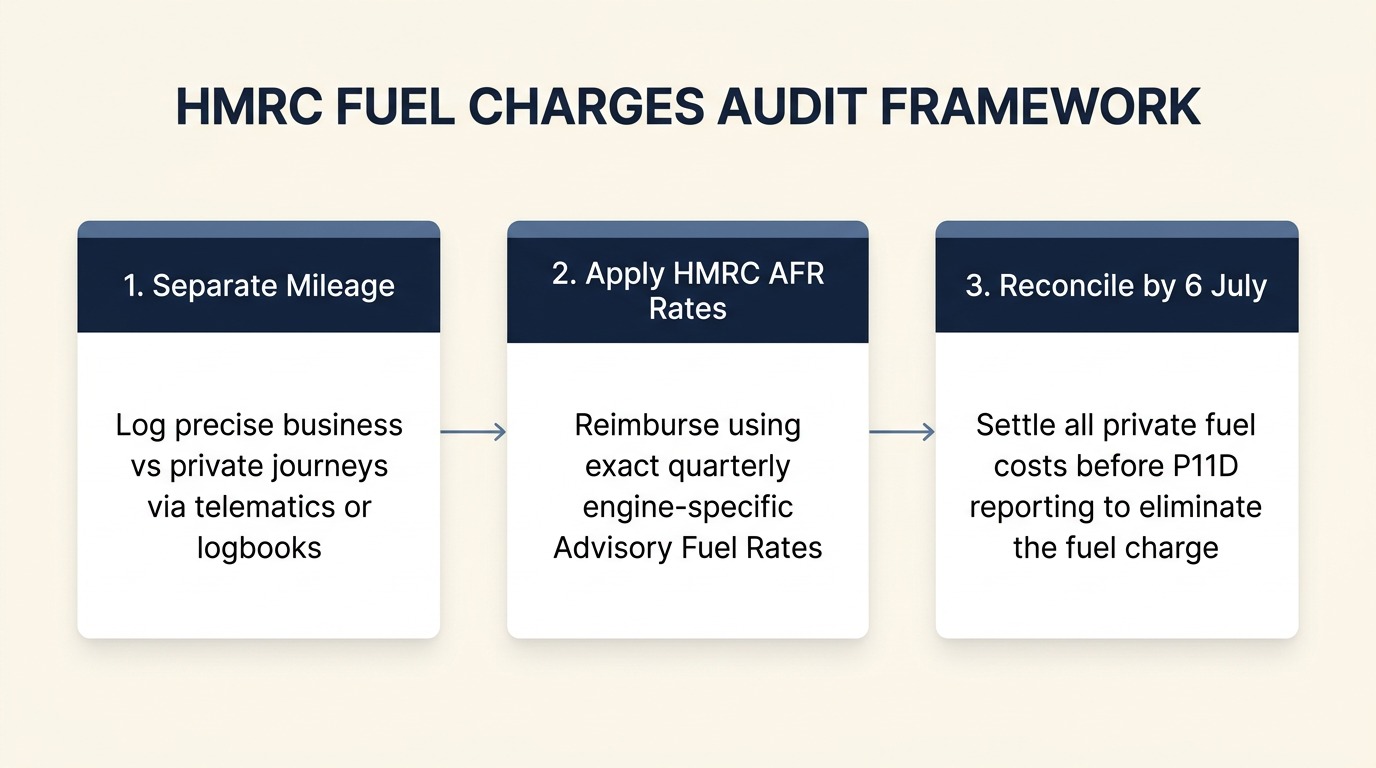
Step 1: Separate Business and Private Mileage via Digital Logs
HMRC requires contemporaneous travel logs showing the date of travel, start and finish postcodes, exact mileage, business purpose of the trip, and client visited. Generic estimates or retrospective diary entries are regularly rejected during compliance audits. Fleet operators should deploy automated telematics, GPS vehicle tracking, or mobile logging applications that allow drivers to tag each journey as business or private with a single tap.
Step 2: Apply Exact Quarterly Advisory Fuel Rates
Ensure your payroll or expense management platform updates automatically on the first day of March, June, September, and December. When employees incur business mileage in company vehicles, reimburse them at the applicable engine rate. If employees use corporate fuel cards for all fuel purchases, deduct the private mileage sum (private miles multiplied by the AFR) directly from their monthly net payroll.
Step 3: Reconcile Accounts Before the 6 July Deadline
HMRC regulations mandate that any private fuel reimbursement for a given tax year must be finalized and paid before 6 July following the end of that tax year. If an employee fails to settle their private fuel balance by 6 July, the employer must submit a P11D reporting the full £29,200 multiplier calculation. Once 6 July passes, retrospective reimbursements cannot overturn the fuel benefit tax liability.
Comparative Analysis: Fuel Benefit vs AFR Reimbursement
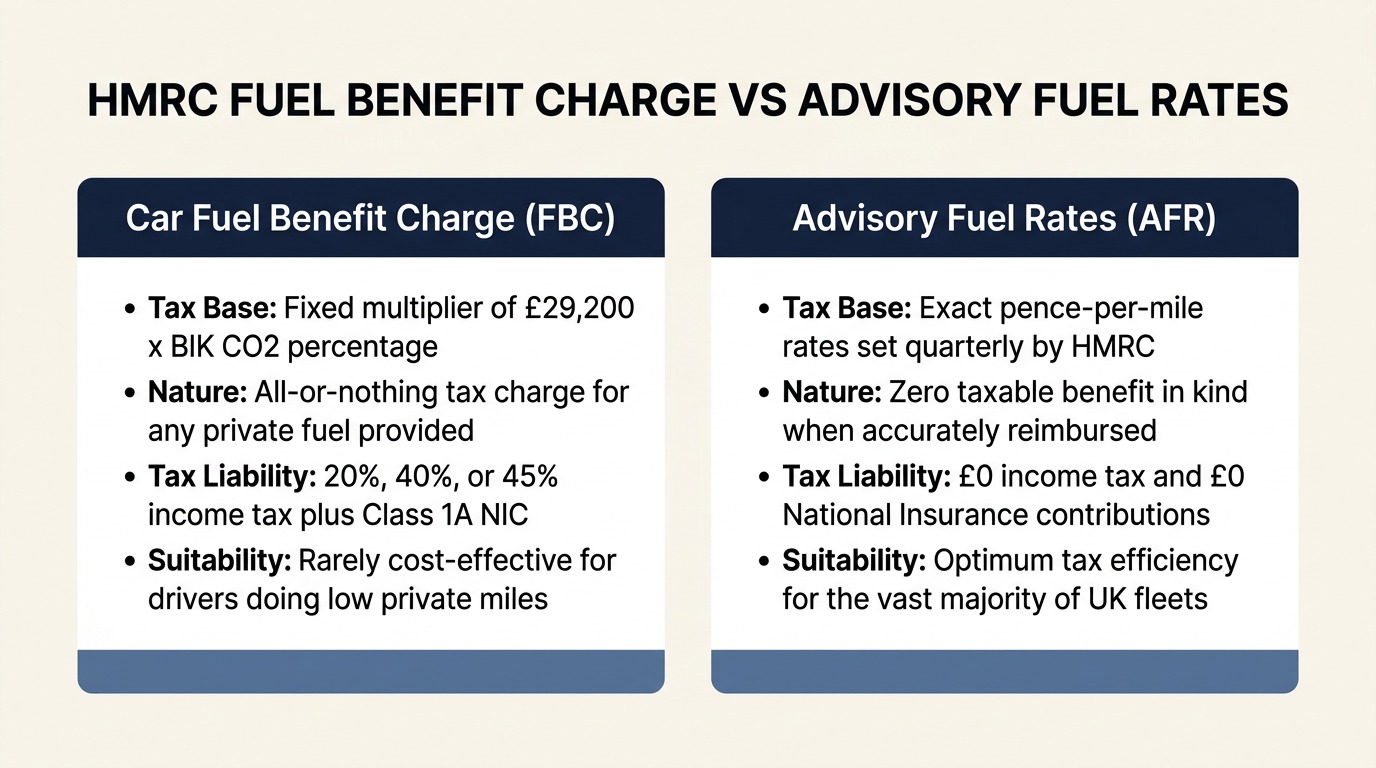
To illustrate why British enterprises are abandoning fuel cards in favour of mileage reimbursement, the table below outlines the total combined tax cost for an employer and employee under both options for an executive saloon car emitting 135g/km CO2 (32% BIK bracket).
| Metric | Option A: Employer Pays Private Fuel | Option B: Employee Repays via AFR |
|---|---|---|
| Statutory Taxable Value | £9,344 (£29,200 × 32%) | £0 (Fully exempt) |
| Employee Tax Cost (40% Rate) | £3,737.60 per year | £0 tax (Pays actual fuel cost) |
| Employer Class 1A NIC (13.8%) | £1,289.47 per year | £0 NIC payable |
| Combined Annual Tax Burden | £5,027.07 in dead tax | £0 in dead tax |
| Administrative Complexity | High (P11D, payroll BIK deductions) | Low (Automated mileage settlement) |
Forcing an employee and employer to pay over £5,027 each year in combined taxes when the driver only consumes £800 worth of private fuel represents bad commercial treasury management. Detailed examination through HMRC guidance on company car fuel benefits underscores that abandoning the company fuel card in favour of mileage reimbursement delivers instant financial savings.
VAT Recovery on Business Fuel
Businesses registered for VAT in the UK must adhere to specific rules when recovering input tax on fuel expenses. The treatment depends on whether the company or the employee purchases the fuel.
When an employee pays for fuel and claims reimbursement via Advisory Fuel Rates, the business can reclaim input VAT on the fuel element of the payment. To make a valid VAT claim, the business must obtain and retain forecourt VAT fuel receipts dated reasonably close to the travel date. The input VAT is calculated using the formula: AFR rate × (1 / 6) for standard 20% VAT rate items.
If the business pays for all fuel upfront and applies the Road Fuel Scale Charge to account for private use, the company can reclaim all input VAT on all fuel purchases, but must output a fixed quarterly scale charge VAT figure based on the car’s CO2 rating. For most small to mid-sized businesses, the mileage reimbursement route with retained VAT receipts offers superior cash flow predictability.
Frequently Asked Questions
What happens if my employee does not repay private fuel by 6 July?
If an employee fails to reimburse their employer for private fuel in full before 6 July following the end of the tax year, HMRC enforces the full Car Fuel Benefit Charge for the entire tax year. The employer must declare the benefit on form P11D and pay Class 1A National Insurance, while the employee faces PAYE tax on the full £29,200 calculation.
Do Advisory Fuel Rates apply to sole traders and self-employed individuals?
No. Advisory Fuel Rates apply strictly to employees and directors operating company-owned or company-leased cars. Self-employed sole traders and partners in unincorporated businesses claim simplified motoring expenses using the 45p/25p mileage rate, or deduct actual vehicle running costs proportionate to business use based on accurate logbooks.
Can employers pay higher mileage rates than HMRC Advisory Fuel Rates?
Employers may pay higher rates than the published AFR only if they can prove to HMRC that the actual fuel cost per business mile is genuinely higher (for example, in high-performance specialist commercial vehicles). If an employer pays above the AFR without evidence, the excess amount is treated as taxable pay subject to income tax and Class 1 National Insurance.
Is there an HMRC fuel benefit charge on electric company cars?
No. Under UK tax law, electricity is categorized as energy rather than fuel. Consequently, no car fuel benefit charge applies to fully electric vehicles, even if the employer provides free electricity at the office or pays for public charging sessions. Business mileage incurred by employees charging at home can be reimbursed at the Advisory Electricity Rate of 7p per mile tax-free.
Are hybrid vehicles subject to the petrol, diesel, or electric fuel rate?
Hybrid cars are treated as either petrol or diesel vehicles for Advisory Fuel Rate purposes. Plug-in hybrids (PHEVs) and full hybrids must apply the rate corresponding to their internal combustion engine size. The 7p electric rate applies exclusively to pure battery electric vehicles.
How often does HMRC change Advisory Fuel Rates?
HMRC reviews Advisory Fuel Rates four times per calendar year: on 1 March, 1 June, 1 September, and 1 December. Businesses have a one-month transitional buffer where they may continue applying the rates from the previous quarter.
What Business Directors and Fleet Managers Must Do Next
Retaining company fuel cards for private travel is an outdated practice that inflicts unnecessary tax costs on both UK employers and their staff. To ensure absolute compliance and maximise cash retention, businesses should execute four immediate actions:
- Audit All Active Fuel Cards: Identify every employee and company director who currently receives employer-funded fuel for private motoring. Calculate their specific BIK tax burden against their actual private mileage.
- Withdraw Private Fuel Cards: Transition employees from company fuel cards to an accurate mileage reimbursement model. Replace employer-paid private fuel with salary compensation if necessary, which is far more tax-efficient.
- Adopt Digital Mileage Logging: Deploy digital GPS trip-recording tools that automate journey tracking, capture start and finish postcodes, and integrate with cloud accounting systems.
- Enforce the 6 July Reconciliation: Establish an annual payroll protocol to ensure all outstanding private mileage settlements for the preceding tax year are paid in full before 6 July.
Article Hyperlink Reference Map
| Link Type | Exact Anchor Text | Destination Target URL | Context & Purpose |
|---|---|---|---|
| Internal | commercial business credit cards | https://elitebusinessjournal.co.uk/business-credit-card-uk-guide/ | Commercial expense payment methods |
| Internal | business vehicle finance agreements | https://elitebusinessjournal.co.uk/business-vehicle-finance-uk-guide/ | Fleet acquisition structures |
| Internal | cash flow management strategies | https://elitebusinessjournal.co.uk/cash-flow-tips-every-small-business-owner-needs-to-know/ | Working capital optimisation |
| External (Authority) | official HMRC Advisory Fuel Rates | https://www.gov.uk/guidance/advisory-fuel-rates | Official UK Government rates benchmark |
| External (Authority) | GOV.UK company car tax regulations | https://www.gov.uk/tax-company-benefits/tax-on-company-cars | Benefit-in-Kind taxation guidance |
| External (Authority) | HMRC guidance on company car fuel benefits | https://www.gov.uk/expenses-and-benefits-company-cars | HMRC employer expense manual |