Quick Answer: How to Pay Corporation Tax UK 2026
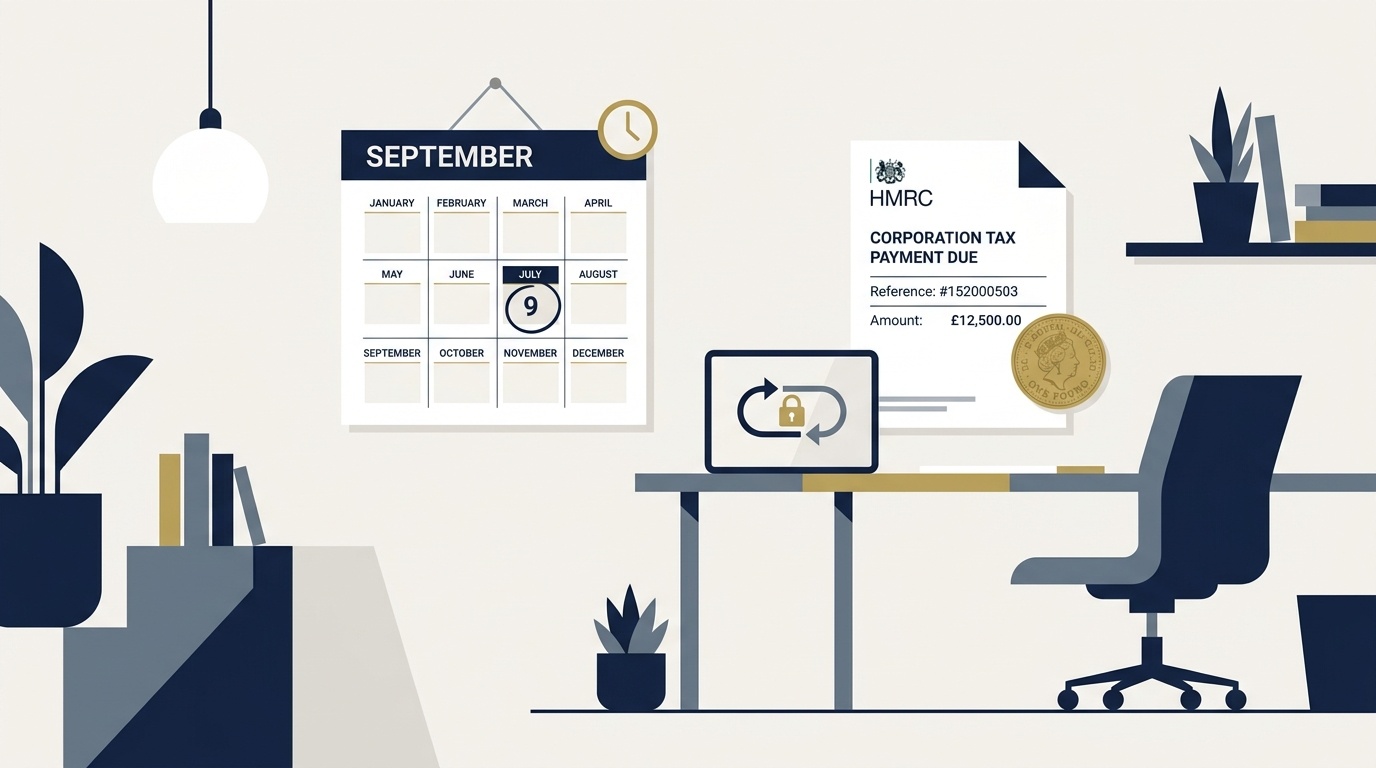
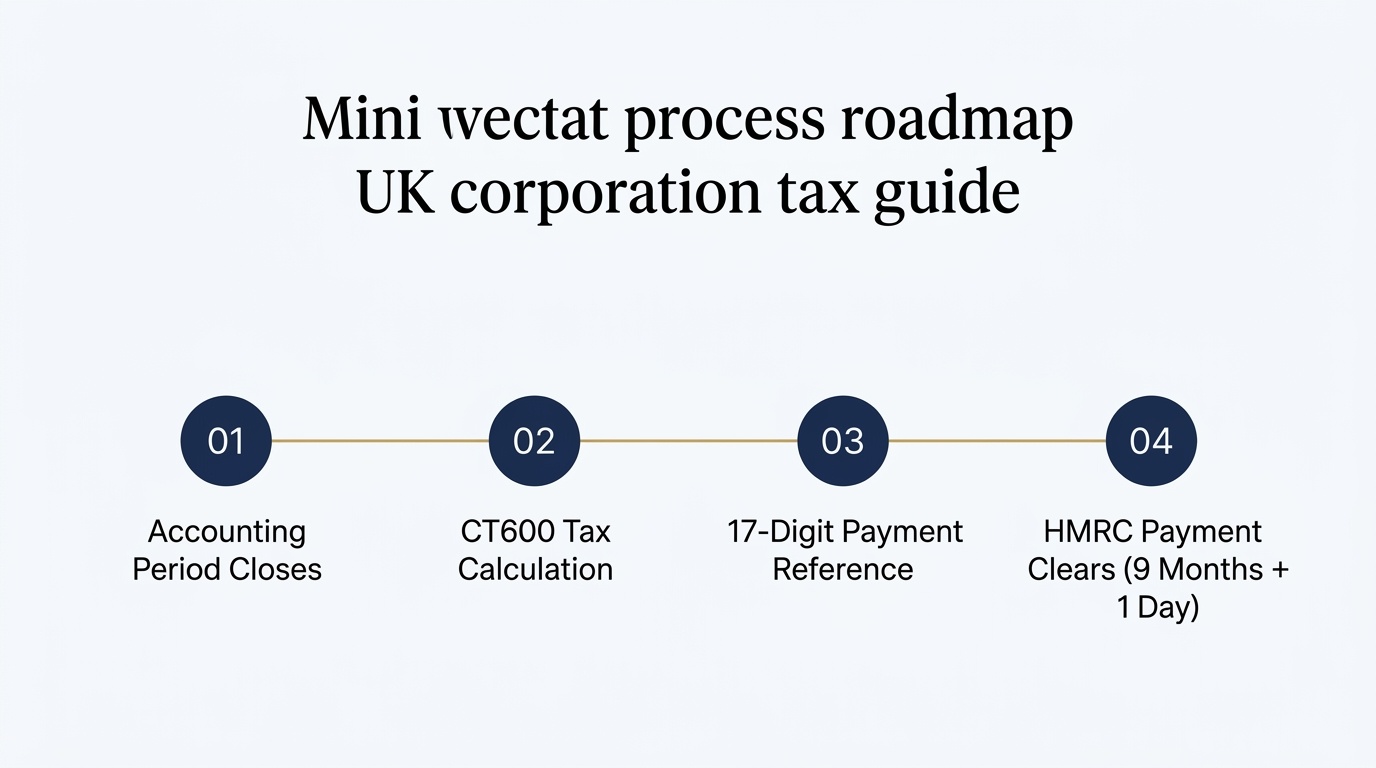
In the UK, companies with taxable profits of up to £1.5 million must pay Corporation Tax exactly 9 months and 1 day after the end of their accounting period. Under the statutory “pay first, file later” principle, your tax payment is due before your formal Company Tax Return (Form CT600) is submitted (due at 12 months). Payments can be made via Faster Payments (online banking) for same-day/next-day clearing, CHAPS for large transactions, Direct Debit (allow 3 to 5 working days), or corporate card. Every payment requires your unique 17-character Corporation Tax payment reference (your 10-digit UTR followed by 7 accounting period digits). Late payments incur daily compounding interest set at the Bank of England base rate plus 2.5%.
Key Takeaways
- Corporation Tax must be paid electronically within 9 months and 1 day following the close of your financial year.
- You must calculate your tax liability and pay HMRC three months before your statutory CT600 return filing deadline.
- Always quote your specific 17-character payment reference; using your 13-character PAYE Accounts Office reference causes misallocation.
- Companies with taxable profits exceeding £1.5 million must pay in mandatory quarterly instalments (QIPs).
For UK limited company directors and financial controllers, managing tax compliance requires strict attention to statutory deadlines. While individual taxpayers pay income tax through PAYE or annual Self Assessment, limited companies operate under a distinct corporate tax regime enforced by HM Revenue & Customs (HMRC Pay Corporation Tax).
One of the most frequent traps for newly incorporated businesses is the “pay first, file later” rule. Many directors mistakenly believe their tax bill is due alongside their statutory annual accounts and CT600 tax return at the 12-month mark. In reality, statutory payment must reach HMRC’s bank account three full months earlier—at 9 months and 1 day.
According to compliance guidance published by GOV.UK Corporation Tax Guidelines, failing to submit payments with the exact payment reference code results in automated misallocations, demand notices, and compounding interest charges.
This comprehensive guide details the exact procedures for paying UK Corporation Tax in 2026, comparing payment methods, outlining official HMRC bank details, decoding the 17-character payment reference, explaining Quarterly Instalment Payments (QIPs) for large enterprises, and detailing how to avoid late payment penalties.
1. Corporation Tax Payment Deadlines: The 9 Months and 1 Day Rule
For small and medium-sized enterprises (companies with taxable profits up to £1.5 million), the statutory payment deadline is fixed by law under the Corporation Tax Act 2010:
| Company Financial Event | Statutory Legal Deadline | Primary Action Required |
|---|---|---|
| Accounting Period Ends | Day 0 (e.g. 31 December 2025) | Finalise bookkeeping, adjust for capital allowances, and reconcile revenue. |
| Corporation Tax Payment Due | 9 months and 1 day (e.g. 1 October 2026) | Transfer funds to HMRC bank account quoting 17-digit reference. |
| Company Tax Return (CT600) Due | 12 months (e.g. 31 December 2026) | Submit formal CT600 return and computations online to HMRC. |
| Companies House Accounts Due | 9 months (for private Ltd companies) | File statutory balance sheet and director’s report with Companies House. |
If your newly registered company’s first accounting period covers more than 12 months (up to the maximum 18 months allowed by Companies House), HMRC legally treats this as two separate accounting periods for Corporation Tax.
You will have two distinct payment deadlines and require two separate 17-character references.
For details on calculating the exact tax percentage due across the small profits and main rates, review our analysis of UK corporation tax rates 2026.
When extracting trading profits as a business owner, align your corporate tax liabilities with personal income tax using our guide to the optimal salary and dividend split.
2. Accepted Payment Methods & HMRC Bank Details
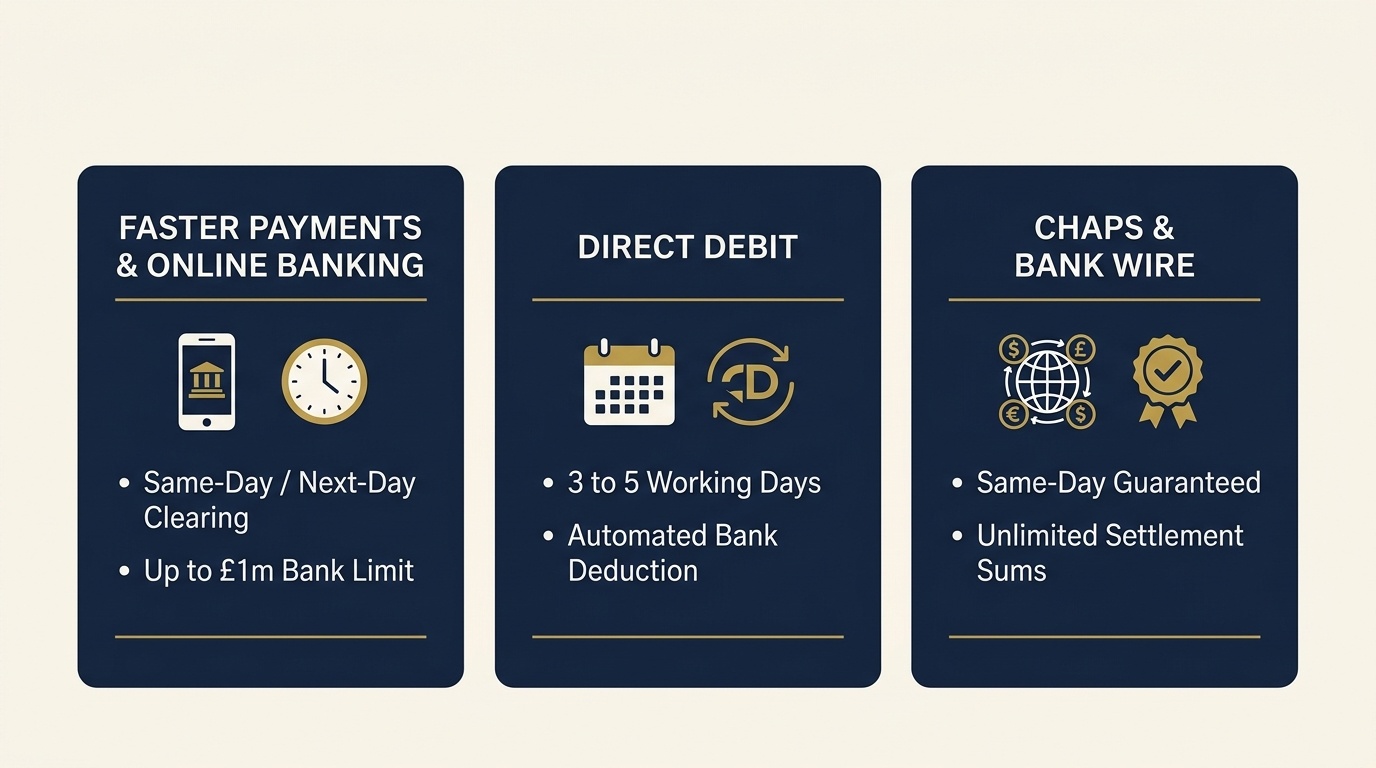
HMRC no longer accepts postal cheques for Corporation Tax. All payments must be made electronically through approved banking channels:
1. Faster Payments & Online Banking (Recommended)
- Clearing Speed: Same day or next day, operating 24 hours a day, 7 days a week, 365 days a year.
- Transaction Limits: Most commercial UK business bank accounts (Barclays, HSBC, NatWest, Lloyds, Monzo Business) permit single transfers up to £50,000 to £250,000 via Faster Payments.
- HMRC Bank Details:
- Account Name: HMRC Cumbernauld
- Sort Code:
08-32-10 - Account Number:
12001039
2. Direct Debit
- Clearing Speed: Allow 5 working days to set up a new Direct Debit instruction on your HMRC online account; recurring payments typically take 3 working days.
- Advantage: HMRC automatically collects the liability calculated on your return, ensuring you never miss a deadline.
3. CHAPS (Same-Day Wire for Large Sums)
- Clearing Speed: Guaranteed same-day settlement if instructed before your bank’s cut-off time (typically 2:00 PM to 3:30 PM).
- Best For: Tax bills exceeding £250,000 or enterprise payments where Faster Payments transaction caps would require multiple transfers.
- HMRC CHAPS Account: Same sort code (
08-32-10) and account number (12001039).
If managing liquidity is challenging before your tax deadline, discover financing solutions in our guide on short term business loans in the UK.
For company directors with outstanding borrowing from their business, check the S455 tax charge rules in our guide to director’s loan account rules in the UK.
3. Decoding Your 17-Character Payment Reference
Entering an incorrect payment reference is the number one reason Corporation Tax payments are rejected or misallocated to holding suspense accounts.
Anatomy of the 17-Character Reference:
Your Corporation Tax payment reference contains exactly 17 characters formatted as follows:
1234567890 A 001 01 A
- Characters 1–10: Your company’s 10-digit Unique Taxpayer Reference (UTR) issued by HMRC at incorporation.
- Character 11: A single letter representing your tax office identifier (e.g.,
A). - Characters 12–14: A 3-digit accounting period sequence number (e.g.,
001for your first period,002for your second). - Characters 15–16: A 2-digit financial year identifier (e.g.,
01,02). - Character 17: A single verification check letter (e.g.,
A,X).
Do not use your 13-character Accounts Office reference (e.g.,
123PA00123456). That reference is strictly for PAYE and National Insurance. If used for Corporation Tax, your payment will be credited to employee payroll taxes, leaving your Corporation Tax marked as unpaid and incurring statutory interest penalties.Track your business cash flow and tax reserves accurately by applying the frameworks in our guide to small business cash flow forecasting.
4. Quarterly Instalment Payments (QIPs) for Large Companies
Large corporations operating above HMRC’s profit thresholds do not enjoy the 9-month-and-1-day grace period. Instead, they must make mandatory Quarterly Instalment Payments (QIPs) during the active financial year:
- Large Companies (Taxable Profits £1.5m to £20m): Must pay in four quarterly instalments: Month 7, Month 10, Month 13 (one month post-year-end), and Month 16.
- Very Large Companies (Taxable Profits > £20m): Must pay in Months 3, 6, 9, and 12 of the active accounting period.
- Associated Companies Rule: The £1.5 million and £20 million profit thresholds are divided by the number of associated companies under common corporate control worldwide. If you control three companies, your threshold drops to £500,000 per entity.
For founders evaluating the tax impact of establishing holding companies or special purpose vehicles, read our guide to limited company buy to let mortgages.
5. Frequently Asked Questions
What happens if my Corporation Tax payment deadline falls on a weekend or bank holiday?
If you pay using Bacs or Direct Debit, your funds must clear into HMRC’s bank account on the last working day before the weekend or bank holiday. However, payments made via Faster Payments (online banking) or approved debit cards clear 24/7, including weekends and public holidays.
Can I pay Corporation Tax from a personal bank account?
Yes. While HMRC strongly prefers payments from a corporate bank account matching the registered company name, you can pay from a director’s personal account provided you enter the correct 17-character Corporation Tax payment reference. The payment is treated as a credit to your Director’s Loan Account (DLA).
What is the penalty for paying Corporation Tax late?
HMRC charges late payment interest immediately from the day after the payment due date. Interest is calculated at the Bank of England base rate plus 2.5%, compounding daily until the balance is fully settled.
Your Next Actions
- Locate Your 17-Digit Payment Reference: Check your official HMRC notice to deliver or log in to your HMRC Business Tax Account.
- Confirm Your Accounting End Date: Add 9 months and 1 day to establish your hard electronic clearing deadline.
- Reconcile Accounts with Your Accountant: Calculate your tax liability early to prevent emergency cash crunches.
- Explore Tools: Use resources in our Business Tools Hub.
Editorial Team & Signature
Written by Oliver Carpenter, Founder & Editor-in-Chief at Elite Business Journal. Published September 2026.