More than 8 million adults in the United States have ADHD. That is a massive group of people who often spend years feeling stuck in jobs that do not fit them. Many get fired. Many quit. Some stay in jobs that make them miserable because they do not know there is a better option.
Here is the truth. The problem is rarely the person. Most of the time, it is the job. When someone with ADHD ends up in the wrong career, everything feels harder than it should. But when they find work that matches how their brain operates, things change fast.
This article covers the best jobs for people with ADHD. You will learn which careers use ADHD strengths like creativity, high energy, quick thinking, and hyperfocus. You will also get honest advice about what to avoid and how to succeed once you land the right role.
Why the Right Job Makes a Huge Difference If You Have ADHD
People with ADHD are not lazy. Their brains are wired differently, and that wiring responds strongly to stimulation, novelty, and interest. When a job offers those things, an ADHD brain performs well. When it does not, even simple tasks can feel impossible.
Think about what happens in a bad job fit. A person with ADHD working in a slow, repetitive role will struggle with focus, make more mistakes, and feel frustrated all day. Over time, that frustration builds into anxiety, low self esteem, and burnout. This is not a character flaw. It is a brain chemistry issue.
Research supports the idea of interest based motivation for people with ADHD. They are driven by passion, urgency, novelty, and excitement far more than deadlines or obligation. A job that triggers these things naturally is a completely different experience than one that does not.
The work environment matters just as much as the job title. Flexible hours, physical movement, variety in daily tasks, and social interaction all support ADHD brains. Rigid rules, silent offices, and repetitive schedules work against them. Choosing with these factors in mind is not optional. It is essential.
For more on ADHD in the workplace, visit theCDC’s ADHD resource page.
The Real Strengths That Come with ADHD
Most conversations about ADHD focus on what is hard. Lack of focus. Poor time management. Impulsivity. But that is only part of the story. There is another side that does not get nearly enough attention.
People with ADHD are often highly creative. They see connections between ideas that others miss. They think fast, take risks, and bring an energy to their work that is hard to match. Many are also deeply empathetic, which makes them excellent communicators and natural leaders.
Hyperfocus is one of the most powerful ADHD traits. When someone with ADHD locks in on something that genuinely interests them, they can work with intense concentration for hours. The right career triggers this state regularly. That is when ADHD stops feeling like a problem and starts feeling like an advantage.
Here is a quick look at core ADHD strengths:
- Creativity and original thinking
- High energy and enthusiasm
- Risk tolerance and bold decision making
- Hyperfocus on topics that matter to them
- Strong empathy and social awareness
- Fast problem solving under pressure
- Resilience after setbacks
The best jobs for people with ADHD are the ones that use these strengths every single day. When the fit is right, people with ADHD do not just get by. They often become the most energetic and innovative person on the team.
Learn more about ADHD strengths at work from CHADD.
Creative Jobs That People with ADHD Often Love
Creative work is one of the strongest matches for ADHD brains. These jobs change often, reward original ideas, and usually allow some flexibility in how and when the work gets done. There is no one right answer in creative fields, which gives ADHD thinkers room to bring their unique perspective.
Graphic Designer
Graphic design is a strong fit because projects change constantly and the work rewards visual creativity. Deadlines create urgency, which helps ADHD brains focus. Many graphic designers work freelance, which gives them full control over their schedule and workload.
Writer or Content Creator
Writing works especially well for people who can hyperfocus on topics they find interesting. Online content creators often choose their own subjects and manage their own time. The variety of projects and topics keeps boredom away. This is one of the most accessible creative careers because it requires very little startup cost.
Photographer or Videographer
These roles are active, social, and always different. No two shoots are exactly alike. The work involves being out in the world and responding creatively to what is in front of you. That kind of real time problem solving is something many ADHD people genuinely enjoy.
Art Director
Art directors lead creative teams and shape the visual identity of brands and campaigns. The role combines big picture thinking with quick creative decisions. People with ADHD often thrive in leadership roles where they set the vision and let others handle the fine details.
Performer or Actor
Performing arts give ADHD people a place to channel intense emotion and high energy. The work is stimulating, deeply social, and never the same twice. Many well known actors have spoken openly about having ADHD, and the connection makes sense. Performance rewards spontaneity and emotional depth, both of which come naturally to many ADHD adults.
Helping Careers That Work Well for People with ADHD
Many people with ADHD feel a strong pull toward helping others. Their empathy is real and often runs deep. Jobs that involve human connection, emotional support, and active problem solving tap into this natural strength.
Social Worker
Social work is emotionally demanding but rarely boring. Every client brings a different situation, and the work is always evolving. People with ADHD who care deeply about fairness and human wellbeing often find this career deeply meaningful, even when it is hard.
Teacher or Coach
Teaching is part performance, part problem solving, and part relationship building. Energetic, creative teachers often connect best with students, especially those who also have ADHD. Each class and each student brings something new, which keeps the job feeling fresh. Coaching, whether academic or athletic, follows a similar pattern.
Nurse or EMT
Fast paced healthcare settings are a natural fit for many ADHD adults. Emergency rooms and ambulance work reward quick thinking, physical action, and the ability to stay calm when everything is moving fast. These are exactly the conditions where many people with ADHD feel most alive and most focused.
Personal Trainer
Personal training combines physical activity with one on one human connection. No two clients have the same goals, fitness levels, or personalities. The job keeps the body moving and the mind engaged. Many ADHD adults who struggled in office settings have found real success in fitness careers.
Counselor or Therapist
People with ADHD often make surprisingly good therapists. Their personal experience with feeling misunderstood gives them real empathy. Each session is different, and the work requires active listening and creative thinking, both of which ADHD brains can do very well when they are engaged.
Note that all of these roles come with some paperwork and administrative demands. Using templates, apps, and time blocking strategies can help manage those tasks without letting them take over.
Active Jobs That Keep ADHD Brains Engaged
Sitting still for eight hours a day is genuinely hard for many people with ADHD. Physical work is not a lesser option. For many ADHD adults, it is the best option. Movement stimulates dopamine, which is the same chemical that ADHD medications target. Active careers can actually make ADHD symptoms easier to manage.
Skilled Trades
Electricians, plumbers, carpenters, and HVAC technicians work with their hands in different locations every day. The work is technical, physical, and results are visible immediately. There is enormous satisfaction in finishing a job and seeing exactly what you built or fixed. Trade careers also pay very well and are in high demand.
Firefighter
Firefighting is high stakes, physical, and unpredictable. It involves teamwork, fast decision making, and genuine purpose. There is also structured downtime at the station, which gives ADHD brains a chance to rest between intense calls. Many firefighters say the variety of the work is what keeps them committed for decades.
Chef or Line Cook
A professional kitchen is fast, loud, and always moving. Chefs must multitask constantly, adapt to problems instantly, and manage time in tight windows. For people with ADHD who love food and thrive under pressure, kitchen work can feel exciting rather than overwhelming. The immediate feedback of cooking something well is also deeply satisfying.
Sports Coach or Athlete
Physical competition involves strategy, energy, split second decisions, and passion. Many professional athletes have spoken publicly about having ADHD. Sport rewards the exact traits that cause problems in a quiet office: boldness, speed, intensity, and risk taking.
Tech Careers Where ADHD Can Be a Real Advantage
Technology rewards fast thinkers who love solving problems and learning new things. It is also one of the most flexible industries in terms of remote work and schedule control. These factors make tech a strong option for many people with ADHD.
Software Developer
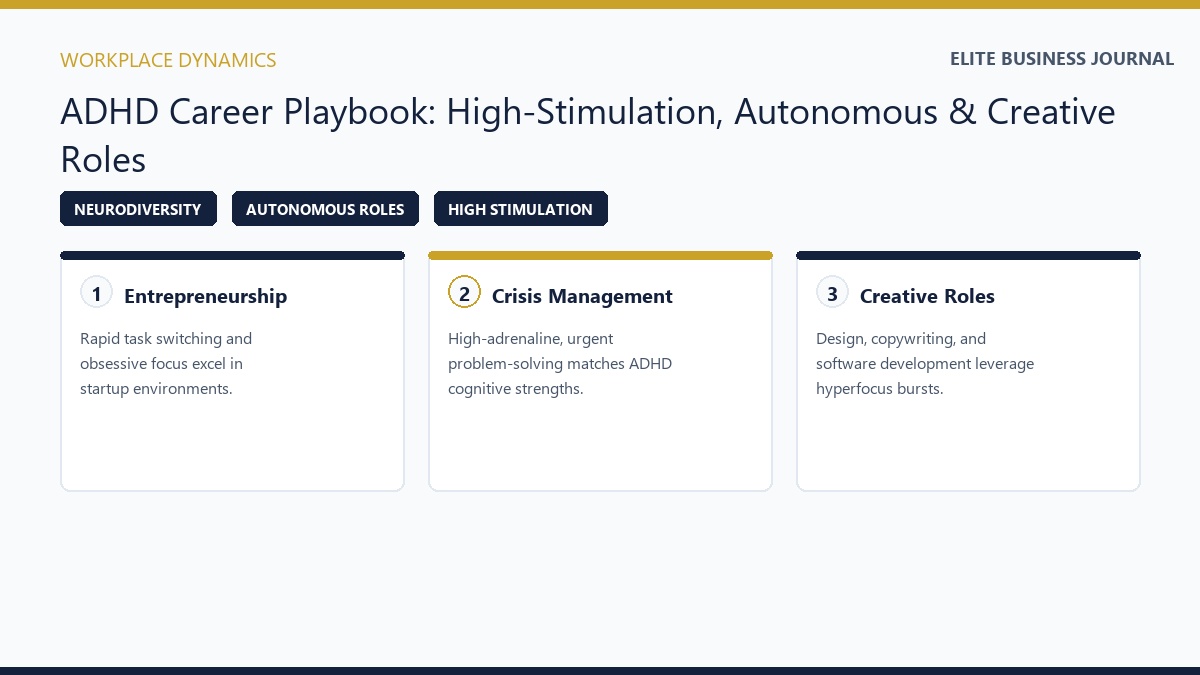
Coding requires focused problem solving and creative logic. People with ADHD who enter hyperfocus on a coding project can produce excellent work in short bursts. Remote work options and flexible hours are common in this field, which allows ADHD adults to work in environments they control.
IT Support Technician
IT support means solving a new problem every hour. Each ticket is a different puzzle. The urgency and variety of the work keeps ADHD brains active and prevents the boredom that kills motivation in repetitive roles. The job also involves real human interaction, which many ADHD adults enjoy.
Cybersecurity Analyst
Cybersecurity involves thinking like an attacker to find weaknesses before someone exploits them. It requires pattern recognition, creative thinking, and the ability to act fast. People with ADHD often think in ways that others do not, and in cybersecurity, that unconventional thinking is a genuine advantage.
Digital Marketer
Digital marketing changes constantly. Platforms shift, trends appear, and strategies that worked last year may not work today. For someone with ADHD, this constant change is stimulating rather than stressful. The creative and analytical mix also appeals to people who like variety in their daily work.
Why Many People with ADHD Succeed as Entrepreneurs
Running your own business removes many of the structures that make traditional employment hard for people with ADHD. You set the schedule. You choose the work. You follow your own interests. Studies show that people with ADHD start businesses at higher rates than the general population, and the reasons are obvious.
Entrepreneurs need to think fast, take risks, generate ideas, and stay passionate through uncertainty. These are ADHD traits. The same impulsivity that gets someone in trouble in a corporate meeting can drive them to launch a business before anyone else sees the opportunity.
The challenges are real. Managing money, handling admin work, and staying consistent without external accountability are all harder when you have ADHD. Successful ADHD entrepreneurs solve this by hiring help, using systems, and building routines around the parts of the business they do well.
Freelancing is the easiest entry point. Writers, designers, developers, photographers, and coaches often start as freelancers. This lets them test their skills in the market, build confidence, and create income without the full risk of starting a company from scratch.
If you are thinking about starting something, connect with a mentor or business advisor. SCORE offers free mentoring from experienced business professionals and is a great starting point for first time entrepreneurs.
Jobs That Can Be Harder for ADHD Brains
Honesty matters here. Some jobs are consistently harder for people with ADHD, and pretending otherwise does not help anyone. That does not mean these careers are impossible for ADHD adults. It means they demand much more energy and create far more daily friction.
Long periods of repetitive work are the biggest problem. Moreover, data entry, certain accounting roles, and assembly line work require doing the same task over and over with no variation. For an ADHD brain, this kind of work is genuinely painful. Focus drops fast. Errors increase. Motivation disappears.
Jobs with very little social interaction or feedback can also be draining. People with ADHD often need to feel the impact of their work in real time. Roles where results take months to see or where there is no human contact during the day tend to create big motivation problems.
High detail administrative roles, like certain legal, government, or compliance positions, can be tough because of the heavy documentation load. People with ADHD can work in these fields, but they will need strong organizational systems and possibly extra support to manage the paperwork demands.
The goal is not to avoid anything that is hard. The goal is to choose work where your strengths show up every day and where the hard parts are manageable, not constant.
How to Do Better at Work with ADHD
Finding the right career is a big step. Staying on track once you are in it is the next challenge. These strategies help people with ADHD build real consistency at work without burning out.
Build simple routines. A morning routine, a brief planning session at the start of the day, and a short review at the end can create stability even in a fast changing job. Routines reduce the number of decisions your brain has to make, which saves energy for the work itself.
Use the right tools. Apps like Todoist, Trello, and Google Calendar are helpful for tracking tasks and deadlines. Setting phone timers to shift between tasks prevents hyperfocus from taking over your whole day. Written reminders and checklists reduce the chance of important things being forgotten.
Ask for what you need at work. You do not have to share your ADHD diagnosis to ask for accommodations. Flexible hours, written instructions, a quieter workspace, or permission to use headphones can all help significantly. Many managers are happy to make small adjustments when asked clearly and professionally.
Break big projects into very small steps. Large tasks feel overwhelming for ADHD brains. Splitting a big project into ten tiny steps makes it feel possible. Completing each step gives your brain a small reward that keeps momentum going.
Find an accountability partner. This could be a coworker, a coach, or even a friend you check in with weekly. Regular accountability helps ADHD adults stay on track without relying entirely on internal motivation, which can fluctuate a lot day to day.
How to Start Looking for the Right Career with ADHD
Knowing the best jobs for people with ADHD is useful. Knowing which one is right for you specifically is more important. That answer starts with honest self reflection.
Write down what has made past jobs feel good or bad. Were you energized by helping people? Did physical activity during the day help you focus? Did paperwork drain you completely? Did you perform better with deadlines or without them? These answers tell you more than any career quiz.
Consider working with a career coach who has experience with ADHD. These professionals help you see your strengths clearly and connect them to real career options. An ADHD coach can also help you build the habits and systems that will support you once you start a new role.
Look for employers who actively support neurodiversity. Many companies now run neurodiversity hiring programs because they recognize the value that ADHD brains bring to teams. Searching for these programs is worth the time.
Test things before committing fully. Volunteering, freelancing, job shadowing, or taking a short course in a new field can tell you a lot before you make a major career change. Small experiments are far less risky than big leaps.
Your Brain Is Not Broken. It Just Works Differently.
People with ADHD spend too much time being told what they cannot do. This article is about what they can do, and what they can do is significant.
The best jobs for people with ADHD share a few common traits. However, they involve variety, creativity, human connection, physical movement, or fast paced problem solving. They reward quick thinking, bold ideas, and genuine passion. They give people room to bring their full energy to the work.
No job is perfect. Even the most ADHD friendly career has hard days and frustrating moments. But choosing the right fit from the start reduces the daily friction dramatically. It means more good days than bad ones. It means going home feeling capable instead of defeated.
Start with one step today. Write down three things that energize you at work and three things that drain you. Then look back at the careers in this article and match your answers to what you read. That small exercise can point you in a better direction than years of trial and error.
Help is also available. ADHD coaches, career counselors, and online communities are full of people who have figured this out and want to help others do the same. You do not have to figure this out alone.
Visit ADD.org for resources, support groups, and tools designed specifically for adults with ADHD.