Quick Answer: Small Business Cash Flow Forecasting 2026
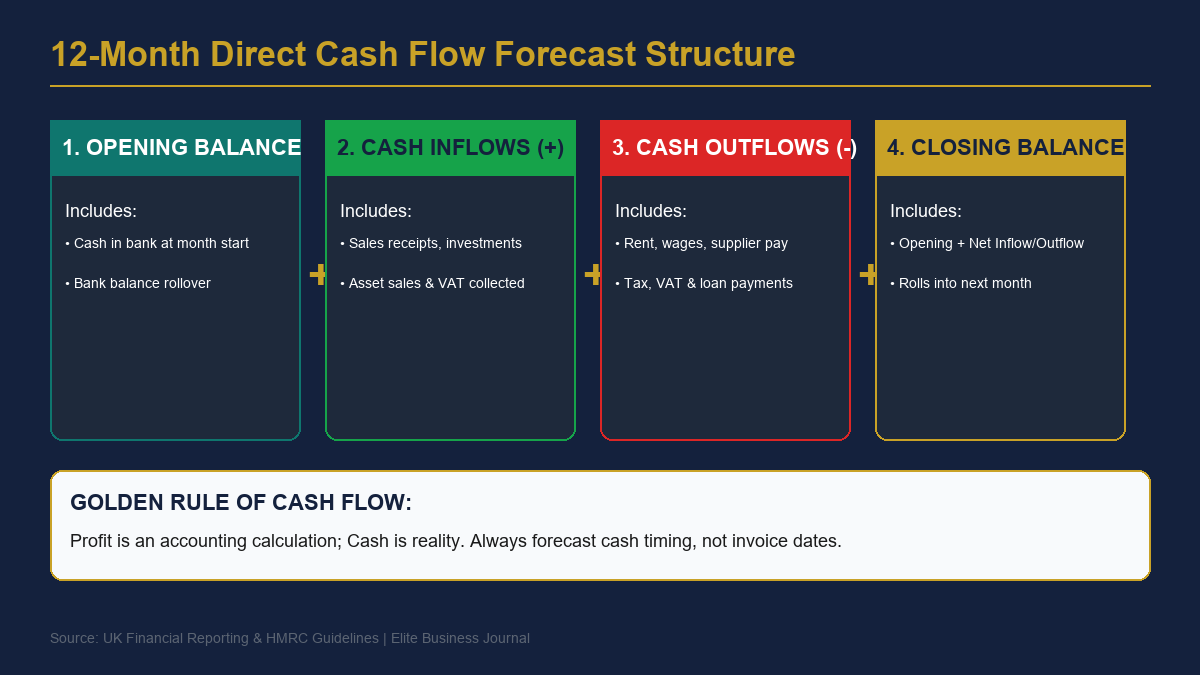
Cash flow forecasting is the process of estimating money flowing into and out of a business over a specific time horizon (typically 12 months). Unlike a Profit & Loss account, a cash flow forecast tracks the exact calendar dates payments are received and settled. To build a robust 12-month forecast, start with your opening bank balance, add projected sales receipts (cash inflows), subtract operational expenses, payroll, and HMRC tax obligations (cash outflows), to determine your monthly closing cash balance. Effective forecasting prevents unexpected insolvencies caused by working capital lag.
Key Takeaways
- According to British Chambers of Commerce insolvency data, over 80% of small business failures stem from poor cash flow timing rather than lack of profitability.
- A 12-month direct cash forecast tracks real cash movement rather than accrual accounting invoice dates.
- Fixed HMRC deadlines (VAT quarters, monthly PAYE/NIC, annual Corporation Tax) must be explicitly built into monthly cash outflow schedules.
- Managing Days Sales Outstanding (DSO) and maintaining a 90-day cash buffer protects against economic volatility.
For UK small business owners, directors, and financial managers, maintaining healthy liquidity is the foundation of operational survival. While generating sales and showing paper profits on a P&L statement demonstrates commercial viability, a company cannot pay staff payroll, rent, or HMRC tax liabilities with uncollected invoices.
According to research from the Insolvency Service and the Institute of Chartered Accountants in England and Wales (ICAEW), cash flow bottlenecks remain the primary cause of small business distress in the UK. Rapid growth, extended customer payment terms, and unexpected tax bills frequently drain cash reserves faster than new revenue arrives.
This comprehensive guide details how to build a 12-month direct cash flow forecast in 2026, manage working capital cycles, schedule HMRC tax liabilities, and protect your business against liquidity shortfalls.
1. Profit vs. Cash Flow: Understanding the Critical Difference
Many first-time founders confuse profitability with cash flow. Understanding the accounting distinction between the two is vital for financial health:
- Profitability (Profit & Loss Account): Calculated on an accrual basis. Revenue is recognized the moment an invoice is raised, and expenses are matched when bills are received — regardless of whether money has changed hands.
- Cash Flow (Cash Flow Statement): Calculated on a cash basis. Tracks only the actual cash movement entering or exiting your business bank account.
For example, if you deliver a £50,000 contract in January on 90-day payment terms, your P&L shows £50,000 profit in January. However, your cash flow forecast reflects £0 cash inflow until April. If you must pay staff wages and supplier bills in February and March, your business faces a critical cash shortfall despite being highly “profitable.”
If you are setting up a new UK business entity to begin trading, review our guide on how to register a company in the UK.
2. How to Build a 12-Month Direct Cash Flow Forecast
A direct cash flow forecast projects cash movements over a rolling 12-month timeline, broken down into monthly (or weekly) columns.
The Core Formula:
Step 1: Record Opening Cash Balance
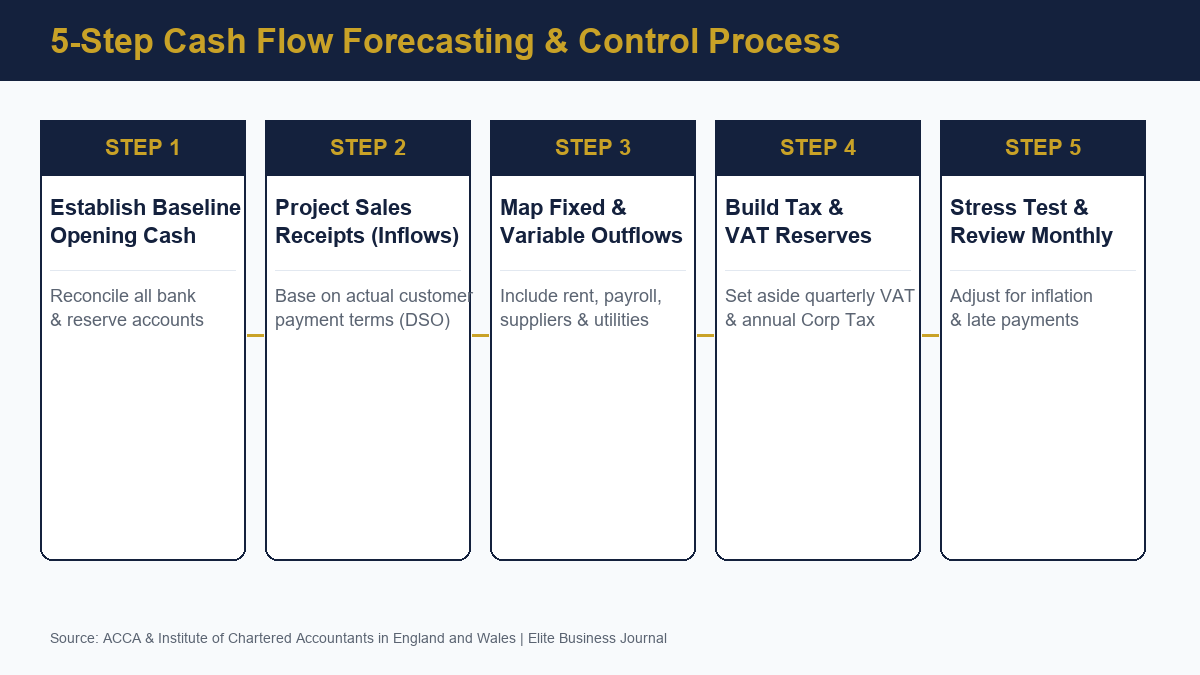
Enter your real-time available cash balance across all current business bank accounts, high-interest reserve accounts, and petty cash funds at the start of Month 1.
Step 2: Project Cash Inflows
Forecast incoming funds based on expected settlement dates rather than sales targets:
- Customer invoice payments (adjusted for customer payment history and credit terms).
- Cash sales and immediate card transactions.
- VAT collected on gross customer invoices.
- Drawdowns from business loans, equity investment, or director loans.
Step 3: Schedule Cash Outflows
List all planned operational disbursements:
- Fixed Overheads: Office rent, software subscriptions, insurance, and utility bills.
- Payroll & Subcontractors: Net staff wages, contractor fees, and pension contributions.
- Supplier Costs: Raw materials, stock inventory, and direct project expenses.
- Tax Payments: PAYE/NIC, VAT quarter settlements, and Corporation Tax.
Step 4: Calculate Closing Cash Balance
Subtract total outflows from total inflows to calculate net monthly cash flow. Add this to your opening balance to establish the closing balance, which automatically becomes the opening balance for Month 2.
Official guidance on business financial planning can be accessed via GOV.UK business finance support.
3. HMRC Tax Payment Calendar (2026/27)
Tax payments represent major, non-negotiable cash outflows that must be strictly scheduled in your 12-month forecast to avoid HMRC interest charges and late payment surcharges.
| Tax Category | HMRC Payment Deadline | Cash Flow Impact Notes |
|---|---|---|
| PAYE & Class 1 NICs | 22nd of each month (electronic) | Monthly outflow. Reflects 15% employer NIC rate and £5,000 threshold. |
| VAT Quarterly Returns | 1 calendar month + 7 days after quarter end | Quarterly spike outflow. Keep VAT collected in a separate reserve account. |
| Corporation Tax | 9 months + 1 day after accounting year end | Annual lump sum (19% to 25% profit rate). Requires ongoing monthly provisioning. |
| Self Assessment Tax | 31 January & 31 July (Payments on Account) | Applies to sole traders and directors paying personal dividend tax. |
For full details on calculating payroll tax liabilities, see our analysis of employer national insurance contributions 2026 rates.
4. Strategies to Improve Working Capital
If your 12-month cash forecast reveals negative cash dips, implement these practical working capital management strategies:
1. Reduce Days Sales Outstanding (DSO)
- Issue invoices immediately upon product dispatch or project milestone completion.
- Offer small early-payment discounts (e.g., 2% for payment within 7 days).
- Enforce strict credit control procedures and automatic payment reminder workflows.
2. Optimize Supplier Payment Terms
- Negotiate 30-day or 60-day credit terms with reliable suppliers.
- Align major supplier payment dates with your peak monthly customer receipt windows.
3. Maintain a 90-Day Cash Reserve
Aim to build a cash reserve equivalent to 3 months of essential fixed operating expenses (rent, payroll, utilities) stored in a high-yield business savings account.
For business owners considering real estate asset holdings to build corporate wealth, read our guide on limited company mortgages in the UK.
5. Frequently Asked Questions
What is the difference between direct and indirect cash flow forecasting?
Direct forecasting tracks specific individual cash receipts and payments coming in and going out of the business bank account (ideal for short-to-medium term 12-month planning). Indirect forecasting starts with net profit from the P&L and adjusts for non-cash items like depreciation (used primarily for long-term strategic financial modeling).
How often should a small business update its cash flow forecast?
A 12-month cash flow forecast should be updated at least once a month with actual bank balances and revised revenue expectations. Fast-growing or cash-constrained businesses should review their forecast weekly.
What accounting software is best for cash flow forecasting in the UK?
Cloud accounting platforms such as Xero, QuickBooks, and FreeAgent offer built-in cash flow reporting. Dedicated forecasting tools like Float, Futrli, and Fathom connect directly to your accounting ledger for automated rolling scenario modeling.
Your Next Actions
- Export Bank Transactions: Download 6 to 12 months of historical bank data to identify recurring operational expense patterns.
- Build Your 12-Month Spreadsheet: Set up monthly columns listing opening cash, categorized inflows, outflows, and closing cash balances.
- Schedule Tax Liabilities: Map exact VAT, PAYE/NIC, and Corporation Tax payment dates into your outflow rows.
- Explore Tools & Calculators: Use our resources in the Business Tools Hub to optimize your financial planning.
Editorial Team & Signature
Written by Oliver Carpenter, Founder & Editor-in-Chief at Elite Business Journal. Published August 2026.