Quick Answer: How to Find Angel Investors in the UK 2026
To find business angel investors in the UK, founders should leverage accredited angel networks affiliated with the UK Business Angels Association (UKBAA), specialized syndicates, and angel platforms like Angel Investment Network and SeedBlink. Angel investors typically invest between £10,000 and £100,000 individually, or up to £500,000 to £1,000,000 as syndicates, in exchange for 10% to 25% equity. Securing investment requires obtaining SEIS (50% tax relief up to £250k) or EIS (30% tax relief up to £1m) Advance Assurance from HMRC, presenting a validated pitch deck with clear unit economics, and executing a standard British Private Equity & Venture Capital Association (BVCA) compliant term sheet.
Key Takeaways
- The UKBAA network represents over 590 member organizations deploying £2.3 billion annually into early-stage British enterprises.
- Securing HMRC SEIS or EIS Advance Assurance is mandatory for attracting high-net-worth UK angels seeking 30% to 50% income tax relief.
- Early-stage founders should avoid giving away more than 15% to 20% equity in an angel round to preserve clean cap table headroom for Series A.
- Term sheets must clearly balance pre-money valuation against investor governance rights, including liquidation preferences and pre-emption rights.
According to annual market reports published by the UK Business Angels Association (UKBAA), business angels represent the single largest source of early-stage risk capital in the United Kingdom, investing over £2.3 billion annually into innovative scaleups across tech, healthcare, clean energy, and manufacturing.
For early-stage entrepreneurs, raising angel investment provides far more than capital. Experienced angel investors contribute sector-specific domain expertise, operational mentoring, executive hiring networks, and follow-on venture capital introductions. However, navigating the UK angel ecosystem requires structured preparation, understanding investor tax psychology, and mastering term sheet negotiation.
According to startup funding guidance from the British Business Bank Angel Finance Hub, prepared founders who secure tax advance assurance and articulate clear customer traction close angel funding rounds in half the time of unassisted peers.
This comprehensive guide details the practical roadmap for finding business angel investors in the UK, structuring SEIS/EIS tax incentives, calculating pre-money valuations, and negotiating term sheet clauses.
1. Where to Find UK Business Angel Investors & Syndicates
Connecting with angel investors requires engaging through established institutional syndicates and accredited regional angel networks:
1. Top UK Angel Networks & Syndicates
- UKBAA Directory: The national trade body’s member directory connects founders to over 590 angel groups, family offices, and early-stage funds across England, Scotland, Wales, and Northern Ireland.
- Regional Angel Hubs: Leading regional syndicates include Archangels (Scotland), NorthInvest (Northern England), Minerva Angels (Midlands), and Cambridge Angels (East of England).
- Sector-Specific Syndicates: Specialist networks such as Green Angel Syndicate (climate tech) and 24Haymarket (B2B SaaS and healthcare).
- Digital Angel Platforms: Platforms like Angel Investment Network, SeedBlink, and SeedLegals provide direct access to verified high-net-worth individuals actively deploying capital.
For founders evaluating broader funding options alongside equity investment, review our guide to business expansion loans in the UK.
2. Tax Relief Power: SEIS & EIS (HMRC Advance Assurance)
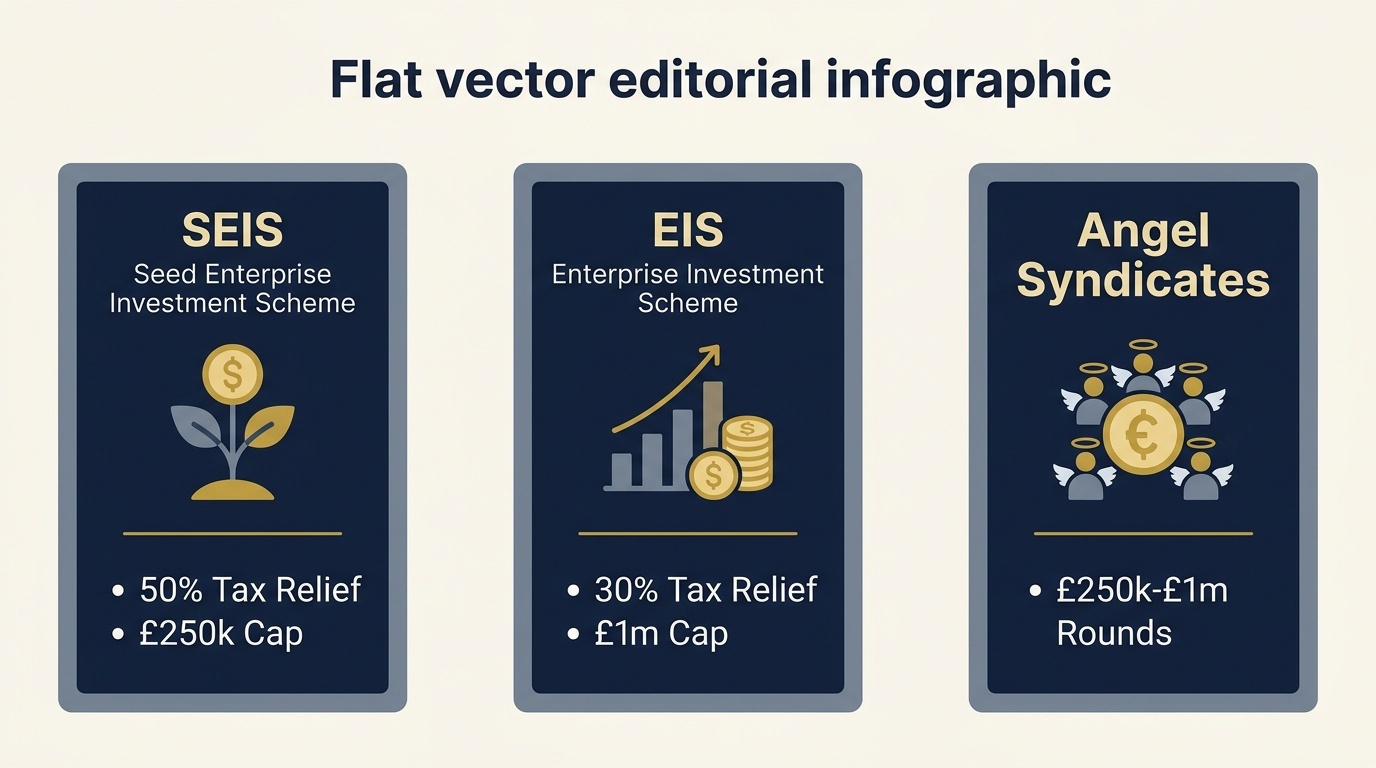
In the UK, over 85% of angel investments are driven by government tax-incentivized venture schemes. Offering eligible shares significantly de-risks early-stage investment for high-net-worth individuals:
| Scheme Feature | Seed Enterprise Investment Scheme (SEIS) | Enterprise Investment Scheme (EIS) |
|---|---|---|
| Investor Income Tax Relief | 50% of investment amount | 30% of investment amount |
| Company Fundraising Limit | Up to £250,000 maximum | Up to £5,000,000 per year (£12m lifetime) |
| Company Age & Asset Limits | Trading under 3 years; gross assets < £350k | Trading under 7 years; gross assets < £15m |
| Capital Gains Tax (CGT) | 100% CGT exemption on growth after 3 years | 100% CGT exemption on growth after 3 years |
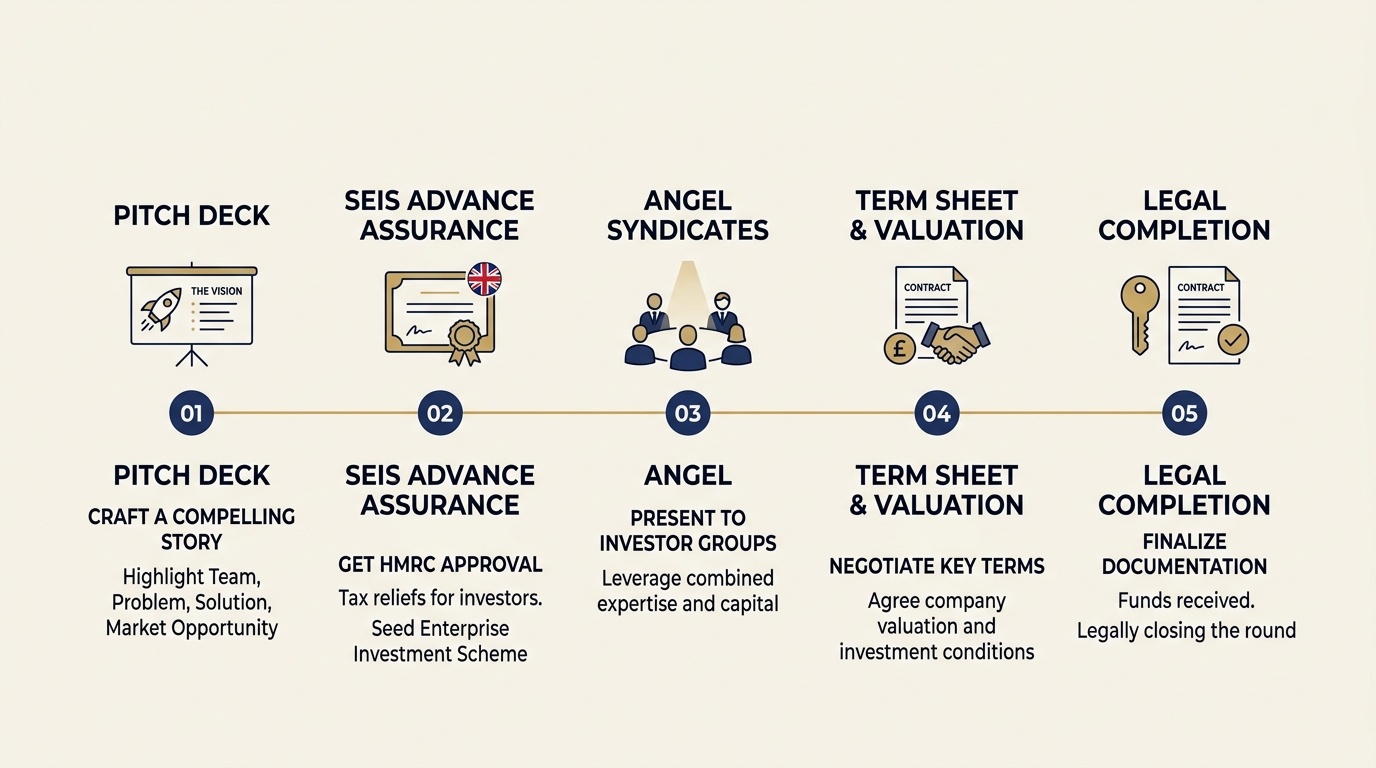
Before pitching angel investors, founders must apply for HMRC Advance Assurance to prove eligibility. Read our comprehensive analysis on qualifying criteria in our SEIS vs EIS UK guide.
3. Pre-Money vs. Post-Money Valuation Math
Understanding valuation mathematics is essential for negotiating term sheets without suffering excessive equity dilution:
Pre-Money Valuation + New Investment Capital = Post-Money Valuation
Investor Equity Percentage
Investment Amount ÷ Post-Money Valuation = Equity Stake (%)
Practical Valuation Example:
If you raise £250,000 at a £1,000,000 pre-money valuation:
- Post-Money Valuation: £1,000,000 + £250,000 = £1,250,000.
- Angel Equity Ownership: £250,000 ÷ £1,250,000 = 20.0%.
- Founder Retention: 80.0% across existing shareholders.
For founder-directors structuring initial cap table equity alongside dividend remuneration, read our guide on the optimal salary and dividend split for UK directors.
4. Key Term Sheet Clauses to Negotiate
When an angel syndicate issues a term sheet (heads of terms), pay close attention to governance and exit control provisions:
- Liquidation Preference: Standard UK angel terms require a 1x non-participating liquidation preference, ensuring investors recover their initial capital before ordinary shareholders in a downside exit. Avoid “participating” preference clauses.
- Board Representation & Observer Rights: Lead angel investors contributing £100k+ often request a seat on the board of directors or formal observer rights to attend quarterly meetings.
- Pre-emption Rights: Grants angels the contractual right to participate pro-rata in future funding rounds to prevent involuntary equity dilution.
- Drag-Along and Tag-Along Provisions: Protects minority investors during an acquisition (tag-along) while ensuring a majority acquisition cannot be blocked by small shareholders (drag-along).
If your startup employs staff or key technical executives, ensure compliant employment agreements are in place by following our guide on employment contracts in the UK.
5. Frequently Asked Questions
How much equity should I give away in an angel round?
Market standard for UK angel rounds is between 10% and 20% equity. Giving away more than 25% at the pre-seed or seed stage creates cap table issues for future institutional Series A venture capital investors.
Do business angels sign Non-Disclosure Agreements (NDAs)?
No. Professional UK business angels and venture syndicates review hundreds of pitch decks monthly and almost never sign NDAs. Focus on sharing commercial traction and market metrics while keeping proprietary source code or confidential IP internal.
Your Next Actions
- Apply for SEIS/EIS Advance Assurance: Submit your business plan, pitch deck, and financial model to HMRC before engaging investors.
- Build a 12-Slide Pitch Deck: Highlight the problem, your solution, customer traction, unit economics, and team background.
- Engage UKBAA Syndicates: Identify angel networks aligned with your industry vertical and geographic region.
- Explore Tools: Use resources in our Business Tools Hub.
Editorial Team & Signature
Written by Oliver Carpenter, Founder & Editor-in-Chief at Elite Business Journal. Published August 2026.