
According to commercial fleet market intelligence from the British Vehicle Rental and Leasing Association (BVRLA), over 4.5 million commercial vehicles and corporate lease cars currently operate across UK roadways, with commercial vehicle leasing volumes expanding by 8.4% as British enterprises actively preserve working capital. Simultaneously, recent commercial registration data from the Society of Motor Manufacturers and Traders (SMMT) confirms that light commercial vehicles (LCVs) and fleet-procured electric models represent the fastest-growing sector of corporate asset expenditure across England, Scotland, and Wales.
For UK limited company directors, fleet managers, and sole traders, acquiring vehicles through cash reserves ties up substantial liquid reserves that could otherwise fund commercial expansion, inventory, or payroll. Choosing the optimal structure for business vehicle finance is no longer just an operational decision—it is a critical tax optimization strategy. The choice between leasing, hire purchase, and contract hire dictates how much VAT your business can reclaim, how rapidly you can offset depreciation against Corporation Tax profits, and the extent of personal Benefit-in-Kind (BiK) liability incurred by your directors and staff.
Quick Answer: What Is Business Vehicle Finance?
Business vehicle finance encompasses a spectrum of commercial lending agreements used by UK enterprises to acquire company cars, commercial vans, and heavy goods vehicles (HGVs) without upfront capital expenditure. The three dominant structures are Business Contract Hire (BCH), where a business leases the vehicle over 24 to 48 months with zero ownership risk; Hire Purchase (HP), where the business pays monthly installments toward ultimate ownership and claims 100% Annual Investment Allowance (AIA) or Full Expensing upfront on commercial vans; and Finance Lease, where the business handles asset residual value and equity proceeds upon sale. Tax treatment varies sharply between commercial goods vehicles (which qualify for 100% VAT reclaim and £4,020 flat-rate van BiK) and passenger cars (subject to a 50% VAT lease restriction and emissions-based P11D BiK).
Key Takeaways for UK Fleet Operators & Directors
- Van vs Car Tax Divide: Commercial vans qualify for 100% VAT reclamation, 100% Annual Investment Allowance (AIA) or Full Expensing, and a low flat-rate BiK charge (£4,020 in 2025/26 and 2026/27).
- Double-Cab Pick-up Reform: Following HMRC’s landmark April 2025 reclassification, double-cab pick-ups with a 1-tonne payload are now classified as passenger cars for capital allowances and BiK calculations.
- VAT Reclamation Rules: Leased company cars face a statutory 50% VAT block on finance payments if used for any private travel, but 100% of VAT is reclaimable on fleet maintenance packages.
- Cash Flow Preservation: Business Contract Hire (BCH) provides predictable fixed monthly budgeting with zero residual depreciation risk, whereas Hire Purchase builds tangible equity on the corporate balance sheet.
- Electric Fleet Incentives: Brand-new zero-emission electric vehicles (0 g/km CO2) unlock 100% First-Year Allowance (FYA) corporation tax relief and hyper-low BiK rates (3% in 2025/26, 4% in 2026/27).
Core Financing Structures: Comparing BCH, HP, Finance Lease, and BCP
Selecting the right vehicle finance agreement requires balancing monthly cash outflow, asset ownership ambitions, balance sheet treatment, and maintenance responsibility. Independent fleet governance standards established under the BVRLA commercial fleet guidance framework govern ethical lending and fair wear-and-tear standards across the UK.
For a broader analysis of how commercial asset acquisition integrates with broader debt structuring, read our comprehensive guide on business asset finance in the UK.
HMRC Tax Rules: Commercial Vans vs. Company Cars
The financial viability of any vehicle finance package depends heavily on how HMRC categorizes the vehicle. Official rules detailed in the HMRC business vehicle capital allowances manual establish strict operational distinctions between “goods vehicles” (vans) and “passenger cars”.
1. Capital Allowances & Corporation Tax Relief
When an incorporated UK business acquires a vehicle through Hire Purchase or outright capital funds, the tax relief mechanism differs fundamentally:
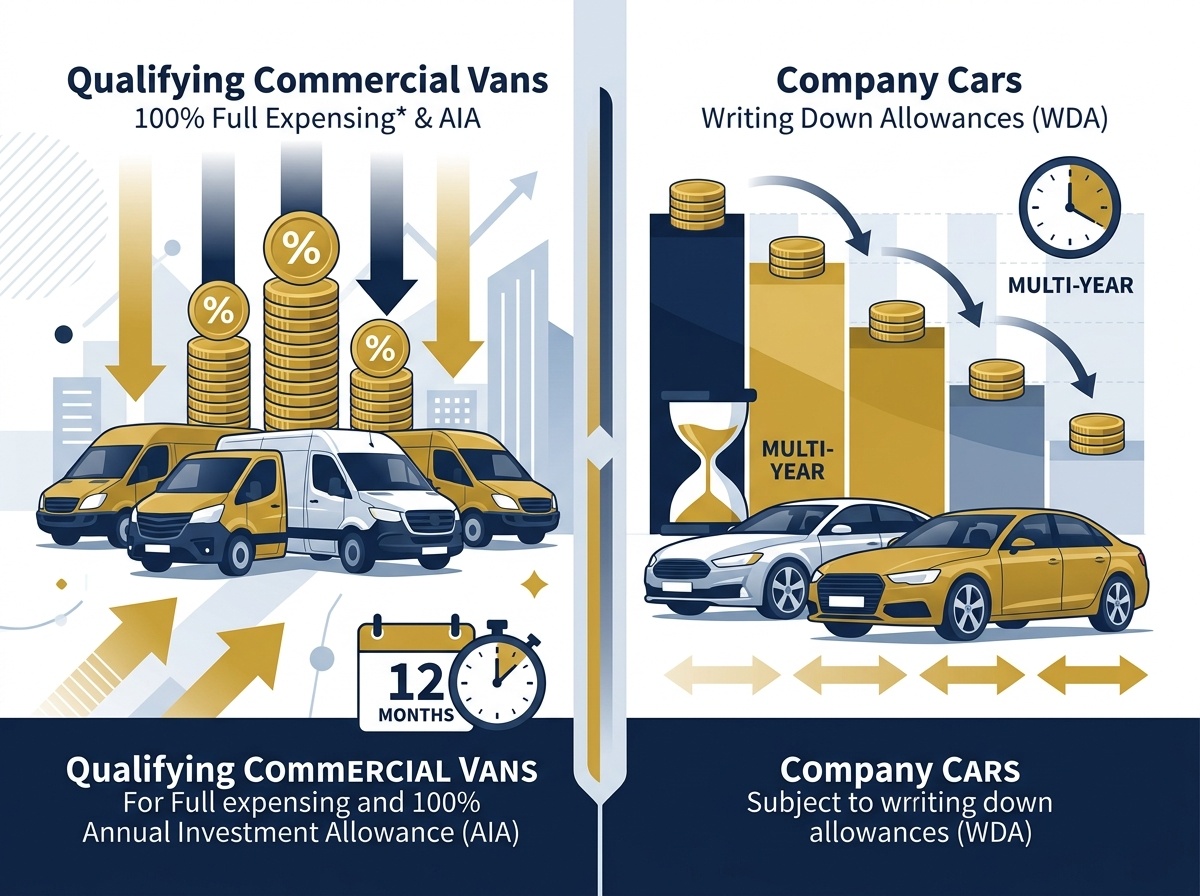
- Commercial Vans (Goods Vehicles): Classified as plant and machinery under UK tax law. Limited companies can claim the Annual Investment Allowance (AIA), writing off 100% of the vehicle’s purchase price against trading profits in Year 1 (up to the statutory £1,000,000 annual threshold). Alternatively, companies can use Full Expensing for brand-new, unused commercial vans for an uncapped 100% first-year tax deduction.
- Electric Company Cars (0 g/km CO2): Brand-new zero-emission electric passenger cars qualify for a 100% First-Year Allowance (FYA), enabling a full 100% write-off in the year of purchase.
- Combustion & Hybrid Cars (1–50 g/km CO2): Do not qualify for AIA or Full Expensing. They enter the main rate capital allowances pool, written down at 14% per annum on a reducing-balance basis.
- High-Emission Cars (>50 g/km CO2): Enter the special rate capital allowances pool, written down at just 6% per annum, severely deferring tax relief over many years.
2. The Double-Cab Pick-up (DCPU) Reclassification Shock
Historically, UK businesses heavily favored double-cab pick-up trucks (such as the Ford Ranger, Toyota Hilux, and Isuzu D-Max) because HMRC treated any pick-up with a payload capacity exceeding 1,000kg (1 tonne) as a commercial goods vehicle. This unlocked 100% AIA tax deductions and flat-rate van BiK.
Following updated HMRC guidelines effective from April 2025, most double-cab pick-ups are now categorized as passenger cars. Unless your vehicle falls under grandfathered transitional provisions (agreements entered into prior to April 2025), newly acquired DCPUs are assessed based on CO2 emissions, triggering steep Benefit-in-Kind tax liabilities and eliminating 100% AIA write-offs.
VAT Reclamation Rules: Navigating HMRC Compliance
VAT-registered businesses can achieve substantial operational savings through vehicle finance, but errors in VAT reclamation represent one of the most frequent triggers for HMRC compliance audits.
The 50% Lease VAT Rule Explained: HMRC recognizes that almost all leased company cars are occasionally used for private journeys (including ordinary commuting). Rather than requiring intricate mileage logging, HMRC applies an automatic 50% block on the finance element of the lease. However, any separate fee for vehicle maintenance, tyre replacement, and servicing is classified as a service supply, allowing 100% of the VAT on maintenance to be reclaimed.
Benefit-in-Kind (BiK) Tax: Calculating Employee and Employer Costs
When a director or employee uses a company-financed vehicle for personal travel, HMRC treats this perk as a taxable Benefit-in-Kind. The tax consequences differ dramatically based on whether you finance a commercial van or a passenger car.
1. Commercial Van BiK (The Flat-Rate Advantage)
If an employee has access to a company van and uses it for personal journeys beyond “ordinary commuting and insignificant private use” (such as picking up milk on the way home or driving to a trade merchant), a standardized flat-rate benefit applies:
- Van Benefit Charge: £4,020 per tax year (for 2025/26 and 2026/27).
- Van Fuel Benefit Charge: £769 per tax year (if the employer pays for private fuel).
- Zero-Emission Electric Vans: Attract a £0 BiK charge, making electric commercial vans 100% tax-free perks for employees!
For a basic-rate (20%) taxpayer, a standard diesel van BiK costs just £804 per year (£67/month). For a higher-rate (40%) taxpayer, the liability is £1,608 per year (£134/month).
2. Company Car BiK (Emissions-Based Calculation)
Company car BiK is calculated by multiplying the vehicle’s P11D manufacturer list price (including VAT and optional extras) by a percentage determined by its certified WLTP CO2 emissions:
- Pure Electric Vehicles (EVs – 0 g/km): 3% BiK in 2025/26, 4% BiK in 2026/27, and 5% BiK in 2027/28.
- Plug-in Hybrids (PHEVs – 1–50 g/km): 5% to 14% BiK depending on electric-only driving range.
- Standard Petrol / Diesel Cars: Ranging from 20% to the statutory ceiling of 37% BiK.
Example: A £45,000 executive diesel car emitting 140 g/km CO2 triggers a 33% BiK bracket. The taxable benefit is £14,850 per year. A 40% taxpayer pays £5,940 annually (£495/month) in income tax for the privilege. Conversely, a £45,000 pure electric car in 2026/27 at 4% BiK results in a taxable benefit of just £1,800, costing the same higher-rate director just £720 per year (£60/month)—an annual tax saving of over £5,200.
Real-World Financial Model: 36-Month Commercial Van Comparison
To demonstrate the real financial impact of financing structures, examine the following worked financial model for a UK electrical contractor financing a brand-new £32,000 + VAT (£38,400 gross) commercial transit van over a 36-month term with an assumed annual mileage of 15,000 miles:
Strategic Insight: While Hire Purchase delivers a slightly lower net true cost due to retained used vehicle equity (£13,900 vs £14,400), Business Contract Hire requires less than one-third of the initial cash outlay (£2,880 vs £9,600). For cash-constrained firms prioritizing liquidity, BCH preserves over £6,700 of crucial working capital at inception.
For businesses seeking complementary working capital solutions to fund initial fleet deposits, our companion analysis on business invoice factoring rates in the UK demonstrates how to release trapped cash flow from unpaid customer invoices.
Commercial Lending Criteria: How to Secure Approval
Underwriting standards for vehicle finance are overseen by the Financial Conduct Authority (FCA) and commercial asset finance lenders accredited by the British Business Bank asset finance portal. Commercial lenders evaluate four primary risk parameters:
- Trading History & Accounts: Established limited companies typically need to show a minimum of 12 to 24 months of filed accounts on Companies House demonstrating operating profitability. New startups (under 12 months) can still qualify but often require director personal guarantees or higher initial deposits (typically 6 to 9 months upfront).
- Corporate Credit Profile: Funders examine commercial credit scores via agencies like Creditsafe or Experian Commercial. Clean payment histories with trade suppliers and absence of County Court Judgments (CCJs) ensure access to prime tier-1 interest margins.
- Affordability & Debt Service: Lenders assess whether monthly vehicle payments fit comfortably within operating cash flow, typically requesting 3 months of corporate bank statements via Open Banking integrations.
- Fleet Fit & Operational Rationale: The vehicle type must match your trade. A construction company financing commercial tipper vans faces minimal underwriting friction; however, financing luxury sports vehicles through a general trade business will invite rigorous scrutiny regarding genuine commercial necessity.
Frequently Asked Questions (FAQ)
Can a brand-new UK business qualify for vehicle leasing?
Yes. Many independent commercial vehicle brokers and specialist funders provide facilities for newly incorporated businesses. However, because new ventures lack a proven Companies House filing history, funders typically require the majority shareholder or director to sign a personal guarantee (PG) and provide 3 to 6 months of personal bank statements, alongside an initial rental deposit of 3 to 9 months.
What happens if my leased business vehicle exceeds its contract mileage?
Under a Business Contract Hire agreement, you agree to an annual mileage limit (typically 10,000 to 25,000 miles per annum). If you exceed this total upon returning the vehicle, the funder levies an excess mileage charge ranging from 6p to 18p per mile depending on the vehicle class. If your business anticipates fluctuating mileage, a Finance Lease is often preferable because it eliminates strict contractual mileage caps.
Can sole traders claim 100% Annual Investment Allowance on a commercial van?
Yes, but with an important restriction: sole traders and partners can claim AIA on commercial vans, but the tax relief must be reduced proportionately to reflect any personal, non-business use. For instance, if an electrician uses their van 80% for commercial jobs and 20% for personal weekend trips, they can claim 80% of the purchase price under AIA against their Self Assessment profits.
Is maintenance included in business vehicle finance agreements?
Standard vehicle finance agreements do not automatically include maintenance. However, most leasing companies offer an optional funder-maintained package for a fixed additional monthly fee. This bundles routine servicing, MOT testing, mechanical repairs, replacement tyres, and 24/7 breakdown recovery. VAT-registered businesses can reclaim 100% of the VAT charged on maintenance contracts, even on company passenger cars.
What is the difference between finance lease and hire purchase?
Under Hire Purchase, your business intends to own the vehicle permanently, paying an option-to-purchase fee at the end of the term. Under a Finance Lease, your business never formally takes title ownership; at the end of the term, the vehicle is sold to an unconnected third party, with your business retaining the vast majority (typically 95% to 98%) of the net sale proceeds.
Can I write off 100% of my monthly lease payments against Corporation Tax?
For commercial vans and passenger cars emitting 50 g/km CO2 or less, yes: 100% of the monthly lease payments are deductible as allowable business expenses. However, for leased cars emitting more than 50 g/km CO2, HMRC enforces a statutory 15% lease rental restriction, meaning your business can only deduct 85% of the monthly rental payments against taxable profits.
Strategic Fleet Financing for UK Enterprises
Navigating business vehicle finance requires looking beyond the headline monthly payment to understand the complete after-tax cost of acquisition. For enterprises prioritizing cash flow preservation and minimal administrative overhead, Business Contract Hire combined with electric fleet adoption delivers unparalleled tax efficiency, predictable budgeting, and insulation against used vehicle price volatility.
Conversely, for trade contractors and high-mileage operators seeking long-term balance sheet strength, Hire Purchase on commercial vans maximizes upfront Corporation Tax relief through 100% Annual Investment Allowances while building tangible company equity. By consulting with your accountant, analyzing your VAT status, and auditing vehicle emissions, your management team can implement a fleet finance strategy that actively drives commercial profitability.