Quick Answer: Employer National Insurance Contributions 2026
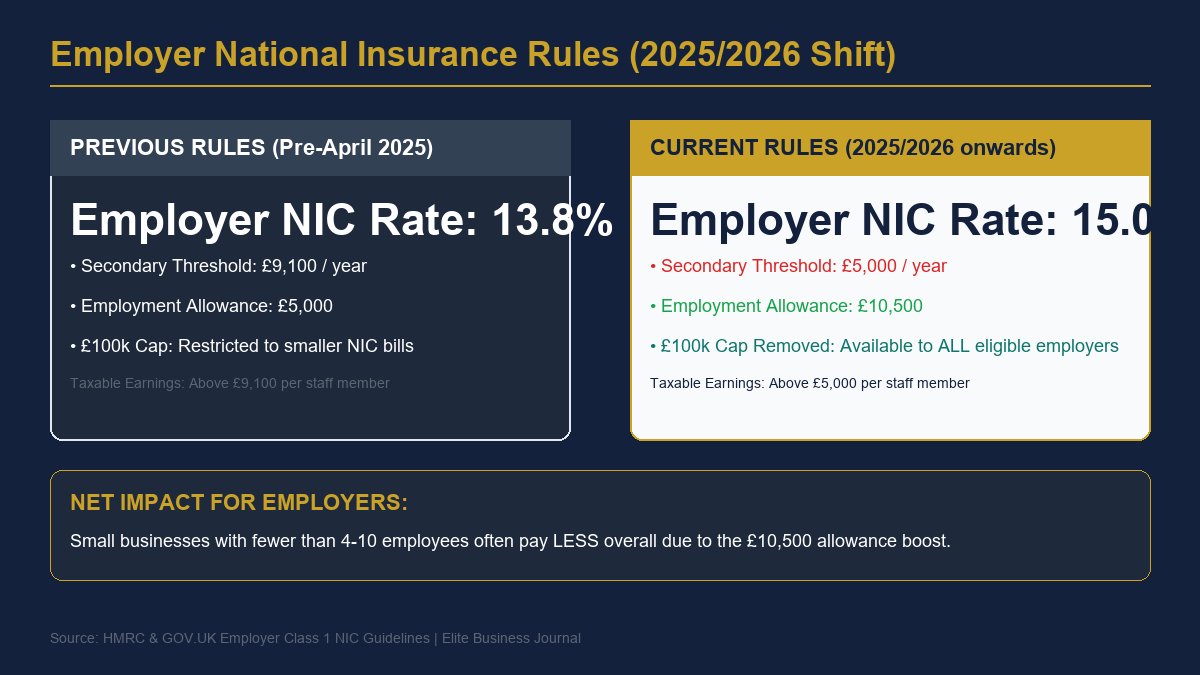
The Employer Class 1 National Insurance rate is 15% (up from 13.8%), and the Secondary Threshold at which employers start paying NIC is £5,000 per year (£96.15 per week / £416.67 per month). However, the Employment Allowance has been increased to £10,500 per year (up from £5,000) and the previous £100,000 prior-year liability cap was completely removed. This means small businesses employing up to 4 full-time staff members earning £25,000 can offset their entire employer NIC bill using the increased allowance.
Key Takeaways
- The main Employer NIC rate increased from 13.8% to 15.0%, adding 1.2 percentage points to secondary Class 1 contributions.
- The Secondary Threshold was slashed from £9,100 to £5,000 per year, bringing an extra £4,100 of gross salary into the employer NIC net per employee.
- The Employment Allowance rose from £5,000 to £10,500, shielding micro-businesses and small employers from net cost increases.
- Single-director companies with no other employees earning above £5,000 remain strictly excluded from claiming Employment Allowance.
For UK business directors, payroll managers, and financial officers, managing payroll costs represents one of the largest ongoing operational commitments. Following major fiscal policy changes enacted by HMRC, the landscape for Employer National Insurance Contributions (NIC) underwent its most significant structural shift in over a decade.
According to figures from HM Revenue & Customs (HMRC) and official Treasury economic forecasts, the combined effect of raising the Employer Class 1 NIC rate and lowering the Secondary Threshold generates over £25 billion annually for public finances. However, the concurrent expansion of the Employment Allowance creates a stark divergence: while medium and large employers face noticeable cost increases, micro-employers and small business startups often experience reduced net payroll liabilities.
This comprehensive guide breaks down the exact 2026 Employer NIC rates, threshold calculations across salary tiers, Employment Allowance eligibility rules, and practical tax planning strategies for limited company directors.
1. What Are Employer National Insurance Contributions?
Employer National Insurance Contributions — officially classified as Secondary Class 1 NICs — are a mandatory tax paid by UK employers on the earnings of their employees. Unlike Employee Primary Class 1 NICs (which are deducted directly from worker pay packets), Employer NICs are paid directly by the business on top of gross wages and salaries.
Employer NICs apply to almost all forms of direct employee remuneration, including:
- Gross basic salaries and hourly wages.
- Overtime payments, commission, and performance bonuses.
- Statutory pay elements (such as Statutory Sick Pay or Statutory Maternity Pay) above statutory thresholds.
- Benefits in kind (which are assessed under Class 1A NICs at the same 15% rate).
If you are setting up a new UK business entity to onboard staff, review our step-by-step guide on how to register a company in the UK.
2. Employer NIC Rates & Thresholds (2026)
To accurately calculate payroll liabilities, employers must understand the key statutory thresholds set by HMRC:
| National Insurance Threshold | Weekly Limit | Monthly Limit | Annual Limit | Employer Rate |
|---|---|---|---|---|
| Secondary Threshold (ST) | £96.15 | £416.67 | £5,000.00 | 15.0% |
| Veterans Upper Secondary Threshold | £967.00 | £4,189.00 | £50,270.00 | 0.0% (Up to limit) |
| Apprentice Upper Secondary (Under 25) | £967.00 | £4,189.00 | £50,270.00 | 0.0% (Up to limit) |
| Freeport / Investment Zone Threshold | £481.00 | £2,083.00 | £25,000.00 | 0.0% (Up to limit) |
Official employer rate details can be cross-checked directly via GOV.UK National Insurance rates guidance.
3. Cost Impact Across Employee Salary Tiers
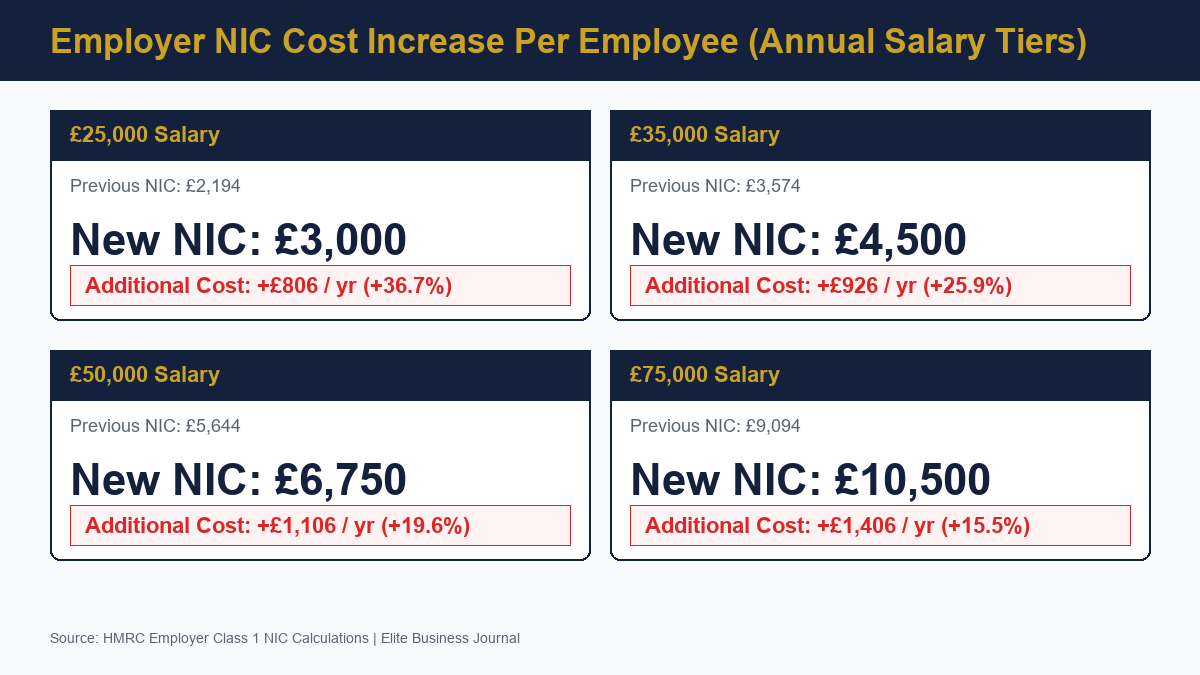
Lowering the Secondary Threshold to £5,000 and raising the rate to 15% significantly increases the baseline cost for each non-exempt employee.
Formula for Calculating Employer NICs:
Worked Example:
For an employee earning a gross salary of £35,000 per year:
- Deduct the Secondary Threshold: £35,000 – £5,000 = £30,000 taxable earnings.
- Apply the 15% rate: £30,000 × 15% = £4,500 annual Employer NIC.
- Under pre-2025 rules (£35,000 – £9,100 = £25,900 × 13.8%), the bill was £3,574.20.
- Net increase per employee at £35,000: +£925.80 per year (+25.9%).
4. The £10,500 Employment Allowance: Who Qualifies?
To shield smaller employers from rising payroll overheads, the Employment Allowance was increased to £10,500 per tax year.
Key Changes to Employment Allowance:
- Higher Credit: Allows eligible businesses to reduce their total Class 1 secondary NIC liability by up to £10,500 each year.
- Removal of £100k Threshold: Previously, businesses with prior-year secondary NIC liabilities over £100,000 could not claim. This restriction was permanently abolished, expanding eligibility to larger firms.
Who CAN Claim:
- Businesses and charities with 2 or more employees (or director + 1 employee) earning above the £5,000 Secondary Threshold.
- Care and support workers employed by individuals.
Who CANNOT Claim:
- Single-Director Companies: Limited companies where the director is the only employee paid above the Secondary Threshold.
- Public sector bodies and local authorities.
- Personal service companies (PSCs) operating inside IR35.
For single-director limited company owners evaluating the impact of these rules on director remuneration, read our guide to the optimal salary and dividend split for UK directors.
5. Strategic Payroll & Tax Planning for Employers
UK business owners can implement several legitimate tax planning strategies to mitigate the impact of increased Employer NICs:
1. Salary Sacrifice Schemes
Structuring employee benefits through HMRC-approved salary sacrifice arrangements (such as workplace pension contributions, electric company cars, or cycle-to-work schemes) reduces gross salary. Because Employer NIC is charged on gross wages, every £1,000 sacrificed into a pension saves the employer £150 in NIC.
2. Utilising Youth & Veteran Reliefs
Employers pay 0% Employer NIC on earnings up to £50,270 for:
- Apprentices aged under 25 following an approved framework.
- Employees under the age of 21.
- Qualifying armed forces veterans in their first year of civilian employment.
3. Managing Redundancy & Termination Costs
When conducting organisational restructuring, remember that statutory redundancy payments up to £30,000 are completely exempt from Employer NICs. For complete rules, see our guide on statutory redundancy pay UK rates and compliance.
6. Frequently Asked Questions
Does Employer NIC apply to dividend payments?
No. Dividends paid to company shareholders are subject to Dividend Tax via Self Assessment, but they do not attract any Primary or Secondary Class 1 National Insurance Contributions.
How do I claim the £10,500 Employment Allowance?
You claim the Employment Allowance through your payroll software by submitting an Employer Payment Summary (EPS) to HMRC. The allowance is automatically applied against your monthly PAYE/NIC liability until the £10,500 credit is fully utilised.
Are director salaries subject to the £5,000 Secondary Threshold?
Yes. Director Class 1 NICs are calculated using an annual cumulative threshold of £5,000 (rather than pay-period non-cumulative rules applied to regular employees), ensuring equal treatment over the full tax year.
Your Next Actions
- Audit Payroll Liabilities: Recalculate your annual employer NIC overhead using the 15% rate and £5,000 Secondary Threshold across all employee salary bands.
- Claim Employment Allowance via EPS: Ensure your payroll software submits an updated EPS claim to claim your £10,500 annual allowance.
- Explore Salary Sacrifice Pensions: Assess whether introducing pension salary sacrifice could lower gross payroll liabilities while boosting staff retirement funds.
- Review Director Tax Strategy: Consult your accountant or review our Business Tools Hub to optimise your director remuneration structure.
Editorial Team & Signature
Written by Oliver Carpenter, Founder & Editor-in-Chief at Elite Business Journal. Published August 2026.