
Official records from HM Revenue and Customs confirm that more than 2.7 million British savers face unexpected tax demands on their cash reserves this year. This represents a dramatic fourfold surge from the 650,000 individuals taxed when the Bank of England base rate sat at historic lows. A decade of frozen tax allowances combined with prevailing bank interest rates has created an aggressive fiscal drag trap. Millions of ordinary depositors, self-employed contractors, and limited company directors who never considered themselves wealthy are suddenly receiving tax bills on routine bank deposits.
Public scrutiny escalated sharply following reports that Chancellor Rachel Reeves approved intensified enforcement measures targeting unearned income and wealth assets. This complete authority guide examines the tax crackdown on savings accounts, explaining how HMRC automated data systems track bank interest, which specific savings thresholds trigger tax bills, how HM Treasury policies impact your cash, and the legitimate statutory shelters available to protect your accumulated capital.
Quick Answer: Why Is HMRC Cracking Down on Savings Accounts?
The UK tax crackdown on savings accounts stems from a collision between relatively high cash interest rates (4% to 5%) and the Personal Savings Allowance (PSA), which has remained frozen since 2016 at £1,000 for basic rate taxpayers, £500 for higher rate taxpayers, and £0 for additional rate taxpayers. High street banks automatically transmit annual interest records directly to HMRC through the Bank and Building Society Interest (BBSI) reporting system. HMRC matches this data against taxpayer records using its Connect digital platform, automatically clawing back unpaid tax by reducing PAYE tax codes, issuing P800 tax calculations, or requiring formal Self Assessment filings.
Key Takeaways for UK Savers and Business Owners
- Frozen allowances cause stealth taxation: A higher rate (40%) taxpayer holding just £10,500 in an account paying 4.8% interest will exceed their £500 allowance and owe tax.
- Automated data sharing leaves no blind spots: UK financial institutions report all savings interest directly to HMRC annually under statutory data exchange rules.
- Upcoming National Insurance reporting: From April 2027, banks must collect and link customer National Insurance numbers to interest feeds to automate tax deduction.
- Cash ISAs remain 100% tax-free: Moving money into an Individual Savings Account shields up to £20,000 per tax year completely from income tax and capital gains.
- Directors face dual tax exposure: Company cash reserves earn interest subject to Corporation Tax (up to 25%), while personal withdrawals face dividend and personal savings tax.
The Anatomy of the Crackdown: Why Cash Savings Are Now Taxed
For almost a decade following the introduction of the Personal Savings Allowance in April 2016, the vast majority of British households paid zero tax on their bank savings. With the Bank of England base rate hovering near 0.1% for extended periods, an individual needed more than £100,000 in cash to generate £1,000 of interest.
That dynamic reversed dramatically when central banks raised borrowing costs to counter persistent inflation. While commercial banks lifted savings account yields to 4% and 5%, the government kept the Personal Savings Allowance permanently frozen at 2016 levels:
- Basic Rate Taxpayers (20%): Receive a tax-free Personal Savings Allowance of £1,000 per tax year.
- Higher Rate Taxpayers (40%): Receive a tax-free Personal Savings Allowance of £500 per tax year.
- Additional Rate Taxpayers (45%): Receive £0 Personal Savings Allowance (every single penny of interest is taxable).
Because the threshold has not risen in line with inflation, savers are experiencing aggressive fiscal drag. Modest emergency funds that previously generated negligible returns now yield substantial interest, transforming everyday financial prudence into an unexpected tax liability.
Rachel Reeves and Treasury Policy: What Has Been Approved?
Media headlines highlighting that Rachel Reeves approves tax crackdown on savings accounts reflect Treasury directives aimed at closing the national fiscal deficit. With public finances under intense pressure, HM Treasury has instructed HMRC to deploy advanced data matching and tighten compliance enforcement across unearned capital income.
Under these policy directives, several concrete administrative changes are actively unfolding across the UK banking landscape:
- Mandatory National Insurance Number Collection: HM Treasury confirmed that UK banks and building societies must collect and verify National Insurance numbers for all account holders by April 2027. This enables instantaneous, automated cross-referencing between banking records and HMRC taxpayer files.
- Proposals to Align Asset Tax Rates: Government fiscal reviews have explored raising the tax rates applied to savings interest, dividends, and capital gains to narrow the gap between earned employment income and unearned capital earnings.
- Accelerated P800 Simple Assessments: HMRC has automated the issuance of P800 tax calculation letters, adjusting PAYE tax codes retroactively rather than waiting for annual self-declaration.
These policy shifts signal that government authorities view untaxed savings interest as a primary source of immediate public revenue. Anyone receiving an official notice should consult our detailed guide on the HMRC savings tax letter warning to understand how simple assessment notices are triggered.
How HMRC Tracks Your Savings: The “Connect” Supercomputer
Many savers mistakenly assume that unless they submit a Self Assessment tax return, HMRC remains unaware of their bank interest. This assumption is completely false under modern financial regulations.
Under Section 17 of the Taxes Management Act 1970 and statutory Bank and Building Society Interest (BBSI) reporting regulations, every licensed UK financial institution (including Halifax, Barclays, HSBC, Lloyds, Santander, and digital neo-banks) must submit an electronic return to HMRC each year. This file contains the account holder name, address, date of birth, total gross interest paid, and account identifier.
HMRC ingests this data directly into “Connect”, its multi-billion-pound analytical database. The algorithm automatically reconciles the reported interest against the taxpayer’s declared employment earnings, pension payments, and current tax code. If the interest exceeds the allowable Personal Savings Allowance, the system calculates the unpaid tax automatically.
Savings Thresholds That Trigger Tax in 2026/27
To understand when your cash savings cross into taxable territory, review the mathematical relationship between interest rates and account balances. The table below illustrates the maximum cash sum an individual can hold in standard taxable accounts before triggering tax, based on current competitive savings rates.
| Taxpayer Band | Personal Savings Allowance | Max Cash at 3.5% AER | Max Cash at 4.5% AER | Max Cash at 5.0% AER |
|---|---|---|---|---|
| Basic Rate (20%) | £1,000 | £28,571 | £22,222 | £20,000 |
| Higher Rate (40%) | £500 | £14,285 | £11,111 | £10,000 |
| Additional Rate (45%) | £0 | £0 (All taxed) | £0 (All taxed) | £0 (All taxed) |
The numbers reveal how easily taxpayers are caught. A professional earning £52,000 per year is a higher-rate taxpayer. If they maintain a modest rainy-day emergency fund of £12,000 in an easy-access account yielding 4.5%, they earn £540 in interest. Because their allowance is capped at £500, they exceed the threshold by £40, triggering an unexpected tax liability.
For official government guidance on verifying your personal allowances, consult the statutory resources published on GOV.UK tax-free savings interest rules.
How HMRC Collects the Unpaid Savings Tax
When HMRC identifies that your savings interest exceeded your allowance, it recovers the outstanding sum through one of three standard statutory routes:
1. PAYE Tax Code Adjustment
For individuals employed under PAYE or receiving a company pension, HMRC adjusts their tax code for the following tax year. For example, if you owe £200 in unpaid savings tax, HMRC reduces your tax-free personal allowance code (e.g. from 1257L to 1207L). This spreads the tax repayment across twelve monthly payroll deductions, resulting in slightly lower take-home pay each month.
2. P800 Tax Calculation Letter
Between June and November following the end of the tax year, HMRC issues automated P800 calculation notices to individuals whose tax cannot be collected smoothly through ongoing payroll. The letter specifies the exact interest reported by each bank and requests payment within 42 days via the HMRC digital app or bank transfer.
3. Self Assessment Tax Return
If your untaxed savings interest exceeds £10,000 in a single tax year, HMRC regulations legally require you to register for and submit a full Self Assessment tax return, even if you are an employed PAYE worker. Failure to register can result in statutory late-filing penalties and compounding interest charges.
Impact on Company Directors and Business Cash Reserves
Small business owners and limited company directors face unique challenges regarding cash interest. Many directors hold substantial surplus operating capital or retained profits in corporate savings accounts or business treasury deposits.
Commercial bank interest earned by a limited company does not qualify for the Personal Savings Allowance. Instead, HMRC treats bank interest earned on company deposits as non-trading income. This interest is added directly to corporate profits and taxed at the prevailing UK Corporation Tax rate (19% for small profits up to £50,000, tapering up to 25% for profits exceeding £250,000).
When directors withdraw this interest from the company as personal income, they face personal dividend tax or income tax, compounding the total tax burden. Efficient treasury oversight requires integrating corporate liquidity into wider cash flow management strategies to avoid double taxation on operational cash reserves.
Strategic Framework to Protect Savings from HMRC Tax
British savers and commercial operators do not have to accept aggressive tax deductions passively. By taking advantage of statutory allowances and government-approved savings structures, you can legitimately shelter your cash from HMRC clawbacks.
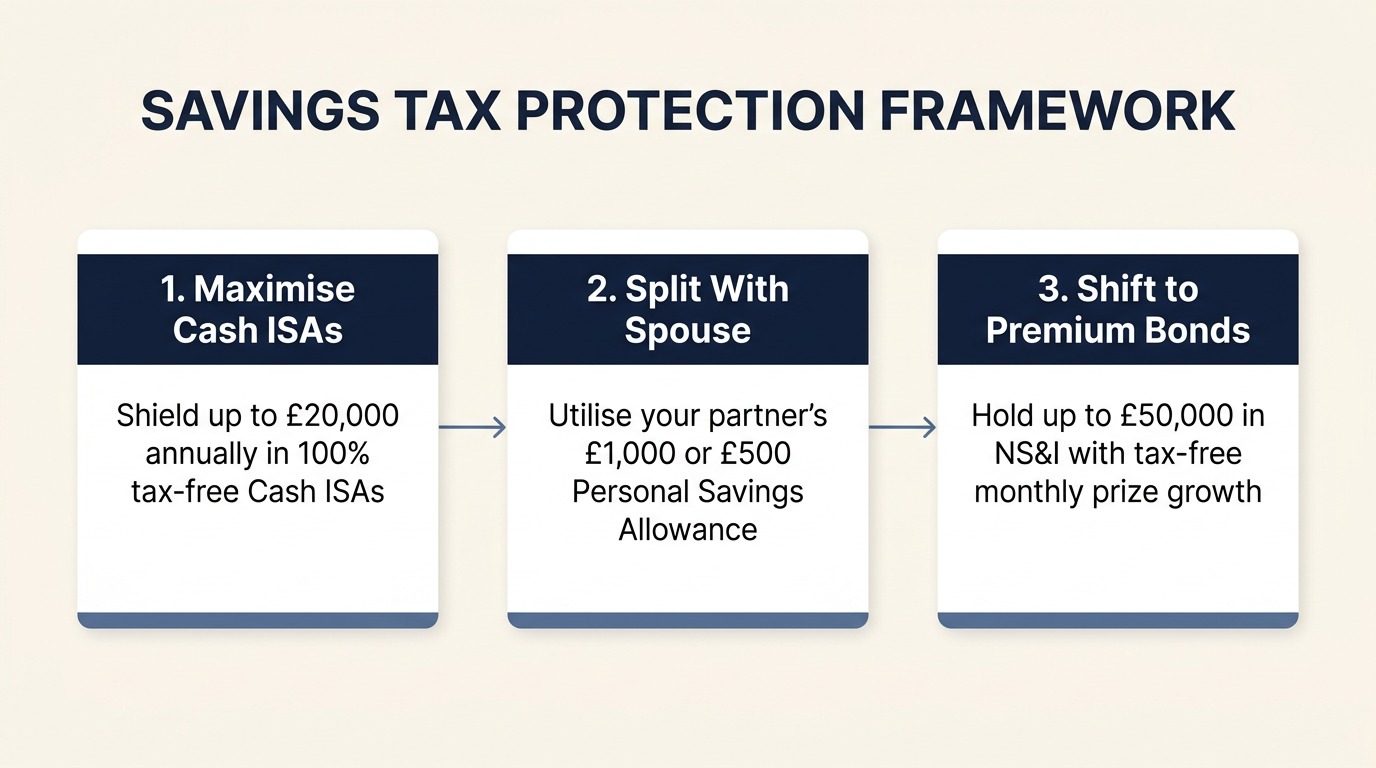
Step 1: Maximise Cash ISAs
Individual Savings Accounts (ISAs) remain completely outside the scope of the savings tax crackdown. Every UK adult possesses a statutory £20,000 annual ISA allowance. Any interest generated within a Cash ISA is 100% tax-free, does not count toward your Personal Savings Allowance, and never needs to be reported on a tax return. A couple can shelter up to £40,000 each tax year.
Step 2: Transfer Assets to a Non-Earning or Lower-Earning Spouse
In the UK, married couples and civil partners can transfer cash balances between spouses without incurring tax liabilities. If one partner is a higher-rate taxpayer (with only a £500 allowance) while the other is a basic-rate taxpayer (with a £1,000 allowance) or earns under the personal allowance threshold of £12,570, transferring savings into the lower-earning spouse’s name instantly increases tax-free interest capacity.
Step 3: Allocate Surplus Cash to NS&I Premium Bonds
National Savings and Investments (NS&I) Premium Bonds allow individuals to hold up to £50,000 in government-backed securities. Rather than earning conventional interest, bondholders participate in monthly prize draws. By law, all prizes won on Premium Bonds are completely exempt from UK income tax and capital gains tax, making them an effective shelter for higher and additional rate taxpayers.
Comparative Analysis: Taxable Accounts vs Cash ISAs vs Premium Bonds
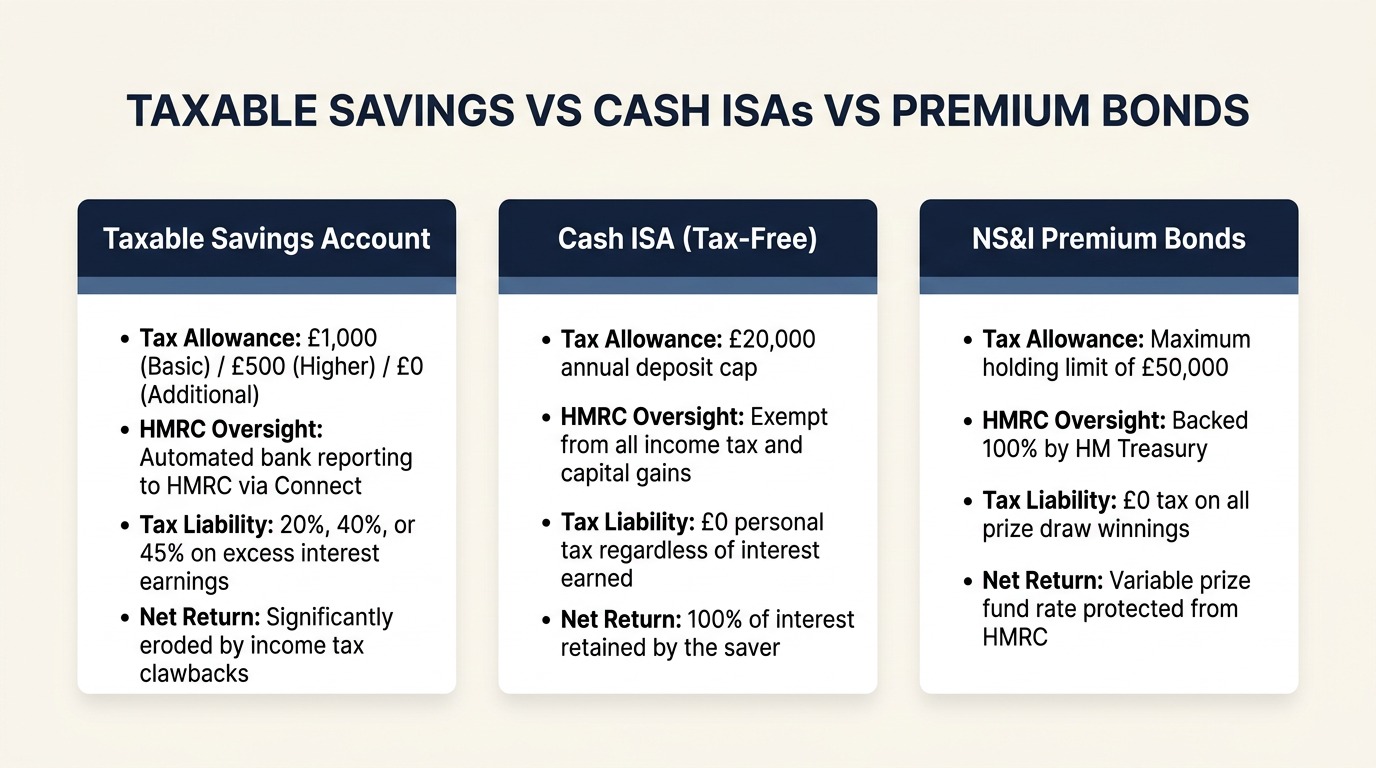
Selecting the optimal vehicle for your cash requires balancing headline gross interest rates against the real net return after HMRC tax deductions. The table below outlines how each structure performs for a higher-rate (40%) taxpayer holding £20,000 in liquid capital.
| Vehicle | Gross Interest (5.0%) | Taxable Interest | Tax Deducted (40%) | Net Cash Retained |
|---|---|---|---|---|
| Standard Savings Account | £1,000 | £500 (Exceeds £500 PSA) | £200.00 | £800.00 (4.0% net) |
| Cash ISA (4.75% Rate) | £950 | £0 (Fully exempt) | £0.00 | £950.00 (4.75% net) |
| NS&I Premium Bonds (4.4% Rate) | £880 (Average prize rate) | £0 (Fully exempt) | £0.00 | £880.00 (4.4% net) |
As demonstrated above, a Cash ISA paying a slightly lower gross rate of 4.75% delivers £150 more in net cash to a higher-rate saver than a 5.0% taxable account. The headline interest rate is irrelevant; what matters is the net return after HMRC tax deductions. Readers managing commercial expenditures should also evaluate structured payment tools, such as commercial business credit card accounts, to maximise interest-free cash flow windows before dipping into interest-bearing reserves.
For additional details regarding official calculations, review statutory statutory documentation on HMRC tax on savings interest thresholds.
What to Do If You Receive an HMRC Savings Tax Letter
If you receive a P800 notice or an adjustment to your PAYE coding notice, do not panic, but do not ignore it. Take the following four steps to ensure the calculation is accurate:
- Audit Bank Certificates of Interest: Request annual interest certificates from every bank and building society where you held deposits during the tax year. Ensure the figures match the numbers cited in HMRC’s letter.
- Verify Joint Accounts: Bank reporting systems sometimes attribute 100% of joint account interest to the primary account holder. By law, joint account interest is divided 50/50 between both holders unless explicitly registered otherwise. If HMRC taxed you on 100% of joint interest, challenge the assessment immediately.
- Check for Excluded Accounts: Ensure HMRC has not mistakenly included interest from Cash ISAs or tax-exempt accounts in your taxable total.
- Notify HMRC Within 30 Days: If errors exist, submit an appeal via your personal tax account or contact the HMRC income tax helpline within 30 days of the notice date.
Frequently Asked Questions
Does HMRC know about savings interest from digital banks?
Yes. All UK-regulated digital neo-banks, including Monzo, Starling, Revolut (for UK deposits), and app-based savings platforms like Chase and Chip, must comply with identical statutory reporting rules. They submit annual interest returns directly to HMRC.
Do children’s savings accounts get taxed under the crackdown?
Children have their own Personal Allowance (£12,570) and Personal Savings Allowance (£1,000). However, if a parent gives money to a child that generates more than £100 in gross interest in a single tax year, HMRC taxes all of that interest as the parent’s income at the parent’s marginal tax rate. This prevents parents from shifting large wealth sums into minor accounts.
Can I avoid savings tax by spreading money across multiple banks?
No. HMRC Connect links all accounts associated with your name, date of birth, address, and National Insurance number across all institutions. The Personal Savings Allowance applies to your cumulative annual interest across all accounts combined, not per bank.
What is the 0% Starting Rate for Savings?
Lower-income individuals can earn up to £5,000 in savings interest completely tax-free under the Starting Rate for Savings. However, every £1 of employment, self-employment, or pension income earned above the £12,570 personal allowance reduces this £5,000 starting allowance by £1. Anyone with non-savings income above £17,570 receives £0 starting rate relief.
Are fixed-rate savings bonds taxed when they mature or annually?
Fixed-rate bonds are taxed at the point when the interest becomes accessible to the account holder. If interest is compounded and locked until maturity, the entire accumulated interest is treated as received in the tax year the bond matures. This can cause a massive interest spike in a single year, pushing you into higher tax brackets.
Does paying into a pension reduce my savings tax liability?
Yes. Making personal pension contributions expands your basic rate tax band upwards by the gross value of the contribution. This can prevent you from crossing into the higher-rate (40%) tax threshold, preserving your full £1,000 Personal Savings Allowance instead of having it cut in half to £500.
Strategic Action Plan: What Savers and Directors Must Do Today
The aggressive enforcement of tax on cash savings marks an enduring shift in British tax administration. As government authorities intensify scrutiny over private wealth, taking immediate structural steps protects your capital from erosion:
- Perform a Complete Interest Audit: Calculate your exact total projected interest across all current and savings accounts for the current tax year.
- Prioritise Cash ISAs: Ensure you utilise your full £20,000 annual ISA allowance before depositing funds into standard taxable accounts.
- Coordinate Household Allowances: Rebalance taxable cash balances between spouses to ensure neither partner breaches their respective Personal Savings Allowance.
- Consider Non-Taxable Alternatives: For balances exceeding ISA limits, evaluate Premium Bonds or short-dated UK government gilts to preserve real net yields.
Article Hyperlink Reference Map
| Link Type | Exact Anchor Text | Destination Target URL | Context & Purpose |
|---|---|---|---|
| Internal | HMRC savings tax letter warning | https://elitebusinessjournal.co.uk/hmrc-savings-tax-letter-guide/ | P800 / simple assessment letter advice |
| Internal | cash flow management strategies | https://elitebusinessjournal.co.uk/cash-flow-tips-every-small-business-owner-needs-to-know/ | Corporate cash preservation techniques |
| Internal | commercial business credit card accounts | https://elitebusinessjournal.co.uk/business-credit-card-uk-guide/ | Expense liquidity & working capital windows |
| External (Authority) | Bank of England base rate | https://www.bankofengland.co.uk/monetary-policy/the-interest-rate-bank-rate | Official UK monetary benchmark |
| External (Authority) | GOV.UK tax-free savings interest rules | https://www.gov.uk/apply-tax-free-interest-on-savings | Official statutory allowance thresholds |
| External (Authority) | HMRC tax on savings interest thresholds | https://www.gov.uk/tax-on-savings-interest | Official HMRC savings tax rules manual |