According to industrial asset reliability benchmarks published by the Society for Maintenance and Reliability Professionals, unplanned machine downtime costs industrial operations an estimated $260,000 per hour across major manufacturing sectors. Yet despite the severe financial toll of equipment breakdowns, dozens of plant managers and facility directors continue to manage multimillion-dollar physical assets through fragmented spreadsheets, dry-erase boards, and paper clipboards. Selecting the best CMMS software directly determines whether an operations department operates as a reactive cost center or a reliable, data-driven profit driver.
A modern Computerized Maintenance Management System (CMMS) does far more than schedule basic lubrication routines. Modern cloud and mobile architectures track complete equipment life cycles, centralize maintenance, repair, and operations (MRO) spare parts inventories, automate regulatory compliance audits, and ingest IoT vibration telemetry to predict equipment failures before catastrophic stoppages occur. Aligning facility operations with international asset governance standards like ISO 55000 asset management requires software architectures that frontline technicians actually adopt in the field.
This guide evaluates the market-leading CMMS software platforms available in 2026, comparing feature capabilities, mobile frontline interfaces, technician adoption rates, integration ecosystems, and total cost of ownership for commercial and industrial facilities.
Quick Answer: What Is the Best CMMS Software in 2026?
The leading CMMS software platforms for industrial and commercial operations in 2026 are MaintainX, Limble CMMS, Fiix by Rockwell Automation, UpKeep, and eMaint by Fluke Reliability. MaintainX ranks as the premier mobile-first platform because of its intuitive, chat-driven work orders and near-zero technician training curve. Limble CMMS provides the leading modular, no-code customization for growing facility teams seeking rapid deployment. Fiix delivers the most advanced artificial intelligence and predictive asset modeling for multi-site industrial enterprises. UpKeep excels for asset-heavy fleets and facilities requiring barcoded MRO inventory control, while eMaint serves as the gold standard for heavily regulated manufacturing plants requiring strict compliance audit trails.
Key Takeaways for Operations Directors and Facility Executives
- Frontline Adoption Is Decisive: A CMMS platform succeeds or fails based on technician field usability. Desktop-heavy systems that require technicians to walk back to an office terminal suffer from delayed logs and incomplete equipment histories.
- Shift from Reactive to Preventive: Transitioning from reactive (run-to-failure) maintenance to structured preventive maintenance (PM) routines reduces total maintenance operating costs by 18% to 25%.
- MRO Inventory Control: Up to 50% of unplanned downtime extensions occur because technicians lack critical replacement parts. Leading CMMS platforms automate low-stock reorder triggers.
- Mobile Offline Functionality: Industrial basements, remote pumping stations, and metal-clad warehouses frequently lack reliable cellular connectivity. Demanding full offline synchronization prevents data loss.
- Financial System Integration: Modern maintenance systems must export asset capital depreciation and vendor purchase orders directly into corporate accounting and bookkeeping software.

Computerized Maintenance Management Systems centralize plant telemetry, technician work orders, and asset reliability records into a unified digital command center.
What Is CMMS Software? The Core Technological Architecture
A Computerized Maintenance Management System serves as the centralized digital repository for an organization’s physical asset infrastructure. At its operational core, CMMS software replaces disparate paper records, tribal technician knowledge, and static spreadsheets with a structured relational database that connects four operational pillars:
- Asset Master Hierarchy: Organizing machinery, HVAC systems, vehicle fleets, and production lines into clear parent-child equipment trees with serial numbers, warranty terms, and documentation schematics.
- Work Order Management: Ingesting work requests from frontline operators, assigning priorities, routing tickets to qualified technicians, and tracking wrench-time labor hours.
- Preventive Maintenance Scheduling: Triggering recurring inspection checklists based on calendar cadences, running hours (meter readings), or automated condition-based sensor thresholds.
- MRO Spare Parts Inventory: Monitoring parts stock levels, bin locations, purchase requisitions, and tracking parts usage against specific equipment work orders.
According to research by the International Facility Management Association, organizations that implement structured digital maintenance tracking extend equipment operational lifespans by an average of 20% to 35% compared to organizations relying on informal maintenance routines.
Detailed Evaluation of the Top 5 CMMS Software Platforms
1. MaintainX: The Premier Mobile-First CMMS for Frontline Collaboration
MaintainX has disrupted the industrial maintenance software market by treating frontline technicians as primary software users rather than secondary data entry clerks. Modeled with the consumer simplicity of modern messaging applications, MaintainX achieves the highest user adoption rates in the maintenance sector.
Key Operational Capabilities:
- Real-Time Team Communication: Incorporates native in-app messaging directly tied to specific work orders. Technicians can photograph damaged components, annotate images, and ask supervisors for guidance without leaving the job ticket.
- Visual Standard Operating Procedures: Converts complex operating manuals into interactive digital checklists requiring technicians to verify steps, input numerical measurements, and capture photographic confirmation.
- Zero-Friction Requester Portals: Non-maintenance staff can submit maintenance tickets by scanning equipment QR codes with smartphone cameras, eliminating unauthorized verbal requests.
- Automated Anomaly Detection: The software flags meter readings that fall outside normal standard operating parameters, instantly generating urgent corrective work orders.
Pricing and Limitations: MaintainX offers a functional Free basic plan, with paid tiers starting at Essential ($10 per user per month), Premium ($39 per user per month), and Enterprise (custom pricing). The platform focuses primarily on maintenance execution; facilities requiring advanced predictive vibration modeling or multi-tier enterprise ERP integrations will require higher-tier API connectors.
2. Limble CMMS: Best for No-Code Workflow Customization and Fast Time-to-Value
Limble CMMS has earned a sterling reputation among facility managers and manufacturing supervisors for its balance of deep functionality and intuitive modular setup. Designed by maintenance professionals, Limble avoids cumbersome enterprise bloat while providing modular customization.
Key Operational Capabilities:
- Intuitive Modular Asset Trees: Users can build deep multi-level equipment hierarchies within hours, attaching historical repair logs, electrical schematics, and vendor warranties directly to each asset node.
- Automated Preventive Maintenance Engine: Schedules complex recurring PMs based on calendar cycles, meter readings, or condition thresholds, balancing technician workloads across interactive calendar boards.
- Parts Kitting and Low-Stock Triggers: Links specific spare parts to preventive maintenance templates, automatically reserving required components in inventory prior to scheduled service days.
- Rapid Deployment Timeframe: Most industrial facilities complete full Limble onboarding and asset data loading within two to three weeks, compared to multi-month rollout timelines typical of legacy systems.
Pricing and Limitations: Pricing begins at Standard ($28 per user per month), Premium+ ($49 per user per month), and Enterprise ($99+ per user per month). While exceptional for facility and plant teams, its out-of-the-box analytical dashboards are less specialized for complex aerospace and defense manufacturing compliance than legacy enterprise tools.

Field technicians utilize mobile CMMS applications to scan asset barcodes, review operating procedures, and log maintenance labor in real time.
3. Fiix by Rockwell Automation: Best for Enterprise AI and Predictive Maintenance
Acquired by industrial automation titan Rockwell Automation, Fiix represents the pinnacle of cloud maintenance intelligence for large-scale manufacturers, utilities, and multi-site enterprise production facilities.
Key Operational Capabilities:
- Fiix Foresight AI Engine: Uses machine learning algorithms to analyze historical work order data, parts consumption rates, and equipment sensor streams to identify hidden failure trends and optimize PM frequencies.
- Deep Rockwell PLC and IoT Integration: Connects directly with industrial programmable logic controllers (PLCs), SCADA systems, and vibration monitors to trigger automated work orders based on live asset operating data.
- Multi-Site Enterprise Governance: Allows corporate operations directors to benchmark maintenance KPIs, parts turnover, and technician efficiency across dozens of disparate production plants globally.
- Extensive Open API Framework: Connects natively with enterprise resource planning systems including SAP, Oracle NetSuite, and Microsoft Dynamics 365.
Pricing and Limitations: Fiix offers a basic Free plan, with Professional plans starting at $45 per user per month and Enterprise plans starting at $75+ per user per month. The software demands dedicated IT configuration and structured change management to capture its full value.
4. UpKeep: Best for Asset-Heavy Fleets and MRO Inventory Control
UpKeep combines mobile-first field workflows with sophisticated inventory logistics, making it the preferred choice for fleet managers, municipal public works departments, and warehousing distribution hubs.
Key Operational Capabilities:
- Advanced Barcode and QR Inventory Scanning: Technicians can scan bin labels using a mobile camera to check out parts, transfer components between facilities, and conduct cycle counts.
- Automated Purchase Order Requisitions: Automatically generates purchase order drafts to preferred suppliers when spare parts inventory dips below safety stock minimums.
- Fleet Maintenance and Telematics Integration: Integrates with fleet telematics hardware to pull automated odometer readings, engine diagnostic fault codes, and fuel usage metrics.
- Cost of Ownership Roll-Ups: Aggregates all parts expenditures, third-party contractor invoices, and internal labor hours into lifetime asset cost reports.
Pricing and Limitations: Plans begin at Lite ($20 per user per month), Starter ($45 per user per month), and Professional ($75 per user per month). UpKeep enforces strict user seat definitions, meaning facilities with large maintenance crews must budget carefully for named user licenses.
5. eMaint by Fluke Reliability: Best for Regulated Manufacturing and Calibration
Developed under the Fluke Reliability banner, eMaint provides an industrial-grade enterprise asset management (EAM) foundation for chemical processing, pharmaceuticals, aerospace, and heavy industrial plants.
Key Operational Capabilities:
- Strict Regulatory Audit Trails: Features 21 CFR Part 11 compliant digital signatures, immutable audit logs, and version-controlled standard operating procedures required for FDA, ISO, and OSHA inspections.
- Fluke Condition Monitoring Pairing: Connects directly with Fluke vibration sensors, thermal imagers, and power quality analyzers for continuous asset health monitoring.
- Unlimited Customization Depth: Allows system administrators to build custom database tables, complex relational fields, and conditional automated approval workflows.
- Multi-Language Global Deployment: Operates across multiple international languages and global currencies, facilitating cross-border industrial operations.
Pricing and Limitations: Pricing starts at $69 per user per month (minimum 3 users) for the Team tier and scales to $120+ per user per month for Enterprise tiers. The interface retains a traditional database layout that requires formal classroom training for maintenance staff.
Feature & Pricing Comparison Matrix
Evaluating the best CMMS software requires contrasting user seat models, mobile offline capabilities, predictive sensor integrations, and ideal operational use cases:
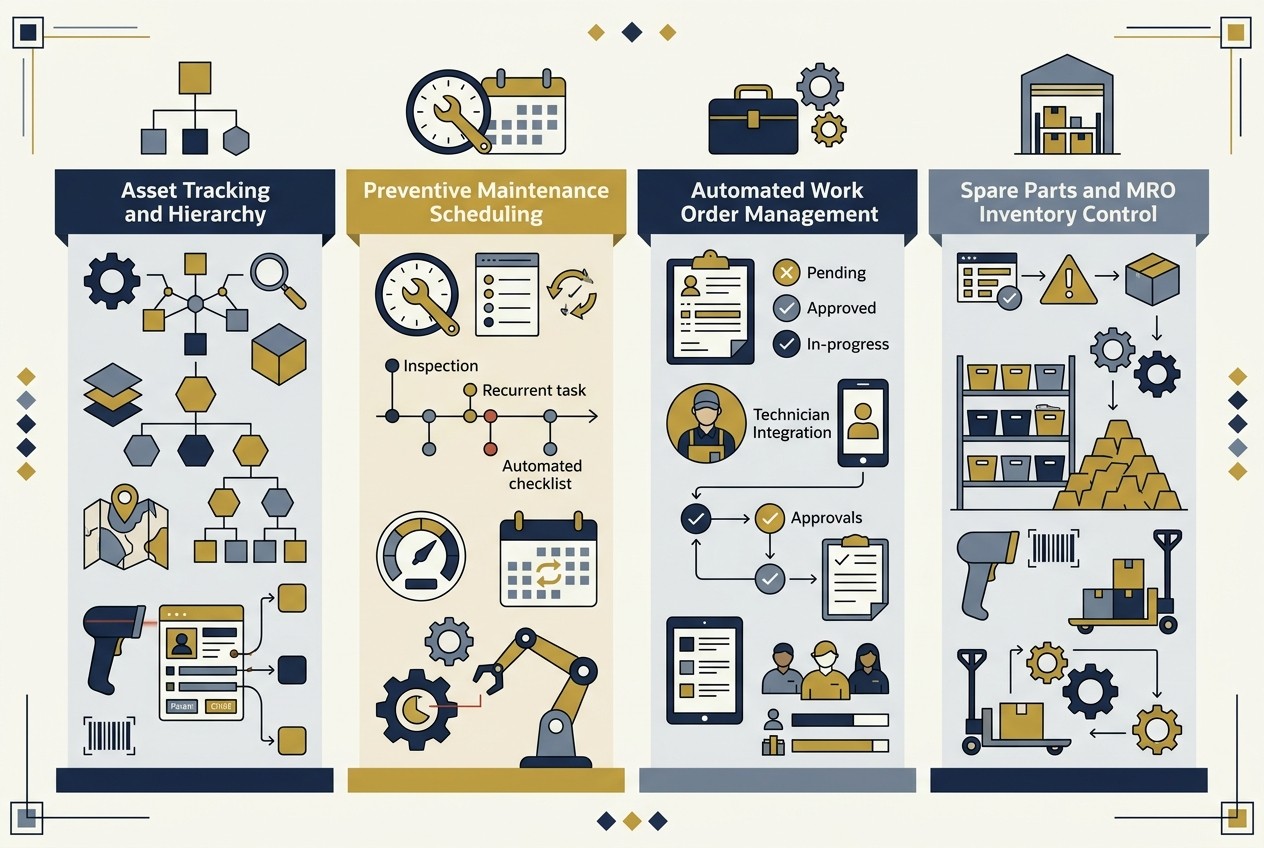
The four operational pillars of CMMS software: asset hierarchy, preventive maintenance scheduling, work order automation, and MRO parts inventory control.
Critical Capabilities Modern Industrial Operations Must Demand
When selecting maintenance management software, operations executives must look beyond marketing brochures and prioritize five functional capabilities that directly drive maintenance metrics:
1. True Offline Mobile Synchronization
Modern industrial plants, subterranean utility tunnels, and rural infrastructure sites contain extensive dead zones where cellular and Wi-Fi networks fail. A modern CMMS must operate as a local-first application on iOS and Android devices. Technicians must be able to view assigned work orders, reference PDF wiring diagrams, record meter readings, and mark checklists complete without connectivity. The moment the mobile device reconnects to a network, the application must automatically resolve conflict timestamps and sync updates to the cloud ledger.
2. QR Code and Barcode Asset Serialization
Manual asset searching invites human error. Technicians often log maintenance against Machine A when they actually serviced Machine B, corrupting machine repair histories. Modern platforms provide instant QR code printing for all asset records and spare parts bins. Technicians scan the physical tag attached to the machine, which opens the exact asset dossier, displays open work orders, and verifies that the technician is physically standing in front of the correct machine before work begins.
3. Automated MRO Spare Parts Management
Unorganized spare parts rooms represent substantial idle capital and extended repair delays. The CMMS must maintain an auditable parts inventory with automated reorder points. When a technician consumes two bearings on a work order, the platform must automatically deduct those items from the specific parts bin. When inventory dips below the safety stock threshold, the system should generate a purchase requisition draft and alert purchasing agents, as detailed in our guide on how to franchise your business and standardize commercial supply chains.
4. Asset Equipment Effectiveness (OEE) and Reliability Analytics
Operational leaders require high-level visibility into maintenance effectiveness. Leading platforms calculate standard reliability metrics automatically:
- Mean Time to Repair (MTTR): The average time required to troubleshoot and restore a failed asset back to operating condition.
- Mean Time Between Failures (MTBF): The operational elapsed time between unexpected equipment breakdowns, measuring asset reliability.
- Planned Maintenance Percentage (PMP): The proportion of total maintenance hours spent on proactive maintenance versus reactive emergency repairs (top-performing facilities maintain a PMP above 80%).
Total Cost of Ownership: Analyzing Hidden Licensing and Rollout Costs
Evaluating CMMS software costs requires examining factors beyond the base per-user subscription rate. Unbudgeted expenses frequently inflate total implementation investments:
Five-Phase Implementation Roadmap for Operational Leaders
Deploying a CMMS requires deliberate operational change management to avoid poor technician compliance and incomplete asset registries:
- Perform an Exhaustive Physical Asset Audit: Walk the plant floor and catalog every production machine, HVAC compressor, and utility system. Record serial numbers, model years, electrical requirements, and exact physical locations. Establish a clean parent-child hierarchy before entering data into the software.
- Standardize Core PM Checklists: Review original equipment manufacturer (OEM) manuals and consolidate maintenance requirements into clear, sequential inspection steps. Eliminate vague instructions such as “inspect pump” in favor of specific criteria like “verify bearing vibration below 0.15 in/sec and log motor casing temperature.”
- Organize and Barcode the Spare Parts Room: Designate specific bin locations for critical MRO spare parts, generate barcoded shelf labels, and count starting stock levels. Link high-mortality wear parts directly to their corresponding machine records in the CMMS.
- Execute a Focused Pilot Rollout: Deploy the software across a single production line or facility zone for 30 days. Train a dedicated pilot crew of senior technicians, incorporate their feedback on mobile checklist usability, and refine custom fields before rolling out facility-wide.
- Establish Maintenance KPI Review Rhythms: Incorporate weekly CMMS dashboard reviews into operations meetings. Track work order completion velocity, overdue PM backlogs, and MTBF trends to ensure the software actively drives maintenance decision-making.
Frequently Asked Questions
What is the difference between CMMS and EAM software?
A CMMS (Computerized Maintenance Management System) focuses primarily on maintenance execution: tracking work orders, scheduling preventive maintenance, and monitoring spare parts inventory. An EAM (Enterprise Asset Management) system encompasses a wider scope, tracking the entire financial life cycle of assets from engineering procurement, accounting depreciation, and regulatory compliance through decommissioning. Modern cloud CMMS platforms now incorporate most traditional EAM capabilities.
How much does CMMS software cost per user?
Modern cloud CMMS platforms typically range from $28 to $85 per maintenance technician per month. Premium enterprise tiers supporting advanced predictive IoT analytics, custom ERP connectors, and 21 CFR Part 11 regulatory compliance range from $90 to $120+ per user per month. Most leading systems offer unlimited free access for non-maintenance requesters who only submit service tickets.
Can technicians use CMMS apps without an internet connection?
Yes. Leading modern platforms such as MaintainX, Limble CMMS, UpKeep, and Fiix offer native offline mobile capabilities. Field technicians can view open work orders, review PDF operating procedures, record meter measurements, and mark tasks complete in dead zones. The application automatically synchronizes all data when the mobile device regains Wi-Fi or cellular connectivity.
What is the typical return on investment timeline for a CMMS?
Most commercial and industrial facilities achieve a full return on investment within 6 to 12 months of deployment. Measurable returns stem from a 15% to 25% reduction in unplanned machine downtime, a 10% to 20% reduction in MRO spare parts inventory holding costs, and a significant decrease in overtime labor expenses driven by proactive scheduling.
How does CMMS software integrate with corporate accounting systems?
Top-tier CMMS platforms connect with corporate accounting systems through REST APIs and pre-built connectors. When maintenance technicians consume high-value replacement components or approve vendor contractor invoices, the CMMS syncs transaction data to general ledger software, ensuring corporate balance sheets accurately reflect asset capital improvements and maintenance expenditures.
Strategic Next Steps for Operations and Facility Leaders
Investing in the best CMMS software is a foundational operational commitment that safeguards company capital assets, protects operating margins, and improves technician safety. Facilities that shift from reactive repair chaos to structured predictive maintenance gain measurable uptime advantages that compound over years of production.
For operations teams seeking an intuitive, mobile-driven tool with rapid technician onboarding, MaintainX represents the premier choice. Facilities prioritizing deep customization and modular asset hierarchies should evaluate Limble CMMS. Multi-site industrial plants requiring predictive AI and PLC integration should test Fiix, while logistics fleets and regulated pharmaceutical plants should focus on UpKeep and eMaint, respectively.
Begin by assembling a cross-functional selection committee comprising maintenance supervisors, plant engineers, and financial controllers. Request live sandbox demonstrations from your top three platform contenders, test mobile offline workflows with frontline technicians, and verify API compatibility with your corporate financial systems before finalizing your maintenance software roadmap.