Executive Brief: The fundamental mechanics of digital customer acquisition are dividing. According to industry projections by Gartner Research, traditional search engine query volume will decline by 25 percent as consumers, enterprise procurement directors, and technical researchers shift their primary inquiry workflows to conversational artificial intelligence platforms. Succeeding in this modern environment requires marketing leaders to transition from traditional search engine optimization to an actionable Answer Engine Optimization strategy designed specifically for conversational synthesis engines like ChatGPT, Perplexity, Claude, and Google AI Overviews.
Quick Answer: What Is an Answer Engine Optimization Strategy?
An Answer Engine Optimization (AEO) strategy is a structured digital marketing and data architecture framework engineered to position enterprise content as the primary direct answer cited by generative artificial intelligence engines. While traditional SEO optimizes individual web pages to rank among ten blue search results, AEO structures brand knowledge, factual specifications, and thought leadership so that large language models (LLMs) extract, attribute, and recommend the brand during conversational interactions.
An effective AEO strategy operates across four foundational elements: semantic entity authority (establishing unified knowledge graph connections), modular content chunking (creating direct, citable 150-word answer passages), technical grounding markup (deploying Schema.org data for RAG crawlers), and prompt share-of-voice tracking (measuring brand inclusion rates across diverse conversational buyer journeys).
Key Takeaways for Chief Marketing Officers and Digital Directors
- From Pages to Entities: Answer engines do not index keywords in isolation; they evaluate entity relationships, semantic credibility, and knowledge graph authority.
- Modular Content Architecture: Long prose blocks fail in AI search. Content must be structured into independent, modular answer units paired with verified data tables.
- RAG Crawler Ingestion: Retrieval-augmented generation bots prioritize structured, machine-readable facts and explicitly penalize complex JavaScript-gated information.
- Attribution Dominance: Winning in AEO means securing in-text citation links within generated answers, driving high-intent referral traffic directly to conversion pages.
- Continuous Prompt Monitoring: Marketing teams must benchmark recommendation frequency and sentiment across multi-model buyer queries rather than tracking static SERP rankings.
The Paradigm Shift: Understanding How Answer Engines Process Information
To build an effective answer engine optimization strategy, marketing executives must first understand how conversational platforms differ from traditional search crawlers. Traditional search engines operate as indexers and matchmakers. Google’s web spiders crawl HTML documents, index keywords, calculate link equity through PageRank, and present a ranked list of external links for the user to visit.
Answer engines operate as real-time synthesis systems. Whether a prospective enterprise buyer queries Perplexity Pro for the best enterprise data privacy software or asks ChatGPT to compare cloud ERP vendors, the system conducts real-time Retrieval-Augmented Generation (RAG). The AI platform searches grounding indices, retrieves relevant text passages, assesses source authority, and generates a unified, synthetic paragraph that answers the user’s question directly.
In this workflow, the user rarely scrolls through secondary search results. They read the synthesized answer and click on the specific footnotes or inline source citations provided by the AI model. If your enterprise content is not formatted for algorithmic extraction, your brand is effectively invisible in conversational search, regardless of your historical keyword rankings. Modern organizations must integrate this discipline alongside established enterprise marketing strategy models to maintain market leadership.
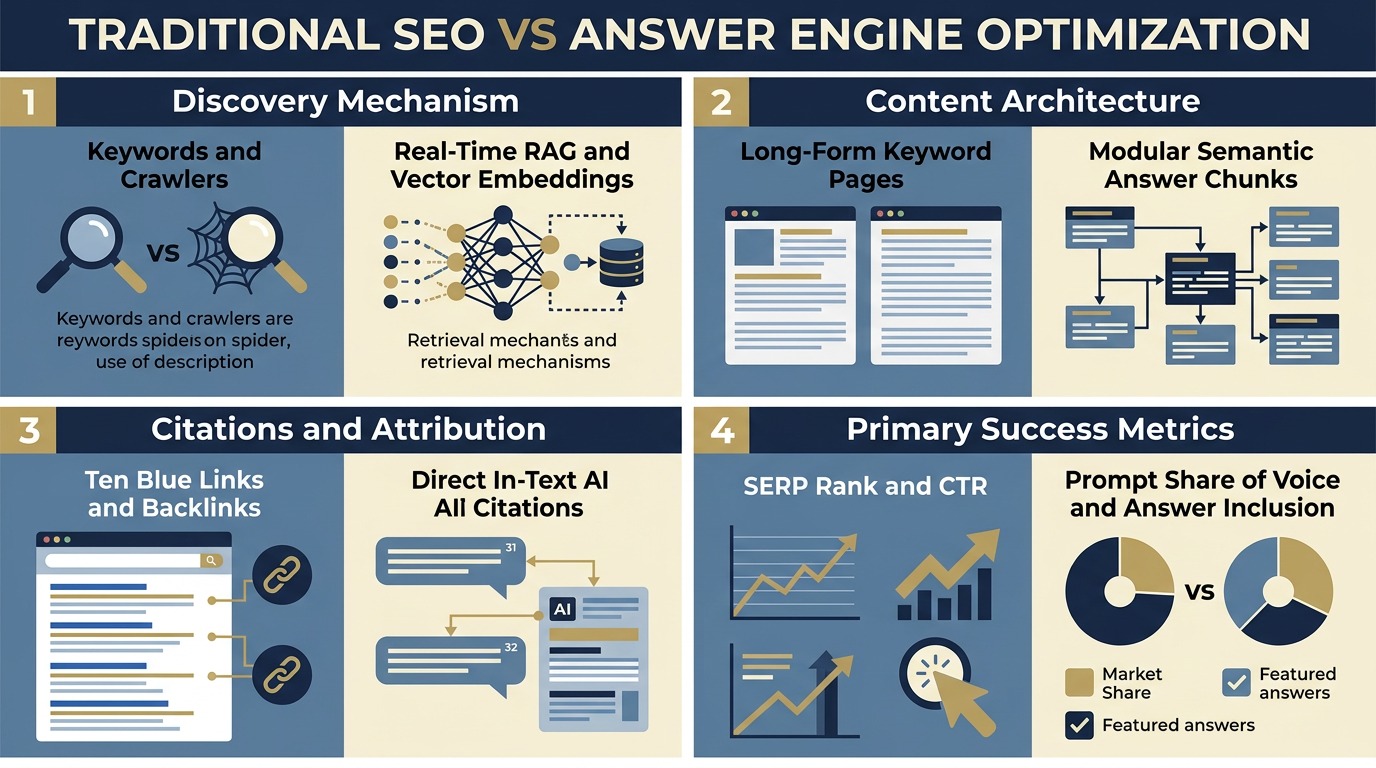
Traditional SEO vs. Answer Engine Optimization: The Core Differences
While traditional search engine optimization and answer engine optimization share common technical foundations (such as crawl accessibility and high domain trust), their execution strategies diverge significantly across four core dimensions:
| Strategic Dimension | Traditional Search Engine Optimization (SEO) | Answer Engine Optimization (AEO) |
|---|---|---|
| User Interaction | Fragmented keyword searches (e.g., “best crm software”) | Complex multi-variable prompts with specific business constraints |
| Content Architecture | Monolithic long-form guides designed to maximize on-page dwell time | Modular semantic answer chunks engineered for immediate RAG extraction |
| Search Discovery Model | Inverted keyword indexing and backlink authority scoring | Vector embeddings, semantic distance, and entity knowledge graphs |
| Traffic Destination | Organic clicks distributed across top ten ranked links | Direct in-text footnote citations and linked recommendation cards |
| Primary Success Metric | Keyword rank, organic impressions, and click-through rate | Prompt Share of Voice (SoV) and citation grounding frequency |
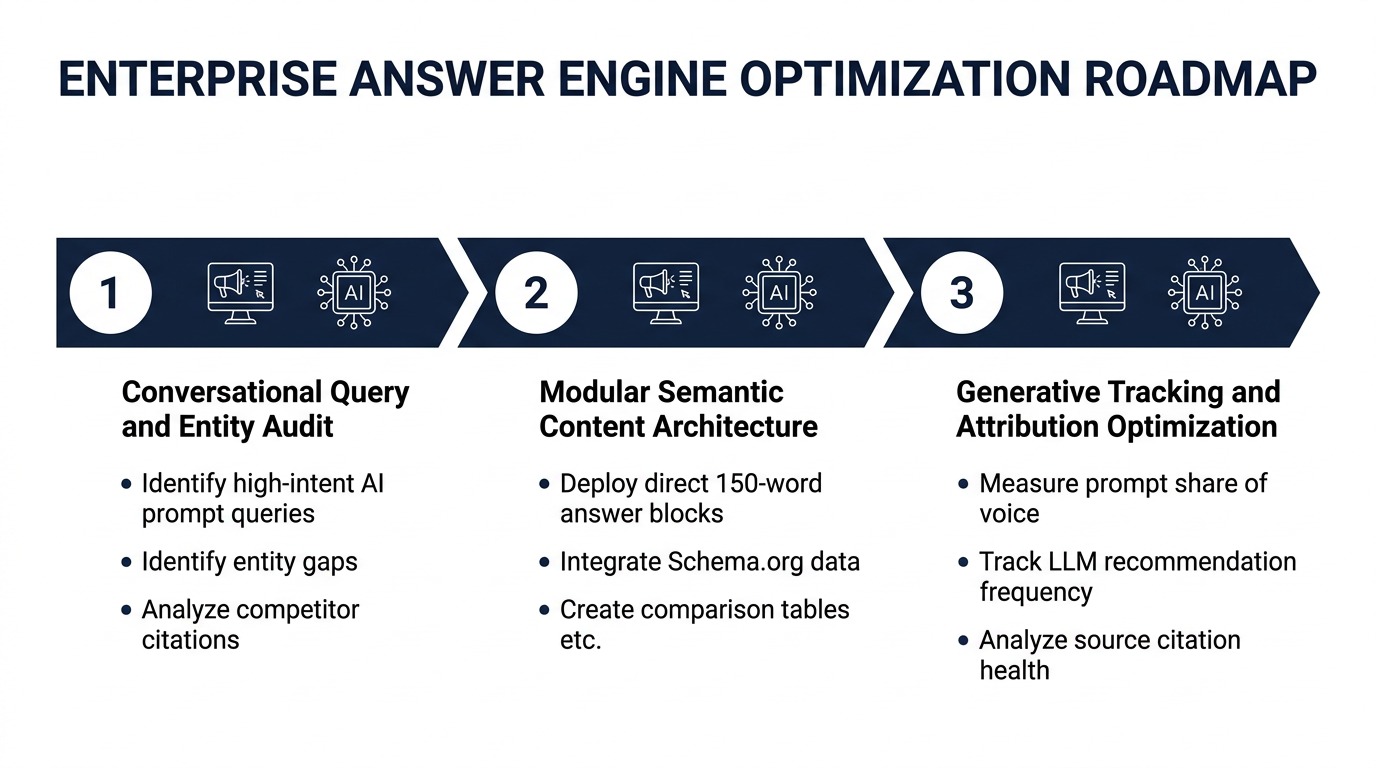
The Four Pillars of an Enterprise Answer Engine Optimization Strategy
An enterprise-grade AEO strategy requires restructuring content production, technical taxonomy, and digital PR around machine interpretability. The framework consists of four actionable pillars:
1. Modular Semantic Content Architecture
Generative artificial intelligence models process information in tokens and context windows. When an AI retrieval system scans a document, it extracts discrete text segments that directly address the user’s intent. Writing monolithic 4,000-word articles where the core answer is buried under flowery introductions guarantees poor AI visibility.
Enterprise content teams must adopt modular architecture principles:
- The Direct Answer Lead: Position a self-contained, 120 to 150-word answer block immediately beneath each primary heading. The answer must stand independently without requiring context from preceding sections.
- High-Contrast Specification Tables: Convert complex comparative data, feature matrices, and pricing tiers into semantic HTML tables. AI answer engines extract tabular data with exceptionally high confidence when generating direct product comparisons.
- Question-Based Subheadings: Formulate headings as natural conversational questions that mirror actual user prompts (for example, “How does enterprise SOC-2 compliance automation work?” rather than simply “Compliance”).
2. Entity Canonicalization and Knowledge Graph Integration
Large language models do not view a brand as a website URL; they view a brand as an entity node within a global knowledge graph. If your organization’s digital footprint contains conflicting naming conventions, outdated executive leadership information, or fragmented address data, the model suffers from entity confusion.
To eliminate this friction, marketing teams must enforce rigorous BrandRank AI normalization transformation rules. Standardizing your brand identity across Wikidata, Crunchbase, Google Knowledge Graph Machine IDs, and public business registries ensures that AI models aggregate all authority signals into a single, unified entity node.
3. Technical Grounding and Schema.org Markup
Retrieval-augmented generation systems rely heavily on structured metadata to verify facts before presenting them to users. Unstructured text requires significant computing resources for an LLM to parse and verify, whereas structured schema markup provides immediate, authoritative confirmation.
Technical teams must implement structured data according to official Schema.org Entity Documentation, including:
- Organization and Brand Schemas: Explicitly defining corporate legal names, official websites, parent organizations, and verified links to social and industry profiles.
- Product and Service Schemas: Specifying exact pricing models, currency types, trial periods, and feature availability to prevent the AI model from hallucinating false terms.
- TechArticle and FAQPage Schemas: Formatting educational documentation with structured question-and-answer pairs, allowing RAG systems to parse question-answer relationships with mathematical precision.
- Quality Alignment: Ensuring that all technical grounding aligns directly with official Google Search Central Content Guidelines, which reward original reporting, source attribution, and structured clarity.
4. Third-Party Consensus and Digital PR Grounding
One of the most critical elements of conversational search is algorithmic consensus. Large language models do not rely solely on what a company says about itself on its own website. When an answer engine recommends a B2B platform, it triangulates sentiment across multiple authoritative third-party sources, including industry analyst reports, software review hubs (G2, TrustRadius, Capterra), tech publications, and customer discussion forums.
Consequently, digital public relations must shift from acquiring generic backlinks to securing structured brand citations in trusted third-party publications. Building verified, consistent brand references across independent review ecosystems directly impacts your model recommendation score and strengthens your corporate brand reputation management.
The Enterprise MarTech Stack for Answer Engine Optimization
Executing an enterprise AEO initiative across global product lines demands specialized software tooling. Traditional rank monitoring and keyword tracking applications fail to capture the nuances of generative model outputs. Enterprise digital teams must deploy an integrated AEO technology stack spanning four specialized categories:
1. RAG Retrieval Simulators and Prompt Sampling Engines
To quantify brand visibility across conversational systems, organizations deploy automated API sampling frameworks. These tools query multiple foundational models (such as GPT-4o, Claude 3.5 Sonnet, Gemini 1.5 Pro, and Perplexity Pro) using automated prompt banks. By systematically evaluating hundreds of buyer intent prompts across variable temperature settings, sampling engines calculate brand appearance rates, attribution citation URLs, and competitive displacement frequencies.
2. Knowledge Graph Modeling and Entity Resolution Platforms
Entity resolution platforms audit your company’s presence across public knowledge bases. These tools cross-reference your corporate profile on Wikipedia, Wikidata, Golden, and official corporate filings, flagging inconsistencies in executive titles, merger histories, and product taxonomies. Eliminating entity drift ensures that large language models do not conflate your brand with unrelated third parties during conversational generation.
3. Vector Chunking and Semantic Proximity Analyzers
Before publishing documentation or product specifications, technical marketing teams run content through semantic vector analyzers. These tools break down web copy into standard 256-token and 512-token chunks, generating high-dimensional mathematical embeddings to calculate semantic distance against target industry queries. If your content exhibits high semantic drift or low factual density, the tooling recommends restructuring passages to maximize retrieval confidence in RAG pipelines.
4. AI Referral Analytics and Citation Header Trackers
Attribution analytics require specialized server log analysis and analytics tagging. Conversational engines often route referral traffic through unique user-agent strings and referrer headers. Enterprise teams configure specialized tracking parameters to distinguish visits originating from in-text AI footnote citations versus traditional organic search clicks, calculating direct conversion rates and pipeline value generated by conversational recommendations.
| AEO Technology Category | Core Function & Workflow | Primary Evaluation Metrics | Enterprise Deployment Tier |
|---|---|---|---|
| Prompt Sampling Engines | Automated multi-model API querying across diverse buyer journey prompts | Share of Model (SoM), citation frequency, competitor displacement | Enterprise Marketing Operations |
| Entity Resolution Systems | Global knowledge graph auditing, Wikidata reconciliation, schema validation | Entity reconciliation score, schema compliance, knowledge panel stability | Technical SEO & Corporate Communications |
| Vector Semantic Analyzers | Token chunking, vector embedding distance calculation, factual density audits | Cosine similarity score, passage factual density, context window fit | Content Strategy & Editorial Teams |
| AI Citation Trackers | Referrer header analysis, server log parsing, conversational attribution modeling | AI referral sessions, downstream demo requests, pipeline contribution | Revenue Operations & Web Analytics |
Step-by-Step Implementation: Building Your Enterprise AEO Roadmap
Transitioning an organization from traditional search marketing to an active AEO posture requires a phased execution plan across cross-functional marketing and technical teams:
Step 1: Conduct a Conversational Prompt Audit
Traditional keyword research tools do not capture how users interact with conversational AI engines. Marketing teams must conduct conversational prompt audits across key buyer personas:
- Identify High-Intent Discovery Prompts: Catalog the multi-sentence questions enterprise decision-makers ask during the software evaluation phase (for example: “Compare the top three enterprise workforce management platforms for manufacturing companies with over 5,000 employees”).
- Benchmark Model Visibility: Execute these prompt sets across major commercial engines (ChatGPT Search, Perplexity, Google Gemini, Claude) to determine how frequently your brand appears in generated answers.
- Audit Competitor Citations: Identify which competitors are currently cited in footnote references and analyze the specific web pages being referenced by the RAG crawler.
Step 2: Re-Engineer Core Content into Modular Answer Chunks
Audit your highest-traffic commercial pages, service descriptions, and documentation libraries. Restructure each page to incorporate modular answer units:
- Add a 150-word quick-answer summary block at the beginning of each major topic section.
- Ensure every definition, cost calculation, and process step is stated plainly in active voice.
- Replace dense bulleted text with clean, responsive HTML comparison tables containing explicit numerical or categorical specifications.
Step 3: Deploy Canonical Entity Schemas and Fix Data Discrepancies
Work with technical web engineering teams to audit your digital identity. Eliminate naming discrepancies, update outdated subsidiary listings, and deploy complete JSON-LD markup across all commercial domains. Verify that all corporate entities link to authoritative knowledge bases via unambiguous matching attributes.
Step 4: Establish Ongoing Share of Model (SoM) Analytics
Traditional rank trackers cannot monitor dynamic AI responses. Enterprise organizations must implement automated prompt sampling tools that query LLM APIs weekly across diverse model temperature settings. Tracking your brand’s Share of Model, sentiment polarity, and citation link health provides the quantitative data required for executive reporting and continuous optimization.
| AEO Implementation Phase | Key Deliverables & Milestones | Expected Business Outcome |
|---|---|---|
| Phase 1: Discovery & Audit (Weeks 1–3) | Conversational prompt database, baseline Share of Model audit, entity conflict report | Complete visibility into current brand perception across ChatGPT, Perplexity, and Gemini |
| Phase 2: Content Architecture (Weeks 4–8) | Modular answer restructuring, comparison table deployment, Schema.org entity markup | High-speed ingestion by real-time RAG crawlers; elimination of AI attribute hallucinations |
| Phase 3: Authority Grounding (Weeks 9–12) | Digital PR citation campaigns, third-party review data synchronization, Wikidata linking | Strengthened algorithmic consensus; increased probability of primary vendor recommendation |
| Phase 4: Tracking & Governance (Ongoing) | Automated API prompt sweeps, hallucination alerts, executive Share of Model dashboards | Continuous market share protection across evolving generative search engine updates |
Common Mistakes to Avoid in Answer Engine Optimization
As enterprise brands redirect resources toward AI visibility, marketing teams frequently encounter common operational pitfalls:
1. Treating AEO as Simple Keyword Placement
Traditional SEO teams often attempt to optimize for AI engines by inserting long-tail keywords into existing blog posts. Large language models operate on probabilistic semantic graphs, not keyword density. Simply repeating a query phrase does not improve your probability of being recommended; the model evaluates whether your content provides a verified, logically sound factual answer.
2. Relying on Gated Whitepapers for Core Information
Many enterprise B2B organizations gate their most valuable research, pricing data, and implementation benchmarks behind lead capture forms. Because RAG search bots cannot fill out forms or bypass PDF authentication gates, this valuable information is completely inaccessible to AI answer engines. Companies must publish core factual data in open HTML tables while reserving proprietary consultation services for gated leads.
3. Ignoring Negative Sentiment Signals in Open Forums
When an AI engine evaluates vendor reliability, it frequently crawls open technical discussion boards such as Reddit, Stack Overflow, and specialized customer communities. If an enterprise neglects public customer complaints or unresolved technical bugs on open forums, the AI model will incorporate that negative sentiment directly into its generated executive summaries.
Frequently Asked Questions About Answer Engine Optimization
What is the primary difference between AEO and GEO?
Answer Engine Optimization (AEO) and Generative Engine Optimization (GEO) are often used interchangeably. However, AEO focuses specifically on formatting content to win direct factual answer boxes and conversational citations, while GEO represents the broader discipline of optimizing brand perception, sentiment, and entity authority across generative AI models.
Does Answer Engine Optimization replace traditional SEO?
No. AEO builds upon the foundation of technical SEO. While conversational answer engines are growing rapidly, traditional search engines still generate substantial transactional traffic. An effective growth strategy integrates both disciplines, using technical SEO to ensure crawl health and AEO to capture conversational search demand.
How do answer engines decide which sources to cite?
Answer engines prioritize sources that demonstrate high factual density, explicit entity clarity, recognized domain authority, and structured data markup. Systems using retrieval-augmented generation extract text passages that match the semantic intent of the query with minimal ambiguity.
Can small businesses compete with enterprise brands in AEO?
Yes. Answer engines prioritize direct factual accuracy and specialized authority over raw domain size. A focused small business that provides clear, machine-verifiable data, detailed local pricing, and transparent specifications can readily outperform a large enterprise that hides its information behind complex navigation or marketing jargon.
How can marketing teams measure AEO return on investment?
Organizations measure AEO return on investment by tracking prompt Share of Voice across commercial buying queries, monitoring referral traffic originating from AI citation links (such as perplexity.ai or chatgpt.com), and measuring inbound sales pipeline opportunities where buyers cite AI recommendations as their discovery channel.
Winning the Future of Conversational Search
The shift from link directories to conversational synthesis engines represents the most significant change in digital discoverability in a generation. Organizations that cling exclusively to legacy keyword strategies risk losing their digital market presence as customer behavior evolves. By establishing an enterprise Answer Engine Optimization strategy grounded in modular content architecture, entity authority, and machine-readable data, forward-looking brands ensure that when artificial intelligence answers the most critical questions in their industry, their organization is the definitive answer provided.