Executive Brief: Enterprise buyer discovery is undergoing an unprecedented structural transition. As enterprise decision-makers migrate their research workflows from traditional search boxes to conversational artificial intelligence models like ChatGPT Search, Perplexity Pro, and Google AI Overviews, legacy search metrics have become obsolete. Market intelligence published by Forrester Research indicates that conversational discovery engines now influence over 30 percent of high-value B2B software and service procurement cycles. To defend market share and secure direct brand citations, forward-thinking marketing organizations are deploying specialized Generative Engine Optimization tools engineered to monitor, analyze, and optimize their presence across large language models.
Quick Answer: What Are Generative Engine Optimization Tools?
Generative Engine Optimization (GEO) tools are specialized enterprise software applications designed to track, benchmark, and optimize brand visibility across generative artificial intelligence platforms and conversational search engines. Unlike traditional SEO tools that evaluate static keyword rankings on Google or Bing search result pages, GEO tools audit dynamic large language model outputs, measuring how often an AI engine recommends a brand, which sources it cites as factual grounding, and whether it represents corporate product attributes accurately.
Core capabilities of enterprise GEO software include automated prompt sampling across multiple commercial AI models (such as GPT-4o, Claude 3.5, and Gemini 1.5), Footnote Citation Mapping, Share of Model (SoM) sentiment scoring, entity knowledge graph validation, and real-time hallucination detection.
Key Takeaways for Chief Marketing Officers and Enterprise Search Leaders
- Beyond Keyword Rank: Traditional position tracking cannot capture probabilistic AI answers. GEO platforms measure citation probability and semantic entity prominence.
- Multi-Model Prompt Sampling: Leading software queries multiple foundational LLMs simultaneously across dozens of buyer persona prompts to establish reliable visibility benchmarks.
- Attribution and Footnote Tracking: GEO platforms monitor which external publications, customer review boards, and technical pages are actively cited by RAG crawlers.
- Entity Governance Integration: High-performing tools synchronize with enterprise knowledge bases and Wikidata entries to eliminate confusing brand attribute hallucinations.
- Revenue Attribution Pipelines: Advanced platforms track direct referral sessions originating from conversational citations to quantify bottom-line pipeline impact.
The Evolution of Search Intelligence: Why Traditional SEO Tools Fail in AI Search
For more than two decades, search engine marketing relied on a predictable operating loop. Marketers identified high-volume keywords using tools like Ahrefs or Semrush, optimized on-page HTML copy, accumulated external backlinks, and monitored weekly rank movements across ten blue links. This mechanical model assumed a deterministic relationship: higher keyword rankings directly produced higher organic impressions and website clicks.
Conversational artificial intelligence has fundamentally disrupted this equation. Modern answer engines do not index static HTML pages to deliver a ranked list of hyperlinks. Instead, they execute real-time Retrieval-Augmented Generation (RAG). When a prospective enterprise client enters a complex query (such as “What are the most reliable SOC-2 compliance automation tools for enterprise fintech startups?”), the generative engine queries its grounding index, summarizes information across disparate domains, and produces a single unified answer accompanied by embedded citation footnotes.
Traditional SEO platforms fail to measure this ecosystem for four foundational reasons:
- Probabilistic Variability: A traditional search engine returns nearly identical results for a specific location and query. In contrast, generative AI engines incorporate non-zero model temperatures, meaning response phrasing and cited references vary across individual interactions.
- Absence of Fixed Rank Positions: There is no “position three” in a synthesized conversational answer. A brand is either included as a primary recommendation, mentioned as a secondary consideration, or completely omitted from the generated text.
- Closed Context Boundaries: Many high-value conversational interactions take place within logged-in enterprise accounts or closed mobile applications that third-party web crawlers cannot observe through static scraping.
- Complex Multi-Sentence Prompts: Enterprise buyers rarely search using isolated two-word phrases. They enter conversational prompts containing multiple enterprise constraints, requiring tools capable of evaluating multi-variable semantic intent.
To overcome these limitations, organizations are transitioning from legacy keyword monitors to an integrated Answer Engine Optimization strategy powered by purpose-built GEO intelligence suites.
Core Architectural Capabilities of Enterprise GEO Software
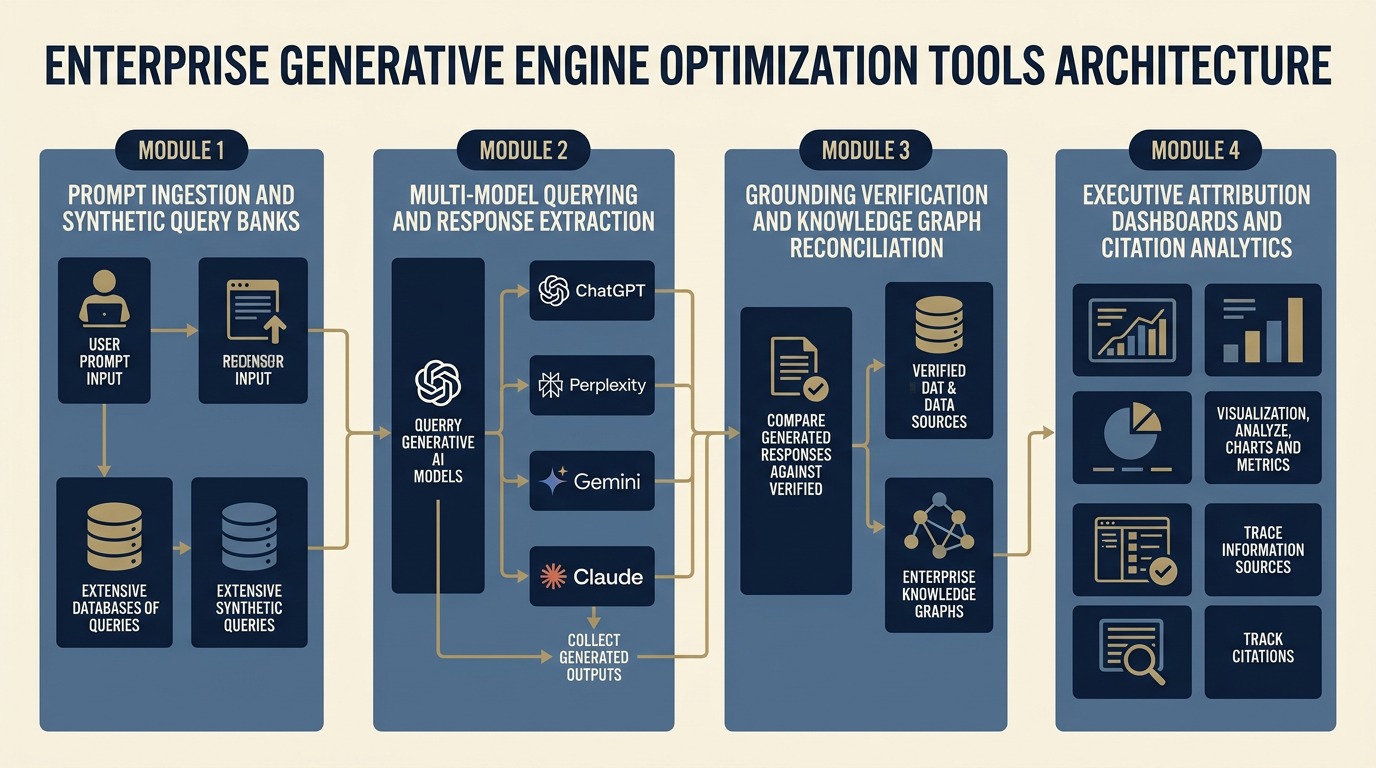
Enterprise-grade Generative Engine Optimization tools are built on sophisticated data ingestion, natural language processing, and automated API querying infrastructure. When evaluating market solutions, enterprise software buyers should evaluate five critical capability pillars:
1. Automated Multi-Model Prompt Sampling
The foundation of any GEO platform is its ability to simulate conversational buyer queries at scale. Enterprise tools maintain automated API connections to major foundational models, including OpenAI ChatGPT (GPT-4o, o1), Anthropic Claude (Claude 3.5 Sonnet), Google Gemini (Gemini 1.5 Pro), and Perplexity Pro. The software repeatedly queries these models using parameterized prompt templates representing awareness, consideration, and vendor decision stages, calculating empirical appearance percentages across diverse system conditions.
2. Citation and Footnote Attribution Mapping
When an AI engine generates an answer, it selects grounding sources through its RAG pipeline. Leading GEO software analyzes the footnote URLs embedded in generated responses, identifying exactly which digital assets are fueling the model’s knowledge. This capability reveals whether the AI is sourcing data directly from your corporate website, independent software review aggregators (such as G2 or Capterra), Wikipedia, or competitor news releases.
3. Entity Normalization and Knowledge Graph Auditing
Generative AI engines rely on semantic knowledge graphs to verify corporate relationships, product features, and leadership rosters. If an organization suffers from fragmented naming conventions or contradictory historical records across the web, AI engines frequently misattribute products or invent non-existent limitations. Advanced GEO tools enforce BrandRank AI normalization transformation rules, reconciling entity mismatches across public knowledge bases like Wikidata and Crunchbase.
4. Sentiment Polarity and Hallucination Monitoring
Beyond measuring whether a brand is mentioned, enterprise marketers must understand how the brand is portrayed. GEO tools employ sentiment classification algorithms to evaluate the tone of generated descriptions, categorizing brand perceptions as positive, neutral, or critical. Additionally, these platforms monitor for factual hallucinations (such as incorrect enterprise pricing tiers, fabricated security vulnerabilities, or discontinued software modules) and alert marketing operations teams immediately.
5. Competitor Share of Model (SoM) Benchmarking
Similar to traditional Share of Voice, Share of Model measures the percentage of relevant conversational responses in which a specific vendor is recommended relative to its primary market competitors. By tracking SoM trends over rolling 30-day and 90-day intervals, enterprise CMOs can determine whether their content publishing and digital PR initiatives are actively expanding their AI footprint or losing ground to competitors.
Leading Generative Engine Optimization Tools: The 2026 Enterprise Evaluation
The market for GEO software has matured rapidly, shifting from experimental prompt scripts to enterprise SaaS platforms equipped with role-based access control, SOC-2 certifications, and advanced data export integrations. Below is an analytical review of the leading generative engine optimization platforms available in 2026:
| Platform Name | Primary Specialization | Engines Monitored | Entity & Graph Governance | Ideal Enterprise Fit |
|---|---|---|---|---|
| BrandRank.ai | Entity trust, normalization rules, and corporate reputation governance | ChatGPT, Claude, Gemini, Perplexity, Copilot | Automated entity reconciliation and knowledge graph drift audits | Global Fortune 500 enterprises, multi-brand conglomerates |
| Profound | AI search visibility intelligence and real-time prompt volume analytics | Perplexity, ChatGPT Search, Google AI Overviews | Citation network graphs and domain authority mapping | High-growth B2B SaaS, enterprise tech vendors |
| Otterly.ai | Automated AI search monitoring, citation alerts, and competitor tracking | ChatGPT, Claude, Google AI Overviews, Perplexity | Basic brand mention tracking and sentiment indexing | Mid-market digital agencies, scaling direct-to-consumer brands |
| Semrush AI Search Toolkit | Hybrid organic search and conversational AI response monitoring | Google AI Overviews, Bing Copilot, ChatGPT | Integration with traditional backlink and keyword databases | Existing enterprise SEO teams integrating AI search metrics |
| Peec AI | Prompt journey tracking and conversational sales funnel intelligence | Perplexity, Claude, ChatGPT, Mistral | Persona-based prompt evaluation and source verification | Enterprise marketing analytics and revenue operations teams |
1. BrandRank.ai: The Enterprise Benchmark for Entity Trust
BrandRank.ai is widely recognized as the premier solution for large enterprises operating multi-brand portfolios. The platform differentiates itself by focusing heavily on entity data integrity. Rather than simply logging whether a model mentions a brand, BrandRank.ai analyzes the underlying semantic relationship graphs connecting corporate entities, executive spokespersons, and proprietary software suites.
The system excels at identifying attribute drift, such as when an AI model erroneously reports that an enterprise product lacks a specific security credential or conflates a subsidiary with an independent competitor. For corporate communications and legal compliance teams, BrandRank.ai provides an audit trail that supports broader corporate reputation management initiatives across machine learning ecosystems.
2. Profound: Precision Intelligence for High-Growth Technology Brands
Profound is designed specifically for digital marketing teams and search specialists seeking actionable intelligence on conversational search behavior. The software operates high-velocity prompt sampling networks that track buyer queries across every stage of the procurement cycle. Its proprietary algorithms calculate prompt volume estimates, enabling marketers to prioritize optimization efforts around the queries that generate genuine commercial impact.
One of Profound’s key strengths is its granular citation network mapping. Users can see precisely which third-party articles, customer review threads, and technical comparison tables are most frequently retrieved by Perplexity and ChatGPT Search. This data allows marketing teams to focus digital PR and media relations on publications that directly feed AI grounding indices.
3. Otterly.ai: Streamlined Monitoring and Automated Executive Alerts
For mid-market enterprises and marketing agencies requiring rapid deployment, Otterly.ai offers an accessible yet capable entry point into generative engine monitoring. The platform tracks brand appearances across Google AI Overviews, Perplexity, and ChatGPT, delivering automated notifications whenever an AI model shifts its recommendation sentiment or introduces new competitor citations.
Otterly.ai is particularly well-suited for organizations that want immediate visibility into AI brand mentions without having to configure complex API pipelines or manage custom prompt banks internally.
4. Semrush AI Search Toolkit: The Hybrid Bridge for Existing Search Teams
For organizations with significant investments in established SEO workflows, Semrush has developed dedicated AI search monitoring modules. These tools bridge traditional organic rankings with generative response data, allowing analysts to compare standard Google keyword rankings directly alongside Google AI Overview citation cards in a unified workspace.
While Semrush focuses primarily on Google’s search ecosystem, its extensive historical keyword data and backlink indices provide useful context when evaluating why specific domains earn citation authority within Google’s retrieval pipelines.
Enterprise Procurement Framework: How to Select the Right GEO Tool
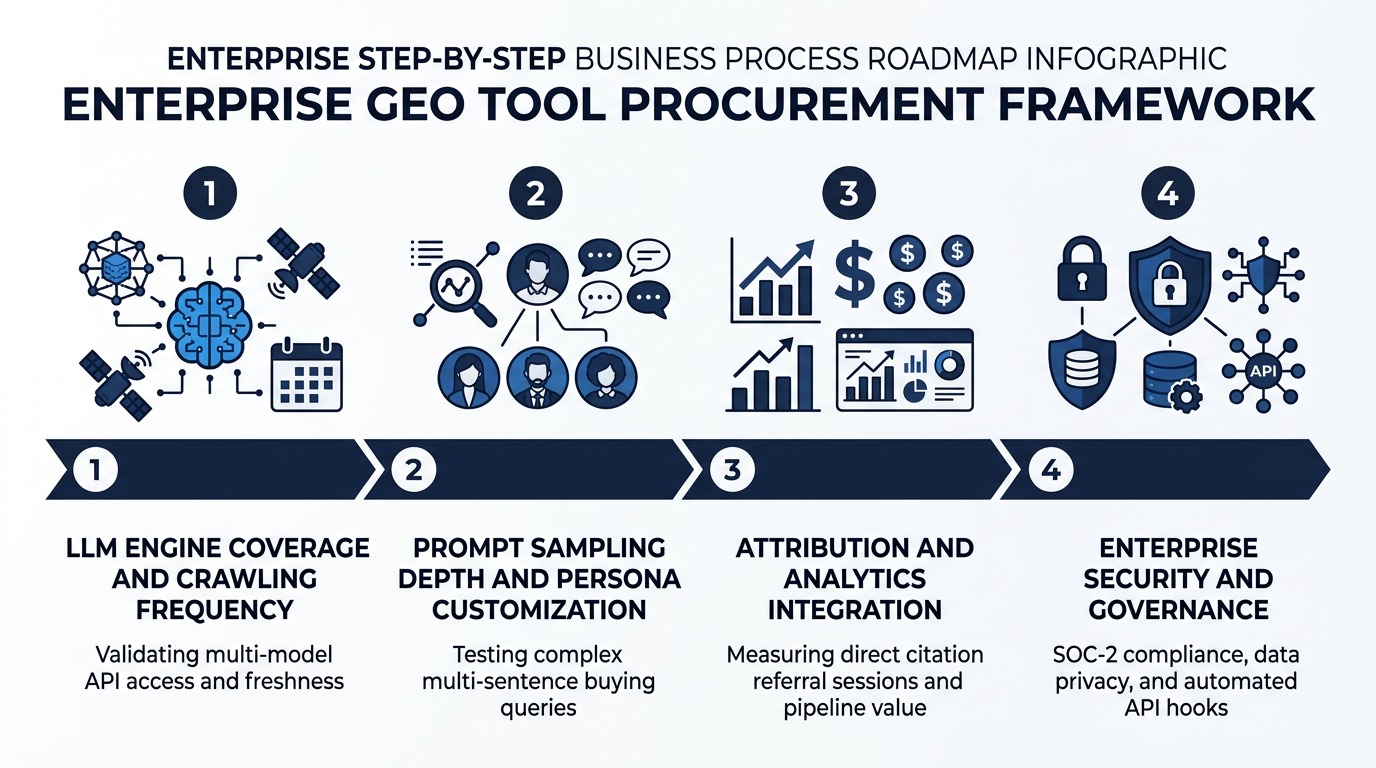
Selecting the optimal generative engine optimization software requires assessing technical capabilities, compliance requirements, and integration architecture. Enterprise procurement committees should evaluate prospective vendors across four stages:
Stage 1: Multi-Model Engine Coverage and Update Frequency
The AI search environment evolves rapidly. Software that only monitors one specific model provides an incomplete picture of your digital footprint. Verify that prospective vendors maintain native API connections to OpenAI, Anthropic, Google, and Perplexity. Inquire about the vendor’s update frequency: how quickly do they incorporate new foundational model releases and modified system prompts into their sampling engines?
Stage 2: Prompt Sampling Depth and Persona Customization
Static queries fail to capture how real buyers evaluate enterprise solutions. The platform must allow content strategists to construct custom prompt variations reflecting diverse industry verticals, enterprise employee sizes, budget parameters, and technical integrations. In addition, the software must simulate variable conversational temperature settings to reflect real-world user experiences.
Stage 3: Enterprise Security and Data Governance Compliance
Enterprise brands handle sensitive intellectual property and confidential customer information. When connecting internal knowledge repositories or customer feedback systems to GEO tools, corporate legal teams must ensure the software complies with established standards, such as the official NIST Artificial Intelligence Risk Management Framework. Insist on SOC-2 Type II certification, role-based user permissions, and strict contractual guarantees that your proprietary prompt data will never be used to train third-party public models.
Stage 4: Data Portability and BI Dashboard Integrations
GEO data cannot exist in an isolated silo. Marketing leaders must correlate conversational visibility with downstream pipeline growth and revenue metrics. Prioritize platforms that provide documented REST APIs, webhook alert capabilities, and pre-built connectors to business intelligence platforms like Tableau, Looker, and Power BI.
Implementation Blueprint: Deploying GEO Tools in Your Organization
Deploying generative engine optimization tools requires structured collaboration across content strategy, technical SEO, digital PR, and web analytics teams. Follow this phased implementation blueprint:
| Deployment Phase | Core Operational Objectives | Key Milestones & Deliverables | Responsible Teams |
|---|---|---|---|
| Phase 1: Foundation (Weeks 1–2) | Build prompt banks, establish baseline Share of Model, configure API tracking | Catalog of 100 high-intent enterprise buyer prompts; baseline visibility score report | Search Strategy & Product Marketing |
| Phase 2: Citation Audit (Weeks 3–5) | Map grounding sources, identify missing third-party citations, audit competitor footnotes | Citation gap matrix highlighting top 25 external review sites and publications driving AI answers | Digital PR & Communications |
| Phase 3: Content Engineering (Weeks 6–9) | Restructure core product pages into modular answer units, deploy entity Schema.org markup | Implementation of structured comparison tables and verified technical documentation chunks | Content Editorial & Web Engineering |
| Phase 4: Governance (Ongoing) | Automate weekly prompt sampling, track referral traffic headers, resolve hallucination alerts | Executive Share of Model dashboards integrated into corporate BI reporting | Marketing Operations & Revenue Analytics |
When executing this roadmap, content teams must adhere strictly to established quality criteria, such as the official Google Search Central Guidelines, ensuring that all published materials offer original technical analysis, verified factual specifications, and direct human expertise.
Frequently Asked Questions About Generative Engine Optimization Tools
How do GEO tools collect response data from commercial AI platforms?
GEO tools gather response data primarily through automated enterprise API connections to commercial foundational models like OpenAI, Anthropic, Google, and Perplexity. By submitting programmatic prompt requests with fixed temperature parameters, the software captures exact output tokens, extracts citation footnotes, and parses entity relationships without relying on fragile web browser automation.
What is the difference between GEO tools and social listening software?
Social listening software monitors public human conversations across social media platforms like X, LinkedIn, and Reddit to measure brand sentiment. In contrast, GEO tools evaluate how artificial intelligence models synthesize brand knowledge during conversational buyer inquiries. While social listening monitors human discourse, GEO tools evaluate algorithmic comprehension and machine retrieval.
How often should an enterprise run prompt sampling sweeps?
Most enterprise brands execute core commercial prompt sweeps once a week. Because foundational models update their grounding indexes continuously, a weekly cadence provides sufficient data to track visibility trends without generating excessive API computing costs. For critical product launch cycles or crisis management events, daily sampling runs are standard practice.
Can GEO tools automatically rewrite website content to fix visibility gaps?
While some emerging tools offer AI-assisted rewriting suggestions, enterprise-grade platforms focus on diagnostic intelligence, source attribution analysis, and entity verification. Automated bulk rewriting often introduces generic phrasing that harms brand credibility. High-performing organizations use GEO tools to identify content gaps, leaving final editorial structuring to experienced subject matter experts.
What budget should enterprise marketing organizations allocate for GEO software?
Enterprise GEO subscriptions generally range from $1,000 to $5,000 per month for mid-market platforms, with full enterprise packages exceeding $10,000 per month for global brands requiring custom prompt banks, dedicated entity governance, and direct data warehouse connectors.
The Strategic Imperative: Securing Brand Authority in the AI Era
The commercial internet has entered a new phase of information retrieval. Conversational synthesis engines are rapidly replacing static search directories as the primary point of consideration for high-value enterprise buyers. Organizations that continue to evaluate digital visibility through the narrow lens of legacy keyword rank risk waking up to discover that their brand has become invisible to modern generative search engines.
Investing in dedicated Generative Engine Optimization tools is no longer an optional experimentation channel; it is a fundamental pillar of corporate market protection. By systematically monitoring multi-model prompt responses, resolving entity contradictions, and tracking citation attribution pathways, forward-thinking enterprise leaders ensure their organization remains the authoritative, verified direct answer recommended by artificial intelligence across global markets.