
According to annual tribunal statistics published by the Ministry of Justice, British employment tribunals receive more than 22,000 single unfair dismissal jurisdictional complaints each year. Yet among these disputes, constructive dismissal claims represent both the most emotionally charged and the most legally precarious. Research compiled by the Chartered Institute of Personnel and Development (CIPD) and judicial analysis of tribunal outcomes indicate that fewer than 20% of constructive dismissal claims succeed at a full hearing, primarily because the legal threshold for establishing that an employer effectively forced an employee to resign is exceptionally demanding.
Under the Employment Rights Act 1996, the burden of proof in an ordinary unfair dismissal claim rests upon the employer to prove a fair statutory reason and a fair disciplinary or dismissal process. In stark contrast, when an employee claims constructive dismissal, that burden reverses completely. The departing worker must prove on the balance of probabilities that the company committed a fundamental, repudiatory breach of contract so severe that it struck at the very root of the employment relationship, leaving them with no reasonable option but to quit.
For company directors, HR executives, and business owners, an unhandled grievance or botched disciplinary procedure can quickly escalate into an expensive tribunal claim. With statutory compensation limits updated for 2026 and major employment law reforms reshaping workplace rights across Great Britain, understanding the legal boundaries is an operational necessity. This 2026 authority guide explains the statutory constructive dismissal uk framework, the four-stage legal test established in case law, the ACAS Code of Practice, compensation calculations, and how employers can protect their enterprises against costly liability.
Quick Answer: What is constructive dismissal in the UK?
Constructive dismissal occurs under Section 95(1)(c) of the Employment Rights Act 1996 when an employee resigns from their position in response to an employer’s fundamental breach of contract. To succeed before an Employment Tribunal, the claimant must satisfy a strict four-stage legal test: they must prove that the employer committed a serious repudiatory breach (either of an express term or the implied term of mutual trust and confidence), that the breach went to the root of the contract, that they resigned in direct response to that breach, and that they did not waive the breach by delaying their resignation (“affirmation”). The employee generally requires two years of continuous service, must initiate ACAS Early Conciliation within three months minus one day of their resignation date, and faces statutory compensation caps of up to £22,530 for the basic award and up to £123,543 (or 52 weeks’ pay) for the compensatory award in 2026.
Key Takeaways: Constructive Dismissal Rules for 2026
- Reversed Burden of Proof: Unlike direct dismissals where the employer must prove fairness, the employee bears the entire legal burden of proving a repudiatory breach of contract.
- The Four-Stage Test: Tribunals strictly apply the Western Excavating principles requiring an actual or anticipatory breach, root severity, direct causal resignation, and zero undue delay.
- The Two-Year Qualifying Threshold: Employees normally need two years of continuous service to claim ordinary constructive dismissal, unless the breach involves discrimination, whistleblowing, or statutory health and safety rights.
- The Affirmation Danger: Continuing to work, accepting contractual pay, or delaying resignation for several weeks without formal written protest usually destroys a constructive dismissal claim.
- ACAS Code Financial Penalties: Failure by either the employer or the employee to follow the ACAS Code of Practice on Disciplinary and Grievance Procedures can result in an award adjustment of up to 25%.
What Is Constructive Dismissal Under UK Employment Law?
In British employment jurisprudence, constructive dismissal is legally classified as a form of dismissal rather than a resignation. The statutory foundation is codified in Section 95(1)(c) of the Employment Rights Act 1996, which states that a dismissal takes place when an employee terminates the contract under which they are employed (with or without notice) in circumstances in which they are entitled to terminate it without notice by reason of the employer’s conduct.
In simple commercial terms, the employer has made the employee’s working life so intolerable, or has committed such an egregious legal wrong, that the law treats the resulting resignation as a termination instigated by the company itself. The employee is deemed to have been “constructively” dismissed.
However, an unreasonable employer is not automatically a law-breaking employer. An Employment Tribunal does not ask whether an employer was unfair, impolite, demanding, or unpleasant. The central legal question is whether the employer committed an actionable breach of contract. This critical distinction explains why many employees who resign over personality clashes, intense workloads, or standard management reorganizations fail before the tribunal.
The Two-Year Qualifying Service Requirement
To lodge a standard claim for constructive unfair dismissal at an Employment Tribunal in England, Wales, or Scotland, an employee must have accumulated at least two years of continuous employment with the company by their effective date of termination. If an individual has worked for your business for 18 months and resigns due to a contract dispute, they are generally barred from bringing a statutory constructive unfair dismissal claim.
However, business owners must recognize crucial statutory exceptions to this two-year rule. “Day-one” claims require zero qualifying service where the employer’s repudiatory breach is linked to an automatically unfair statutory reason:
- Protected Characteristics & Discrimination: Breaches related to age, disability, gender reassignment, marriage/civil partnership, pregnancy/maternity, race, religion, sex, or sexual orientation under the Equality Act 2010.
- Public Interest Whistleblowing: Detrimental conduct or constructive termination following a protected disclosure under the Public Interest Disclosure Act 1998.
- Health & Safety Enforcement: Resigning because the employer failed to rectify imminent, serious danger or penalized the worker for raising safety concerns.
- Statutory Wage Protection: Enforcing statutory rights, including the National Minimum Wage or Working Time Regulations.
Where qualifying service is absent and no statutory exception exists, an employee’s sole potential recourse is a common law claim for wrongful dismissal (a breach of contract claim focused strictly on unpaid notice pay), which can be pursued in an Employment Tribunal or the County Court.
Legal Claim Type |
Who Initiates Termination |
Primary Legal Question |
Burden of Proof |
|---|---|---|---|
| Constructive Dismissal | Employee resigns (forced by breach) | Did employer commit a fundamental repudiatory breach? | Rests entirely on the employee |
| Direct Unfair Dismissal | Employer terminates employment | Was the reason fair and procedure reasonable? | Rests on the employer |
| Wrongful Dismissal | Either party (usually employer) | Was contractual notice pay paid or lawfully withheld? | Claimant must prove contractual term breach |
| Standard Resignation | Employee resigns voluntarily | Did employee serve lawful contractual notice? | Not applicable (no dispute) |
The Four-Stage Legal Test: The Western Excavating Standard
To succeed in a constructive dismissal claim, it is not enough for an employee to feel aggrieved. Since the landmark Court of Appeal ruling in Western Excavating (ECC) Ltd v Sharp [1978], English tribunals have maintained a rigorous four-stage test. An employee must satisfy every single branch of this test; failing any single branch leads to immediate dismissal of the claim.
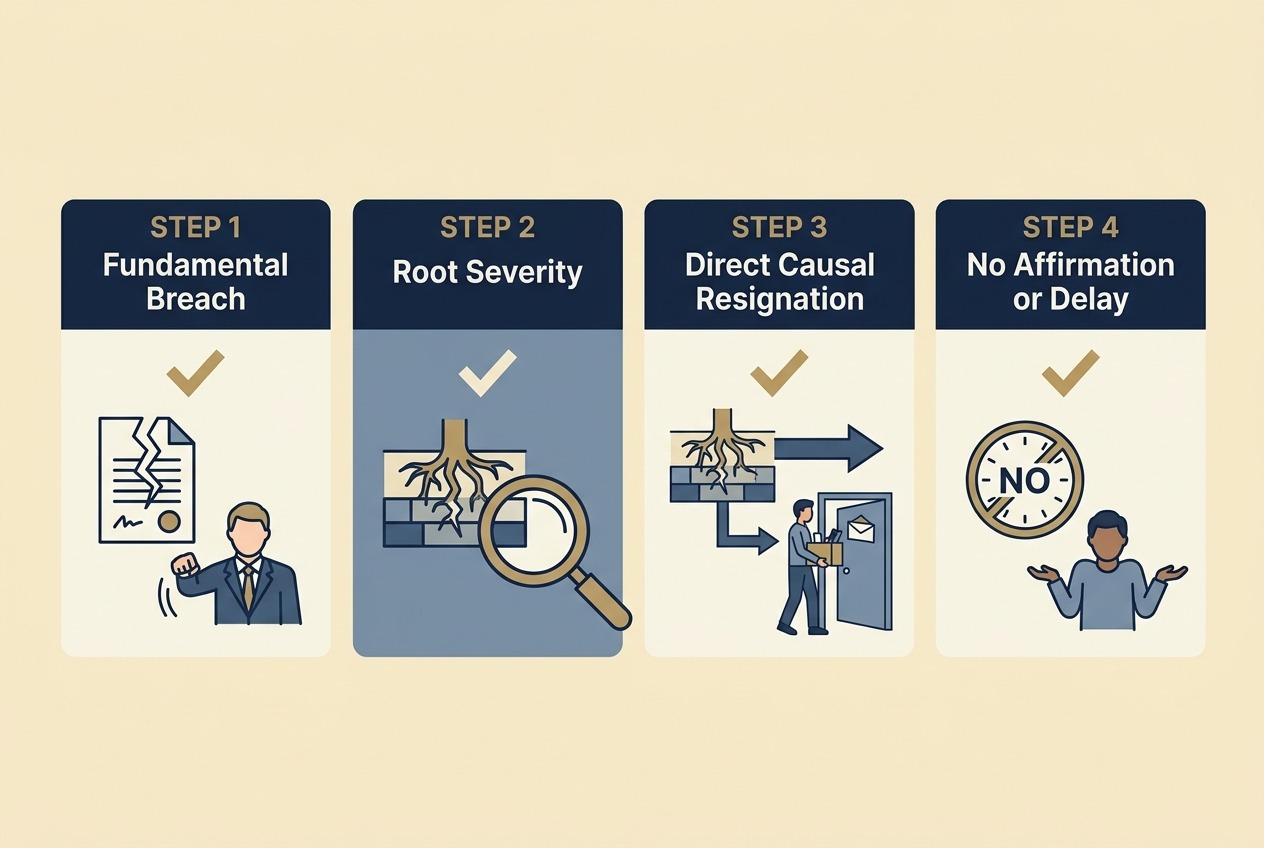
Stage 1: A Serious Breach of Contract (Actual or Anticipatory)
There must be a fundamental breach of contract by the employer. This breach can be actual (an action already taken, such as slashing wages or stripping managerial duties) or anticipatory (the employer formally announcing an intention to commit a repudiatory breach in the near future, such as stating: “starting next month, your salary will drop by 30% or you will be dismissed”).
The breach can involve an express contractual term (written terms governing basic pay, contractual hours, job title, or location) or an implied term. Most constructive dismissal claims hinge upon the implied term of mutual trust and confidence.
Stage 2: The Breach Must Be Repudiatory (Going to the Root)
The conduct must not be minor, technical, or inconsequential. It must be a “repudiatory” breach, meaning conduct that demonstrates the employer no longer intends to be bound by the fundamental terms of the employment agreement. An administrative error that delays expense reimbursements by five days is an annoyance; an intentional refusal to pay contractual salary for two consecutive months is a repudiatory breach.
Stage 3: Resignation in Direct Response to the Breach
The employee must prove that the employer’s repudiatory breach was the effective, operating cause of their resignation. If an employer commits a serious breach, but evidence proves that the employee resigned because they had already accepted a higher-paying job elsewhere, were relocating to another city for personal reasons, or were planning retirement, the claim collapses. While the breach does not need to be the sole reason, it must be an effective moving factor.
Stage 4: Prompt Resignation Without Undue Delay (No Affirmation)
The final requirement is the most frequent stumbling block for claimants. When a repudiatory breach occurs, the employee faces an immediate legal election: they can either accept the breach, treat the contract as terminated, and resign; or they can affirm the contract and continue working under its terms.
If an employee remains in their role for weeks or months after the breach, continues collecting full monthly pay, performs regular duties, and raises no formal written protest, the law treats them as having “affirmed” the contract. Once affirmed, the breach is legally waived and cannot subsequently be used as the basis for a constructive dismissal claim.
Common Workplace Examples: Express and Implied Breaches
Workplace friction takes many forms, but repudiatory breaches generally divide into explicit contractual alterations and breaches of the implied duty of mutual trust and confidence.
1. Unilateral Imposition of Contractual Changes
When businesses experience financial pressure or operational shifts, directors sometimes attempt to impose changes unilaterally without consulting staff. The following employer actions constitute textbook repudiatory breaches:
- Unilateral Salary Reductions: Slashing basic pay, withdrawing contractual bonuses, or withholding commissions without explicit contractual authority or genuine mutual agreement.
- Unilateral Demotion or Status Stripping: Removing a manager’s direct reports, revoking their operational title, or reallocating core responsibilities to junior staff, even if basic salary remains untouched.
- Imposing Unreasonable Location Changes: Enforcing a geographic relocation without an express mobility clause in the contract. Even where a mobility clause exists, invoking it unreasonably (such as demanding a parent relocate 150 miles away with three days’ notice) breaches implied terms.
- Drastic Shifts in Working Hours: Forcing a day-shift worker onto night rotations or drastically cutting hours without contractual variation agreements.
When businesses restructure teams or reorganize operational departments, formal procedures must be followed to avoid accidental repudiation. Review our guide on redundancy consultation rules and timelines to ensure corporate restructurings adhere to statutory collective consultation thresholds.
2. Breach of Mutual Trust and Confidence (The Malik Standard)
Every UK employment contract contains an inescapable common-law term: neither party will, without reasonable and proper cause, conduct itself in a manner calculated or likely to destroy or seriously damage the relationship of trust and confidence between employer and employee. This standard was firmly established by the House of Lords in Malik and Mahmud v Bank of Credit and Commerce International SA [1997].
Examples of conduct that breach this fundamental term include:
- Subjecting an employee to public humiliation, shouting, or abusive language in front of clients or colleagues.
- Fabricating disciplinary charges or manufacturing unfounded allegations of gross misconduct to drive an employee out.
- Failing to provide a safe working environment, including ignoring documented bullying, harassment, or physical hazards.
- Imposing an excessive workload over an extended period while ignoring medical notes and occupational health warnings of impending psychological breakdown.
- Suspending an employee arbitrarily without reasonable and proper cause, treating suspension as a routine sanction rather than an exceptional holding measure.
3. The “Last Straw” Doctrine
Constructive dismissal does not always stem from a single dramatic event. In many workplaces, a toxic environment develops through a succession of minor incidents over months or years. An employee may endure petty insults, missed overtime payments, unreasonable micromanagement, and overlooked grievances.
Under the legal doctrine established in Omilaju v Waltham Forest London Borough Council [2005], an employee can resign in response to a cumulative course of conduct. The final event, known as the “last straw”, does not need to be a repudiatory breach in its own right. However, it must contribute something to the breach of trust and confidence. It cannot be an entirely benign, reasonable action by the employer. If the final straw is a legitimate, reasonable management action (such as an employer reasonably declining an unapproved holiday request), the cumulative chain breaks and the claim fails.
The ACAS Code of Practice and Grievance Procedures
When an employee believes their employer has committed a serious breach, standard practical and legal guidance dictates that they should raise a formal internal grievance before walking out the door. The definitive statutory framework governing workplace disputes is set out in the ACAS Guidance on Workplace Dismissals.
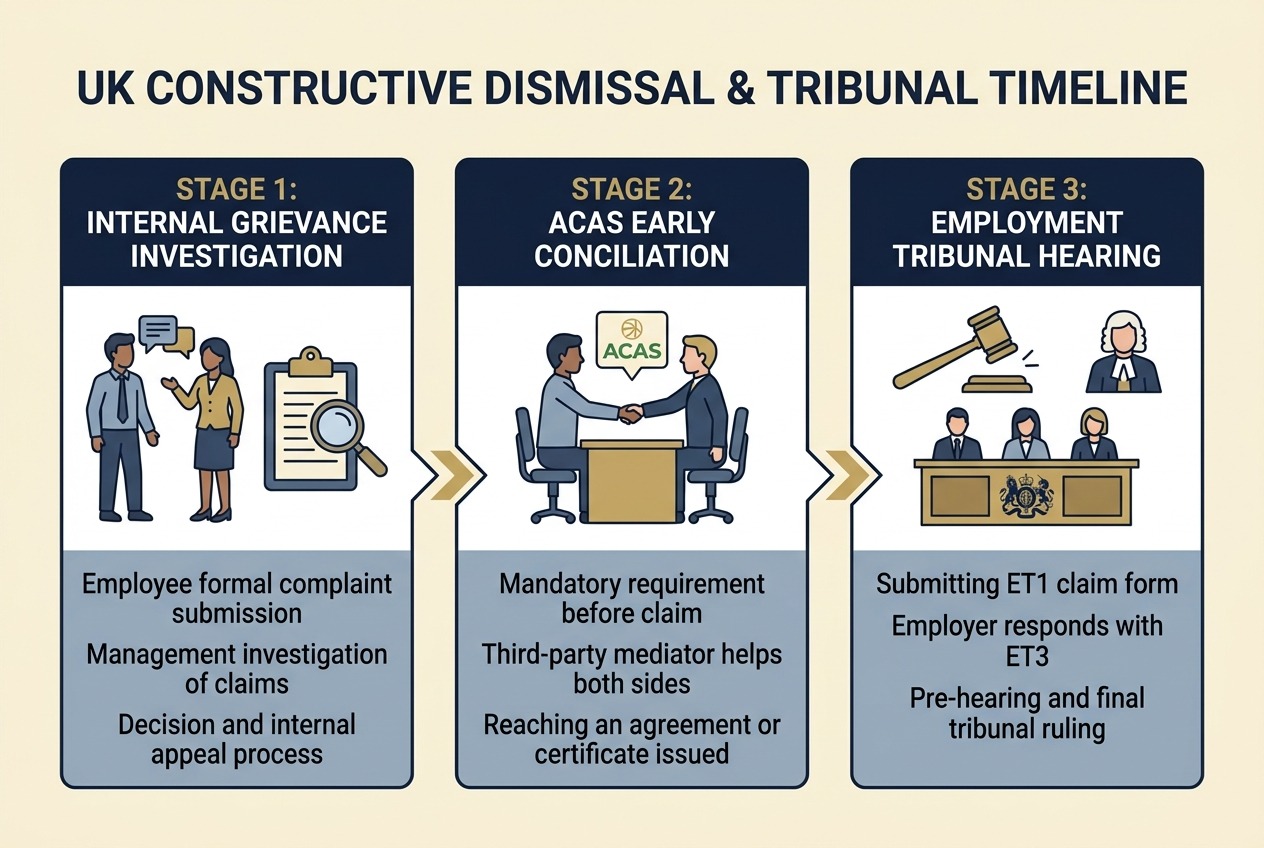
Is Raising a Formal Grievance Legally Mandatory?
Strictly speaking, the Employment Rights Act 1996 does not make lodging an internal grievance a statutory precondition to claiming constructive dismissal. If an employer’s physical assault or extreme fraud makes continued presence impossible, an employee can resign immediately without notice.
However, resigning without submitting a formal written grievance is a catastrophic tactical error in 95% of cases. Employment Tribunals expect employees to give their employer an opportunity to investigate and rectify problems internally. Under Section 207A of the Trade Union and Labour Relations (Consolidation) Act 1992, if an employee unreasonably fails to follow the ACAS Code of Practice on Disciplinary and Grievance Procedures by resigning without attempting internal resolution, the tribunal can penalize them by reducing any compensation awarded by up to 25%.
Conversely, if an employee submits a formal grievance and the employer ignores it, delays the hearing unreasonably, or conducts a whitewash investigation, that procedural failure provides potent additional evidence of a breach of mutual trust and confidence. If the employer unreasonably fails to follow the ACAS Code, the tribunal can increase the employee’s compensation by up to 25%.
Mandatory ACAS Early Conciliation
Before any claim can be submitted to an Employment Tribunal, the claimant must notify ACAS and complete the Early Conciliation process. Early Conciliation is a free, confidential service designed to explore whether the dispute can be settled through financial compensation, an agreed reference, or a workplace mediation agreement without formal litigation.
If conciliation succeeds, the parties sign a legally binding COT3 agreement. If conciliation fails or either party declines to participate, ACAS issues a formal Early Conciliation Certificate with a unique reference number. An Employment Tribunal will automatically reject any claim form (ET1) that lacks this reference number.
Tribunal Time Limits: The Three-Month Cliff Edge
Employment tribunal deadlines operate with ruthless strictness. Under standard UK law, an employee has exactly three months minus one day from their Effective Date of Termination (EDT) to commence ACAS Early Conciliation. If an employee resigns on 15 May, the deadline to approach ACAS is 14 August.
Notifying ACAS pauses the statutory limitation clock during the conciliation period (a mechanism known as the “stop the clock” provision). Once ACAS issues the conciliation certificate, the claimant has at least one calendar month from the certificate date to submit their formal ET1 claim form to the HM Courts and Tribunals Service Employment Tribunal Portal.
Missing this deadline by even an hour is fatal to the claim. Tribunals can only grant an extension where it was “not reasonably practicable” for the claim to be presented in time, an exceptionally high legal bar that ignorance of the law or poor advice from a non-lawyer will not satisfy.
Employment Tribunal Compensation and Statutory Caps (2026 Limits)
If an employee successfully proves constructive unfair dismissal, the financial remedy awarded by the tribunal consists of two primary elements: the Basic Award and the Compensatory Award.
1. The Basic Award
The Basic Award is a statutory formula designed to compensate the worker for loss of job security. It is calculated identically to statutory redundancy pay, using a three-tier multiplier based on the employee’s age and complete years of continuous service (capped at 20 years):
- Age under 22: 0.5 week’s pay for each full year of service.
- Age 22 to 40: 1.0 week’s pay for each full year of service.
- Age 41 and older: 1.5 weeks’ pay for each full year of service.
Effective from 6 April 2026, the statutory cap on a “week’s pay” under the Employment Rights (Increase of Limits) Order is £751 per week. Consequently, the maximum statutory Basic Award payable in 2026 is £22,530 (30 weeks maximum x £751).
2. The Compensatory Award
The Compensatory Award compensates the claimant for actual net financial loss suffered as a direct result of the dismissal. It covers:
- Net earnings lost between the date of resignation and the tribunal hearing (after deducting earnings from any new job).
- Estimated future loss of earnings until the claimant secures comparable employment.
- Loss of contractual benefits, including company car allowances, private healthcare, and employer pension contributions.
- A modest award for loss of statutory employment rights (typically £350 to £500).
For dismissals occurring on or after 6 April 2026, the statutory cap on the Compensatory Award is £123,543, or 52 weeks’ actual gross pay, whichever is lower. However, employers must heed an essential warning: if the constructive dismissal is tainted by unlawful discrimination or public interest whistleblowing, the statutory compensation cap is removed entirely, exposing the business to uncapped financial liability.
| Compensation Element | Statutory Cap (2026/27) | Calculation Basis | Potential Adjustments |
|---|---|---|---|
| Basic Award | £22,530 maximum | Age multiplier x service years x £751 weekly cap | Can be reduced for blameworthy conduct |
| Compensatory Award | £123,543 (or 52 weeks’ pay) | Actual net earnings, pension & benefit losses | +/- 25% ACAS Code uplift or deduction |
| Discrimination Element | Uncapped | Vento bands for injury to feelings + total net loss | Aggravated damages in severe cases |
| Duty to Mitigate | Reduces total loss claim | Claimant must actively search for alternative work | Loss cut off once new comparable role starts |
The Harsh Reality: Why Most Constructive Dismissal Claims Fail
Employees regularly consult solicitors believing they have an open-and-shut case, only to discover their claim is legally fragile. Understanding the primary pitfalls protects employers during dispute resolution and prevents individuals from prematurely resigning into financial hardship.
1. The Severity Hurdle
Workplace life is frequently stressful. Managers give critical performance reviews, deny discretionary bonuses, decline holiday requests, and introduce unpopular operational procedures. While these actions may generate discontent, they do not cross the high threshold of a repudiatory breach. Tribunals recognize that employers possess management prerogative to run their business, provided they do not breach core contractual terms.
2. Accidental Affirmation
Claimants frequently destroy their case through hesitation. If an employer announces an unlawful salary cut in January, and the employee continues working, accepts the reduced pay, attends team meetings, and only resigns in May when they find another job, the tribunal will rule that the employee affirmed the contract. Waiting more than a few weeks without lodging a formal written objection or grievance creates an almost insurmountable presumption of affirmation.
3. The Resignation Letter Defect
In many failed claims, the employee’s own resignation letter undermines their legal argument. If an employee submits a warm, polite resignation letter stating: “I want to thank the company for five wonderful years, but I have decided to pursue a new career opportunity,” that document becomes definitive evidence in the employer’s hands. The employer will present that letter to the tribunal to prove the employee did not resign in response to an alleged breach.
To preserve a constructive dismissal claim, a resignation letter must explicitly state that the employee is resigning with immediate effect solely because of the employer’s fundamental breach of contract, itemizing the specific conduct that forced the departure.
Employer Defences: How to Prevent and Manage Constructive Dismissal Risks
For company founders, executives, and HR leaders, constructive dismissal claims represent an expensive drain on executive time and legal budgets. Taking four decisive proactive measures eliminates risk before workplace friction matures into litigation.
1. Investigate Grievances Promptly and Impartially
Never ignore a formal or informal complaint. The moment an employee expresses dissatisfaction regarding workplace treatment, discrimination, bullying, or contractual variations, trigger the formal grievance procedure under the ACAS Code. Appoint an impartial manager to conduct thorough interviews, review documentary evidence, and deliver written findings with clear appeal rights. A demonstrated willingness to investigate and resolve issues destroys the argument that the company shattered mutual trust and confidence.
2. Handle Contract Variations Lawfully
If your enterprise needs to restructure salaries, alter working hours, or relocate operations, never impose changes by managerial decree. Engage in genuine, documented collective or individual consultations. Explain the commercial necessity, listen to counter-proposals, and seek explicit written consent. If agreement proves elusive, consider whether contractual flexibility clauses exist or whether the business must follow formal fire-and-rehire procedures (subject to the rigorous statutory ACAS Code on Dismissal and Re-engagement).
Structuring formal executive duties and employment frameworks correctly from day one is essential for every growing business; review our detailed guidance on registering a limited company in the UK to establish clear corporate governance and fiduciary boundaries.
3. Utilize Protected Conversations and Settlement Agreements
When an employment relationship has clearly fractured beyond repair, attempting to force the employee out invites an immediate constructive dismissal tribunal claim. Instead, employers can utilize Section 111A of the Employment Rights Act 1996 to initiate a “protected conversation”.
Section 111A allows an employer to hold confidential, off-the-record discussions regarding a mutually agreed termination without those conversations being admissible as evidence in an ordinary unfair dismissal claim. The parties can negotiate a formal Settlement Agreement, under which the employee receives a severance package in exchange for signing a full waiver of all statutory tribunal claims. To be legally binding, the employee must receive independent legal advice from a qualified solicitor, funded by the company.
In addition, businesses must ensure their balance sheets and commercial operations are insulated against operational and liability claims; explore our analysis of public liability insurance and commercial protection to safeguard your enterprise against broader third-party risks.
Frequently Asked Questions
Can I claim constructive dismissal if I have worked somewhere for less than two years?
Under standard UK employment rules, you cannot claim ordinary constructive unfair dismissal without at least two years of continuous service. However, there is zero service requirement if the employer’s conduct involves unlawful discrimination under the Equality Act 2010, public interest whistleblowing, statutory health and safety enforcement, or pregnancy/maternity rights. In non-qualifying cases without discrimination, your only recourse is a wrongful dismissal claim for breach of contractual notice pay.
Can I work my notice period if I claim constructive dismissal?
While Section 95(1)(c) of the Employment Rights Act 1996 allows an employee to resign “with or without notice”, resigning with notice carries immense legal risk. Working out a prolonged three-month notice period provides the employer with powerful evidence that the breach was not truly fundamental and that you affirmed the contract. If you elect to work your notice, you must explicitly state in writing that you are working under protest to mitigate immediate financial losses while actively reserving your legal rights.
What happens if my employer rejects my formal grievance?
If an employer holds a fair hearing and rejects your grievance with reasonable, objective justification, that outcome does not automatically entitle you to claim constructive dismissal. To succeed before a tribunal, you must prove that the rejection itself was perverse, tainted by bias, or conducted in bad faith, thereby worsening the fundamental breach of mutual trust and confidence.
How is compensation calculated for constructive dismissal?
Compensation consists of two distinct components: the Basic Award (calculated using statutory age multipliers, years of continuous service up to 20 years, and the statutory weekly pay cap of £751 in 2026, creating a maximum basic award of £22,530) and the Compensatory Award (covering actual net loss of earnings and pension contributions, capped at £123,543 or 52 weeks’ gross pay, whichever is lower). Awards can be adjusted up or down by up to 25% for failure to follow the ACAS Code of Practice.
Can an employer defend a constructive dismissal claim by showing financial distress?
No. Financial hardship does not give an employer the legal right to commit a repudiatory breach of contract. An employer cannot justify unilaterally cutting basic pay, withholding contractual wages, or stripping core contractual benefits by pointing to falling revenues or cash flow problems. While financial difficulties may justify initiating a lawful redundancy process, they do not excuse contract repudiation.
What is the difference between unfair dismissal and constructive dismissal?
In a direct unfair dismissal claim, the employer terminates the employment contract (by firing the worker or refusing to renew a fixed-term contract), and the employer must prove a fair statutory reason and reasonable procedure. In a constructive dismissal claim, the employee terminates the contract by resigning, and the employee must prove that the employer committed a fundamental breach of contract that forced the departure.
What to Do Next: Employer Workplace Dispute Action Plan
Preventing workplace friction from turning into an expensive constructive dismissal claim requires rapid, structured intervention. If your business faces an escalating staff dispute, execute these four immediate management actions:
- Acknowledge Grievances in Writing Within 48 Hours: Never let a written complaint linger. Acknowledge receipt immediately, provide a copy of your internal grievance procedure, and schedule a formal investigation meeting in accordance with the ACAS Code of Practice.
- Audit Management Communications & Paper Trails: Review emails, Slack messages, and performance review notes involving the disputed employee. Identify whether any line manager engaged in inappropriate language, unilateral contractual alterations, or unreasonable performance targets that could support a breach of trust claim.
- Engage an Accredited Workplace Mediator: Where disputes stem from interpersonal friction or executive personality clashes rather than contractual non-payment, offer voluntary workplace mediation before positions harden into formal tribunal litigation.
- Consider a Protected Conversation Under Section 111A: If the employment relationship has irreparably broken down and mediation fails, seek specialist employment legal counsel to structure a confidential, protected discussion and offer a formal Settlement Agreement with a full statutory waiver.
Managing employee disputes demands strict adherence to statutory procedures, balanced documentation, and an objective understanding of employment law. Consult a qualified UK employment solicitor or an experienced CIPD-certified HR adviser to safeguard your business culture, protect commercial operations, and resolve workplace friction compliantly.