Executive Brief: Film, high-end television, and commercial theatre productions operate under extreme financial exposure. According to official data from the British Film Institute (BFI), annual UK screen production expenditure regularly surpasses £4.2 billion. Within this high-stakes environment, the unexpected illness, injury, or bereavement of a lead artist can halt principal photography instantly. Cast insurance provides vital financial indemnity against catastrophic delay overheads, rescheduling penalties, recast fees, and total project abandonment.
Quick Answer: What Is Cast Insurance in the UK?
Cast insurance (technically underwritten as Essential Elements insurance) is a specialised contingency policy for media production companies. It covers gross extra expenditures and rescheduling overheads incurred when declared key persons (lead actors, directors, key musical artists, or essential crew) suffer death, accidental injury, or acute illness that prevents them from working.
Coverage reimburses ongoing shoot costs during downtime, studio rental holds, equipment rental penalties, location re-booking fees, script rewrites, recasting expenses, and, in severe cases, the complete financial loss of abandoning the production. Premiums typically range from 1.5% to 3.5% of the gross production budget, depending on artist medical declarations, shoot duration, and stunt hazard levels.
Key Takeaways for UK Producers and Business Directors
- Contingency Core: Cast cover is not standard employer liability; it specifically indemnifies direct financial delays and restart costs caused by artist non-appearance.
- Medical Declarations: Every declared individual must complete a medical questionnaire or undergo an independent medical examination before cover binds.
- Pre-Existing Condition Exclusions: Underwriters exclude unmanaged chronic illnesses unless specific medical waivers or buy-back riders are negotiated.
- Essential Elements Endorsement: Can extend beyond actors to cover visionary directors, principal cinematographers, or indispensable theatre soloists.
- Motor Insurance Distinction: Driving with a physical plaster cast in the UK falls under separate Road Traffic Act regulations and invalidates standard motor policies without medical clearance.
The Economics of Production Delays: Why Cast Cover Is Mandatory
In mainstream commercial filming, daily operational burn rates range from £35,000 for independent features to upwards of £350,000 per day for major studio tentpoles and television dramas filmed at Pinewood, Shepperton, or Elstree Studios. Once a shoot commences, production companies incur non-negotiable overheads including sound stage leases, generator rentals, bespoke camera packages, lighting rigs, support crew wages, and catering logistics.
If a lead actor fractures an ankle or contracts severe respiratory illness, camera operations halt. However, the fixed production expenses do not stop. Studio spaces remain booked, specialised crew members must be retained on holding contracts, and post-production delivery schedules slide toward breach-of-contract deadlines with commercial distributors and broadcasters.
Completion guarantors and commercial financiers will not release production funds without active cast insurance in place. Just as standard trading businesses protect balance sheets with sole trader insurance requirements and commercial liability, film production companies establish cast coverage as their primary defence against solvency collapse.
Core Coverage Components: What Cast Insurance Covers
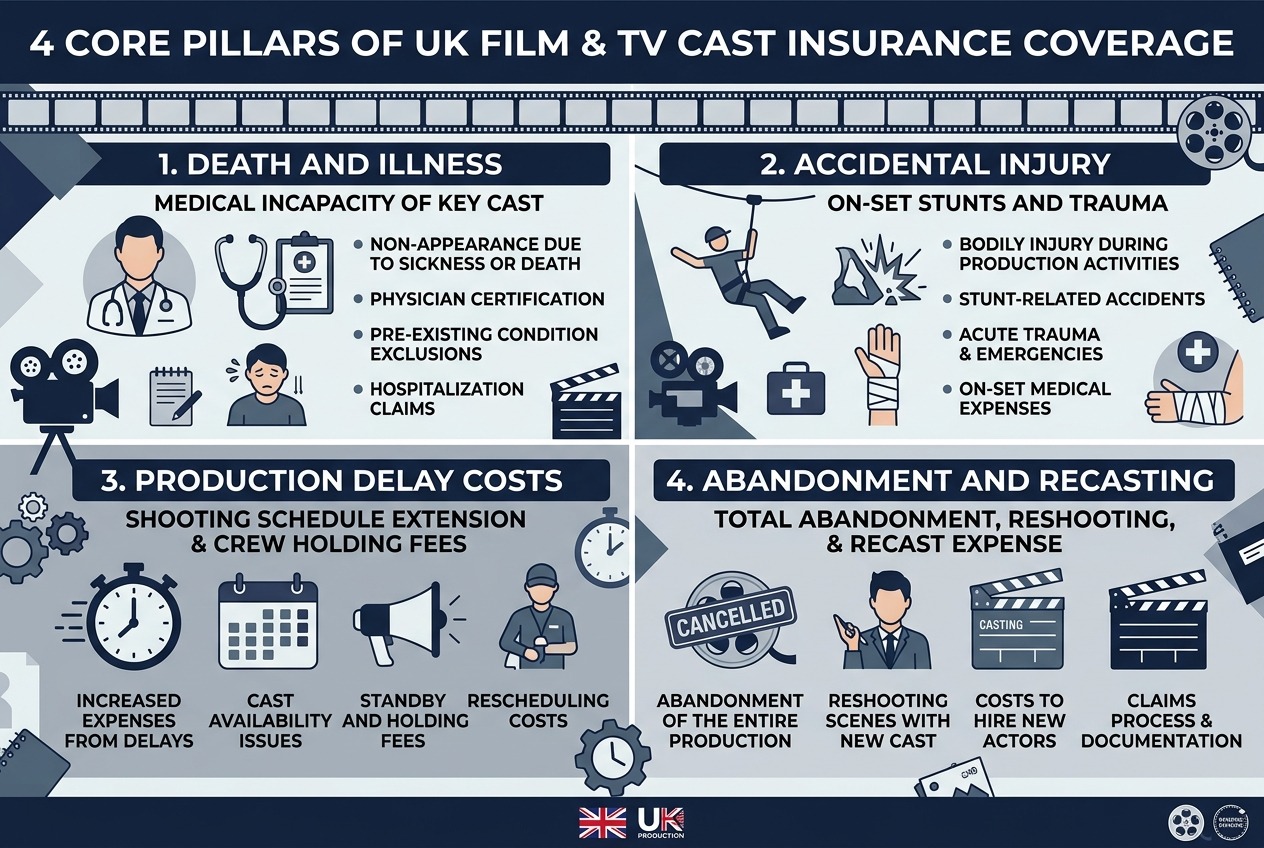
A standard cast insurance policy underwritten through Lloyd’s of London or leading specialist entertainment underwriters (such as Hiscox, Allianz Global Corporate and Specialty, or Media Insurance Brokers) covers four primary operational loss triggers:
1. Sickness and Incapacity Non-Appearance
Covers unexpected acute illnesses, surgical emergencies, contagious viral infections, and hospitalisations. The condition must be verified in writing by an independent registered medical practitioner appointed or approved by the insurance company.
2. Accidental Bodily Injury
Protects the production if an artist suffers physical trauma during rehearsals, principal photography, or travel to location shoots. While high-risk stunt work requires dedicated stunt coordinators and bespoke policy riders, standard coverage protects against routine slips, falls, sprains, and fractures occurring on set.
3. Death and Bereavement
Provides financial restitution in the tragic event of an artist’s death. This indemnity covers the expenditure required to rewrite screenplays, hire replacement talent, reshoot historical scenes, or execute an orderly total abandonment of the project.
4. Kidnap, Ransom, and Extortion Contingencies
When productions film in high-risk global jurisdictions, producers frequently attach kidnap, extortion, and forced detention riders to protect key declared personnel and cover crisis negotiation expenses.
Essential Elements vs Blanket Cast Coverage
Producers must understand the structural difference between blanket cast insurance and specific Essential Elements endorsements:
- Blanket Cast Cover: Protects the broader ensemble cast. It carries lower financial limits and covers day-to-day cast members whose temporary illness causes minor scheduling adjustments rather than an existential halt to production.
- Essential Elements Cover: Applies exclusively to named individuals whose personal participation is indispensable. If an Essential Element becomes permanently incapacitated, the production company has the legal right to abandon the entire project and claim the full agreed production budget back from the insurers.
| Policy Element | Standard Blanket Cast | Essential Elements Cover |
|---|---|---|
| Covered Personnel | Secondary actors, supporting cast, day players | Lead actor, director, visionary showrunner |
| Medical Examination | Standard health questionnaire declaration | Independent clinical exam and blood panels |
| Total Abandonment Right | No (rescheduling and delay costs only) | Yes (full budget payout if artist cannot continue) |
| Typical Waiting Period | 24 to 48 hours deductible threshold | Zero hours or immediate claim attachment |
| Budget Cost Allocation | Bundled within standard film package policy | Separate scheduled endorsement loading |
The Underwriting Process: From Medical Exams to Policy Binding
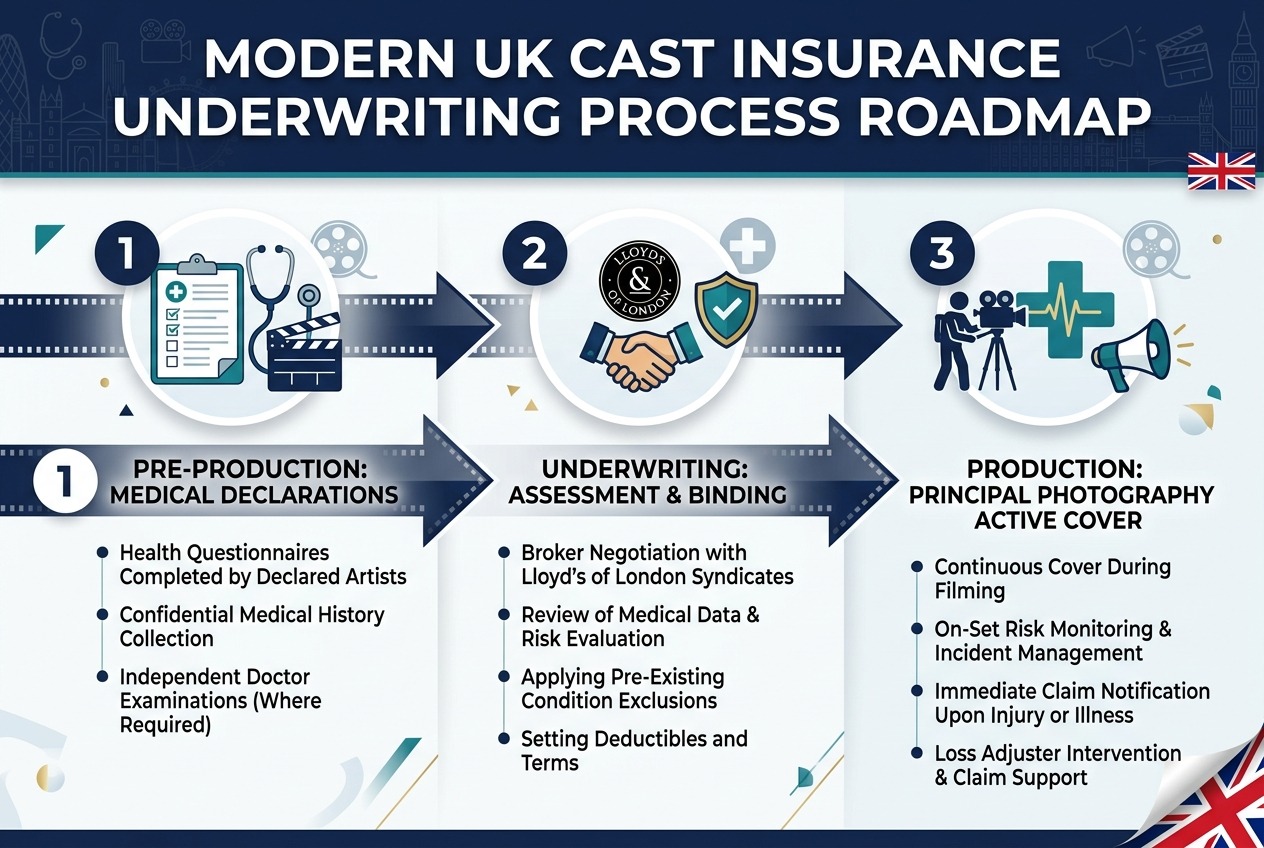
Securing cast insurance requires careful planning during pre-production. Underwriters do not issue binders without thorough risk assessments of the declared artists.
Stage 1: Pre-Production Medical Declarations
Every artist designated under the policy must complete a confidential medical history declaration. For productions with budgets exceeding £2 million, underwriters mandate an in-person clinical examination by a registered General Practitioner or specialist occupational physician.
Standard examination protocols evaluate cardiovascular health, musculoskeletal mobility, substance use history, mental health conditions, and current prescriptions. According to standard actor representation terms under Equity UK Insurance Guidance, producers bear all medical consultation fees, and artists maintain confidentiality regarding non-relevant personal health details.
Stage 2: Risk Assessment and Exclusions
Underwriters review the completed medical files against the proposed shooting schedule, script stunts, and physical demands. If an actor exhibits a pre-existing medical issue (such as chronic back spasms, previous knee reconstructions, or asthma), underwriters respond with three possible determinations:
- Standard Terms: Full cover granted with standard deductibles and no special restrictions.
- Exclusion Endorsement: Cover binds for general illness, but claims arising directly from the declared pre-existing condition remain completely excluded.
- Medical Buy-Back: The production company agrees to an increased premium surcharge or higher policy excess to buy back coverage for the specific pre-existing risk.
Stage 3: Binding and Principal Photography Monitoring
Once terms are agreed, the policy binds prior to camera commencement. During the shoot, the production coordinator must immediately notify the insurance broker of any schedule interruptions, accidents, or medical consultations. Failure to notify underwriters within 24 to 48 hours of an incident can prejudice subsequent claim payouts.
The Declaration of Health: What Cast Members Must Disclose
The foundation of every cast insurance policy is the formal Declaration of Health (DOH). Completed under strict principles of utmost good faith (uberrimae fidei), this document requires key artists to disclose their complete medical history. Underwriters inspect several critical areas:
- Hospital Admissions and Surgical Interventions: Any hospital stay or surgery within the preceding five years must be fully detailed, accompanied by discharge notes where requested.
- Chronic and Recurrent Conditions: Ongoing issues including spinal complaints, disc herniations, cardiovascular disease, hypertension, diabetes, and clinical depression require current management reports.
- Prescription Medications: Regular medication regimens must be disclosed, specifically pharmaceuticals that cause drowsiness, impair reflexes, or interact with physical performance.
- High-Risk Personal Pursuits: The artist must confirm whether they participate in motor racing, private flying, scuba diving, equestrian events, or extreme sports.
Material non-disclosure on a Declaration of Health gives underwriters statutory grounds to void coverage entirely. If an actor conceals a chronic spine condition and subsequently halts production due to severe sciatica, the insurer can reject the claim outright, leaving the production company to shoulder all delay costs.
What Cast Insurance Excludes: Common Policy Pitfalls
Cast insurance is not an unconditional guarantee. Policy wordings contain strict exclusions that production managers must understand to avoid disastrous coverage denials:
1. Hazardous Personal Activities and Breach of Warranty
Standard cast insurance policies incorporate strict behavioural warranties. While on contract, declared artists are strictly forbidden from participating in hazardous recreational pursuits without prior written underwriter consent. These prohibited activities include skiing, motorcycle riding, skydiving, scuba diving, rock climbing, and piloting private aircraft.
2. Substance Misuse and Non-Prescription Narcotics
Incapacity resulting directly from alcohol intoxication, non-prescribed pharmaceuticals, or illicit drug use is universally excluded across commercial UK policies. In the event of a suspected claim, underwriters frequently request clinical toxicological screens before authorising payout advances.
3. Cosmetic Alterations and Intentional Non-Appearance
If an artist refuses to perform due to contractual disputes, salary negotiations, or unapproved cosmetic modifications (such as unscheduled haircuts, extensive tattoos, or elective cosmetic surgeries that disrupt character continuity), cast insurance will not respond. Such situations constitute breach of employment contract rather than insurable medical contingencies.
4. Travel Disruptions and Visa Delays
Unless specifically endorsed with commercial civil authority or travel delay extensions, cast insurance covers medical incapacity, not border control rejections, missing transit visas, or flight cancellations. Producers must secure complementary production travel policies to address transit risks.
| Claim Scenario | Covered by Cast Insurance? | Underwriting Remedy / Action Required |
|---|---|---|
| Actor breaks wrist during rehearsal | Yes (Full Coverage) | Immediate medical log, incident report, loss adjuster assigned |
| Director contracts acute influenza on set | Yes (Essential Element) | Doctor certificate required confirming inability to direct |
| Lead actor fractures leg skiing on rest day | No (Policy Breach) | Excluded under hazardous activities warranty unless pre-endorsed |
| Pre-existing back condition flares up | Conditional | Covered only if medical buy-back endorsement was purchased |
| Cast walkout over contract terms | No (Excluded) | Commercial legal dispute, uninsurable under contingency cover |
Cost of Cast Insurance: Premium Calculations and Deductibles
Cast insurance premiums are calculated as a percentage of the total insurable production budget. For typical UK productions, cast coverage accounts for between 1.5% and 3.5% of the gross budget.
Several financial and logistical variables influence final underwriting rates:
- Length of Principal Photography: A fast 20-day independent shoot carries substantially lower risk exposure than a 120-day multi-location international production.
- Artist Age and Health History: Veteran performers or actors with documented health challenges require higher premium loadings and specific medical endorsements.
- Action and Stunt Density: High-octane physical sequences, vehicle chases, wire work, and pyrotechnics significantly increase premium brackets compared to interior dialogue dramas.
- Policy Deductibles: Deductibles are commonly structured either as a fixed monetary sum (e.g. £10,000 to £50,000 per occurrence) or as a time-deductible (e.g. the first 24 to 48 hours of delay costs borne entirely by the production company).
Producers managing corporate tax planning should note that commercial insurance premiums qualify as legitimate business operating expenses. When structuring UK screen vehicles, these costs form part of the qualifying core expenditure for the Audio-Visual Expenditure Credit (AVEC) under HMRC Creative Industry Tax Reliefs, assisting companies alongside broader qualifying production business expenses.
Commercial Distinction: Can You Drive With a Plaster Cast in the UK?
Beyond entertainment production, search queries surrounding cast insurance frequently involve motorists asking whether driving with an arm or leg plaster cast invalidates their UK motor insurance policy. Because this question represents a substantial proportion of UK search volume, business motorists and fleet operators must understand the legal position.
Regulation 104 and Due Care and Attention
Under Regulation 104 of The Road Vehicles (Construction and Use) Regulations 1986, any person driving a motor vehicle on a road must be in such a position that they can exercise proper control of the vehicle at all times. In addition, driving with a plaster cast or rigid limb brace can lead to criminal prosecution for driving without due care and attention under Section 3 of the Road Traffic Act 1988.
Motor Insurance Policy Conditions
UK motor insurance contracts include express conditions requiring drivers to be medically fit to operate a vehicle safely. If an individual drives with an immobilising cast on their right arm, left leg (in a manual vehicle), or either foot:
- Automatic Policy Invalidation: In the event of a collision, insurers can refuse payout cover on the grounds that the driver failed to maintain physical vehicle control.
- Third-Party Claims: While the insurer remains legally obligated by statute to compensate injured third parties, they retain the statutory right to seek full financial recovery from the at-fault driver.
- Medical Clearance Requirement: Motorists must never drive while wearing a plaster cast or splint without formal written confirmation from their orthopaedic surgeon or General Practitioner confirming full physical competence.
- Mandatory Insurer Notification: Drivers must notify their motor insurer before operating a vehicle with any temporary physical impairment to ensure policy validity remains intact.
How Production Companies Manage Financial Risk and Claims
When an unforeseen cast incident occurs during filming, producers must execute an immediate risk containment strategy to protect insurance payouts and maintain project cash flow:
Step 1: Rapid Schedule Rearrangement
Insurers expect production managers to exercise due diligence by mitigating delay losses. If the lead actor is indisposed for four days, the first duty of the assistant director and production manager is to review the call sheet. Can second-unit exterior shots be accelerated? Can supporting dialogue scenes be filmed out of sequence? Payouts cover only unavoidable, non-mitigatable financial losses.
Step 2: Broker and Loss Adjuster Engagement
The company must notify its entertainment insurance broker immediately. For significant claims, the underwriting syndicate appoints an independent specialist entertainment loss adjuster. The adjuster visits the set, reviews revised shooting schedules, audits invoices, and approves cash advances to sustain ongoing operations.
Step 3: Maintaining Cash Flow Liquidity
Because major insurance claim settlements can take weeks or months to audit and disburse, independent producers frequently face severe liquidity bottlenecks. In such instances, production companies often utilise emergency revolving credit lines or working capital and cash flow lending facilities to cover weekly payroll and studio leases while awaiting underwriter remittances.
Step-by-Step Claim Notification Checklist for Production Managers
When an accident or sudden medical crisis occurs on set, seconds count. Adhering to the formal claims protocol prevents underwriter disputes:
- Secure Immediate Medical Attention: Provide emergency medical care or hospital transport for the affected artist. Obtain an official clinical admission note or signed physician certificate.
- Log the Exact Downtime: The unit production manager must document the precise moment cameras stopped rolling, noting down all active crew on payroll, contracted equipment on hire, and location permits affected.
- Issue Written Broker Notification Within 24 Hours: Send formal written notice to the insurance broker detailing the artist’s name, nature of injury or illness, expected recovery timeframe, and initial financial delay estimate.
- Segregate Claim Costs in Accounting Software: Open a dedicated sub-ledger code in the production accounts software. Every rescheduling cost, crew holding fee, hotel extension, or doctor consultation fee must be coded specifically to the insurance claim code.
- Cooperate with the Appointed Loss Adjuster: Provide the loss adjuster with full access to call sheets, daily production reports (DPRs), medical certificates, and vendor hire contracts without delay.
Protecting Creative Assets in Commercial Media
In commercial film, television and performing arts, talent represents both the primary creative asset and the greatest operational vulnerability. Cast insurance bridges the gap between creative ambition and financial reality. By conducting rigorous pre-production medical declarations, understanding policy exclusions, and budgeting appropriately for Essential Elements coverage, UK producers protect investors, maintain delivery commitments, and ensure unforeseen medical incidents do not lead to financial ruin.