There are approximately 5.7 million private-sector businesses in the UK, according to Office for National Statistics data published at the start of 2025. Small and medium-sized enterprises account for 99.9% of that total, and Companies House processed more than 200,000 new company incorporations in the first quarter of 2026 alone. The idea that most UK startups fail in their first year is also a well-documented myth: approximately 93% to 94% of new businesses survive their first twelve months. The real attrition happens later, with roughly 38% to 40% of businesses still trading at the five-year mark.
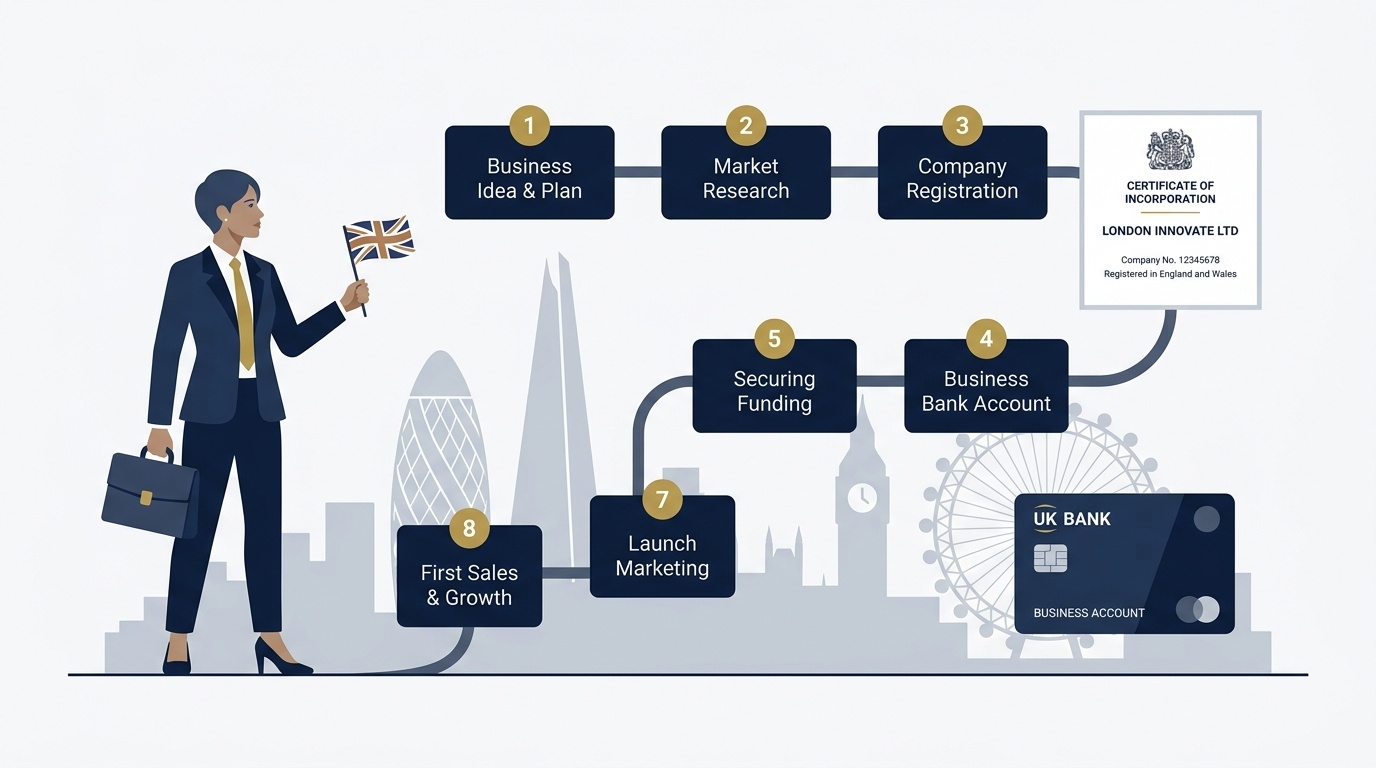
Those numbers frame what starting your own business in the UK actually involves in 2026: a structured sequence of legal registrations, financial decisions, and early commercial actions, not a single dramatic leap. Whether you are starting as a freelancer, building a product company, or turning a trade skill into a formal business, the process follows the same eight steps. This guide covers each one with the current UK figures you need: the fees, thresholds, deadlines, and regulatory changes introduced in 2025 and 2026 that affect every new UK founder.
Key Takeaways
- Approximately 5.7 million private-sector businesses operate in the UK, with 99.9% classed as SMEs (ONS, 2025)
- The UK Trading Allowance lets you earn up to £1,000 gross from self-employment in a tax year before registering with HMRC or paying tax on that income
- Companies House now charges £100 (digital) to incorporate a limited company, up from £50 following the February 2026 fee increase
- Since 18 November 2025, identity verification via GOV.UK One Login is a legal requirement for all new company directors and persons with significant control
- The VAT registration threshold is £90,000 of VAT-taxable turnover in a rolling 12-month period
- Starting as a sole trader alongside existing employment is the lowest-risk route for most first-time UK founders
Quick Answer
Most UK first-time founders should start as a sole trader. Register with HMRC for Self Assessment once your self-employment income exceeds £1,000 in a tax year. Open a separate bank account for your business from day one, set aside 25% to 30% of net profits for Income Tax and National Insurance, and focus on securing your first two or three paying clients before spending money on branding, websites, or formal premises.
Estimate Your First-Year Start-Up Costs
Planning your UK launch? Select the essential tools, registrations, and insurance your startup needs to build your itemized 2026 launch budget.
1: Validate Your Idea Before You Spend Anything
The single most common cause of early business failure in the UK is not lack of marketing or undercapitalization. It is building a product or service that real buyers do not value enough to pay for at a price that covers your costs.
Validation means securing genuine commercial evidence of demand before you commit money or time to formal setup. Contact twenty people who match your target customer profile: not friends or family, but actual potential buyers. Describe the specific problem you solve, the outcome you deliver, and a preliminary price. Track how many conversations lead to requests for more information, offers to pay a deposit, or requests to start work.
If none of twenty targeted conversations produce any commercial interest, your offer, target market, or pricing needs adjustment before you proceed. If five or more produce genuine buying signals, you have a validated starting point.
UK-specific note: You can test ideas and earn up to £1,000 gross in a tax year under the UK Trading Allowance without registering with HMRC, paying tax on that income, or setting up a formal business structure. This window is specifically designed to let you validate a business idea without committing to registration until you have confirmed revenue.
2: Choose Your Legal Structure
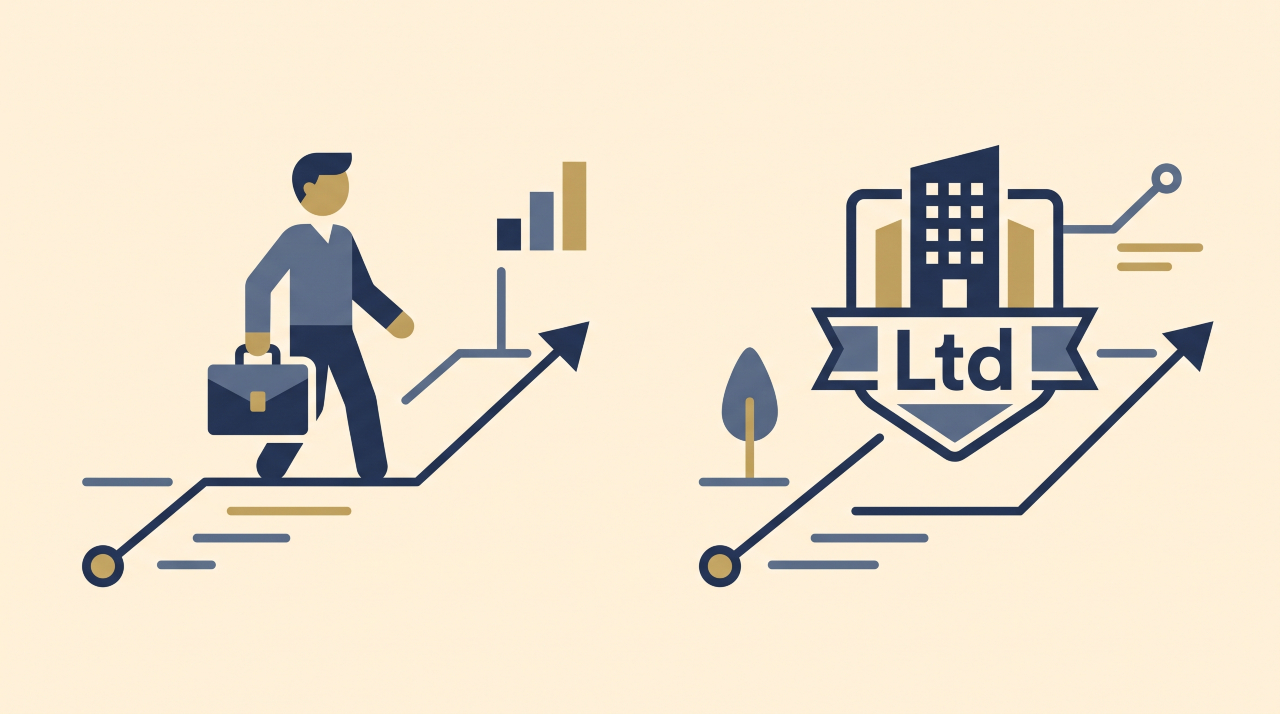
Your legal structure determines how you pay tax, what your personal liability is, and what administrative obligations apply from day one. There are three main structures for UK small businesses.
Sole Trader
A sole trader is the simplest and cheapest structure to establish. You and your business are legally the same entity. You file a Self Assessment tax return once a year, pay Income Tax on your net profits above the personal allowance (£12,570 for 2025/26), and pay Class 4 National Insurance contributions on profits above £12,570.
Liability: You are personally liable for all business debts. If your business is sued, your personal assets, including your home, are not legally protected.
Best for: Service businesses, freelancers, consultants, and tradespeople in the early stages where revenue is unpredictable and administrative overhead needs to stay low.
Private Limited Company (Ltd)
A limited company is a separate legal entity. Its owners (shareholders) are only liable for debts up to the value of their investment. Directors take a salary and dividends, and the company pays Corporation Tax on its profits.
Registration fee (from 1 February 2026): £100 digital incorporation via Companies House (up from £50). Paper incorporation costs £124.
Identity verification requirement: Since 18 November 2025, all new company directors and persons with significant control must complete identity verification via GOV.UK One Login using photo identification (passport or driving licence) before or at the point of incorporation. Non-compliance can result in prosecution or restrictions on filing.
Best for: Founders with significant revenue, those operating in sectors where professional liability insurance and corporate structure matter (legal, financial, technology), or anyone planning to take on external investment.
Business Partnership
Two or more people running a business together. Each partner is personally liable for the business’s debts, including debts created by the other partners. A formal partnership agreement is strongly recommended.
For a detailed breakdown of the tax and liability differences between these structures, our guide on sole trader or limited company walks through the financial breakpoints with real UK numbers.
Structure Comparison Table
| Factor | Sole Trader | Limited Company |
|---|---|---|
| Setup cost | Free (HMRC registration only) | £100 (digital, Companies House) |
| Personal liability | Unlimited | Limited to investment value |
| Tax filing | Self Assessment (annual) | Corporation Tax + Confirmation Statement (annual) |
| Privacy | Trading name publicly findable | Director details on Companies House public register |
| Identity verification | Not required | Required for all directors and PSCs (from Nov 2025) |
| Best revenue stage | £0 to ~£30,000 profit | £30,000+ profit or regulated sector |
3: Register Your Business
As a sole trader: You do not register a business name with Companies House. You register for Self Assessment with HMRC. You must do this by 5 October following the end of the tax year in which you earned more than £1,000 from self-employment. Registration is free and completed online via your Government Gateway account.
As a limited company: Register directly with Companies House using the online incorporation service. You will need: a company name (checked against the Companies House register for availability), a registered office address in the UK, at least one director (who must complete identity verification), details of shareholders, and the Standard Industrial Classification (SIC) code for your primary business activity. Digital incorporation costs £100 and is typically processed within 24 hours.
Trading name: Both sole traders and limited companies can trade under a name that differs from their legal name, provided the name does not infringe existing trademarks and complies with Companies House naming rules. You do not register a trading name separately unless you want trademark protection.
4: Open a Dedicated Business Bank Account
Mixing personal and business finances creates two serious problems. First, it makes accurate tax reporting extremely difficult and risks HMRC scrutiny if your records cannot distinguish business transactions from personal spending. Second, it removes the practical paper trail that protects you in any future dispute, insurance claim, or contract disagreement.
Open a dedicated business bank account before you accept your first client payment, even if you are a sole trader with no legal obligation to do so. Several UK digital banks offer free business accounts for sole traders with no monthly fees, no minimum balance, and instant setup.
Tax reserve practice: Every time you receive a client payment, transfer 25% to 30% of the net amount into a separate savings bucket for Income Tax and National Insurance. Self Assessment bills arrive every January (and a payment on account in July). Having the money reserved prevents the tax liability from becoming a cash flow crisis.
5: Handle Your Tax and National Insurance Obligations
Sole Trader Tax Obligations
As a sole trader, you pay Income Tax on your net business profits (gross income minus allowable expenses) above the personal allowance of £12,570 (2025/26 tax year). The basic rate of 20% applies to profits between £12,570 and £50,270. Higher rate of 40% applies above £50,270.
You also pay Class 4 National Insurance: 6% on profits between £12,570 and £50,270, and 2% above that.
Filing deadline: online Self Assessment tax returns must be submitted by 31 January following the end of the tax year (5 April).
VAT Registration
You must register for VAT when your VAT-taxable turnover exceeds £90,000 in a rolling 12-month period. You have 30 days from the end of the month in which you exceeded the threshold to register. Voluntary registration below £90,000 is permitted and can be beneficial if most of your clients are themselves VAT-registered businesses.
Limited Company Tax Obligations
A limited company pays Corporation Tax on its taxable profits: 19% on profits up to £50,000, and 25% on profits above £250,000, with marginal relief between those figures. Directors must file an annual Confirmation Statement (£50 from February 2026) with Companies House and submit annual accounts.
6: Sort Your Business Insurance
Insurance is not optional in most UK sectors, and some types are legally required before you accept your first client or employ your first member of staff.
Employers’ Liability Insurance: Legally required if you employ anyone, even on a casual or part-time basis. Minimum cover of £5 million. Fines of up to £2,500 per day for non-compliance.
Professional Indemnity Insurance: Strongly recommended for any business providing advice, consultancy, design, legal, financial, or technical services. Covers the cost of claims arising from professional errors, omissions, or negligence.
Public Liability Insurance: Essential if your business involves any physical interaction with clients, members of the public, or third-party property. Covers claims for personal injury or property damage caused by your business activities.
Policies for sole traders and micro-businesses in most sectors cost between £150 and £600 per year depending on your industry, revenue, and specific cover requirements.
7: Set Up Your Basic Operating Infrastructure
Before taking on paying clients, establish the minimum operational infrastructure to deliver professionally and legally.
Contracts: Every client engagement needs a written contract or service agreement before work begins. It should specify the scope of work, payment terms, revision limits, intellectual property ownership, and what happens if either party needs to cancel. Basic contract templates are available from the Federation of Small Businesses (FSB) and Rocket Lawyer UK.
Invoicing: Use invoicing software or a simple template that includes your name or business name, your address, the client’s details, a unique invoice number, a clear description of the goods or services supplied, the total amount due, VAT details if applicable, and your payment terms (typically 14 or 30 days). If you operate as a sole trader, your personal name must appear on the invoice alongside any trading name.
Record-keeping: HMRC requires sole traders to keep records of all income and expenses for a minimum of five years after the Self Assessment filing deadline for the relevant tax year. Keep digital copies of all receipts, invoices, bank statements, and contracts.
Right-to-work checks: If you hire anyone, including contractors, confirm you have completed a right-to-work check before their first day. Employing someone without a legal right to work in the UK carries civil penalties of up to £60,000 per illegal worker.
8: Get Your First Paying Client
Formal registration and infrastructure are complete when you have your first client lined up, not before. Every day you spend building a website, refining a logo, or researching accounting software without a paying client is a day that produces no revenue.
The most effective route to a first client for a UK service-based business in 2026 is direct outreach to your existing professional network. Identify fifteen to twenty people who match your target client profile. Send a brief, personalized message describing the specific problem you help clients solve, the outcome you deliver, and an offer for a short introductory conversation. Do not send a generic newsletter or a mass email.
Set a fixed daily outreach target and maintain it until you have two confirmed paying clients. Two clients generate your first genuine case study data, which is the foundation of all subsequent marketing.
For the full strategic roadmap of building a business from its first client through to stable revenue, our guide on turning a side hustle into a full-time business covers the financial milestones and decision points in detail.
First-Year Cost Reality: What Starting a Business in the UK Actually Costs
| Item | Sole Trader | Limited Company |
|---|---|---|
| Business registration | Free (HMRC Self Assessment) | £100 (Companies House, digital) |
| Business bank account | Free (digital banks available) | Free to ~£10/month |
| Basic insurance (PI + PL) | £150 to £600/year | £150 to £600/year |
| Accounting software | £0 (free tier) to £30/month | £15 to £50/month |
| Accountant (optional year 1) | £300 to £800/year | £800 to £2,500/year |
| Business website (basic) | £0 to £200 | £0 to £200 |
| Realistic minimum year 1 cost | ~£150 to £1,600 | ~£1,100 to £3,500 |
For most service-based businesses, a sole trader can realistically begin operating for under £300 in the first year if they use a free digital bank account and free-tier accounting software, and handle their own Self Assessment filing.
Common Mistakes to Avoid
Starting with the brand instead of the client.
Spending the first two weeks designing a logo, building a website, and printing business cards before securing any client commitment produces zero revenue and creates a false sense of progress. Get a paying client first. Build the brand when you need it to convert the second and third client.
Mixing personal and business finances from day one.
Many sole traders treat their personal current account as their business account for the first few months. This makes accurate tax reporting harder, increases the risk of overpaying or underpaying tax, and removes the financial record trail that protects you in contract or insurance disputes.
Underestimating the Self Assessment learning curve.
Your first Self Assessment tax return is more complex than it appears, particularly when you need to claim all allowable business expenses (home office, equipment, travel, subscriptions) and calculate payments on account for the following year. Many first-time sole traders overpay their first tax bill because they do not know which expenses are deductible. An accountant for your first year typically saves more than their fee in correctly claimed expenses.
Not keeping records from the very first day.
HMRC requires business income and expense records for five years from the Self Assessment filing deadline. Most sole traders assume record-keeping can start once they are “properly” up and running. Every client payment and business expense from your first day of trading is a legitimate record — and potentially a tax deduction.
Set your price at what feels comfortable rather than what the market supports.
UK first-time founders consistently price below the market rate out of insecurity. Research what established providers in your sector charge and set your introductory price at 60% to 70% of that, with a clear commitment to yourself to raise rates after your first three testimonials.
Frequently Asked Questions
Do I need to register my business before I start trading in the UK?
As a sole trader, you can start trading immediately without any formal registration. However, you must register for Self Assessment with HMRC by 5 October following the end of the tax year in which your gross self-employment income exceeds £1,000. If you are forming a limited company, you must register with Companies House before you begin trading. There is no requirement to register a trading name separately from your legal business structure.
How much does it cost to start a business in the UK in 2026?
A sole trader can start operating for as little as £0 if they stay below the £1,000 Trading Allowance and use free digital tools. Once trading actively, realistic minimum costs for year one are approximately £150 to £1,600 for a sole trader (covering basic insurance, a business bank account, and minimal software). A limited company typically costs £1,100 to £3,500 for year one including the £100 Companies House incorporation fee, basic insurance, and accountant costs.
What is the difference between a sole trader and a limited company for tax purposes?
A sole trader pays Income Tax on net business profits through Self Assessment, plus Class 4 National Insurance. A limited company pays Corporation Tax on its profits (19% on profits up to £50,000 in 2025/26). Directors then take salary and dividends, each of which has different Income Tax and National Insurance treatment. For most UK founders, the limited company structure becomes more tax-efficient at net profit levels above approximately £30,000 per year, though the exact breakpoint depends on your personal circumstances.
Do I need a business bank account as a sole trader in the UK?
There is no legal requirement for a sole trader to hold a business bank account. However, using a dedicated account for all business income and expenses is strongly recommended from a practical and tax compliance standpoint. Several UK digital banks (including Starling, Monzo Business, and Tide) offer free business accounts for sole traders with same-day setup, no monthly fees, and direct accounting software integration.
When do I need to register for VAT?
You must register for VAT when your VAT-taxable turnover exceeds £90,000 in any rolling 12-month period. You have 30 days from the end of the month in which you breached the threshold to register. Voluntary VAT registration below this threshold is allowed and can be advantageous if you work primarily with VAT-registered business clients. Check the gov.uk VAT guidance directly for current threshold confirmation before registering.
What is the UK Trading Allowance and how does it help new founders?
The Trading Allowance is a £1,000 tax-free allowance for gross self-employment income per tax year. If your total self-employment earnings in a tax year are £1,000 or less, you do not need to register with HMRC, file a Self Assessment return, or pay tax on that income. It is specifically designed to allow individuals to test a business idea, earn initial revenue, and validate commercial demand without any administrative burden until income meaningfully exceeds that level.
What changed at Companies House in 2025 and 2026 that affects new business owners?
Two significant changes took effect in this period. First, from 18 November 2025, identity verification became a legal requirement for all new company directors and persons with significant control under the Economic Crime and Corporate Transparency Act. Verification is completed online via GOV.UK One Login using photo ID, and failure to comply can result in prosecution or restrictions on filing ability. Second, from 1 February 2026, the digital incorporation fee increased from £50 to £100, and the annual Confirmation Statement fee increased from £34 to £50.
Your Next Three Actions
The most productive thing you can do after reading this guide is to move immediately to the three practical steps that every other article on this topic leaves until later.
First, open a free digital business bank account today. This takes approximately 10 minutes with any of the major UK digital business banking providers and creates the financial separation that underpins every correct tax, insurance, and legal decision you will make going forward.
Second, book 30 minutes to write a one-paragraph description of the specific problem you solve, the outcome you deliver, and your preliminary price. Send that description to ten people in your network who match your target client profile this week. Your first client will likely come from this cohort.
Third, register for Self Assessment with HMRC the moment your gross income from your new business exceeds £1,000. Do not wait until January of the following year. Early registration avoids penalty risk, and it is a five-minute process via Government Gateway.
For HR and compliance guidance once you take on your first employee, our full breakdown of HR support for small businesses covers the Employment Rights Act 2025 changes and the practical compliance checklist every UK employer now needs.