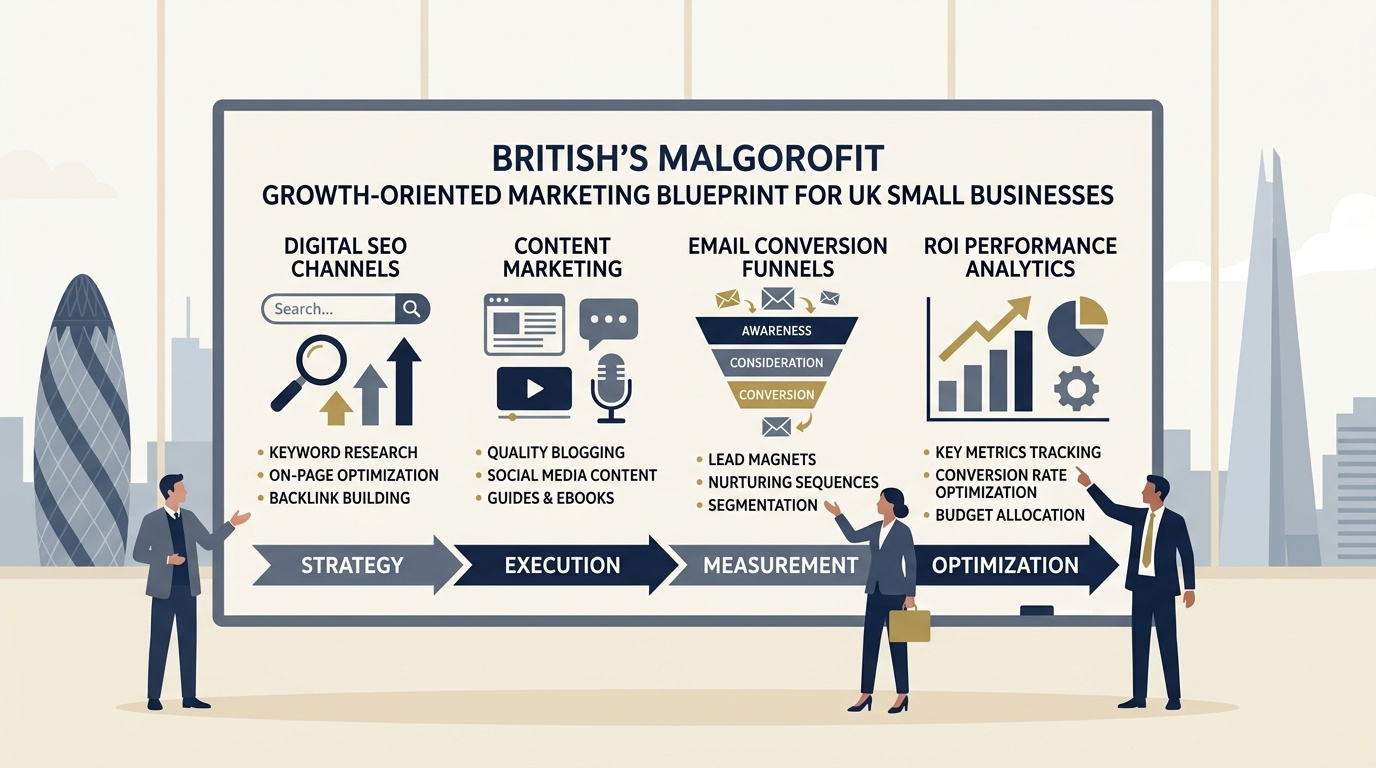
Only 47% of UK small businesses have a documented marketing strategy — yet those that do are 313% more likely to report success, according to research published by the Content Marketing Institute. If you’re running a small business in the UK and winging your marketing, you’re not alone. But you’re also leaving serious revenue on the table.
This guide gives you a clear, step-by-step marketing strategy for small business UK owners can actually use — without a big budget, a marketing department, or years of experience. By the time you finish reading, you’ll know exactly which channels to prioritise, how to reach the right customers, and how to measure whether any of it is working.
What a Marketing Strategy Actually Is
A marketing strategy isn’t something you bolt on after your business is already running. If you get marketing from day one, you build customer awareness and revenue momentum at the same time — which makes every stage of growth easier. Most businesses that struggle with marketing started too late and are playing catch-up.
Many small business owners confuse a marketing strategy with marketing tactics. Tactics are the individual actions — posting on Instagram, running a Google Ad, sending an email. Your strategy is the bigger picture that decides which tactics make sense for your specific business, your audience, and your budget.
Without a strategy, you end up doing random acts of marketing. You spend money on ads that don’t convert, post on social media and get no engagement, and wonder why nothing is working. A clear strategy fixes that.
Step 1 — Define Your Target Customer
You can’t market to everyone. The UK has 67 million people, but your business serves a specific slice of that population — and the more clearly you define who that is, the more effective every piece of marketing becomes.
Start by building a simple customer profile. Ask yourself: How old are they? Where do they live? What problem are they trying to solve? What do they search for online?
If you already have customers, speak to them directly. A 10-minute phone call with three existing clients will tell you more about your target audience than any marketing course. Real insight beats guesswork every time.
Step 2 — Set Clear Marketing Goals
Good marketing goals are specific and measurable. “Get more customers” is not a goal — “generate 20 new enquiries per month by September” is a goal. The difference matters because vague goals produce vague results.
Use the SMART framework: Specific, Measurable, Achievable, Relevant, Time-bound. A small bakery in Manchester might set a goal to increase online orders by 30% within 90 days using Instagram and Google Search. That’s something you can actually track.
Your goals should also match your business stage. If you’re brand new, brand awareness is the priority and if you’ve been trading for two years, you might focus on customer retention and referrals instead.
If you’re still in the early planning stages, make sure the marketing section of your business plan sets out your target audience, your chosen channels, and your goals before you spend a single pound. A business plan with a weak marketing section is a plan with a revenue gap built into it.
Step 3 — Know Your Budget (And Be Honest About It)

UK small businesses spend, on average, between 2% and 10% of their annual revenue on marketing, according to data from the Federation of Small Businesses. If you’re turning over £100,000 a year, that’s £2,000–£10,000. For many early-stage businesses, it’s even less.
Here’s the truth: some marketing channels require money and some require time. If you don’t have a big budget, you need to invest more time. There’s no shortcut around that trade-off.
The table below shows five common marketing channels, their typical monthly cost for a UK small business, and the time investment required.
| Marketing Channel | Typical Monthly Cost | Time Required | Best For |
|---|---|---|---|
| Local SEO | £0–£200 | Medium | Service businesses with local clients |
| Social Media (Organic) | £0 | High | B2C brands with visual products |
| Email Marketing | £0–£50 | Low–Medium | Retention and repeat sales |
| Google Ads (PPC) | £200–£1,000+ | Medium | Fast lead generation |
| Content Marketing / Blog | £0–£300 | High | Long-term organic traffic growth |
Pick one or two channels to start. Spreading yourself thin across five channels with a small budget produces weak results across the board. Focus always wins.
Step 4 — Build a Simple Online Presence First
Before you run any paid ads or invest in content, make sure your foundations are solid. That means a working website, a verified Google Business Profile, and consistent basic information across the web.
Your Google Business Profile is free and critical. When someone in the UK searches for a plumber, accountant, or café near them, Google Business Profiles appear before organic search results. Claim yours at Google Business Profile, fill in every field, and add real photos. Businesses with photos receive 42% more requests for directions and 35% more clicks to their websites, according to Google’s own data.
Your website doesn’t need to be fancy. It needs to load quickly, explain clearly what you do, show your location or service area, and make it easy to contact you. Those four things beat a visually impressive website that confuses visitors.
Step 5 — Choose the Right Marketing Channels for Your Business
Not every channel works for every business type. Here’s how to think about it:
Local service businesses (tradespeople, therapists, accountants, salons) benefit most from local SEO, Google Business Profile, and word-of-mouth referral systems. Paid local search ads can also deliver fast results when done correctly.
E-commerce and product businesses should prioritise Instagram, Pinterest, email marketing, and Google Shopping ads. Visual platforms perform well for physical products, and email marketing delivers an average ROI of £36 for every £1 spent, according to Litmus research on email marketing ROI.
B2B service businesses (consultants, agencies, coaches) get strong results from LinkedIn, content marketing, SEO, and networking — both online and in person at UK business events.
Running a side business alongside a full-time job adds another layer of constraint — your time is even more limited. If that’s your situation, our guide to marketing your side hustle covers how to prioritise the channels that produce results without demanding 20 hours a week.
The mistake most small business owners make is copying what a competitor does without asking whether it fits their own customer base. Pick your channel based on where your specific customers actually spend time, not where you feel most comfortable.
Step 6 — Create Content That Builds Trust
Content marketing means creating genuinely useful material — blog posts, videos, guides, social media posts — that helps your target audience before they spend a penny with you. It builds trust, improves your search rankings, and positions you as the expert in your field.
You don’t need to post daily to see results. Consistency beats frequency. One well-researched blog post per month that answers a real question your customers ask will outperform five rushed posts that say nothing new. If you own a landscaping business in Bristol, a post titled “How to Choose the Right Garden Design for a Small UK Garden” targets exactly the searches your ideal customers make.
Track what content gets the most traffic and engagement, and create more of that. Google Search Console (free) shows you which search queries bring people to your website — and that data is gold for planning what to write next.
The UK-Specific Marketing Factors You Shouldn’t Ignore
This section is what most generic guides skip entirely — and it matters if you’re specifically building a marketing strategy for a small business in the UK market.
GDPR compliance affects your marketing directly. If you collect email addresses, run retargeting ads, or use website cookies, you must comply with UK GDPR rules. Non-compliance carries fines of up to £17.5 million or 4% of global annual turnover. Check the ICO guidance on direct marketing before you build any email list or run any paid ad campaign.
UK consumer trust levels are high. UK shoppers research purchases carefully. Reviews on Google, Trustpilot, and industry-specific platforms carry serious weight. Actively asking satisfied customers to leave reviews is one of the highest-ROI activities a UK small business can do — and it costs nothing.
Seasonal UK patterns matter. Black Friday, January sales, the summer holiday period, and the back-to-school season all affect consumer behaviour in the UK. Plan your marketing calendar around these moments rather than treating every month as identical.
Local pride is real. UK consumers increasingly prefer to buy from local and independent businesses. Marketing that genuinely highlights your local roots, your community involvement, or your British-made products can be a significant differentiator against larger, impersonal brands.
Step 7 — Measure What’s Working (And Cut What Isn’t)
You need to know whether your marketing is actually generating results. Set up Google Analytics 4 on your website (it’s free) so you can see where your visitors come from, what they do on your site, and whether they take the actions you want — booking a call, making a purchase, or filling in a contact form.
Review your results monthly, not daily. Daily fluctuations create panic and bad decisions. Monthly data shows trends. After three months, you should have enough information to decide which channels deserve more of your time and budget, and which ones to stop.
Be honest with yourself here. Most small business owners continue investing in channels that don’t perform because they’re familiar and comfortable. If a channel isn’t producing measurable results after 90 days, reallocate that time and money somewhere more effective.
Common Mistakes UK Small Businesses Make With Marketing
Trying to do everything at once. Spreading a limited time across six channels produces weak results everywhere. Start with one or two, do them well, then expand.
Skipping the strategy and going straight to tactics. Buying ads without a clear audience profile or a tested offer wastes money fast. Think first.
Expecting instant results. SEO takes 3–6 months to show meaningful results. Content marketing takes longer. Paid ads can produce quick wins, but they stop the moment you stop paying. Built for the medium term, not an overnight success.
Ignoring existing customers. It costs five times more to win a new customer than to retain an existing one. Email marketing, loyalty programmes, and simple follow-up calls to past clients often produce faster revenue than any new customer acquisition campaign.
How Long Does a UK Small Business Marketing Strategy Take to Work?
Be realistic about timelines. Marketing is not a switch you flip — it’s more like a garden you tend.
Paid advertising (Google Ads, Meta Ads) can produce results within days if set up correctly, but it requires an ongoing budget. Local SEO improvements typically show measurable gains within 60–90 days. Organic search (blogging and SEO) usually takes 3–6 months before significant traffic arrives. Email marketing builds value over time — the bigger and more engaged your list, the more impact each send has.
Most small businesses see meaningful results from a consistent, focused marketing strategy within 3–6 months. That’s not discouraging — it’s the reality of sustainable business growth. Any strategy promising overnight results is selling you something.
Frequently Asked Questions
What is the best marketing strategy for a small business in the UK?
The best strategy depends on your business type, budget, and target audience. For most UK small businesses, the highest-priority starting points are claiming your Google Business Profile, building a simple website, and focusing on one social media channel where your customers are active. These three actions require a minimal budget and produce real results.
How much should a small business spend on marketing in the UK?
The Federation of Small Businesses suggests spending 2–10% of annual revenue on marketing. If you’re in a competitive market or in a growth phase, lean towards the higher end. If budget is tight, prioritise free channels like local SEO and content marketing before investing in paid ads.
Do UK small businesses need to worry about GDPR in their marketing?
Yes. If you collect email addresses, use website cookies, or run retargeting ads, you must comply with UK GDPR. The Information Commissioner’s Office (ICO) provides free guidance for small businesses. Non-compliance can result in significant fines, so build compliant processes from the start.
How do I market my small business locally in the UK?
Local marketing works best through a combination of your Google Business Profile, local SEO (including location-specific keywords on your website), reviews on Google and Trustpilot, and community involvement. Sponsoring a local event or partnering with complementary local businesses also builds strong word-of-mouth visibility.
What is the 4 Ps of marketing for small businesses?
The 4 Ps are Product, Price, Place, and Promotion. Product means what you sell and how it meets customer needs. Price means your pricing strategy relative to competitors and perceived value. Place means where and how customers can buy from you. Promotion means how you communicate your offer — which covers all the marketing channels and tactics discussed in this guide.
Can a UK small business market effectively without a big budget?
Absolutely. Local SEO, a well-optimised Google Business Profile, organic social media, and email marketing to an opt-in list all deliver strong results with minimal financial investment. The trade-off is time — low-cost channels require consistent effort. Start with what you can sustain, and build from there.
Your Next Step
The single most important thing you can take away from this guide is this: pick one strategy, execute it consistently for 90 days, and measure the results before adding anything else. That discipline separates small businesses that grow from those that stay stuck.
Your specific next step: open Google Business Profile right now, claim your listing if you haven’t already, and spend 20 minutes completing every section. It’s free, it takes less than an hour, and it’s the single highest-impact action most UK small businesses can take today. Once that’s done, choose one marketing channel from the table above that fits your business type — and commit to it for the next three months.
Marketing doesn’t need to be complicated. It needs to be consistent.