According to the British Business Bank’s latest Small Business Finance Markets Report, gross lending to UK small and medium-sized enterprises reached £68 billion in recent figures. Yet traditional clearing banks still reject more than half of early-stage debt applications, with approval rates among smaller commercial enterprises hovering near 44%. For company directors managing sudden inventory demands, payroll pinches, or urgent equipment replacements, waiting eight weeks for a high-street credit committee is rarely feasible.
This structural friction across high-street banking has accelerated the adoption of alternative commercial lenders and fintech platforms. An instant business loan provides UK business owners with rapid access to working capital, often delivering provisional credit decisions in under twenty minutes and depositing funds via Faster Payments within hours. By connecting directly to accounting platforms and commercial bank accounts via Open Banking, digital lenders evaluate live trading data rather than relying solely on historical filed accounts.
Quick Answer: What Is an Instant Business Loan in the UK?
An instant business loan is a digital commercial finance facility where UK businesses secure funding decisions in minutes and loan disbursements within 24 hours. Digital lenders use secure Open Banking APIs to inspect live banking transactions, cash flow stability, and merchant revenue rather than requiring lengthy business plans or paper bank statements. Typical facilities range from £1,000 to £500,000 with repayment tenures between 3 and 36 months. While unsecured options exist for established companies, most facilities require a personal guarantee from company directors. Interest rates vary from 9.9% APR for prime trading profiles to over 35% APR for higher-risk or younger enterprises.
Key Takeaways for UK Business Directors
- Digital lenders utilize Open Banking integrations to assess live revenue patterns, enabling loan approvals in under 30 minutes.
- Unsecured facilities above £25,000 almost always require a personal guarantee from company directors, creating personal liability for the debt.
- Effective annual percentage rates (APR) range from 9.9% to 45%+, requiring careful evaluation against anticipated profit margins.
- Alternative structures include fixed-term loans, revolving credit facilities, and merchant cash advances linked directly to card terminal turnover.
- Soft credit searches allow business owners to compare multiple funding quotes without damaging their commercial or personal credit files.
What Is an Instant Business Loan?
An instant business loan refers to a modern commercial credit facility engineered for rapid automated underwriting. Unlike legacy business borrowing that relies on physical paperwork and branch manager reviews, instant lending platforms run on automated credit decisioning engines. These engines pull live financial telemetry directly from your corporate bank accounts, cloud accounting software like Xero or QuickBooks, and credit reference agencies like Experian and Creditsafe.
Speed is the defining characteristic of this lending model. UK small businesses can apply online within ten minutes, receive automated approval in principle within seconds, and complete digital identity verification immediately. Once the digital credit agreement is executed via electronic signature, loan proceeds are dispatched through the UK Faster Payments Service, landing in the designated business bank account within hours.
Most instant loans operate on an unsecured basis, meaning the lender does not take a fixed legal charge over commercial property or machinery. However, this absence of physical collateral shifts the lender’s risk management strategy onto trading velocity and director commitments. Borrowers must demonstrate consistent monthly turnover, active UK Companies House registration, and a clean banking history free of unpaid direct debits or winding-up petitions.
How an Instant Business Loan Works: The Digital Underwriting Pipeline
Understanding the automated underwriting pipeline allows applicants to prepare their accounts and maximize approval odds before initiating an application. Automated lenders assess commercial viability using three distinct phases.
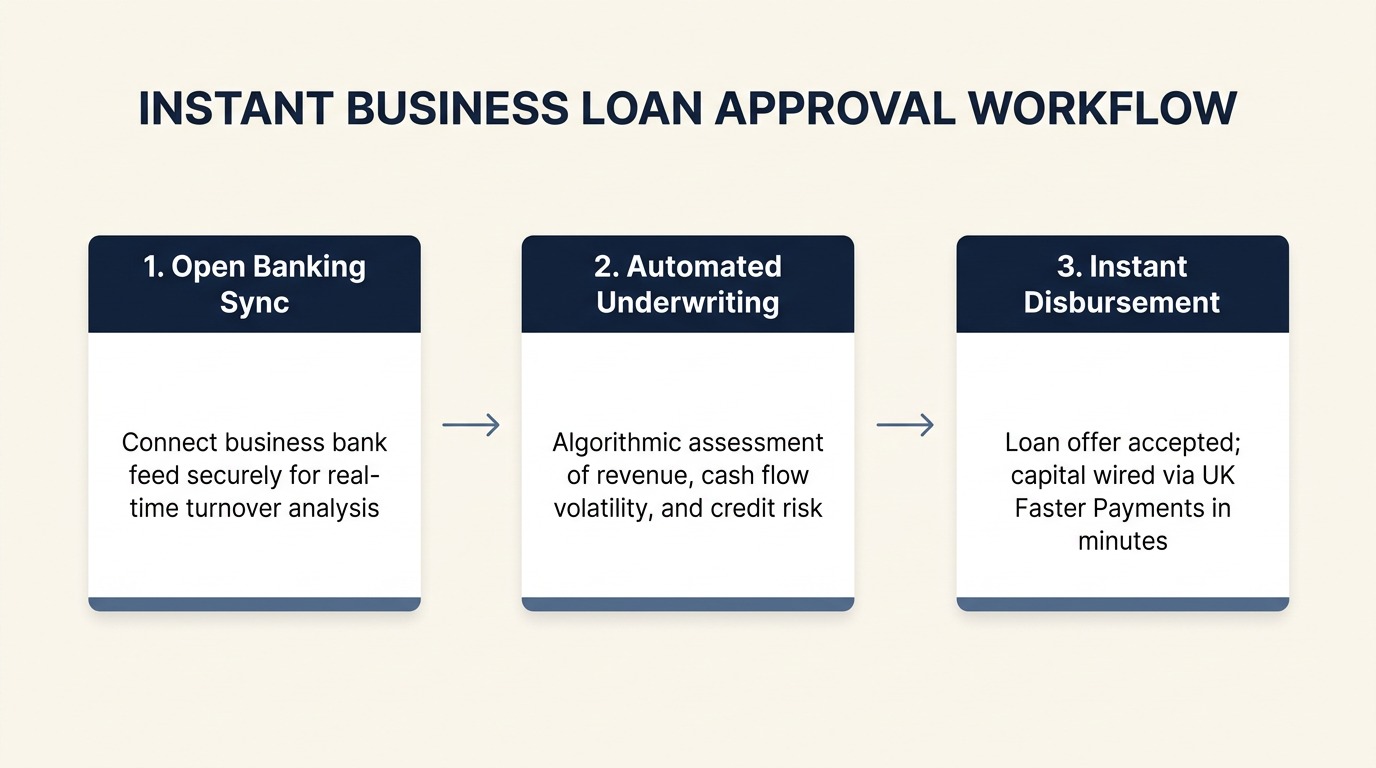
Phase 1: Real-Time Open Banking Synchronization
The application commences with Open Banking verification. Regulated under Financial Conduct Authority standards, Open Banking permits the prospective lender to view read-only transaction data directly from your business checking accounts. The lender cannot move capital or modify settings; they merely extract between three and twelve months of raw transactional statements.
This automated data extraction replaces the archaic requirement of exporting, redacting, and emailing PDF statements. The lender’s data ingestion engine categorizes income streams, separates customer deposits from inter-account transfers, detects seasonal revenue peaks, and flags irregular outgoings within seconds.
Phase 2: Algorithmic Risk Assessment and Credit Scoring
Once bank transaction feeds are ingested, algorithmic underwriting models analyze the applicant’s real-time financial health. These models evaluate key ratios such as debt-service coverage, monthly recurring revenue, operating expense volatility, and average daily ledger balances.
Simultaneously, the platform performs an automated soft search across UK commercial credit reference agencies, inspecting your Companies House filing status, director appointment records, and payment history with commercial suppliers. If the automated risk score meets the lender’s internal threshold, a binding loan offer is generated dynamically, outlining borrowing limits, interest rates, and fee structures.
Phase 3: Digital Contracting and Faster Payments Disbursement
Upon reviewing the terms, the director completes verification through an automated know-your-customer (KYC) identity check, photographing their driving licence or passport and performing a biometric facial scan on their smartphone. Director guarantees and loan agreements are signed digitally using DocuSign or native electronic signatures.
Following final digital signature, the lender’s automated treasury system queues the disbursement. In the UK, transfers are executed over the Faster Payments Service or CHAPS, crediting the recipient’s commercial account on the exact same business day.
Types of Fast Business Finance Available in the UK
Instant borrowing is not a one-size-fits-all product. UK digital lenders provide several distinct credit structures, each designed for different cash flow profiles, revenue cycles, and capital deployment needs.
1. Unsecured Digital Term Loans
The unsecured term loan is the most common form of instant financing. A lender provides a lump-sum cash injection repayable over a fixed term ranging from three to thirty-six months. Repayments consist of fixed monthly principal and interest charges, giving businesses total certainty over cash outflows. These loans suit specific, one-time outlays such as inventory purchases ahead of peak trading seasons or planned commercial renovations.
2. Revolving Business Credit Lines
A revolving credit facility functions like an agile corporate overdraft. The lender approves a maximum credit ceiling, such as £50,000, which the business owner can draw down, repay, and redraw as operational demands dictate. Interest accrues solely on the active drawn balance rather than the total facility limit. This format represents an ideal liquidity cushion for balancing fluctuating working capital, managing delayed trade debtor payments, or financing unexpected operational repairs.
3. Merchant Cash Advances (Revenue-Based Financing)
Designed primarily for retailers, restaurants, and e-commerce companies, merchant cash advances exchange upfront capital for an agreed percentage of future card sales. Rather than fixed monthly instalments, the lender claims a daily or weekly slice (typically between 8% and 20%) of gross card processing receipts through card terminals or payment gateways like Stripe and Worldpay.
Because repayments fluctuate directly alongside sales volume, a merchant cash advance offers flexibility during quiet trading weeks. If your sales dip, your repayment amount contracts automatically. However, merchant cash advances frequently carry higher effective APRs than standard term loans, making them costly if repaid too rapidly.
4. Digital Invoice Discounting
For business-to-business operators struggling with 30-day, 60-day, or 90-day payment terms, digital invoice financing unlocks tied-up cash immediately. By synchronizing with your cloud invoicing software, the lender advances up to 90% of the gross value of outstanding client invoices within hours of issuance. When your corporate client settles the invoice, the lender remits the remaining 10% balance minus a modest discount fee, typically between 1.5% and 4% per month.
Instant vs Traditional Commercial Lending: Key Trade-Offs
Before applying for fast business capital, commercial directors must weigh speed against cost. Traditional bank lending remains cheaper for established businesses with tangible property collateral, but digital lenders provide unmatched agility when immediate cash injection is paramount.
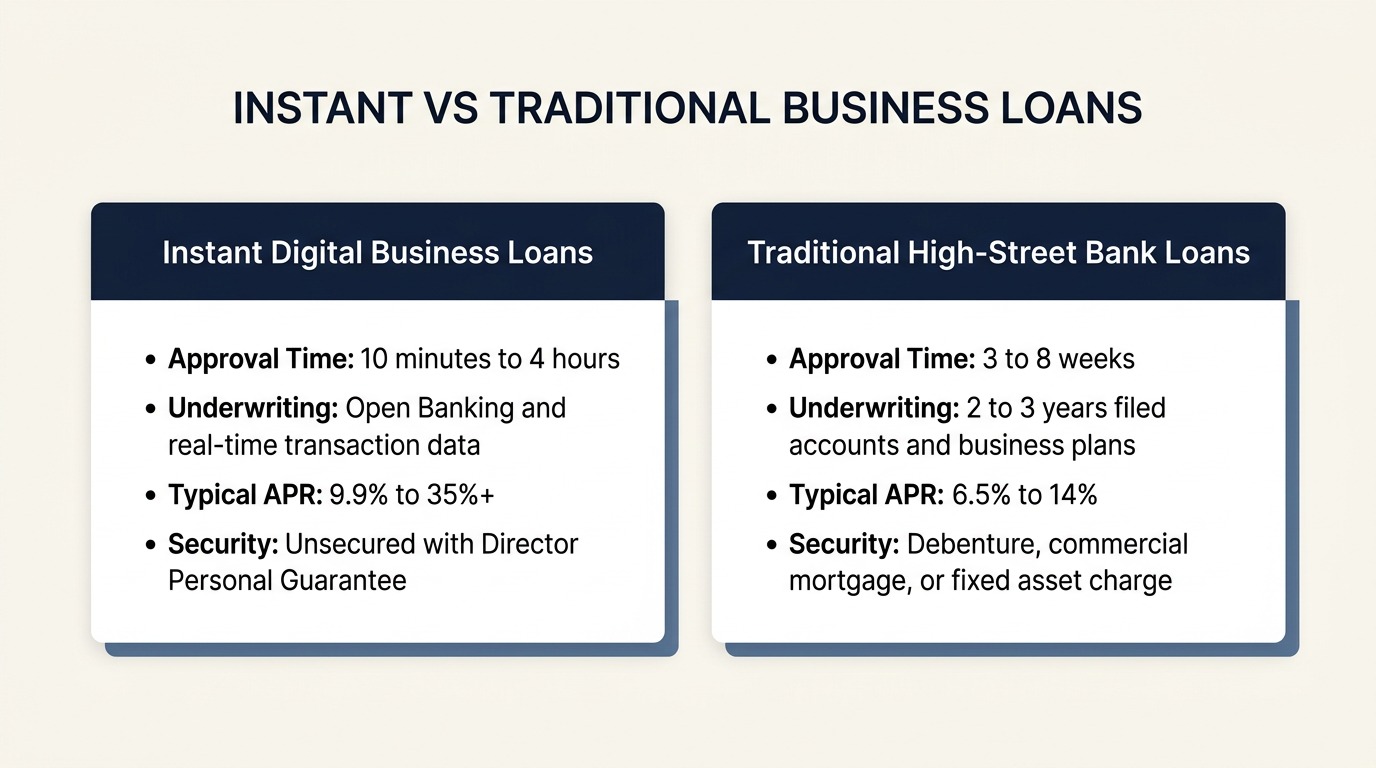
The operational contrasts between these two funding channels highlight why modern businesses frequently rely on both models for distinct balance sheet requirements.
According to UK Finance business lending data, commercial borrowing trends reflect an increasing migration toward non-bank lenders for short-term working capital requirements. While prime long-term commercial mortgages remain firmly on high-street balance sheets, immediate operational credit needs are now dominated by specialized fintech originators.
Eligibility Criteria and Open Banking Verification Requirements
While instant business loan providers operate with greater flexibility than traditional banking institutions, they maintain strict automated eligibility thresholds. Applicants must satisfy basic legal and financial standards to qualify for instant algorithmic approval.
1. Minimum Trading History and Turnover
Most digital lenders require a minimum of six months of continuous active trading, though certain providers demand twelve months. In addition, businesses must satisfy minimum annual turnover thresholds, typically starting at £25,000 to £50,000 gross annual receipts. For larger borrowing facilities above £100,000, lenders expect consistent monthly banking credits of at least £15,000.
2. UK Business Entity Registration
To qualify, your enterprise must be registered in the United Kingdom, either as a private limited company (Ltd), limited liability partnership (LLP), or registered sole trader. Limited companies must be actively registered at Companies House, with their confirmation statements and statutory accounts up to date. Digital lenders cross-reference Companies House records in real time to verify that the applicant holds active director status and that no insolvency actions or gazette strike-off notices are pending.
3. Credit History and County Court Judgments (CCJs)
Algorithmic underwriting assesses both corporate credit profiles and individual director credit histories. A business can often obtain finance with a minor credit blemish, but active County Court Judgments (CCJs) above £250 or recent formal insolvency filings usually disqualify applicants. If CCJs have been satisfied, providing proof of settlement accelerates manual underwriter reviews.
4. Bank Account Telemetry and Cash Flow Health
Lenders review your daily operating balances via Open Banking. Algorithms look unfavourably upon accounts that regularly breach authorized overdraft limits or suffer from frequent unpaid direct debits. Maintaining a positive end-of-day bank balance over ninety consecutive days substantially boosts your risk rating and lowers borrowing costs.
If your enterprise also benefits from local government support, ensuring your operational savings align with schemes like Small Business Rates Relief UK can free up additional monthly cash flow to comfortably service debt repayments.
The True Cost of Capital: APRs, Fees and Total Repayments
Calculating the true cost of an instant loan is critical for protecting company profitability. Borrowers must differentiate between nominal headline interest rates, factor rates, and the full Annual Percentage Rate (APR), which accounts for all mandatory fees.
Understanding Factor Rates vs APR
Many short-term digital lenders quote pricing as a “factor rate” or fixed fee rather than an annualized percentage. For example, a lender offering £30,000 with a factor rate of 1.20 over six months means you will repay £36,000 in total (£30,000 x 1.20), representing £6,000 in finance charges.
While a 20% total charge over six months sounds straightforward, converting this pricing to an annualized APR reveals a borrowing cost exceeding 40%. When capital turns over quickly to generate high gross margins, such pricing is commercially justifiable. However, using high-factor capital to service slow-moving overheads can quickly strain working capital reserves.
Ancillary Fees to Inspect
Before executing a credit facility agreement, scrutinize the contract for ancillary charges:
- Arrangement Fees: An upfront administrative fee deducted from the gross loan advance, usually ranging between 1.5% and 5.0%.
- Drawdown Fees: Charged on revolving lines of credit each time capital is pulled down into the main checking account.
- Late Payment Penalties: Substantial administrative charges and default interest rates applied if direct debits bounce.
- Early Repayment Charges: Top-tier lenders do not penalize early settlement, allowing you to save on unaccrued interest, but lower-tier lenders often demand the entire contracted interest charge regardless of when the loan is settled.
The table below provides a representative breakdown of real borrowing costs across common commercial funding scenarios in the UK.
For strategic planning advice on managing recurring outgoings and maintaining operating buffers, consult our detailed analysis of cash flow management strategies.
Legal Realities: Personal Guarantees and Director Liability
The term “unsecured” frequently creates a dangerous misconception among company directors. An unsecured commercial loan means the lender does not hold a mortgage or debenture over tangible company assets. It does not mean the debt vanishes if the company faces insolvency.
Under standard UK commercial practice, almost every instant loan exceeding £25,000 requires a formal Director’s Personal Guarantee (PG). In signing a personal guarantee, you legally bind yourself to settle the debt out of your private wealth if your limited company defaults or enters administration.
Joint and Several Liability
If your company has multiple directors or major shareholders, lenders generally demand personal guarantees from all individuals holding significant control (typically 20% or 25% equity). Crucially, these guarantees are almost universally structured on a “joint and several” basis.
Joint and several liability gives the lender total legal discretion. If the company defaults, the lender is not required to pursue each director equally for their proportional share. Instead, they can pursue whichever director possesses the most liquid personal assets or unencumbered residential property equity for 100% of the outstanding balance.
Capped vs Uncapped Guarantees
Directors should always negotiate for a capped personal guarantee. An uncapped guarantee leaves your personal assets vulnerable to the principal balance as well as compounding default interest rates, legal expenses, and collection fees incurred by the lender.
A capped guarantee limits your personal exposure to an explicit agreed figure, such as 100% of the original principal plus a maximum of 90 days of statutory interest. Reviewing the guarantee terms with an independent solicitor before signing is an essential governance step.
The British Business Bank SME finance guidance notes that personal guarantee insurance (PGI) is increasingly utilized by UK executives. PGI policies can cover up to 80% of personal liability under a business guarantee, protecting family homes and personal savings in severe downside scenarios.
Common Mistakes When Seeking Fast Working Capital
Speed can be a double-edged sword. In the rush to resolve cash shortages, business directors often make critical financial missteps that compromise long-term solvency.
1. Debt Stacking (Over-Borrowing)
Debt stacking occurs when a business takes out multiple instant loans or merchant cash advances across short time horizons without clearing existing obligations. Because digital applications take only minutes to complete, directors sometimes draw capital from two or three separate fintechs simultaneously before credit bureaus register the initial loans.
This creates an unsustainable compounding repayment load. When daily or weekly direct debits drain more cash than trading operations generate, the business enters a fatal cash insolvency spiral. Reputable lenders will immediately reject applicants who show signs of recent unrecorded borrowing.
2. Treating Short-Term Debt as Long-Term Capital
Instant loans are designed for short-term liquidity bottlenecks, such as bridging a 45-day inventory cycle or purchasing discounted stock that will sell within 90 days. Using high-cost instant loans to fund multi-year capital projects, product development cycles, or prolonged trading losses is dangerous. Long-term investments should be funded via equity programmes like the Seed Enterprise Investment Scheme or structured multi-year commercial mortgages.
3. Overlooking Daily Debit Mechanics
Merchant cash advances and certain short-term loans utilize daily repayments rather than monthly direct debits. While daily micro-deductions prevent large month-end shocks, they continuously strip working liquidity from your operating account. If your supplier payments or payroll falls on a Monday after an unexpectedly quiet trading weekend, daily debits can trigger accidental overdraft breaches.
4. Working with Unregulated or Bogus Brokers
The UK commercial finance market is competitive, and dishonest lead-generation brokers frequently target distressed businesses. Some charge substantial upfront “brokerage search fees” without guaranteeing funding access, while others sell your application data to dozens of aggressive secondary lenders.
Always verify that any commercial broker or lending platform is registered on the Financial Conduct Authority regulatory register. Legitimate commercial finance brokers earn their commission from the lender upon loan completion, never demanding upfront administration fees from the borrower.
Step-by-Step: How to Apply for Fast Working Capital
Following a structured preparation routine ensures your application sails through automated underwriting without hitting manual referral holds.
Step 1: Audit Your Bank Telemetry and Cloud Books
Log in to your business bank account and cloud accounting platform (Xero, FreeAgent, or QuickBooks). Ensure all recent supplier invoices and customer payments are fully reconciled. Verify that your account shows no unpaid direct debits or unauthorized overdraft charges over the past 90 days.
Step 2: Check Your Corporate and Personal Credit Files
Review your commercial credit rating on Experian Business or Creditsafe, and inspect your personal credit report via Equifax or TransUnion. Confirm that Companies House records show your correct registered office and up-to-date confirmation statements. Settle any trivial outstanding disputed balances to clear your records.
Step 3: Define Exact Capital Needs and Repayment Margins
Do not apply for maximum arbitrary limits. Calculate precisely how much capital your business requires to achieve its operational objective, and confirm that your expected monthly gross profit covers the repayment instalments by at least 1.5 times. Borrowing more than necessary simply increases interest drag.
Step 4: Use Eligibility Soft Checks First
Submit your initial details through platforms that explicitly offer “soft credit search” eligibility checks. A soft check generates quotes and pre-approval terms without leaving a public credit footprint on your corporate file. Multiple hard searches in a brief timeframe signal distress to automated underwriting algorithms.
Step 5: Connect Open Banking and Execute Contracts
Authenticate your primary business bank account through the lender’s secure Open Banking portal. Complete the photographic ID verification for all directors holding over 25% equity. Review the final loan agreement carefully, noting personal guarantee caps, early settlement terms, and payment schedules, then execute the contract digitally.
Frequently Asked Questions
How fast can you get an instant business loan in the UK?
Most UK digital lenders provide automated approval decisions within 10 to 30 minutes of connecting your Open Banking feed. Once electronic contracts are signed, funds are typically transferred via the Faster Payments Service within two to four hours, and almost always within the same business day.
Can a brand new UK startup get an instant business loan?
Brand new startups without established revenue generally cannot qualify for instant digital business loans, as automated underwriting requires at least six months of verifiable bank transaction history. Early-stage businesses should instead consider the government-backed Start Up Loans scheme, which provides up to £25,000 per founder at a fixed 6% interest rate with no trading history requirements.
Do instant business loans require a personal guarantee?
Almost all instant unsecured commercial loans above £25,000 require a personal guarantee from company directors. For loans under £25,000, certain fintech lenders offer guarantee-free facilities, although these products typically carry higher interest rates to compensate for the lender’s increased exposure.
Will checking my eligibility harm my business credit score?
No, provided you use lenders or comparison services that utilize soft credit checks for initial eligibility screening. Soft searches are only visible to you and leave no footprint on your public credit file. A formal hard search is only recorded once you formally accept the offer and execute the credit agreement.
What is the difference between an APR and a factor rate?
An APR (Annual Percentage Rate) reflects the total annualized cost of borrowing, incorporating both interest and compulsory fees over twelve months. A factor rate is a fixed multiplier applied to the principal advance regardless of the duration. A factor rate of 1.20 means you repay £1.20 for every £1.00 borrowed, which can equate to an APR well above 30% on short-term facilities.
Can sole traders apply for instant business loans?
Yes, self-employed individuals and sole traders can access instant business finance. However, because sole traders lack the limited liability shield of a corporate entity, they are personally liable for 100% of the loan amount by default, making thorough cash flow assessment essential prior to borrowing.
The Bottom Line: How to Proceed
An instant business loan represents a valuable liquidity instrument for UK commercial operators facing time-sensitive opportunities or unexpected working capital shortfalls. When deployment speed is critical, automated Open Banking underwriting eliminates the delays, bureaucracy, and paperwork characteristic of traditional clearing banks.
However, agility should never replace commercial discipline. High interest rates, factor rate compounding, and personal guarantee obligations mean that fast debt must always be paired with a clear, realistic cash generation timeline. Scrutinize the total cost of capital, verify your lender’s authorization on the Financial Conduct Authority register, and ensure your monthly trading surpluses can comfortably absorb debt service without compromising operational resilience.