
According to commercial asset market data released by the Finance & Leasing Association (FLA), the commercial vehicle finance sector expanded by 7% year-on-year, providing over £10 billion in annual funding to British commercial fleets, delivery vans, and executive company cars. Commercial vehicle finance now accounts for more than half of all asset finance contracts written across the United Kingdom. Yet company directors and financial controllers routinely find themselves caught between competing finance products, uncertain whether to pursue an off-balance-sheet operating lease or build asset equity through hire purchase.
Choosing the correct business vehicle finance structure requires balancing immediate cash flow impact against corporation tax deductions, VAT reclamation limits, and employee Benefit-in-Kind (BiK) taxation. A limited company selecting an unsuitable leasing product can easily forfeit thousands of pounds in capital allowances, trigger unnecessary VAT leakage, or burden employees with high personal tax liabilities. This guide provides a detailed operational breakdown of commercial vehicle funding options in the UK, helping business leaders select the optimal finance model for their fleet.
Quick Answer: What Is Business Vehicle Finance in the UK?
Business vehicle finance encompasses commercial funding products used by UK companies to acquire commercial vans, trucks, and company cars without paying the full purchase price upfront. The three primary structures are Business Contract Hire (BCH), Hire Purchase (HP), and Finance Lease. BCH functions as a long-term rental where the vehicle is returned at term end, offering fixed monthly outgoings and up to 100% tax-deductible rentals. HP provides an asset ownership route where payments are capitalized on the balance sheet, qualifying for HMRC Capital Allowances such as the Annual Investment Allowance. VAT-registered businesses can reclaim 100% of VAT on commercial vans and 50% on leased cars with private use. Zero-emission electric vehicles enjoy substantial tax advantages, including a low 3% Benefit-in-Kind rate for the 2025/2026 tax year.
Key Takeaways for UK Business Directors
- Business Contract Hire (BCH) offers fixed monthly operating rentals with zero vehicle depreciation risk.
- Hire Purchase (HP) delivers ultimate asset ownership and enables companies to claim Annual Investment Allowance on commercial vans.
- VAT-registered companies can reclaim 100% of VAT on commercial vans and 50% of the finance VAT on leased company cars with private use.
- Lease rental deductions on passenger cars with CO2 emissions above 50g/km face an automatic 15% HMRC tax disallowance.
- Pure electric vehicles carry a modest 3% Benefit-in-Kind rate for 2025/2026, delivering substantial personal tax and National Insurance savings.
The Core Business Vehicle Finance Structures
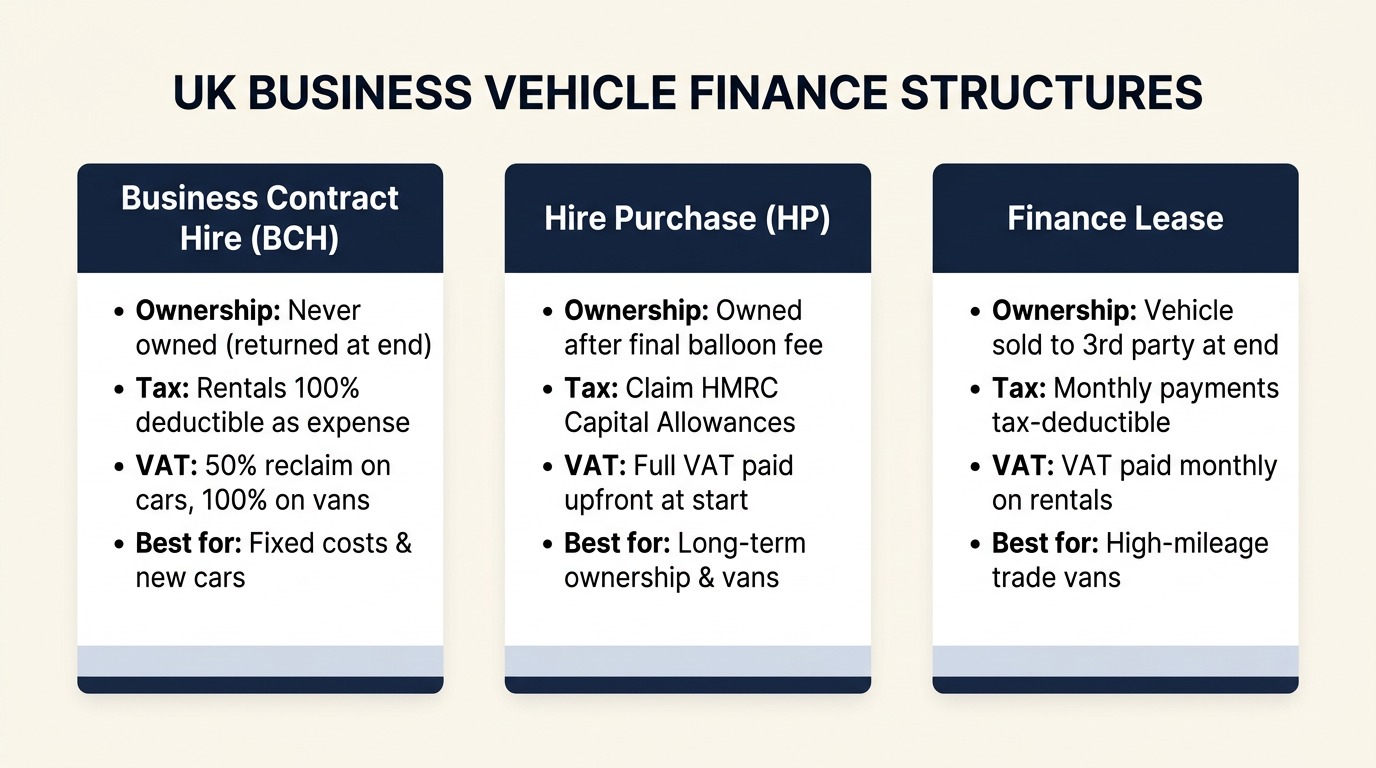
Commercial vehicle funding in the UK is dominated by three main contractual models. Each format carries distinct balance sheet treatments, cash flow obligations, and ownership outcomes.
1. Business Contract Hire (BCH)
Business Contract Hire is the most popular leasing arrangement for UK corporate car fleets and small delivery operations. Under a BCH agreement, the finance company buys the vehicle and leases it to your business for a pre-determined duration, typically between 24 and 48 months, in exchange for a fixed monthly rental fee.
Your business never owns the vehicle. At the end of the contracted term, the vehicle is collected by the leasing provider. Provided the vehicle adheres to agreed mileage limits and meets industry wear standards, your business incurs no further financial liability. The funder absorbs the residual value depreciation risk, giving finance directors predictable monthly outgoings.
2. Hire Purchase (HP)
Hire Purchase is an asset-backed lending arrangement designed for businesses seeking full legal ownership. The business pays an initial deposit (typically 10% to 20% of the vehicle value plus the full upfront VAT amount) followed by fixed monthly instalments covering principal and interest over two to five years.
Upon paying the final instalment and a nominal “option to purchase” fee (often £100 to £250), title of the vehicle transfers permanently to your company. Because the vehicle is recognized as a fixed capital asset from day one, it appears on your corporate balance sheet, allowing the business to claim capital allowances against taxable profits.
3. Finance Lease
Finance Lease is particularly favoured by trade businesses, construction contractors, and logistics companies operating high-mileage commercial vans. Unlike Contract Hire, which enforces rigid mileage caps and strict bodywork damage penalties, a Finance Lease provides operational latitude.
The business rents the vehicle for a fixed period while carrying the asset on its balance sheet. Repayments can be structured as level monthly payments or lower monthly fees paired with a deferred balloon payment based on anticipated residual value. At the end of the term, the vehicle is sold to an independent third party. If the sale price exceeds the balloon target, your business retains the bulk of the surplus (usually 95% to 98%). If it sells below the balloon target, your company must make up the shortfall.
Detailed Comparison: Comparing UK Vehicle Finance Options
Understanding how each financing model impacts your balance sheet, tax exposure, and day-to-day operations allows you to match vehicles with the appropriate funding format.
Adherence to standards set by the BVRLA fair wear and tear standard ensures that businesses returning vehicles under Contract Hire avoid unexpected refurbishment penalties at lease maturity.
HMRC Tax Rules, VAT Reclaim & Capital Allowances
The tax treatment of commercial vehicles represents one of the most technical areas of UK corporate accounting. HM Revenue & Customs applies radically different standards to passenger cars versus commercial goods vehicles.
1. Car vs Commercial Van Definition
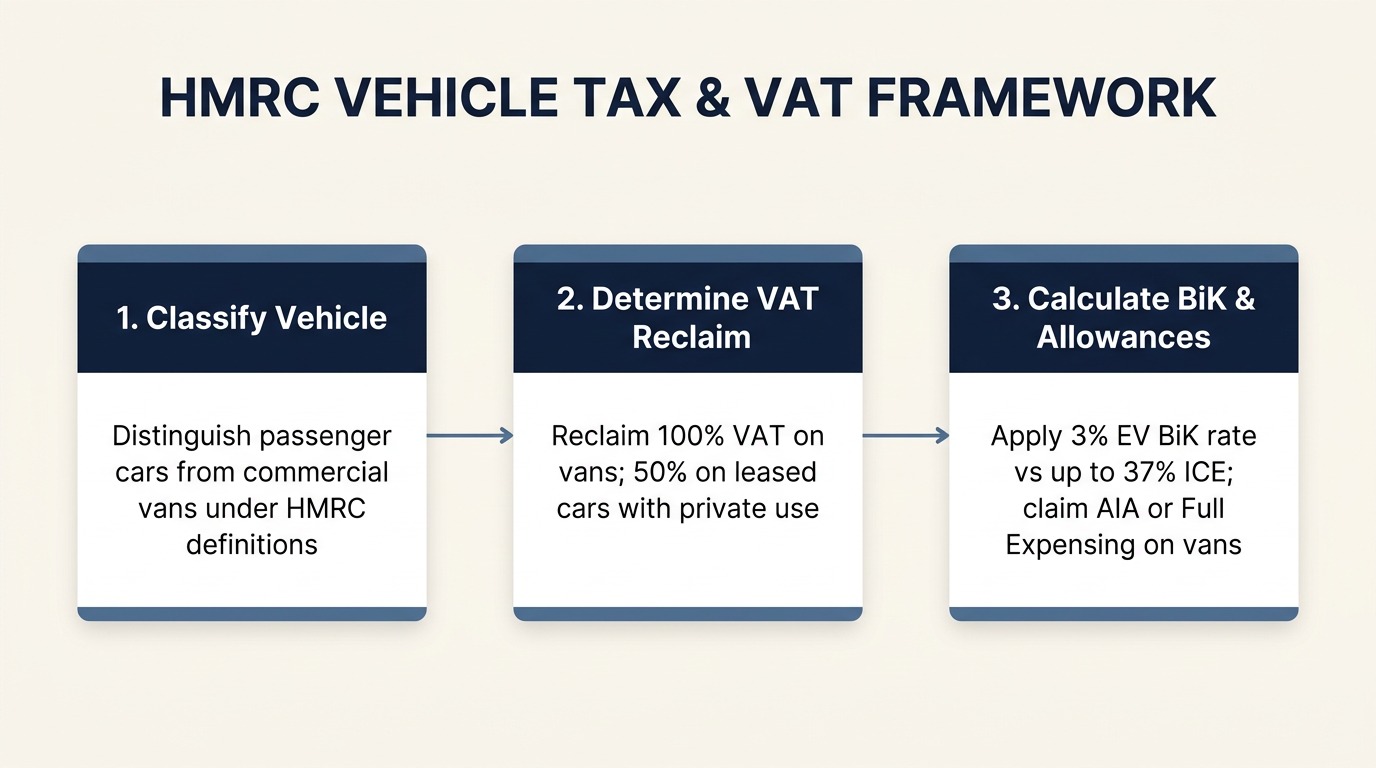
To qualify as a commercial goods vehicle (van) under HMRC rules, a vehicle must be constructed primarily for the conveyance of goods or burden. Commercial vans benefit from generous tax reliefs that are strictly denied to standard passenger cars.
For double-cab pick-up trucks, HMRC enforces a strict one-tonne payload threshold. Pick-ups with a payload capacity below 1,000kg (or 1,040kg with a hard top) are classified as passenger cars, removing van capital allowance benefits and triggering punitive company car Benefit-in-Kind charges.
2. VAT Reclamation Protocols
VAT recovery rules vary according to vehicle classification and business usage:
- Commercial Vans: If your company is VAT-registered, you can reclaim 100% of the VAT charged on purchase, hire purchase, or monthly lease rentals, provided the van is used for commercial trade. Incidental home-to-work travel does not compromise this 100% recovery.
- Leased Passenger Cars (BCH): When a leased company car is available for any personal or commuting use, HMRC imposes a mandatory 50% block on the finance element of the VAT. The remaining 50% can be reclaimed. If you add an optional maintenance package, 100% of the VAT on the service element is reclaimable.
- Purchased Passenger Cars (HP): Reclaiming VAT on purchased cars is practically impossible unless the car is used 100% exclusively for commercial purposes (such as a driving school car, taxi, or pool vehicle kept permanently on corporate premises overnight).
3. Corporation Tax Deductions: Rental Expense vs Capital Allowances
The timing of your corporation tax deduction depends directly on the finance contract type:
- Leased Vehicles (BCH / Finance Lease): Monthly lease payments are deducted as allowable operating expenses against trading profits. For passenger cars with CO2 emissions exceeding 50g/km, HMRC applies a mandatory 15% disallowance rule. This means your business can only deduct 85% of the finance rental costs against taxable income. Cars emitting 50g/km or less (including all battery electric vehicles) escape this penalty and enjoy 100% rental deduction.
- Purchased Vehicles (Hire Purchase): Because the vehicle is a balance sheet asset, you claim Capital Allowances instead of deducting monthly payments. Qualifying commercial vans are eligible for the Annual Investment Allowance (AIA), allowing up to 100% of the purchase price to be written off against corporation tax in year one. In contrast, passenger cars do not qualify for AIA; new zero-emission cars qualify for a 100% First Year Allowance, while combustion cars are written down slowly at 18% (under 50g/km) or 6% (over 50g/km) per annum.
To evaluate how capital allocations integrate with broader operational savings, review statutory exemptions like Small Business Rates Relief UK.
Benefit-in-Kind (BiK) Company Car Tax: The Electric Vehicle Advantage
When a limited company provides a vehicle to an employee or director that is available for private travel, HMRC treats this as a taxable non-cash perk known as a Benefit-in-Kind (BiK). The employee pays personal income tax on this value, while the employing business pays Class 1A National Insurance contributions at 13.8%.
The annual taxable benefit is calculated using three factors: the vehicle’s official list price including options (P11D value), its certified CO2 emissions band, and the employee’s marginal income tax rate (20%, 40%, or 45%).
As confirmed by official HMRC company car tax rules, zero-emission electric vehicles carry a BiK rate of just 3% for the 2025/2026 financial year, rising incrementally to 4% in 2026/2027 and 5% in 2027/2028. Supplying an electric company car saves a higher-rate taxpayer over £5,000 each year compared to a traditional diesel equivalent, while significantly lowering employer Class 1A National Insurance contributions.
Commercial Underwriting and Fleet Eligibility Criteria
Vehicle leasing companies and asset finance houses conduct thorough credit assessments before approving commercial vehicle finance facilities.
1. Corporate Financial Health and Trading Duration
Lenders evaluate your filed accounts at Companies House. Tier-one funders typically expect at least two continuous years of profitable trading, a clean credit history, and positive net asset values. For established businesses, credit lines can be approved without requiring personal guarantees or upfront vehicle deposits beyond the initial rental.
2. Early-Stage and Startup Businesses
Newer companies with under two years of trading can still access vehicle finance, though underwriters will apply compensatory risk measures. These include requesting three to six months of business bank statements via Open Banking, requiring larger upfront advance rentals (such as 6 or 9 months in advance instead of 3), or requesting personal guarantees from company directors.
If your business also relies on short-term liquidity to support working capital alongside fleet costs, examine alternative facilities like instant business loan options or invoice discounting facilities.
Common Fleet Pitfalls and Mistakes to Avoid
Overlooking commercial contract terms can lead to severe end-of-contract liabilities. Commercial directors should guard against four recurring operational errors.
1. Underestimating Contracted Mileage
Opting for a lower annual mileage quota reduces headline monthly rental figures during quotes. However, leasing companies levy excess mileage charges ranging from 8p to 30p per mile plus VAT upon return. Exceeding a 10,000-mile contract by 15,000 miles over three years can result in an unexpected £3,500 penalty invoice.
2. Neglecting Fair Wear and Tear Standards
Leased vehicles must be returned in acceptable cosmetic and mechanical condition. Scuffed alloy wheels, panel dents exceeding 10mm, torn seat upholstery, or missing spare keys trigger commercial recharge penalties. Arranging smart repairs through an independent body shop before scheduled vehicle collection is invariably cheaper than paying leasing company end-of-term repair rates.
3. Forgetting the 15% Lease Disallowance on High-Emission Cars
Many business owners assume all company car lease rentals are 100% deductible against corporation tax. Contracting petrol or diesel cars emitting over 50g/km CO2 triggers HMRC’s 15% disallowance, permanently increasing the real tax cost of executive vehicles.
4. Working with Non-Regulated Brokers
Always verify that commercial brokers or vehicle finance providers hold active authorization from the Financial Conduct Authority and are registered members adhering to the Finance and Leasing Association code of practice. Accredited members guarantee transparent commission disclosure, standardized wear guidelines, and compliant financial promotions.
Frequently Asked Questions
Can a brand new limited company lease a business vehicle?
Yes, startups and newly formed limited companies can secure business vehicle finance. While high-street clearing banks may hesitate without filed accounts, specialist vehicle funders accept applications supported by three to six months of Open Banking statements, director personal guarantees, or higher initial deposits.
Is it better to buy or lease a business van?
The decision depends on mileage and vehicle modifications. For companies operating standard delivery routes with regular 3-to-4-year vehicle upgrades, Business Contract Hire provides fixed costs and 100% tax-deductible rentals with zero resale risk. For businesses installing bespoke racking, heavy tow bars, or operating extreme mileage, Hire Purchase is preferable, as it avoids return penalties and qualifies for 100% Annual Investment Allowance tax deductions.
How much VAT can a business reclaim on a leased company car?
A VAT-registered business can reclaim 50% of the VAT on the monthly finance rental of a leased car if it is available for any private use or commuting. If the car is used exclusively for business with zero private use, 100% of the VAT is reclaimable. If a maintenance package is included, 100% of the VAT on the maintenance portion is reclaimable regardless of private mileage.
What happens if I want to terminate a business lease early?
Terminating a Business Contract Hire agreement early typically incurs an early termination fee, usually calculated as 50% of the remaining outstanding monthly rentals. If your fleet requirements fluctuate frequently, consider short-term flexible leases or Finance Lease agreements that permit early vehicle sale settlement.
Does a business vehicle lease include maintenance and tyres?
Standard vehicle finance agreements do not include maintenance automatically. However, most providers offer optional “customer-maintained” or “fund-maintained” packages for an additional monthly fee. Fund-maintained contracts cover routine servicing, mechanical repairs, MOT testing, and replacement tyres, providing complete cash flow predictability.
What is the Benefit-in-Kind rate for an electric company van?
Zero-emission electric vans carry a 0% Benefit-in-Kind tax rate under current UK tax rules. Unlike electric cars, which carry a 3% BiK rate in 2025/2026, employees driving electric commercial vans for private journeys pay zero personal income tax, and employers pay zero Class 1A National Insurance on the benefit.
The Bottom Line: How to Proceed
Business vehicle finance serves as an essential lever for UK commercial enterprises, allowing directors to equip their workforce with modern, efficient vehicles while conserving liquid capital. Balancing cash flow stability against tax efficiency is the foundation of sound fleet procurement.
For executive passenger travel, transition to battery electric vehicles to capture immediate 3% Benefit-in-Kind rates and full lease rental tax deductibility. For commercial work vans, weigh whether high annual mileage favours an equity-building Hire Purchase arrangement or whether predictable operating costs make Business Contract Hire the superior choice. Review contract terms carefully, verify broker credentials, and consult your company accountant to ensure your vehicle funding strategy delivers maximum commercial value.