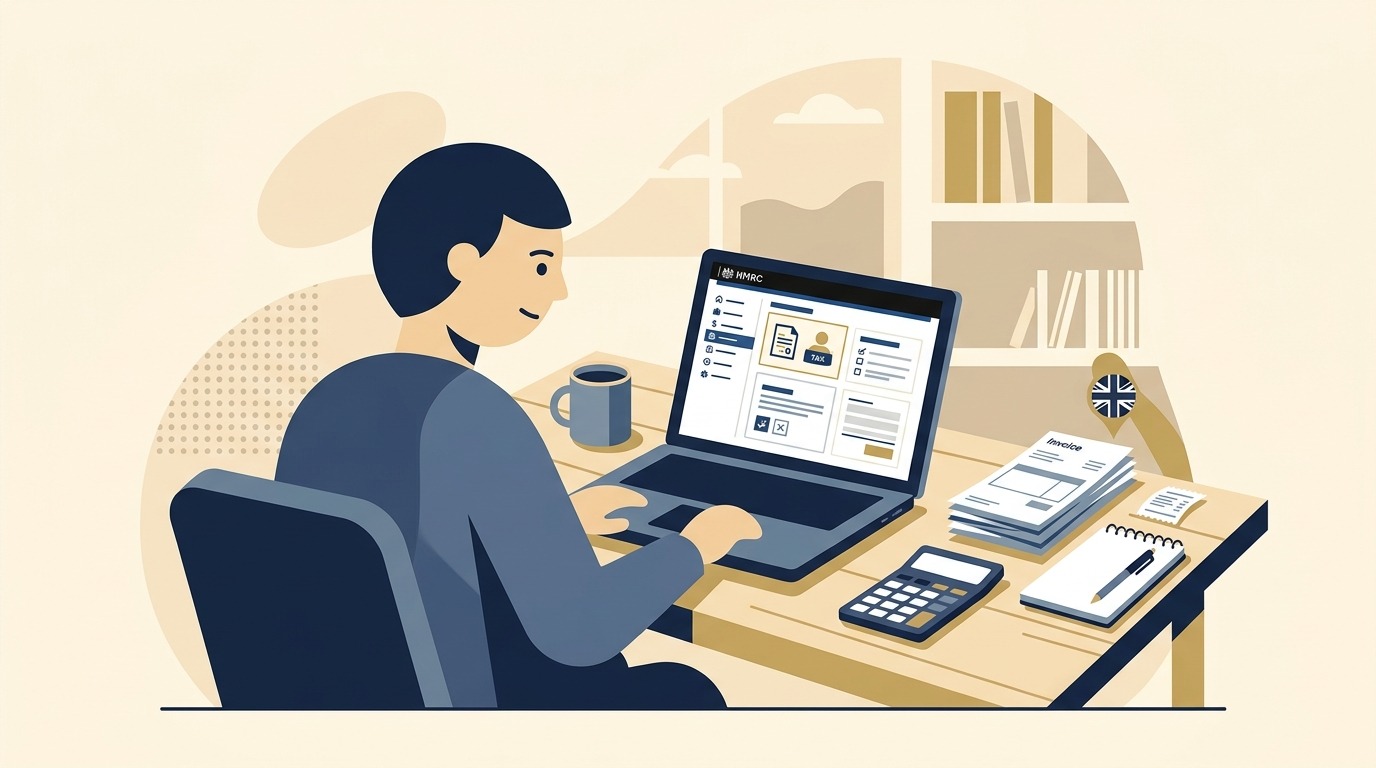
According to business population statistics published by the Department for Business and Trade, sole proprietorships represent over 56% of the UK private sector enterprise population, totaling approximately 3.1 million active commercial ventures. Yet despite operating as the most popular and agile legal structure in Britain, thousands of emerging founders encounter financial penalties each year through delayed tax notifications. Knowing when and how to register as a sole trader with HM Revenue and Customs (HMRC) forms the foundational legal step of self-employment.
Operating as a sole trader offers complete managerial autonomy, minimal administrative filing overheads, and the legal right to retain all business profits after taxation. However, this simplicity coexists with unlimited personal liability for commercial debts and strict statutory deadlines enforced by HMRC. Missing the annual registration window can trigger automatic penalties, interest charges, and unexpected tax demands.
This operational guide details the legal obligations, registration procedures, tax brackets, National Insurance rules, and compliance deadlines required to successfully establish your sole proprietorship in the United Kingdom.
Quick Answer: How to Register as a Sole Trader in the UK
You must register as a sole trader with HMRC if your gross self-employed income exceeds £1,000 within a single UK tax year (6 April to 5 April). Registration is completed online through the HMRC Government Gateway portal using the digital service for Self Assessment. The statutory registration deadline is 5 October following the end of the tax year in which you began trading. Once registered, HMRC issues your 10-digit Unique Taxpayer Reference (UTR) number by post within 10 to 15 working days. This number enables you to submit annual Self Assessment returns, pay Class 4 National Insurance, and calculate your income tax liabilities before the 31 January statutory deadline.
Key Takeaways for Emerging UK Sole Traders
- Trading Allowance Threshold: Registration is legally required only after gross commercial receipts exceed £1,000 in a tax year.
- Strict 5 October Deadline: You must inform HMRC by 5 October in your business’s second tax year to avoid failure-to-notify penalties.
- 10-Digit UTR Number: HMRC issues your Unique Taxpayer Reference by post; this identifier remains with you for life.
- National Insurance Reforms: Mandatory Class 2 National Insurance is abolished; Class 4 National Insurance is set at 6% between £12,570 and £50,270.
- Making Tax Digital Readiness: Sole traders with gross income above £50,000 must prepare for digital quarterly reporting starting April 2026.
Understanding the Sole Trader Business Structure
In legal terms, establishing oneself as a sole trader means there is no legal separation between the individual and the business. Unlike a private limited company registered at Companies House, a sole proprietorship does not constitute a separate legal person. You own all business assets personally, retain all net profits, and carry personal responsibility for every commercial debt, supplier contract, and customer dispute.
This structure delivers significant operational benefits. Administrative formalities are minimal: there is no requirement to publish annual financial accounts on a public register, file Confirmation Statements, or maintain statutory director records. Sole traders retain privacy over their commercial revenue, disclosing financial statements only to HMRC via confidential Self Assessment filings.
Conversely, unlimited personal liability represents the primary structural risk. If your enterprise incurs commercial debts or faces legal action, creditors can pursue your personal assets, including personal savings and residential property. For this reason, professional tradespeople and consultants should establish adequate sole trader public liability insurance before delivering client services.
The £1,000 Trading Allowance: When Is Registration Mandatory?
A common point of confusion among freelancers and side-hustlers is determining the exact moment HMRC registration becomes legally mandatory. You do not need to register on the day you conceptualize an idea or buy supplies. The statutory trigger depends entirely on gross earnings.
Under UK tax legislation, every individual benefits from a £1,000 annual Trading Allowance. If your total gross income from self-employment, freelancing, or casual commercial sales is £1,000 or less during a single tax year (running from 6 April to 5 April), you are exempt from notifying HMRC and do not need to file a tax return.
The moment your cumulative gross trading receipts surpass £1,000 within a tax year, formal registration becomes compulsory. This rule evaluates gross income (total sales receipts before deducting any business expenses), rather than net profit. If you generate £1,400 in client fees but incur £600 in equipment expenses (yielding a £800 net profit), you must still register with HMRC because gross turnover exceeded the statutory threshold.
Entrepreneurs weighing the operational tradeoffs between corporate models and sole proprietorship can review our limited company vs sole trader tax comparison to assess where profitability tipping points occur.
Step 1: Selecting a Legally Compliant Business Name
Sole traders can trade under their own personal name (such as “David Miller”) or adopt a distinct business name (such as “Miller Precision Consulting”). Unlike limited companies, you do not register this trading name with Companies House. However, you must comply with strict naming guidelines set out by GOV.UK sole trader registration guidance.
Your chosen trading name must not:
- Include terms implying a corporate structure, including “Limited”, “Ltd”, “LLP”, “Public Limited Company”, or “Plc”.
- Contain offensive language or terms protected under national legislation.
- Include “sensitive words” (such as “British”, “Royal”, “Chartered”, or “Insurance”) without explicit written permission from relevant government bodies.
- Infringe on existing registered trademarks owned by competing commercial entities.
You must display your personal name and business name clearly on all business stationery, commercial invoices, client contracts, and digital websites. For example, your invoice footer should read: “David Miller trading as Miller Precision Consulting”.
Step 2: Setting Up Your HMRC Government Gateway Account
To register with HMRC, you require an active Government Gateway user ID. If you already access UK personal tax accounts online (for viewing PAYE tax codes or National Insurance records), you can utilize your existing login credentials.
If you do not possess an account, the setup procedure requires approximately five minutes:
- Navigate to the official HMRC portal on GOV.UK and select “Create sign in details”.
- Provide a verified email address to receive an immediate security confirmation code.
- Enter your full legal name and create a secure password.
- Set up two-factor authentication using a mobile text message or authenticator application.
- HMRC generates a 12-character Government Gateway user ID, which is displayed on screen and sent to your email. Keep this identifier secure.

Small business owners and consultants reviewing digital bookkeeping records, allowable expense categories, and National Insurance calculations.
Step 3: Registering for Self Assessment via Form CWF1
Once logged into your Government Gateway profile, you must formally register for Self Assessment as a self-employed individual. This procedure utilizes digital form CWF1 (“Registering for Self Assessment and National Insurance as self-employed”).
During the online submission, HMRC requires specific personal and business details:
- National Insurance Number: Your permanent 9-character UK personal identifier.
- Personal Residential Address: Your official residential location and date of birth.
- Business Trading Name: The commercial name under which you provide services.
- Business Commencement Date: The precise date your commercial operations began. This date establishes your liability tax year.
- Nature of Business: A concise description of your commercial trade (e.g. “Management Consulting”, “Electrical Contracting”, “Graphic Design”).
- Business Contact Details: Your operating address, commercial telephone number, and business email.
After reviewing your details, submit the application electronically. HMRC provides an on-screen acknowledgement reference confirming your application is in progress.
Step 4: Receiving and Activating Your 10-Digit UTR Number
Following application submission, HMRC processes your file and creates your Self Assessment tax account. The department assigns a 10-digit Unique Taxpayer Reference (UTR) number.
HMRC dispatches your UTR by physical post in an official confirmation letter (document reference SA250) within 10 to 15 working days. If you reside outside the UK, postal delivery may require up to 21 working days. If you possess the official HMRC mobile application, your 10-digit UTR will frequently appear in your digital tax profile several days before the paper document arrives.
Your UTR number is permanent. Even if you subsequently pause trading, take up salaried employment, or close your business, this 10-digit identifier remains linked to your tax record indefinitely. You will require your UTR for submitting tax returns, registering for VAT, opening merchant payment accounts, and verifying subcontractor status under the Construction Industry Scheme (CIS).
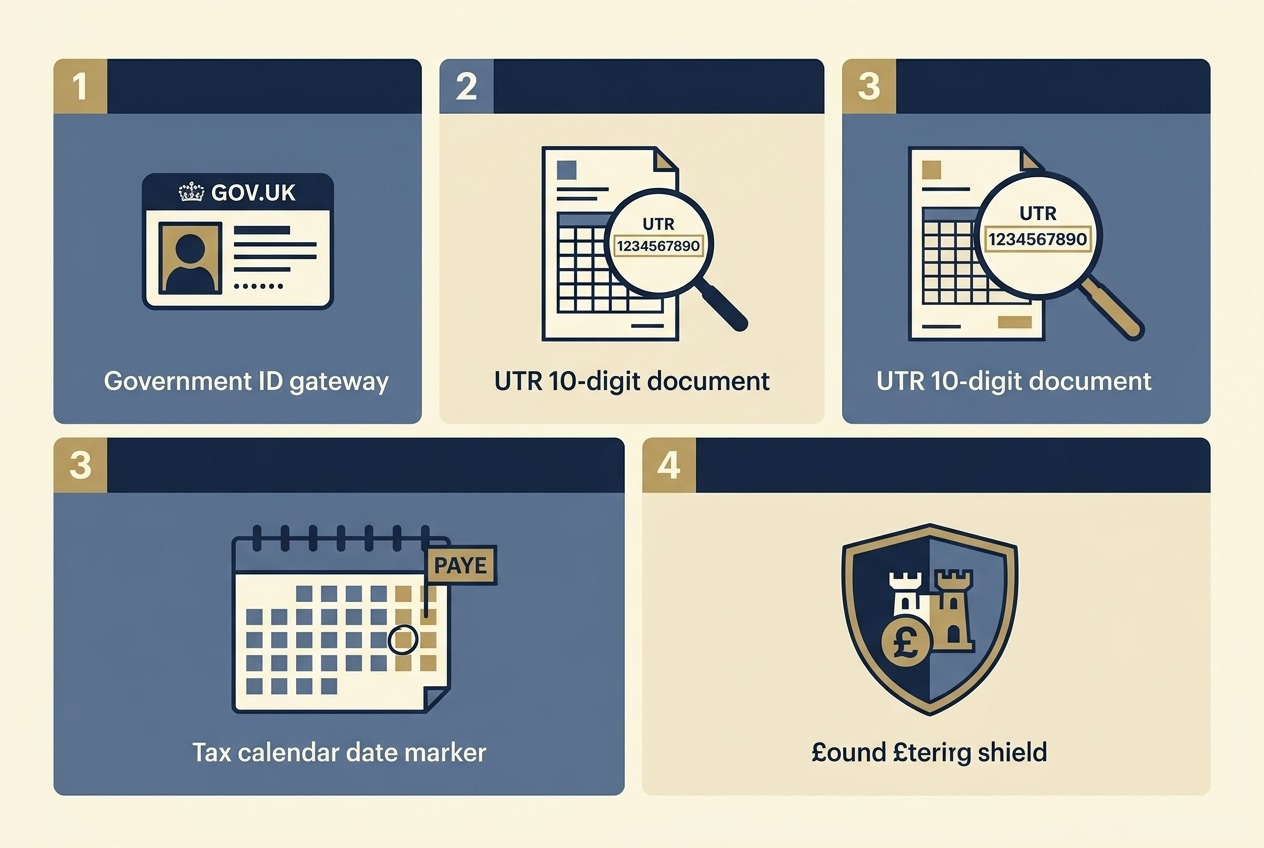
The four key milestones to register as a sole trader with HMRC: Government Gateway, UTR issuance, statutory tax calendar, and operational protection.
Step 5: Commercial Banking and Record-Keeping Protocols
Legally, UK sole traders are permitted to receive business income into a standard personal current account. In practice, mixing personal transactions with commercial revenue creates severe operational complications.
Most UK retail banks prohibit using personal accounts for commercial business transactions within their standard account terms. Maintaining a dedicated business bank account simplifies income tracking, clarifies expense reconciliation, and produces clean audit trails for your year-end tax return. Modern UK digital banks provide dedicated sole trader accounts that integrate directly with cloud accounting platforms.
Under statutory HMRC regulations, you must maintain complete commercial records for at least five years after the 31 January submission deadline of the relevant tax year. Essential records include:
- Numbered sales invoices and merchant receipt statements
- Supplier purchase invoices and digital receipt images
- Business bank account statements and credit card summaries
- Vehicle mileage logs recording date, destination, and commercial purpose
- Documentation of personal funds introduced or withdrawn from the business
Understanding Sole Trader Taxes: Income Tax and National Insurance
Sole traders pay tax on business profits, not total revenue. Profit is calculated by subtracting allowable commercial expenses from total gross turnover. Unlike corporate structures subject to Corporation Tax, sole trader profits are taxed as personal income.
The table below summarizes the personal tax rates and National Insurance contribution bands applicable to UK sole traders:
| Tax / Contribution Tier | Applicable Rate | Applicable Profit Band | Commercial Description |
|---|---|---|---|
| Personal Allowance | 0% | Up to £12,570 | Tax-free threshold (frozen across the UK until April 2028). |
| Basic Rate Income Tax | 20% | £12,571 to £50,270 | Standard income tax band applied to taxable net profit. |
| Higher Rate Income Tax | 40% | £50,271 to £125,140 | Higher rate threshold applied to earnings above £50,270. |
| Additional Rate Income Tax | 45% | Over £125,140 | Top tier rate; personal allowance tapers above £100,000. |
| Class 4 National Insurance | 6% | £12,570 to £50,270 | Profit-related National Insurance rate (reduced from 9%). |
| Class 4 Upper Rate NI | 2% | Over £50,270 | Applied to all net annual profits exceeding £50,270. |
| Class 2 National Insurance | Abolished (£0) | Profits over £6,725 | Mandatory payments removed; voluntary contributions remain. |
The Payments on Account Cash Flow Trap
The single greatest financial shock experienced by first-time sole traders is HMRC’s “Payments on Account” framework. If your calculated Self Assessment tax bill exceeds £1,000, HMRC legally assumes you will owe a similar sum in the following tax year.
Under this mechanism, you must pay your assessed tax for the completed year on 31 January, plus an advance payment equal to 50% of that bill toward the upcoming tax year. A second 50% balancing installment falls due on 31 July. For example, if your initial tax liability is £3,000, your total payment on 31 January will be £4,500 (£3,000 completed bill plus £1,500 advance payment). Emerging sole traders must reserve between 25% and 30% of every customer invoice in a dedicated savings account to manage this double payment smoothly.
VAT Registration and Making Tax Digital (MTD)
Registering as a sole trader does not automatically register you for Value Added Tax (VAT). VAT operates under independent statutory rules:
- Compulsory Registration Threshold: You must register for VAT if your rolling 12-month taxable turnover exceeds £90,000, or if you expect gross receipts to surpass £90,000 in the next 30 days alone. Review our UK VAT registration guide for exact turnover calculation formulas.
- Voluntary Registration: Sole traders with revenue below £90,000 can register voluntarily. This strategy allows you to reclaim VAT incurred on initial tools, computer equipment, and operational overheads, provided your commercial clients are VAT-registered entities capable of reclaiming input tax.
Preparing for Making Tax Digital (MTD for ITSA)
HMRC is rolling out mandatory digital record-keeping under Making Tax Digital for Income Tax Self Assessment. Sole traders must prepare for new quarterly reporting obligations:
- April 2026: Sole traders and unincorporated landlords with gross commercial income exceeding £50,000 must maintain digital software records and submit quarterly summary updates to HMRC.
- April 2027: The digital mandate expands to sole traders with gross commercial income exceeding £30,000.
Adopting compliant accounting software now ensures a smooth transition before HMRC imposes digital compliance penalties.
Statutory Deadlines and Failure-to-Notify Penalties
HMRC enforces strict compliance timetables. Mark these essential dates in your operational calendar:
| Milestone | Statutory Deadline | Associated Penalty or Consequence |
|---|---|---|
| HMRC Sole Trader Notification | 5 October following tax year | Failure-to-notify penalty calculated as a percentage of tax due (up to 30% for non-deliberate failure). |
| Paper Tax Return Filing | 31 October following tax year | Immediate £100 fixed late-filing penalty applies if submitted after midnight. |
| Online Tax Return Submission | 31 January following tax year | Immediate £100 fixed penalty; daily £10 penalties begin after 3 months. |
| Balancing Payment & 1st Advance | 31 January at midnight | HMRC interest charges accumulate immediately; 5% surcharge added after 30 days. |
| 2nd Payment on Account | 31 July at midnight | Late payment interest charged daily until outstanding balance clears. |
According to compliance guidance on HMRC Self Assessment filing deadlines, late submission penalties escalate rapidly. If a return remains outstanding for six months, an additional penalty equal to 5% of the estimated tax bill (or £300, whichever is greater) is added, repeating again at 12 months.
Transitioning to a Limited Company as Your Business Expands
The sole trader structure provides an ideal launchpad for early-stage ventures. However, as net annual profits climb beyond £40,000 to £50,000, the corporate structure frequently becomes more tax efficient.
Operating through a limited company allows founders to extract income via a tax-efficient combination of director salary (set within the primary National Insurance threshold) and shareholder dividends. In addition, limited liability status rings fences personal assets from corporate trading risks, and holding a corporate identity can improve credibility when pitching to large enterprise clients or securing institutional credit.
When you reach the operational scale where incorporation makes commercial sense, our step-by-step tutorial on how to register a company in the UK guides you through Companies House incorporation and asset transfer protocols.
Frequently Asked Questions
Can I register as a sole trader while remaining in full-time employment?
Yes. UK employment law permits individuals to operate as a sole trader while working as an employee, provided your employment contract does not contain restrictive covenants or conflict of interest clauses. You must inform HMRC about your self-employed trading activities through Self Assessment. In your annual tax return, you declare both your PAYE employment earnings (from form P60) and your sole trader profits.
Do I need to pay to register as a sole trader with HMRC?
Registering as a sole trader with HMRC is completely free of charge. You should always register directly through the official GOV.UK portal. Beware of unofficial third-party websites charging intermediary fees to complete standard Government Gateway or CWF1 submissions.
How long does it take for HMRC to issue a UTR number?
HMRC typically processes digital registrations and delivers your 10-digit Unique Taxpayer Reference within 10 to 15 working days by post. During peak Self Assessment filing months (December and January), processing times can extend to 20 working days. If you use the HMRC mobile app, your UTR often appears in your account dashboard several days before postal delivery.
What allowable expenses can a UK sole trader claim to reduce tax?
Sole traders can deduct commercial expenses incurred wholly and exclusively for the purposes of trade. Common allowable deductions include office equipment, software subscriptions, commercial phone bills, professional indemnity insurance, marketing expenses, accountancy fees, trade tools, and vehicle mileage at standard HMRC approved rates (45p per mile for the first 10,000 miles).
What happens if I miss the 5 October sole trader registration deadline?
If you fail to register by 5 October following the end of the tax year in which you started trading, you may face a failure-to-notify penalty. However, if you complete your Self Assessment return and pay all assessed tax in full before the 31 January deadline, HMRC frequently reduces or waives penalties for non-deliberate registration delays.
Can two people register as a sole trader together?
No. By definition, a sole trader is a single individual trading independently. If two or more people wish to run an unincorporated commercial business together and share profits, they must form a General Business Partnership or Limited Liability Partnership (LLP), registering the partnership structure separately with HMRC.
Strategic Next Steps for New UK Sole Traders
Registering as a sole trader marks the official beginning of your commercial enterprise. Taking prompt control of administrative filings protects your early trading revenue from unnecessary penalties and creates a sound financial baseline.
Begin by logging into the Government Gateway and submitting form CWF1 well ahead of the 5 October deadline. Open a dedicated commercial bank account, connect digital invoicing software, and transfer approximately 25% of all client receipts into a protected tax reserve. By mastering these operational habits from day one, you establish an agile, resilient foundation that allows you to focus on client acquisition, service delivery, and sustainable business growth.