Quick Answer: SEIS vs EIS Differences 2026
The primary difference between the Seed Enterprise Investment Scheme (SEIS) and the Enterprise Investment Scheme (EIS) lies in company maturity, fundraising caps, and investor tax relief rates. SEIS targets early-stage startups trading for under 3 years with under 25 employees, offering investors 50% Income Tax Relief on up to £200,000 per year (company lifetime cap £250,000). EIS targets larger growth-stage companies trading for under 7 years with under 250 employees, offering 30% Income Tax Relief on up to £1 million per year (company annual cap £5 million). Both schemes require a 3-year minimum shareholding period and provide 100% Capital Gains Tax exemption on qualifying profits.
Key Takeaways
- Official HMRC data confirms that over £2.1 billion was raised by UK businesses through venture capital tax schemes in the latest reporting year.
- SEIS provides 50% Income Tax Relief up to £200,000 per investor per tax year.
- EIS provides 30% Income Tax Relief up to £1 million per investor (£2 million for knowledge-intensive companies).
- Loss relief allows investors to offset net share losses against UK income tax or capital gains tax if a startup fails.
According to official venture capital statistics published by HMRC, more than 4,000 UK companies secure equity funding through the Seed Enterprise Investment Scheme (SEIS) and Enterprise Investment Scheme (EIS) each year. Together, these two government-backed tax incentives channel over £2 billion in private angel capital into British innovation annually.
For early-stage UK founders, offering SEIS or EIS advance assurance is often the single most powerful incentive when pitching angel investors and venture capital syndicates. The tax reliefs significantly lower an investor’s downside risk while preserving unlimited upside potential on company equity.
However, navigating the distinct eligibility criteria, gross asset caps, trade limits, and HMRC compliance rules between SEIS and EIS requires careful structural planning before opening an investment round.
This guide provides a comprehensive breakdown of SEIS vs EIS for 2026, comparing investor tax benefits, company fundraising limits, HMRC advance assurance procedures, and common compliance pitfalls.
Overview of UK Venture Capital Tax Schemes
The UK government established SEIS and EIS to encourage private investment into early-stage, high-risk unquoted trading companies that face difficulties securing traditional bank debt finance.
Both schemes operate by offering individual UK taxpayers generous tax incentives in exchange for purchasing newly issued ordinary shares in qualifying companies.
│
Unlocks Income Tax Relief + 100% CGT Exemption + Loss Relief
For founders evaluating early capital requirements alongside software, legal, and premises overheads, calculate your launch runway using our Start-Up Cost Estimator.
Key Differences: SEIS vs EIS (2026 Rules)
While both schemes share similar tax exemption goals, they apply to different stages of company growth and carry distinct investor caps:
| Feature | SEIS (Seed Enterprise) | EIS (Enterprise Investment) |
|---|---|---|
| Income Tax Relief Rate | 50% of investment | 30% of investment |
| Max Annual Investor Limit | £200,000 | £1,000,000 (£2m Knowledge-Intensive) |
| Company Lifetime Raising Cap | £250,000 lifetime limit | £5m per year (£12m lifetime limit) |
| Max Company Trading Age | Under 3 years | Under 7 years (10 years Knowledge-Intensive) |
| Max Gross Assets Limit | Under £350,000 before raise | Under £15 million before raise |
| Max Full-Time Employees | Fewer than 25 FTE employees | Fewer than 250 FTE employees (500 KI) |
| Min. Holding Period | 3 years from share issue | 3 years from share issue |
| Capital Gains Tax (CGT) Exemption | 100% CGT free on share sale after 3 yrs | 100% CGT free on share sale after 3 yrs |
Official tax guidance and compliance rules can be reviewed directly on the GOV.UK SEIS guidance portal.
Investor Tax Relief Breakdown
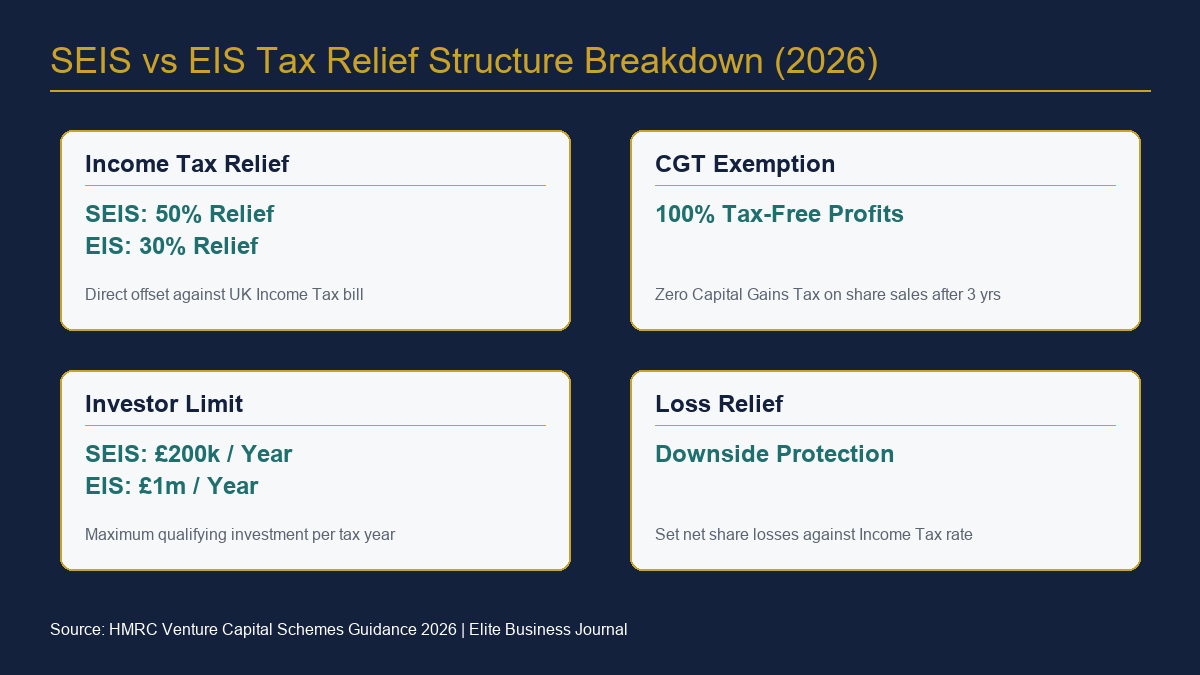
The financial attraction of SEIS and EIS for private UK investors stems from four distinct tax advantages:
1. Income Tax Relief
Investors can offset a percentage of their investment directly against their UK Income Tax bill for the current or previous tax year (“carry back”):
- SEIS Example: A £50,000 investment reduces the investor’s UK Income Tax bill by £25,000 (50%).
- EIS Example: A £100,000 investment reduces the investor’s UK Income Tax bill by £30,000 (30%).
2. Capital Gains Tax (CGT) Exemption
If the shares are held for at least three years and income tax relief was claimed, any capital gain realized upon selling the shares is completely exempt from Capital Gains Tax.
3. CGT Reinvestment & Deferral Relief
- SEIS Reinvestment Relief: If an investor sells an asset (such as property or stocks) and reinvests the gain into SEIS shares, they receive a 50% exemption on the original capital gain up to £100,000.
- EIS Deferral Relief: Reinvesting a capital gain into EIS shares defers the CGT liability until the EIS shares are sold.
4. Loss Relief Protection
If an early-stage startup fails and the shares are written off, investors can claim Loss Relief. Loss relief allows the net loss (investment minus income tax relief already claimed) to be set against the investor’s income tax rate, cushioning effective risk.
For company founders structuring early equity allocation alongside debt options, review our breakdown of financial modeling for startups.
Company Eligibility Criteria for UK Startups
To issue SEIS or EIS qualifying shares, your limited company must satisfy strict HMRC operational rules:
↓
Gross Assets Under £350k (SEIS) / £15m (EIS) | FTE Employees Under 25 (SEIS) / 250 (EIS)
↓
HMRC QUALIFYING COMPANY STATUS APPROVED!
Excluded Trades
HMRC excludes certain business activities from SEIS and EIS eligibility. A company cannot qualify if more than 20% of its activities consist of excluded trades, including:
- Financial services, banking, insurance, or money lending.
- Property development, land dealing, or leasing.
- Legal and accountancy services.
- Hotels, nursing homes, and guest house management.
- Electricity, gas, or energy production.
When incorporating a new entity, founders should also ensure compliance with general corporate laws outlined in our guide on advantages of a corporation.
How to Apply for HMRC Advance Assurance
Before asking investors for funds, founders should obtain Advance Assurance from HMRC. Advance Assurance is formal written confirmation from HMRC that your business qualifies for SEIS or EIS scheme rules based on your pitch deck and business structure.
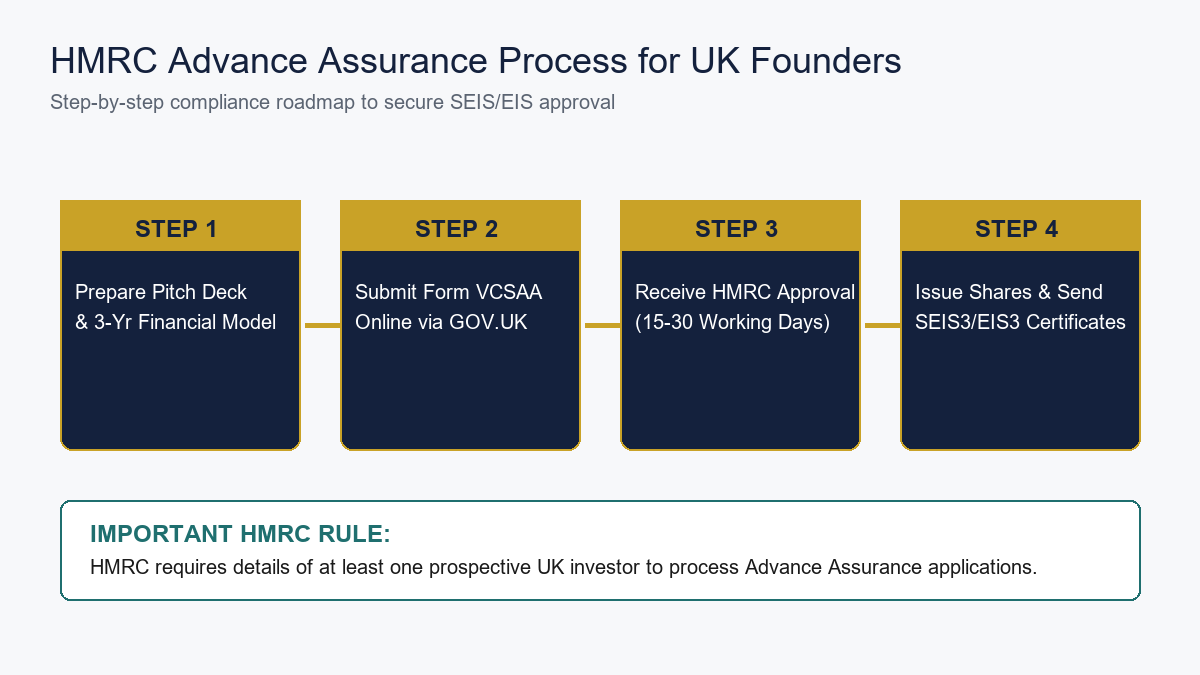
Step-by-Step Advance Assurance Process:
- Prepare Required Documents: Business plan, pitch deck, financial forecasts, articles of association, and details of proposed investors.
- Submit Form VCSAA Online: Complete the HMRC Venture Capital Schemes Advance Assurance application portal on GOV.UK.
- Specify Proposed Investor Details: HMRC requires details of at least one prospective investor who plans to participate in the round.
- Receive HMRC Approval Letter: HMRC typically issues Advance Assurance within 15 to 30 working days.
- Issue Shares & File SEIS1/EIS1 Form: After raising capital and issuing shares, submit the compliance form SEIS1 or EIS1 to HMRC.
- Distribute SEIS3/EIS3 Tax Certificates: HMRC provides SEIS3/EIS3 certificates which you distribute to investors so they can claim tax relief on their annual Self Assessment returns.
For more capital raising strategies, view our complete analysis of UK business grants.
Frequently Asked Questions
Can founders claim SEIS or EIS tax relief on their own company?
Generally, no. Investors who hold more than a 30% stake in the company or are employed by the company (such as founder directors) are considered “connected” by HMRC and cannot claim Income Tax Relief under SEIS or EIS. However, unpaid directors or minority angel investors can qualify.
Can a company raise SEIS and EIS in the same funding round?
Yes. A startup can raise its £250,000 SEIS cap and immediately raise additional funds under EIS within the same investment round, provided SEIS shares are issued before EIS shares.
What happens if SEIS shares are sold before 3 years?
If an investor sells or transfers their SEIS shares before the 3-year minimum holding period ends, HMRC will claw back the 50% Income Tax Relief, and any capital gains realized will become subject to standard UK Capital Gains Tax.
Is SEIS relief available to non-UK residents?
Non-UK resident investors can claim SEIS or EIS tax relief if they pay UK Income Tax or Capital Gains Tax against which the relief can be offset.
Your Next Actions
- Verify Trade & Age Eligibility: Confirm your company has been trading for under 3 years for SEIS (or 7 years for EIS) and is not in an excluded trade sector.
- Prepare Advance Assurance Package: Draft your pitch deck, 3-year financial model, and cap table to submit HMRC Form VCSAA.
- Identify Initial Lead Investor: Secure commitment details from at least one prospective UK investor to attach to your HMRC application.
- Model Your Funding Runway: Use our interactive Start-Up Cost Estimator to calculate total equity capital requirements.
Editorial Team & Signature
Written by Oliver Carpenter, Lead Business Analyst at Elite Business Journal. Published February 2026.