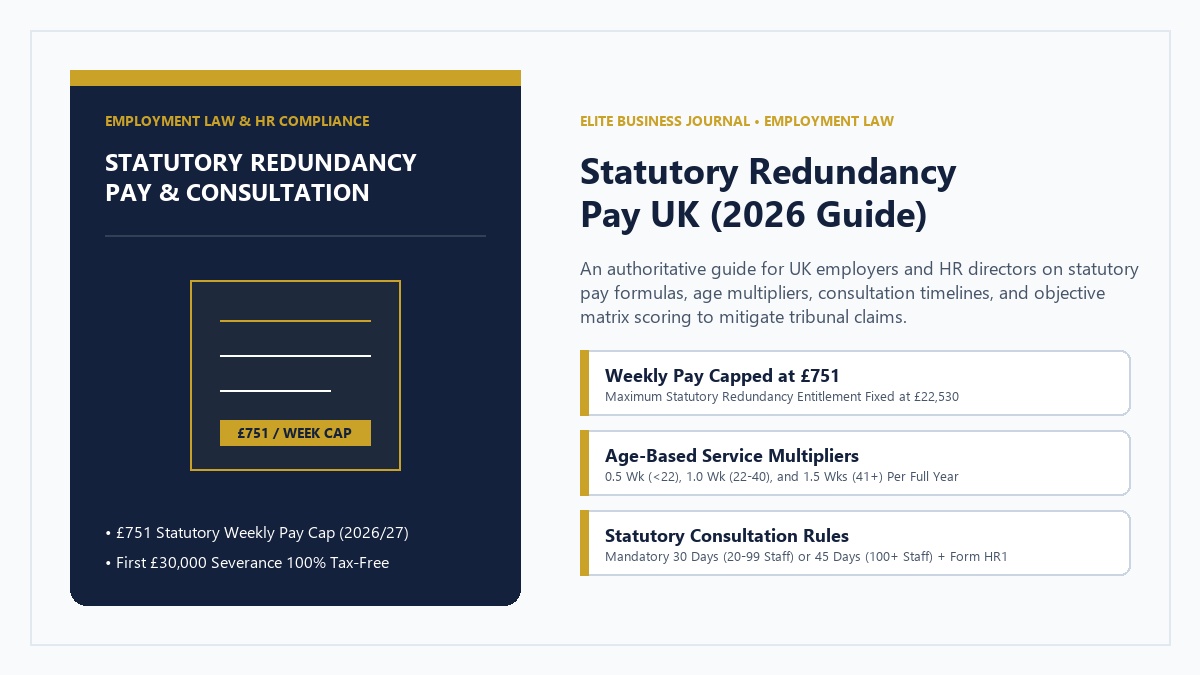
Quick Answer: Statutory Redundancy Pay UK 2026
Statutory Redundancy Pay (SRP) is the mandatory severance compensation UK employers must pay to employees with at least 2 continuous years of service whose roles are made redundant. For redundancies taking effect on or after 6 April 2026, statutory weekly pay is capped at £751 per week, with maximum statutory redundancy compensation fixed at £22,530 (capped at 20 years of service). Entitlement is calculated using three age multiplier tiers: 0.5 week’s pay for each full year of service under age 22; 1.0 week’s pay for each year aged 22 to 40; and 1.5 weeks’ pay for each year aged 41 and older. Under UK tax law, the first £30,000 of redundancy pay is completely tax-free.
Key Takeaways
- Employees require a minimum of 2 continuous years of service to qualify for statutory redundancy pay.
- The statutory weekly pay cap is set at £751 per week for 2026/27, establishing a statutory ceiling of £22,530.
- Redundancy payments up to £30,000 are completely exempt from Income Tax and National Insurance contributions.
- Employers planning 20+ redundancies must observe mandatory collective consultation periods (30 to 45 days) and submit Form HR1.
Restructuring and organizational downsizing represent some of the most sensitive legal challenges facing UK business owners, HR directors, and operations executives. While commercial pressures or technological automation may necessitate workforce reductions, executing redundancies requires strict adherence to statutory compensation formulas, consultation timetables, and fair selection procedures under the Employment Rights Act 1996.
According to employment tribunal statistics published by the Ministry of Justice and guidance from GOV.UK Statutory Redundancy Pay and the Advisory, Conciliation and Arbitration Service (Acas), procedural errors during redundancy consultations remain one of the leading causes of costly unfair dismissal claims.
This authoritative guide details the legal mechanics of statutory redundancy pay in 2026, breaking down weekly pay caps, age multiplier formulas, the £30,000 tax-free exemption, collective consultation statutory thresholds, and objective redundancy matrix scoring.
1. Statutory Redundancy Pay Rates & Calculation Formula
To qualify for statutory redundancy pay, an individual must be legally classified as an employee and hold a minimum of two years of continuous service with the employer at the relevant termination date.
The Three Age-Based Multipliers
Statutory entitlement is calculated based on three sliding age brackets applied to completed full years of continuous employment:
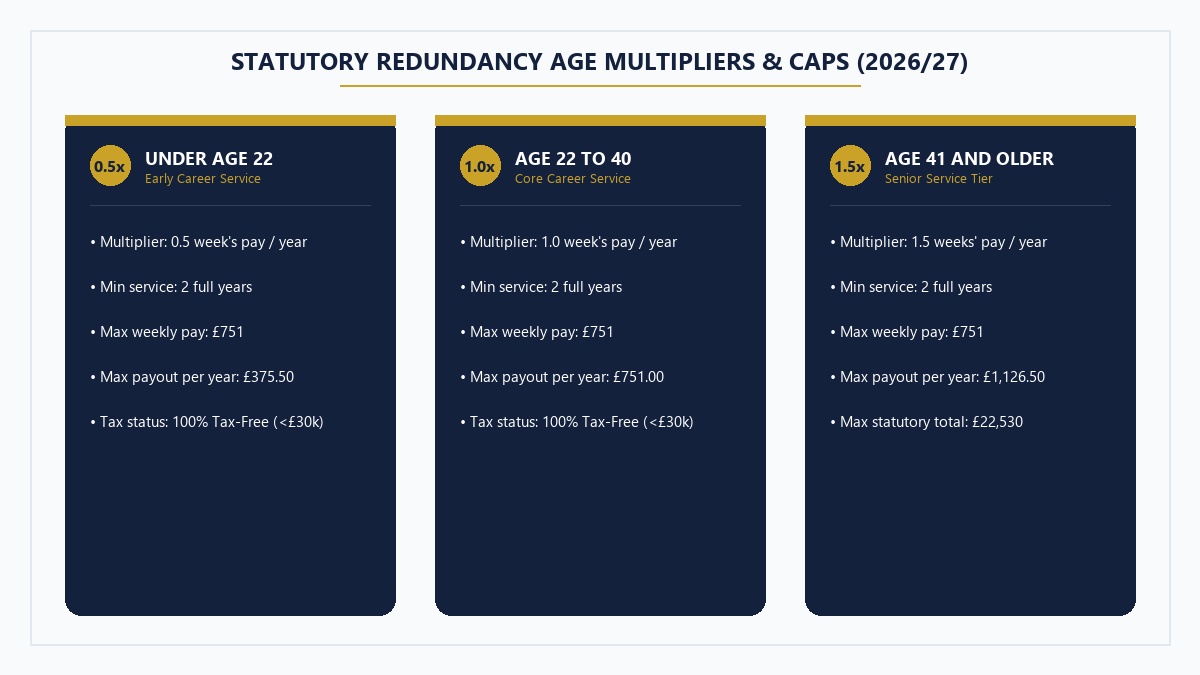
| Age During Service Year | Multiplier (Weeks’ Pay) | 2026/27 Max Value Per Year | Tax Treatment |
|---|---|---|---|
| Under Age 22 | 0.5 week’s pay per full year | £375.50 / year | 100% Tax-Free (under £30k threshold) |
| Age 22 to 40 | 1.0 week’s pay per full year | £751.00 / year | 100% Tax-Free (under £30k threshold) |
| Age 41 and Older | 1.5 weeks’ pay per full year | £1,126.50 / year | 100% Tax-Free (under £30k threshold) |
Statutory Limits:
- Weekly Pay Cap (£751): If an employee earns £900 per week, statutory calculations use the £751 weekly cap. If they earn £500 per week, calculations use their actual weekly rate of £500.
- Service Cap (20 Years): Total length of qualifying continuous service is capped at a maximum of 20 years.
- Maximum Statutory Payout: The maximum possible statutory redundancy pay in 2026/27 is £22,530 (20 years × 1.5 × £751).
Weekly Gross Pay: £850 (Capped at £751)
Years Aged 35–40 (5 Years @ 1.0 wk): 5 × £751 = £3,755
Years Aged 41–45 (5 Years @ 1.5 wks): 5 × 1.5 × £751 = £5,632.50
Total Statutory Redundancy Pay: £9,387.50 (100% Tax-Free)
For guidance on written employment statements and statutory contractual notice obligations, consult our guide to employment contracts in the UK.
Review employer pension obligations during restructuring in our guide on workplace pension compliance and auto-enrolment.
2. Tax Rules: The £30,000 Tax-Free Exemption
Under Section 401 of the Income Tax (Earnings and Pensions) Act 2003 (ITEPA), termination and redundancy payments receive favorable tax treatment:
- The £30,000 Exemption: The first £30,000 of genuine redundancy pay (both statutory redundancy pay and discretionary enhanced severance) is 100% exempt from Income Tax and both Employee and Employer National Insurance contributions.
- Payments Over £30,000: Any redundancy severance exceeding £30,000 is subject to Income Tax at the employee’s marginal rate and 15% Employer Class 1A National Insurance, but remains exempt from Employee Class 1 NIC.
- Contractual Pay vs. Severance: Payments in Lieu of Notice (PILON), accrued untaken holiday pay, and contractual bonuses are not covered by the £30,000 exemption and must be processed through standard payroll subject to full PAYE Income Tax and Class 1 NIC.
To ensure proper employer payroll tax accounting on termination packages, review our detailed guide on employer national insurance contributions 2026 rates and thresholds.
For founder-directors modeling the corporate tax deductibility of restructuring costs against annual company profits, explore our guide to UK corporation tax rates 2026.
3. Collective Consultation Rules (20+ Employees)
When an employer proposes to make 20 or more employees redundant at a single establishment within a 90-day period, strict statutory collective consultation rules apply:
1. Consultation Timelines
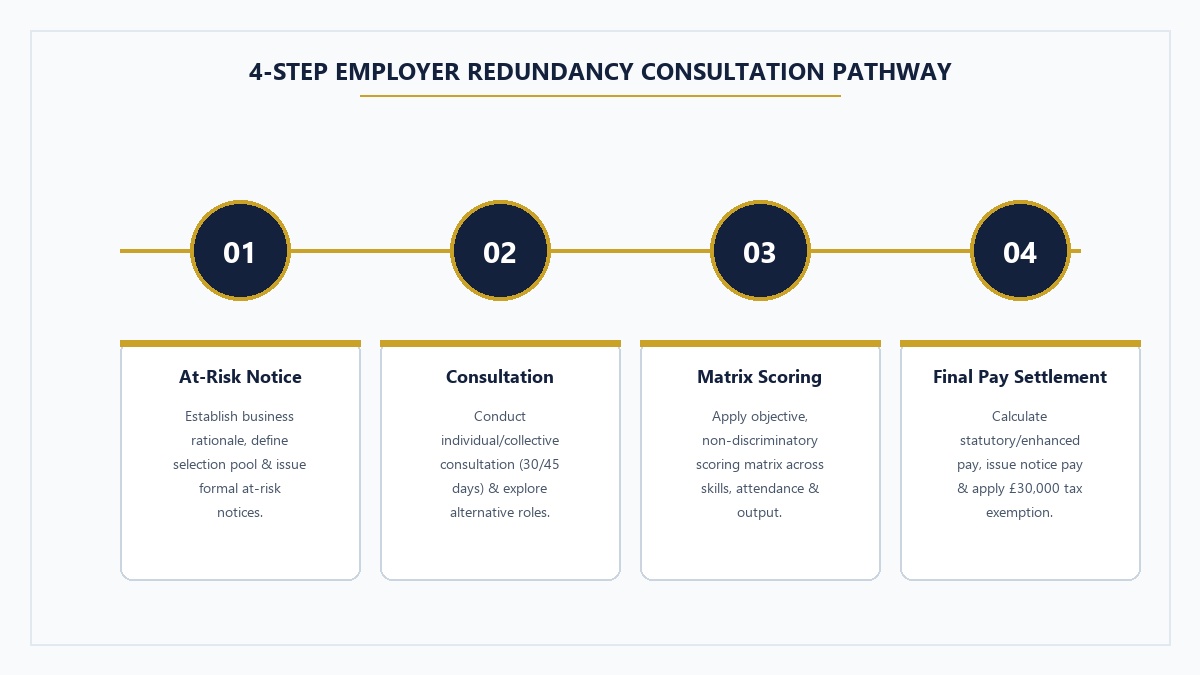
- 20 to 99 Proposed Redundancies: Consultation with trade union or elected employee representatives must commence at least 30 days before the first dismissal takes effect.
- 100+ Proposed Redundancies: Consultation must begin at least 45 days before the first dismissal takes effect.
- Form HR1 Notification: Employers must formally notify the Redundancy Payments Service (part of the Insolvency Service) using Form HR1 before starting collective consultation. Failure to submit Form HR1 is a criminal offense subject to an unlimited fine.
2. The Protective Award Penalty
If an employer fails to conduct meaningful collective consultation, an Employment Tribunal can order the employer to pay a Protective Award of up to 90 days’ gross uncapped pay per affected employee.
Ensure your company preserves adequate liquid capital to cover restructuring liabilities by following our framework for small business cash flow forecasting in 2026.
4. Objective Redundancy Selection Matrices
To defend against claims of unfair dismissal, employers must apply fair, transparent, and objective selection criteria to an agreed “pool for redundancy”:
- Objective Scoring Criteria: Standard lawful matrix criteria include documented skills/qualifications, formal performance appraisal data, disciplinary records, and verifiable attendance records.
- Unlawful Criteria to Avoid: Employers must not score based on age, pregnancy/maternity leave, trade union membership, whistleblowing activities, or disability-related sickness absence (which constitutes unlawful discrimination under the Equality Act 2010).
- Individual Consultation Meetings: Employers must conduct at least two individual consultation meetings with each employee in the selection pool to discuss their provisional score, explore alternative vacancies, and consider ways to avoid dismissal.
If your enterprise is restructuring to transition into a new operational entity or pivot, review the funding options in our guide on business expansion loans in the UK.
5. Frequently Asked Questions
What happens if an employee finds another job during their notice period?
If an employee served with redundancy notice wishes to leave early before their statutory notice period expires, they must submit written notice to the employer. The employer may agree to release them early without forfeiting statutory redundancy pay, provided the agreement is formally documented.
Can a company claim back redundancy costs if insolvent?
Yes. If an employer enters formal liquidation or administration and lacks funds to pay statutory severance, employees can apply directly to the government’s Redundancy Payments Service (RPS) via the National Insurance Fund for their statutory redundancy pay, holiday pay, and basic notice pay.
Your Next Actions
- Audit Continuous Service Records: Identify which staff meet the 2-year service threshold for statutory redundancy pay.
- Apply Statutory Weekly Pay Caps: Calculate entitlements using the £751 weekly cap and correct age multipliers (0.5x, 1.0x, 1.5x).
- Submit Form HR1 if Proposing 20+ Roles: Ensure advance notification is filed with the Insolvency Service before collective consultation begins.
- Explore Tools: Use resources in our Business Tools Hub.
Editorial Team & Signature
Written by Oliver Carpenter, Founder & Editor-in-Chief at Elite Business Journal. Published August 2026.