
Quick Answer: Commercial Bridging Loans UK 2026
A commercial bridging loan is a short-term, asset-backed debt facility designed to bridge the funding gap between immediate commercial property acquisition or refurbishment and long-term financing or sale. In the UK, commercial bridging loans are generally unregulated by the Financial Conduct Authority (FCA) when secured on commercial premises or borrowed via a limited company (SPV). In 2026, monthly interest rates range between 0.5% and 1.5% per month, with maximum Loan-to-Value (LTV) limits between 70% and 75% of open market value (up to 100% with secondary collateral). Approval hinges upon a clearly defined, viable exit strategy—typically long-term commercial mortgage refinancing or asset disposal within 1 to 24 months.
Key Takeaways
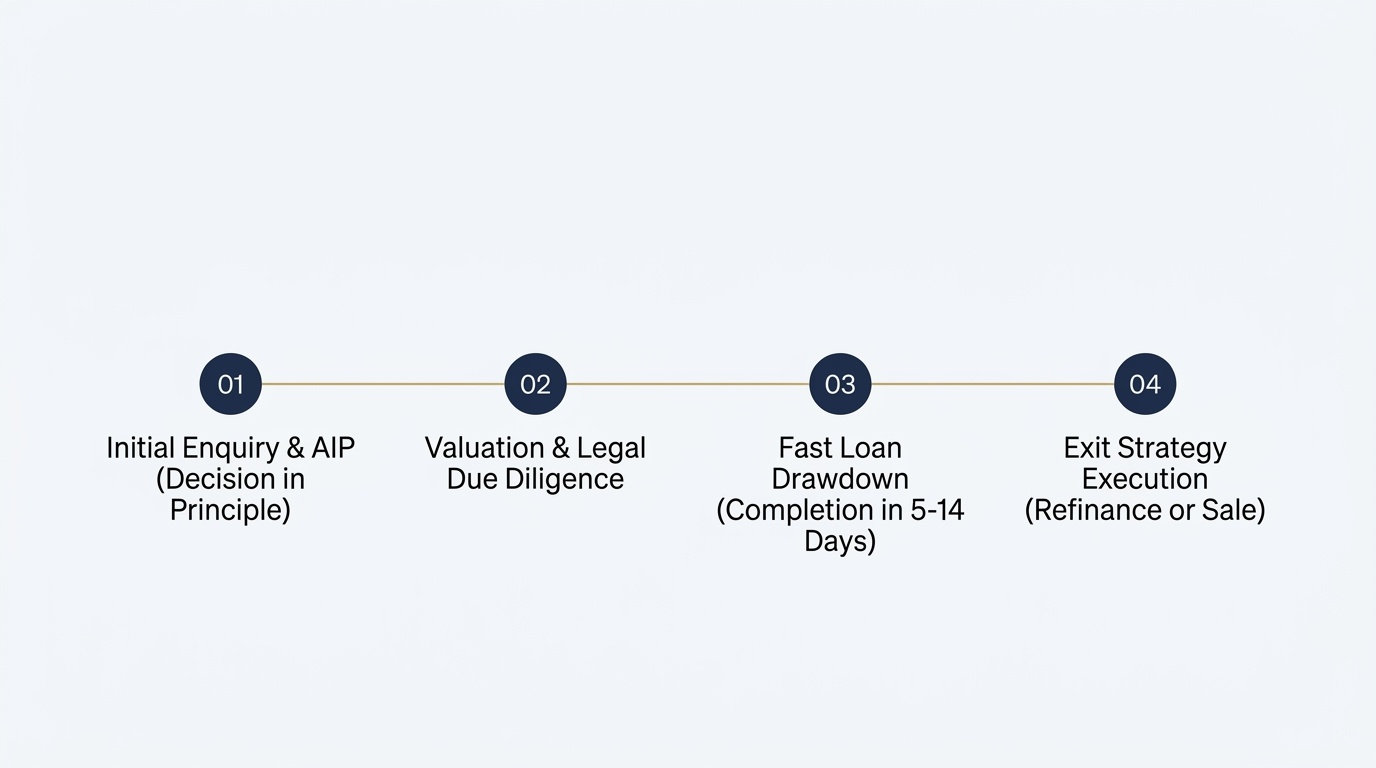
- Commercial bridging loans execute in 5 to 14 days, providing rapid liquidity for property auctions, time-sensitive acquisitions, and major conversions.
- Loans on purely commercial assets or Special Purpose Vehicles (SPVs) are exempt from FCA consumer credit regulations.
- Borrowers can select between Retained Interest, Rolled-Up Interest, or Serviced Monthly Interest to preserve working capital during refurbishments.
- A credible, stress-tested exit strategy (refinance or open-market sale) is mandatory for lender credit approval.
In the fast-moving UK commercial property market, standard institutional mortgage underwriting timescales—often spanning 60 to 90 days—regularly cost property investors and expanding enterprises lucrative acquisition opportunities. Whether securing an unmortgageable commercial unit at auction, purchasing freehold retail premises under tight 28-day completion deadlines, or financing heavy office-to-residential Permitted Development conversions, commercial bridging finance provides the agile liquidity necessary to execute transactions swiftly.
According to commercial lending data from the British Business Bank and industry transaction indices, short-term specialist property lending in the UK accounts for over £8 billion in annual originations. Understanding how specialist lenders assess loan security, calculate monthly interest compounds, and evaluate exit viability enables directors to minimize finance charges while maximizing capital agility.
This authoritative guide details the mechanics of commercial bridging loans in 2026, comparing interest payment structures, underwriting criteria, facility fees, and the step-by-step pathway from Decision in Principle to successful loan redemption.
1. How Commercial Bridging Loans Operate in the UK
A commercial bridge is a specialized form of short-term lending secured by a legal first or second charge over commercial property, land, or mixed-use real estate. Unlike traditional commercial mortgages that focus heavily on historical company trading accounts and debt service coverage ratios (DSCR), bridging lenders prioritize asset security and exit strategy execution.
Regulated vs. Unregulated Bridging Loans
Under regulatory guidelines monitored by the Financial Conduct Authority (FCA), bridging finance is split into two distinct legal frameworks:
| Feature | Commercial Bridging (Unregulated) | Residential Bridging (Regulated) |
|---|---|---|
| Security Property | Offices, retail, industrial units, semi-commercial, land, BTL portfolios | Borrower or immediate family’s primary residence (40%+ occupancy) |
| Borrower Entity | Limited companies (SPVs), LLPs, corporate partnerships, commercial investors | Individuals, sole traders borrowing against personal home |
| FCA Oversight | Exempt from FCA Consumer Credit sourcebook rules | Strictly regulated by FCA Mortgage Conduct of Business (MCOB) |
| Max Loan Term | Flexible (typically 1 to 24 months, extendable) | Capped at 12 months maximum by statute |
If you are establishing a Special Purpose Vehicle (SPV) limited company to ring-fence commercial property acquisitions, follow our detailed walkthrough on how to register a company in the UK.
2. Interest Rate Structures: Retained vs. Rolled-Up vs. Serviced
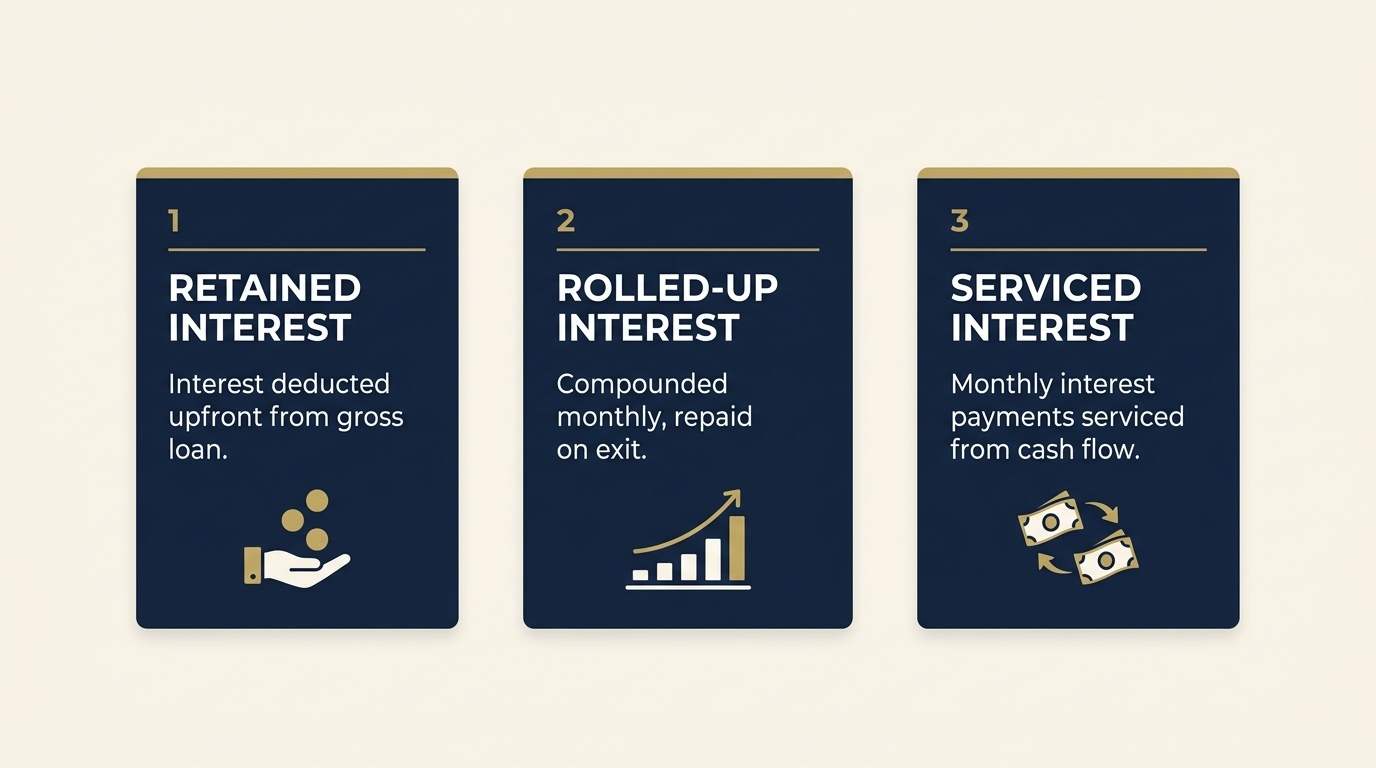
Because commercial bridging facilities are designed for short durations, interest is quoted as a monthly rate (e.g., 0.65% per month) rather than an annual percentage rate (APR). Lenders offer three distinct interest servicing models tailored to project cash flow:
1. Retained Interest
The lender calculates the total interest for the agreed loan term (e.g., 12 months) and deducts that entire sum upfront from the gross loan advance. The borrower makes zero monthly payments throughout the term. If the borrower redeems the loan early (e.g., in month 6), the unexpired retained interest is credited back to the borrower.
2. Rolled-Up (Accrued) Interest
Interest is calculated monthly and added directly to the principal loan balance. No interest is paid out-of-pocket during the project lifecycle. The full accumulated capital plus compounded interest is settled in a single balloon payment upon loan redemption. This method is common for heavy development or un-let commercial assets where no rental cash flow exists.
3. Serviced Interest
The borrower services the monthly interest charge directly from company cash flow or commercial tenant lease income, exactly like an interest-only commercial mortgage. This maximizes the net cash advanced to the borrower on day one.
Gross Loan: £500,000 | Monthly Rate: 0.75% per month | Term: 12 Months
Total Retained / Rolled Interest: £45,000 | Net Advance (excl. fees): £455,000
For business owners comparing asset-backed bridging finance with long-term institutional borrowing, consult our comprehensive analysis of business expansion loans in the UK.
Commercial landlords and corporate tenants negotiating property terms should also review our guide on commercial lease agreement terms and tenant rights.
3. LTV Limits, Valuation & Fee Breakdown
Commercial bridging lenders assess loan limits based on two distinct valuation metrics:
- Open Market Value (OMV): The standard commercial property valuation under normal marketing conditions. Maximum standard LTV is typically 70% to 75%.
- Gross Development Value (GDV): For refurbishment and conversion projects, specialist lenders fund up to 70% of the completed GDV (and up to 85% to 90% of total project costs).
- 100% Funding via Additional Security: If the borrower provides a legal charge over an existing unencumbered commercial asset or residential property, lenders can advance 100% of the purchase price and refurbishment costs.
Comprehensive Fee Schedule
| Fee Type | Typical UK Market Cost | Payment Timing |
|---|---|---|
| Arrangement (Facility) Fee | 1.0% to 2.0% of gross loan | Deducted from loan advance on completion |
| RICS Valuation Fee | £1,000 to £3,500+ (asset size dependent) | Paid upfront before survey inspection |
| Lender Legal Fees | £1,500 to £4,000+ | Undertaking paid upfront / deducted on completion |
| Exit (Redemption) Fee | 0% to 1.0% (many lenders charge 0%) | Paid upon final loan settlement |
To accurately model loan interest deductions against your company profits and Corporation Tax liabilities, check our guide on UK corporation tax rates 2026.
4. Formulating a Viable Exit Strategy
Bridging lenders operate on a short-term horizon. An application cannot progress beyond the Decision in Principle (AIP) stage without an airtight, verifiable exit strategy. The two primary exit routes in the UK are:
1. Refinancing onto a Commercial or Buy-to-Let Mortgage
This is standard for property investors acquiring unmortgageable commercial buildings or converting units under Permitted Development rights. Once works are finished and tenants are installed, the stabilized property is refinanced with a high-street or specialist commercial mortgage lender. Lenders typically require an Agreement in Principle (AIP) or proof of debt service affordability.
2. Open Market Property Sale
Developers who purchase, refurbish, and sell commercial units repay the facility from completion proceeds. Lenders will examine local market liquidity, comparable sales data, and pricing strategy. Borrowers should allow a 3 to 6-month buffer in their loan term to protect against conveyancing delays.
Ensure your business maintains strong financial visibility during major transactions by implementing the frameworks in our guide to small business cash flow forecasting in 2026.
5. Frequently Asked Questions
How quickly can a commercial bridging loan complete?
Straightforward commercial bridging loans can complete within 5 to 14 working days, provided the RICS valuation is expedited and solicitors on both sides are responsive. In auction scenarios, funds can occasionally be deployed within 72 hours using desktop valuations.
Can I get a commercial bridging loan with adverse credit?
Yes. Because bridging loans are asset-backed and unregulated, specialist lenders focus on the quality of the property collateral and the credibility of the exit strategy rather than personal credit scores.
Your Next Actions
- Stress-Test Your Exit Strategy: Secure an Agreement in Principle for term debt or establish realistic sale comparables before drawing funds.
- Calculate Gross vs. Net Loan: Model retained interest and facility fees to ensure net proceeds cover purchase and refurbishment costs.
- Instruct Dual-Representation Legal Teams: Choose commercial solicitors experienced in bridging finance to avoid conveyancing bottlenecks.
- Explore Tools: Use resources in our Business Tools Hub.
Editorial Team & Signature
Written by Oliver Carpenter, Founder & Editor-in-Chief at Elite Business Journal. Published August 2026.